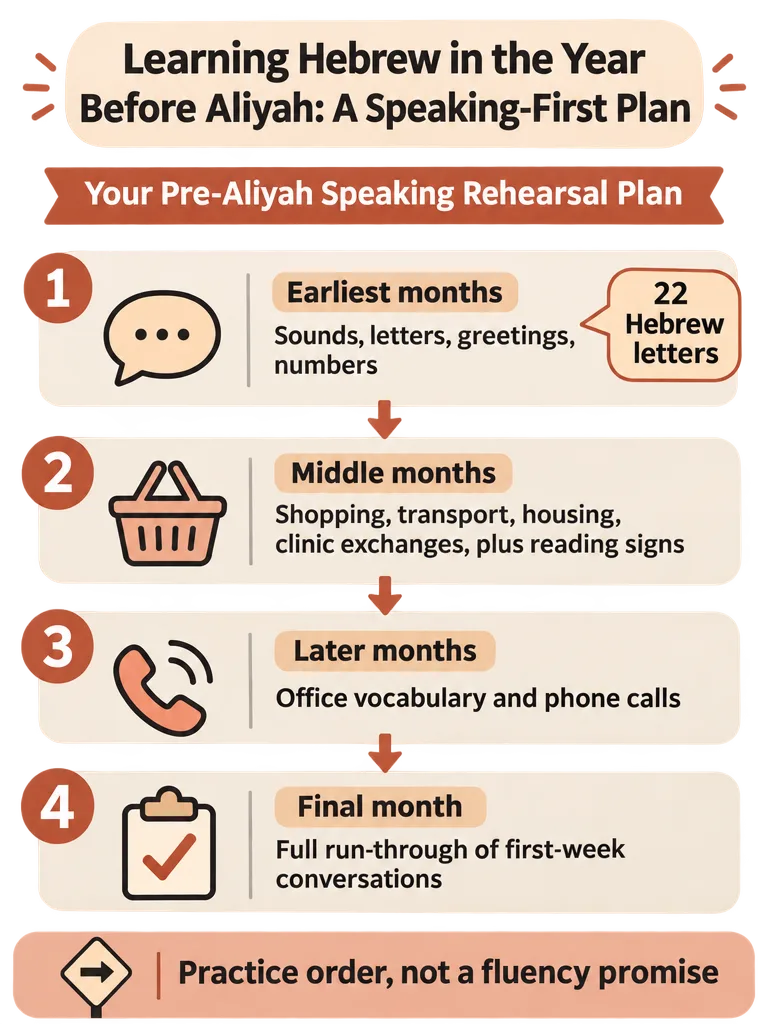
To learn Hebrew before aliyah, practice everyday conversations, office vocabulary, phone calls, and reading signs. Start with three essential words.
What should I focus on before I move to Israel?
To learn Hebrew before aliyah, practice speaking for four everyday jobs: survival conversations, office and paperwork vocabulary, phone calls, and reading signs. Nefesh B'Nefesh recommends starting your Hebrew education before aliyah and says speaking Hebrew allows easier absorption and integration. This is a practice order, not a fluency promise.
Start with a five-minute exercise today. Baba's aliyah guides define three words you'll meet in your first weeks:
תור (tor): an appointment, or your place in a queue
תעודת זהות (teudat zehut): the Israeli ID card
תעודת עולה (teudat oleh): the oleh certificate
Say each word aloud three times. Record yourself, play it back, then say each one more time. The goal is to say and recognize these three words without hesitating. The rest of this plan builds on that habit: say it, hear it back, fix one thing.
Do I need to speak Hebrew to make aliyah, and should I start abroad or wait for ulpan?
No, Hebrew isn't required to make aliyah, according to the FAQ in baba's aliyah guides. Nefesh B'Nefesh still recommends beginning your Hebrew education before the move. Offices, letters, and phone lines are mostly in Hebrew, and Nefesh B'Nefesh notes that although many Israelis have a working knowledge of English, speaking Hebrew allows easier absorption and integration.
On ulpan, Nefesh B'Nefesh's Learning Hebrew and Ulpan page states that olim are granted five months of free, intensive Hebrew ulpan as part of their aliyah benefits. That statement is undated. This article doesn't cover eligibility, deadlines, or funding, so confirm those with the official sources listed at the end.
Starting abroad is a preparation choice, not a replacement for ulpan. Useful goals before you land are getting comfortable with the sounds of the letters, saying your own name and the document names out loud, and hearing Hebrew before a classroom full of strangers does it for the first time.
Ulpan and pre-departure practice also do different jobs. Ulpan builds your general Hebrew. Pre-departure practice rehearses specific first-month conversations, such as the counter, the clinic desk, and the landlord, so they aren't also your first attempt at speaking.
Watch
Life in Israel - Vlog in Easy HEBREW | Exploring the Negev Desert with Our Dog
From Piece of Hebrew on YouTube
What should I practice month by month in the year before aliyah?
The pre-aliyah Hebrew calendar below has five blocks: sounds and greetings first, daily-life exchanges second, office vocabulary third, phone calls fourth, and a full first-week run-through last. It's an editorial practice framework, not a tested curriculum. No source here shows that any schedule produces a particular proficiency level, so read the months as an order of priorities, not a timeline.
Months before aliyah
Speaking focus
Reading focus
Rehearsal task
12 to 9
Greetings, thanks, introducing yourself, numbers
The 22 letters, as Baba's new-olim path walks them, and how Israelis name them aloud
Say your name, city, and phone number in Hebrew without notes
8 to 6
Shopping, transport, housing, clinic exchanges
Signs, price tags, bus numbers
Role-play buying groceries, asking directions, and describing a pain at a clinic
5 to 3
Office vocabulary: document and office names, the word tor
Letters and forms: headings, dates, amounts
Say each office and document name aloud, then recognize it when someone else says it
2
Phone calls: opening a call, confirming a time
Text messages and apartment listings
Rehearse a call aloud, then repeat it with the lines you stumbled on
Final month
All of the above, in sequence
Whatever you still misread
Run the first-week conversations end to end: airport, bank, phone plan, landlord
The middle blocks cover topics the new-olim path also teaches after landing, so use them here at a lighter level and save the depth for your first month. If you have fewer than twelve months, compress the early blocks and keep the office and phone blocks.
How do I practice phone calls and office conversations before I land?
Pre-aliyah phone practice starts with the names you'll say and hear most: the offices, the documents, and the word tor. The supplied sources do not provide verified phone scripts, so this section drills vocabulary from baba's aliyah guides, which explain what each office does, the Hebrew you'll see, and what to say when you call.
Say each name aloud three times, then say what it is in English without looking:
Misrad HaKlita (משרד הקליטה): the Ministry of Aliyah and Integration
Misrad HaPnim (משרד הפנים): the Interior Ministry; for olim, its Population and Immigration Authority
Bituach Leumi (ביטוח לאומי): the National Insurance Institute
Kupat cholim (קופת חולים): a health fund
Teudat zehut (תעודת זהות) and teudat oleh (תעודת עולה): the ID card and the oleh certificate
Tor (תור): an appointment, or your place in a queue
Hebrew changes by gender, so practice the form that matches you. The guides list oleh chadash (עולה חדש) for a man and olah chadasha (עולה חדשה) for a woman. Say yours aloud as you'd introduce yourself.
For a full call, ask a Hebrew-speaking tutor or friend to give you the exact sentence for the one thing you need, such as asking for a tor. Then rehearse that sentence in your own gender form. To get the first sentence out without freezing, use the same trick as for voice messages: rehearse a reply aloud before the real call.
How do I learn to read Hebrew signs without vowel marks?
Reading Hebrew signs means learning the letters, then practicing on text without nikud (vowel marks). Baba's new-olim path contrasts nikud in primers with unpointed signs on the street, then moves to numbers and listings. Work through these four steps in order:
Learn the letters and how Israelis name them aloud. Baba's new-olim path walks through the 22 letters. Say the names, not just the sounds.
Compare vowel-marked material with unpointed signs. Read a pointed line, then find the same word without vowels and notice what you still recognize.
Say money amounts, bus numbers, and apartment numbers aloud. The path counts money, buses, and apartment numbers out loud, and notes that prices and bus lines sit in the 11 to 100 range.
Read an apartment listing or a Rav-Kav screen. Baba's path covers decoding rooms, prices, and the shorthand landlords use in listings. Baba's aliyah guides also cover the Hebrew on Rav-Kav machines, the public transportation card's machines.
The new-olim path is a 30-day first-month structure for after landing. It's a lesson order, not a measured result. Here you're doing a lighter pass so your first month isn't your first contact with unpointed text.
How do I stop freezing when it's time to actually speak?
Spoken-Hebrew practice can follow a three-step loop: say a phrase aloud, answer a real reply, then review the mistake. This is an editorial exercise, not a tested method, but it targets a common pain point: knowing words and still freezing in conversation.
Say it aloud. Pick one line, such as a greeting or one of the office names from the previous section, and say it in the form that fits you.
Answer a real reply. A tutor, a partner, or a recording responds, and you answer without a script.
Review the mistake. Note what you got wrong, say the corrected line, and come back to it a few days later.
Gender changes what you say, so practice the form that matches you and the person you're addressing. Oleh chadash and olah chadasha are one example.
baba Learn is a speaking-practice app in private beta, with AI tutors Maya and David, role-plays, correction explanations, and My Cards review. The interface is English only, it's for adults 18+, and its feedback can be wrong, so treat a correction as a prompt to check.
Where do I check official rules instead of relying on a language article?
Official aliyah rules, amounts, and deadlines are kept by the offices that set them, according to baba's aliyah guides. This article and baba's guides help with the Hebrew. They aren't legal, tax, or medical advice. Check these sources:
Nefesh B'Nefesh, which has the Learning Hebrew and Ulpan page and step-by-step aliyah guidance for olim from North America and the UK.
The Ministry of Aliyah and Integration and other offices on gov.il.
Bituach Leumi, at btl.gov.il.
Kol Zchut, for rights.
This week, return to the starter exercise: say tor, teudat zehut, and teudat oleh aloud, record yourself, play it back, and fix one thing.
Frequently asked questions
How early should I start learning Hebrew before aliyah?
As early as you can. Nefesh B'Nefesh recommends starting your Hebrew education before aliyah, though no source gives a minimum number of months. With less than a year, shorten the sounds-and-greetings stage and keep time for office vocabulary and phone-call practice, because offices, letters, and phone lines are mostly in Hebrew.
Can I get by in Israel with only English?
Only partly, and rarely for paperwork. Nefesh B'Nefesh notes that many Israelis have a working knowledge of English, but speaking Hebrew allows easier absorption and integration. Official documents such as a Bituach Leumi letter or an arnona bill arrive in Hebrew, so some Hebrew helps even if daily conversations happen in English.
Which Hebrew words should I learn first before aliyah?
Start with the words on your documents and at the offices: tor (an appointment, or your place in a queue), teudat zehut (the ID card), teudat oleh (the oleh certificate), and Misrad HaKlita (the Ministry of Aliyah and Integration). Also learn your own gendered label: oleh chadash for a man, olah chadasha for a woman.
Is ulpan free for new olim?
According to Nefesh B'Nefesh, olim are granted five months of free, intensive Hebrew ulpan as part of their aliyah benefits. Baba's aliyah guide describes the route as a Misrad HaKlita referral. That Nefesh B'Nefesh statement is undated, so confirm eligibility and deadlines with Nefesh B'Nefesh or gov.il before planning around it.
What should I do first after landing in Israel?
Nefesh B'Nefesh lists the first steps as booking your biometric Teudat Zehut, opening a bank account, meeting Misrad HaKlita, and finishing your kupat cholim registration. Each step happens mostly in Hebrew, so rehearsing the office and document names before you land means the counter isn't the first place you say them aloud.
Can I practice speaking Hebrew with an app before I move?
Yes, for speaking rehearsal. baba Learn is a speaking-practice app, currently in private beta for adults 18+, with AI tutors Maya and David, role-plays, and correction explanations. The interface is English only and feedback can be wrong, so check corrections. It is not a complete accredited course and does not replace ulpan.