Turn Hebrew flashcards into spoken practice with a same-day loop, 40–50 phrase-builders, and gender-aware sentence reuse.
How do you turn Hebrew flashcards into real conversation practice?
Turning Hebrew flashcards into conversations takes a same-day loop: review the card, say the word out loud inside a short phrase, then use that phrase in a real exchange before the day ends. HebrewPod101's lesson on learning strategies lists conversation itself, not flashcard review alone, as one of the best ways to learn new words and phrases. Reviewing a card in silence doesn't build speaking skill.
Fluent in 3 Months' 90-day Hebrew plan makes a related point from a different angle. It treats flashcards as a place to store useful chunks and corrected sentences that came up during real conversation, rather than a substitute for speaking. The card is the memory tool. The conversation is where the word actually becomes usable.
That changes what a study session should look like. Instead of finishing a stack of 20 cards and closing the app, pick two or three cards, build a short spoken sentence from each, and say that sentence out loud, to a person, a voice note, or yourself, before moving to the next batch. The rest of this guide breaks that loop into steps you can run with any Hebrew learning app, including one built around conversation from the start.
Should you learn Hebrew with single words, phrase chunks, or full dialogues?
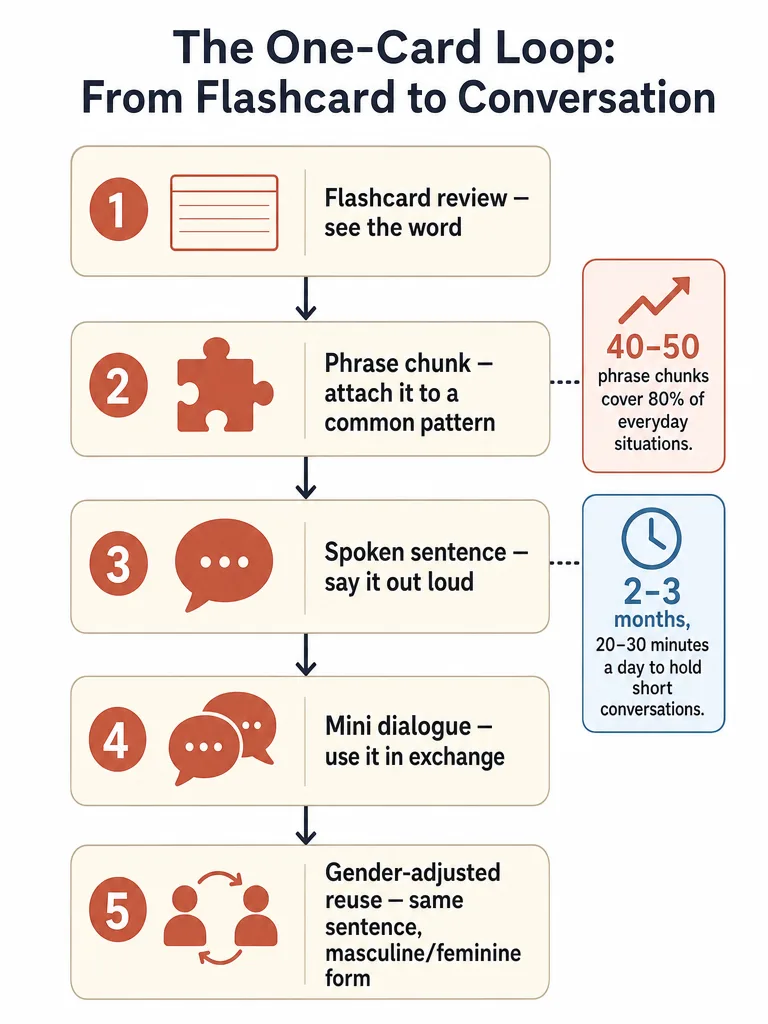
Phrase chunks beat single words for building speaking speed, and full dialogues come after a handful of chunks feel automatic. HebrewGlot's guide to conversational Hebrew recommends sound first, then whole phrase-builders, then short real dialogues. It finds that memorizing roughly 40 to 50 phrase-builders covers about 80% of everyday situations, a small target compared to a full vocabulary list.
Start with sound and high-frequency words. Greetings, numbers, and a handful of common verbs get your mouth used to Hebrew phonemes before you add grammar complexity.
Move to phrase chunks, not isolated vocabulary. A sentence pattern like "אני רוצה..." (ani rotzeh / rotza..., "I want...") teaches you a slot you can refill with new words, closer to how HebrewGlot's phrase-builders work than a single flashcard ever is.
Practice short real dialogues once a few chunks feel automatic, swapping new vocabulary into sentence frames you already know.
Two popular approaches sit on either side of this order. Anki-style spaced repetition decks are built around single-word or single-fact review, strong for retention but not built to teach you when to use a word in a sentence. Rosetta Stone takes the opposite route: it builds from greetings and simple grammar toward idioms and cultural expressions, mixing reading, listening, speaking, and comprehension from the first lesson, closer to the chunk-first approach than a flashcard deck.
Watch
How I Would Learn Hebrew (If I Could Start Over)
From Kamoni on YouTube
How many Hebrew phrases do you need, and how soon can you start speaking?
You need roughly 1,500 words for conversational fluency, according to HebrewPod101's learning-strategies lesson, but far fewer phrases to start speaking at all. HebrewGlot's conversational Hebrew guide finds that about 40 to 50 phrase-builders cover close to 80% of everyday situations, meaning most of the jump from silence to spoken Hebrew happens with a small, specific set of chunks, not the full word list.
The timeline for getting there is shorter than most learners expect:
Milestone
Timeframe
Source
First simple phrases, greetings, "thank you," ordering coffee
Week 1
HebrewGlot
Core phrase-builder set covering ~80% of daily situations
No fixed week given; comes with regular daily practice
HebrewGlot
Short comfortable conversations: directions, food orders, small talk
2 to 3 months at 20 to 30 minutes a day
HebrewGlot
Conversational fluency (~1,500 words)
Longer term
HebrewPod101
The gap between "week 1 phrases" and "month 2-3 conversations" is exactly where a flashcard-only routine tends to stall. Chunks you can say on command close that gap faster than vocabulary you can only recognize.
The one-card loop: turn a single flashcard into a spoken Hebrew exchange
One flashcard can produce a full spoken exchange if you run it through five steps: review, chunk, sentence, dialogue, and gender-adjusted reuse. This loop is the practical bridge the flashcard-only and conversation-only approaches above are missing. It forces you to work the same word through all five steps before you move to the next card.
Take a basic adjective card: עייף (ayef, masculine) / עייפה (ayefa, feminine), meaning "tired."
Review the card. Say both forms out loud, not just the one that matches your own gender, since you'll need the other form the moment you talk about someone else.
Build a phrase chunk. "אני עייף היום" (ani ayef hayom) is "I'm tired today" from a male speaker. A female speaker says "אני עייפה היום" (ani ayefa hayom). Same sentence, one letter of difference, different grammatical gender.
Turn it into a full sentence with a reason. "אני עייף היום, ישנתי מעט" (ani ayef hayom, yashanti me'at), "I'm tired today, I slept little."
Build a two-line mini dialogue. A: "מה נשמע?" (ma nishma), "What's up?" B: "אני עייפה היום, ישנתי מעט" (ani ayefa hayom, yashanti me'at).
Reuse the same chunk with a new gender context. Say the exchange again as if you're asking a male friend how he is, then answering as if you're describing a female friend who's tired. Hebrew grammar shifts the verb, the adjective, and sometimes the pronoun depending on who's speaking and who's being addressed, not just the subject's own gender. How Hebrew gender works across speaker, listener, and job titles breaks down the full pattern, including mixed groups and professional titles.
How do you practice Hebrew speaking without a conversation partner?
You don't need a human partner to start practicing Hebrew out loud. Shadowing native audio, recording yourself, and getting the grammatical gender right in a card's phrase all build speaking muscle on their own. HebrewPod101 builds its app around listening to native dialogue and repeating it aloud, which is the shadowing method in its simplest form. The available sources don't compare how far AI conversation practice gets you against a real human partner, so treat it as one tool among several rather than a full substitute.
Shadow native audio. Play a short dialogue line from a lesson, pause, and repeat it out loud before moving to the next line. Match rhythm and stress, not just the words.
Record yourself saying the card's phrase chunk and its gender-adjusted variant, then play your recording back against the native audio to catch where your pronunciation drifts.
Use a chat tool that remembers the conversation and lets you set speaker and listener gender, so the Hebrew it hands back matches your actual situation instead of defaulting to one grammatical form. baba's Chat Translate keeps context across a full back-and-forth, and its built-in tutor, Avi, can continue the exchange when you're practicing a gendered sentence like the "tired" example above.
How do you combine flashcards with listening and repetition so words stop staying passive?
Flashcards stay passive until you pair them with audio and uneven review that favors the words you still get wrong. Integraliah's guide to Hebrew flashcards, written from an Ulpan in Tel Aviv, recommends combining a flashcard deck with Hebrew audio or video rather than studying the deck in isolation, and keeping each card to one word or phrase so it doesn't overload memory.
Review due cards with spaced repetition that surfaces difficult words more often and known words less often. HebrewPod101's learning-strategies lesson notes this as a core feature of a working spaced-repetition system, not an optional setting.
Pair each review session with native audio or video covering related vocabulary, following Integraliah's recommendation to combine flashcards with listening material rather than treat the deck as a standalone activity.
After a real conversation, with a partner, a tutor, or an AI chat, add any sentence you got wrong back into the deck as a new card. Fluent in 3 Months' 90-day plan frames this as the point of the deck: it stores what conversation revealed you didn't know, so the deck keeps feeding off real speaking instead of replacing it.
Run those three steps in order and a flashcard stops being the finish line. It becomes the thing that tells you what to listen for next and what to fix after your next conversation.
How do you fit Israeli slang and filler words into your flashcard-to-conversation routine?
Spoken Israeli Hebrew leans on slang and filler words that textbooks tend to skip, so your flashcard-to-conversation loop needs a dedicated slot for them. HebrewGlot's guide to conversational Hebrew names יאללה (yalla), דווקא (davka), and סבבה (sababa) specifically as words that carry real weight in daily speech but rarely get proper treatment in formal courses.
Treat these the same way you treat a grammar card: add one to a mini dialogue, say it out loud, then listen for it the next time you're around Hebrew speakers or native audio. Because these words are common in everyday spoken Hebrew, per HebrewGlot, they deserve the same review-and-reuse treatment as any phrase-builder, rather than being left for "whenever it comes up."
Sababa, yalla, nu: Hebrew filler words in real use goes deeper on when each word fits and where swapping one for another gets you an odd look.
Do you need the Hebrew alphabet if you started with transliteration?
The Hebrew alphabet is the 22-letter script Hebrew is written in, and HebrewGlot's guide to conversational Hebrew says it's worth learning early, even for learners who start with transliteration. Transliteration, Hebrew sounds spelled out in English letters, gets you speaking fast, but it caps out the moment you need to read a sign, a menu, or app content with no English spelling available.
A practical split: keep using transliteration for your first phrase-builders and mini dialogues while pronunciation is still new, then start shifting flashcard review to the Hebrew script once a handful of chunks feel automatic, the same stage where HebrewGlot's 40 to 50 phrase-builders start covering most daily situations. Reading the 22 letters doesn't replace the speaking loop; it runs alongside it, so you can eventually read a menu or a WhatsApp message without converting it back to English letters in your head first.
Hebrew transliteration guide for English speakers covers the full case for choosing sounds versus letters depending on the job, speaking versus names and records, and why that choice shows up in things like the multiple English spellings of Hanukkah.
Frequently asked questions
Do flashcards alone make you fluent in Hebrew?
No. HebrewPod101's learning-strategies lesson lists conversation itself, not flashcard review, as one of the best ways to learn new words and phrases, and Fluent in 3 Months' 90-day plan treats flashcards as storage for chunks that came up in real conversation rather than a substitute for speaking. A card teaches recognition; only saying the sentence out loud, to a partner or a voice note, turns it into something you can actually use.
How much time per day should you spend practicing Hebrew to start having conversations?
Twenty to thirty minutes of daily practice gets most learners to short, comfortable conversations, directions, food orders, small talk, within 2 to 3 months, according to HebrewGlot's guide to conversational Hebrew. That estimate assumes regular phrase-builder practice rather than occasional flashcard review, and it lands well before HebrewPod101's roughly 1,500-word mark for full conversational fluency.
What Hebrew phrases should complete beginners learn first?
Beginners should start with simple greetings, "thank you," and phrases for ordering coffee, achievable in the first week according to HebrewGlot's guide to conversational Hebrew. From there, HebrewGlot recommends building a core set of roughly 40 to 50 phrase-builders, which cover close to 80% of everyday situations, before moving to full dialogues. Starting with sentence patterns you can refill, rather than isolated vocabulary, gets you speaking sooner.
Can an AI chat app replace a human Hebrew conversation partner?
Not based on available evidence, no direct comparison exists showing AI chat matches a human partner for Hebrew speaking practice. HebrewPod101 builds its app around listening to native dialogue and repeating it aloud, a shadowing method that works without any partner, human or AI. A chat tool that remembers context and lets you set speaker and listener gender, like baba's Chat Translate with its tutor Avi, is useful as one practice tool among several, not a full substitute.
Is Anki-style spaced repetition a good way to learn Hebrew?
Anki-style decks work well for retaining single words or facts through spaced review, but they aren't built to teach when to use a word inside a sentence. Rosetta Stone's approach, by contrast, mixes reading, listening, speaking, and comprehension from the first lesson, closer to a chunk-first method. Spaced repetition is a solid memory tool for vocabulary you already understand in context, not a stand-in for sentence practice.
Why does Hebrew grammar change depending on who you're talking to, not just your own gender?
Hebrew verbs, adjectives, and sometimes pronouns shift based on both the speaker's gender and the listener's gender, not the subject alone. A male speaker telling a female friend "I'm tired" needs a different verb form than a female speaker saying the same thing to a male friend. This matters in mixed groups and professional titles too, which is why reviewing a flashcard's masculine and feminine forms together, rather than only the one that matches your own gender, builds more usable speaking skill.