Products מוצרים
Mobile AppWeb TranslatorChrome ExtensionSpeak HebrewAPIs & DevelopersHebrewCore APIEnterpriseFor NewsroomsFor GovernmentTools כלים
All Hebrew ToolsHebrew to English TranslatorEnglish to Hebrew TranslatorOnline Hebrew KeyboardVerb ConjugatorGematria CalculatorHebrew Date ConverterToday's Hebrew DateJewish Holidays This YearZmanim by CityYour Name in HebrewThe Hebrew AlphabetSlang Dictionarybaba AtlasLearn ללמוד
Hebrew GuidesAI Hebrew TutorHebrew for Yom KippurHebrew for TravelHebrew in the NewsIsraeli News in EnglishHebrew News in EnglishHebrew on WhatsAppBlogNews חדשות
baba NewsGood Morning, IsraelIsraeli NewsroomsIsraeli News APIMore עוד
PricingAboutSupportIsrael’s newsrooms, compared.
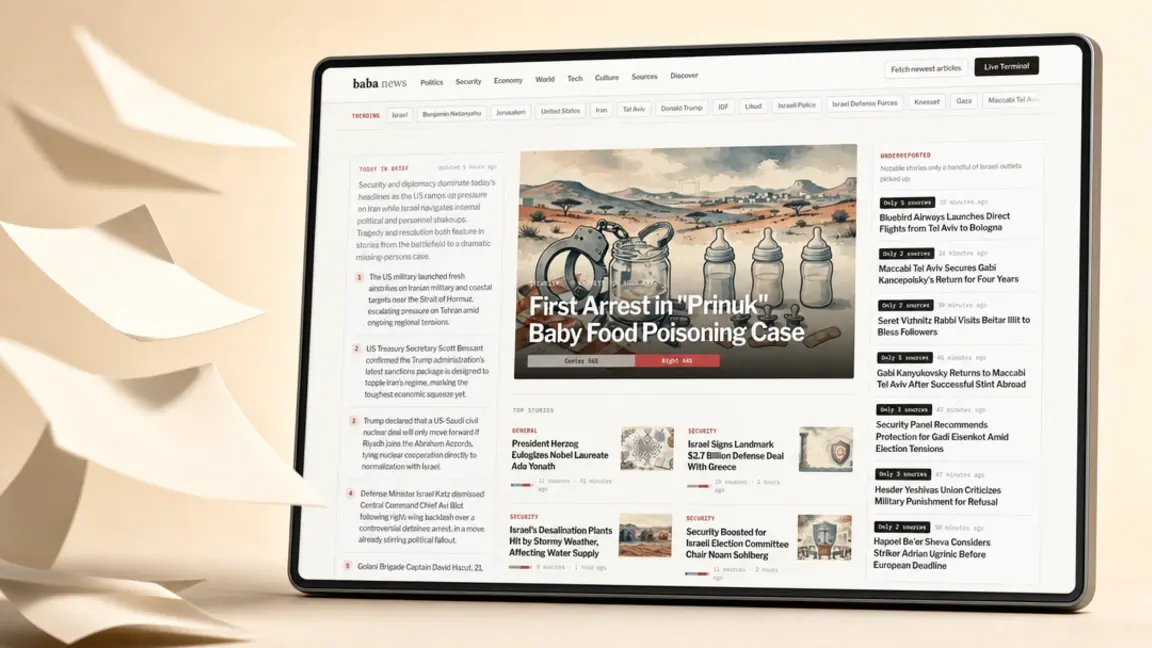
baba News clusters the same event across 40+ Israeli newsrooms in Hebrew, Arabic, Russian, and English — plus i24NEWS in French — and shows who ran it, who skipped it, and how they worded it.
 Scan with your phone to install
Free on iPhone and Android · Alerts when a story breaks · Or read the live wire on the web ↗
What Is baba News?
baba News is how you read the Israeli press without picking a side first. It watches the newsrooms Israelis actually read, groups every outlet covering the same event, and shows the spread: left, center, and right, plus the Haredi and Arab press that a left-to-right bar cannot describe. You read a short summary written by baba, then open the original.
It is not a newsroom, not a translation of one paper, and not a social feed. Most of these outlets publish only in Hebrew, Arabic, or Russian. English editions exist for a handful; the rest of the story is otherwise missing if you do not read the language. Our guide to reading Israeli news in English covers which outlets publish in English and what each is for, and Hebrew news in English covers the Hebrew-only press and how it is translated. Developers get the same wire as the Israeli news API. For the press itself: every newsroom and who owns it, how the press splits on a story, and the gaps one side leaves.
The App, and the Same Wire on the Web
iPhone and Android, plus the website at news.itsbaba.com. One account works on all three, and the wire is free to read.
Scan with your phone to installRead on the web · Hebrew edition · Daily podcast: Good Morning, Israel
The Wire
Live as newsrooms file. Latest, Top, or Following. Filter by time, coverage, language, or a single newsroom.
The Brief
What happened overnight, in a few minutes. Rebuilt on a six-hour cycle over a rolling day. Optional email with News Plus.
Discover
Across the press, Not Everywhere, developing stories, threads, people, and desks including weather.
Coverage
Every newsroom that ran the story, grouped by side and language, with who filed first.
Ask Duki
Questions answered from the coverage, with those claims cited. Context the articles lack is labeled Background. Five free questions a day in the app.
Alerts
Breaking news, the three daily editions, a story everyone is covering, Not Everywhere, the newsrooms you follow, what happened over Shabbat, and coverage shifts, free. News Plus adds alerts for the topics, people, and stories you follow. Quiet hours are Jerusalem time.
What a Single Feed Hides
Not Everywhere
Stories that ran widely on one side of the Israeli press and not at all on another. baba names the side that did not run it.
How the headlines differ
The same event, each newsroom’s own headline, side by side — subject, verb, and who they blamed.
Who filed first
A filing timeline for the cluster: which outlet moved, and how long the others waited.
Follows and saved stories
Follow newsrooms, people, and topics, five free and unlimited with Plus. Save a story on the phone and it syncs to the web, free.
English or Hebrew reading
The app and the site re-report in the language you pick. Newsroom names and original links stay as they are.
Independent, no ads
ZipLyne LLC runs baba News. No newsroom, government, or party pays to be included or to change how it is described.
Browse by Desk
Each desk is a live hub of clustered stories from across the press.
How Does baba News Work?
Watch the newsrooms
baba reads 40+ Israeli outlets as they publish — broadcast, daily, Haredi, religious, Arabic, Russian, business, and official statements.
Cluster the same event
Reports about one event are grouped together, counted by newsroom rather than by duplicate edition, so Haaretz Hebrew and Haaretz English are one newsroom.
Summarise, then send you out
baba writes a short English summary and key points, labeled as ours, and links to the newsroom’s own article. We do not reproduce their text.
The Wire Stays Free
The live wire, Not Everywhere and the brief are free for everyone. News Plus adds the headlines side by side, the whole archive, and alerts for the topics, people and stories you follow, on the web, iPhone and Android.
| Free | News Plus | |
|---|---|---|
| Live wire, brief, saved stories | Yes | Yes |
| Not Everywhere stories | Yes | Yes |
| Follows | 5 in total | Unlimited |
| Alerts for topics and people you follow | — | Yes |
| Story alerts | — | Yes |
| Hide read stories | — | Yes |
| Daily brief by email | — | Yes |
| Headlines side by side | — | Yes |
| Who reported first | — | Yes |
| Newsroom clips on a story | YouTube | Every platform |
| Newsroom photos on a story | Official photos | Every newsroom |
| Search | Last week | Everything |
| Your reading diet | — | Yes |
| Duki questions | 5 a day in the app or signed in | Unlimited |
| What changed since you read it | — | Yes |
| The Desk, spoken every hour | — | Yes |
| The Wire (web) | — | Yes |
News Plus is $4.99 a month or $34.99 a year (₪19.90 / ₪129), with a 7-day trial on the annual plan. One subscription is recognized on the web and in the app when you sign in with the same account. See News Plus · News API for developers
How Can I Read Israeli News in English?
Open baba News on the web, iPhone, or Android. The wire is free, with no account required. baba follows the outlets Israelis actually read, summarizes each report into clear English the moment it is clustered, and links straight back to the original. Compare coverage across the spectrum instead of reading one paper’s version of the day.
Want the language itself, not just the headlines? The free baba Hebrew translation app turns Hebrew text, voice, photos, and PDFs into English, and it gets gender and Israeli slang right where generic tools guess.
Frequently Asked Questions
What is baba News?
baba News is an independent aggregator that reads 40+ Israeli newsrooms in Hebrew, Arabic, Russian, and English — plus i24NEWS in French — then clusters reports about the same event so you can see who covered it, who did not, and how the headlines differ. It is not a newsroom and does no original reporting. Every story is summarized by baba and links back to the original article.
Is baba News free?
Free covers the live wire, Not Everywhere, Discover, the in-app brief, the Hebrew edition, newsroom profiles and threads, saved stories synced to the web, YouTube clips and official photos on each story, a week of search, five follows, five Duki questions a day in the app or signed in on the web, and alerts for breaking news, the three daily editions, a story everyone is covering, Not Everywhere, the newsrooms you follow, what happened over Shabbat, and coverage shifts, plus the weekly and breaking emails, no account required to read the wire. The Mamad siren forecast is free on the web at news.itsbaba.com/mamad. News Plus adds unlimited follows, alerts for the topics, people and stories you follow, hide-read stories, the daily brief by email, headline framing, filing order, every newsroom clip from Instagram, TikTok, X and Telegram, every newsroom photo, the full archive, and your reading diet, plus unlimited Duki questions, what changed in a story since you read it, The Desk, an hourly spoken bulletin, and on the web the Wire, the live feed of every report.
Which sources does baba News cover?
More than forty Israeli newsrooms across five groups of the press (left, center, right, Haredi, and Arab), plus the Russian-language, business, and sports press and official statements from the IDF, Home Front Command, and government ministries. Ynet, Haaretz, Kan, N12, Channel 13, Israel Hayom, Maariv, Globes, Calcalist, Arutz Sheva, Srugim, Kikar HaShabbat, Behadrei Haredim, Arab48, Panet, Vesty, NEWSru, and more. The full list is on the sources page.
Is the English AI-generated?
Yes. baba writes a short English summary and key points from the source, labeled as ours. We do not reproduce publisher article text, and we do not republish source photos. Illustrations are marked as generated. Every story links to the newsroom’s own article, with their advertising and paywall intact.
How does baba News handle bias?
It shows it. Each newsroom has a hand-assigned lean (left, center, right, or unrated) and a press group (left, center, right, Haredi, or Arab, with the Russian-language, business, and sports outlets and official statements listed outside the groups). Coverage is grouped so you can see what one side ran and another left out. Lean is baba’s editorial judgment, explained on the methodology page.
What is the difference between the website and the app?
The website is the live front page, desks, story pages, Hebrew edition, daily brief, Discover, terminal, and archive. The iPhone and Android app add the live Wire with filters, follows, alerts, offline reading of saved stories, and the same account as the web. One News Plus subscription covers web, iPhone, and Android.
What is Ask Duki?
Duki answers from the coverage and cites those claims. When a question asks for context the articles do not have, that part is labeled Background and is not a citation. Free readers get five Duki questions a day in the app or signed in on the web, and two a day signed out. News Plus removes the limit.
See what the Israeli press is actually saying.
Get the iPhone and Android app, with alerts when a story breaks. One event, every newsroom that ran it.