Many Hebrew school programs focus on prayer reading, not conversation. Try three spoken phrases to see where you stall and what to practice.
I learned Hebrew as a kid. Why can't I hold a conversation?
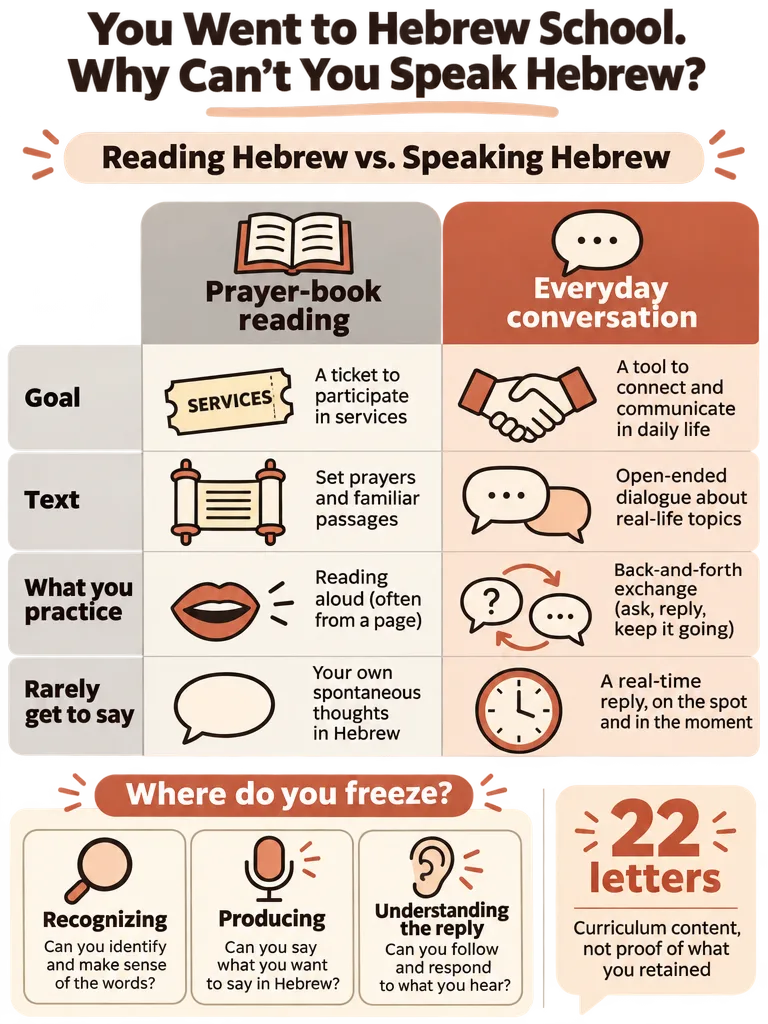
If you went to Hebrew school and can't speak Hebrew, one common mismatch is the goal: many programs prepare children to read prayers and get through bar or bat mitzvah services, not to hold spontaneous conversation. Cole S. Aronson writes in Tikvah Ideas that synagogue-run Hebrew schools teach children what they need for those services.
Try this first: the next section has three short Hebrew phrases to say aloud and answer. It's an informal exercise, and the outcome is modest. You'll see more clearly whether reading, producing a phrase, or following a reply is where you stall.
Aronson separates synagogue-run schools from Jewish day schools, which teach Hebrew grammar and vocabulary, and from newer Hebrew-language charter schools. "Hebrew school" can mean different things, so your own program's goals matter.
Baba's 30-day bar and bat mitzvah plan shows what one ritual-preparation target looks like. Its listed outcomes are to write and recognize your Hebrew name, read a short blessing and the Shema with support, follow the week's Torah portion page, and greet guests in simple Hebrew.
Decoding a pointed blessing and building a reply in real time are separate tasks. Hebrew Verbs makes a related point: being able to explain how a verb conjugates does not mean the right form will appear when someone is waiting for your answer. Reading preparation alone doesn't establish spontaneous conversational ability.
Can you say these three Hebrew phrases out loud?
Saying three short phrases aloud, then answering a reply you actually hear, is a simple way to practice spoken Hebrew and notice where you stall. Baba's learning hub offers these three: meeting someone, ordering something, and asking for another try. Treat this as an informal exercise, not a diagnostic test.
נעים מאוד (naim meod): "Nice to meet you"
אפשר קפה, בבקשה? (efshar kafe, bevakasha?): "A coffee, please?"
לא הבנתי (lo hevanti): "I did not understand"
Run each phrase through these steps. Take as long as you like.
Read it aloud from the Hebrew letters. Cover the transliteration first. Can you sound the phrase out?
Say it without looking. Turn away from the page and produce the phrase from memory. Transliteration is fine as a backup.
Get a real reply. Ask a teacher or language partner to answer you in Hebrew, as if you'd just said the phrase to them.
Answer that reply out loud, even with a single word.
Review it together. Ask what you could fix, then note where you stalled: reading, producing the phrase, understanding the reply, or answering.
The step where you stalled is a place to start practicing, not a verdict on your Hebrew. The hub also tells beginners to notice how a sentence changes for the speaker or listener, so listen for that in the reply. For more on this problem, see why you understand Hebrew but freeze when you speak.
Watch
Have you ever wondered why most Jews don’t actually speak Hebrew?
From StandWithUs on YouTube
Is prayer-book Hebrew the same as spoken Israeli Hebrew?
Prayer-book Hebrew and everyday Israeli Hebrew are different learning targets with different goals. The prayer-book rows below describe Baba's ritual-preparation plan, not every prayer-book class. Baba's learning hub says its resources focus on modern Israeli Hebrew, and that Biblical Hebrew has different texts, vocabulary, and learning goals.
Bar/bat mitzvah plan (ritual preparation)
Everyday Israeli Hebrew (per Baba's hub)
Goal
Readiness for services and Torah reading
Everyday conversation, current expressions, cultural context
Text type
Siddur and humash letters, blessings, the Shema, the weekly portion
Useful spoken phrases and replies
Reading support
Nikud makes a pointed blessing readable, not guessed; Torah scrolls are unpointed, so teachers point photocopies
You can begin with transliteration while learning the alphabet
What you practice
Letters, vowels, a blessing, reading a pointed paragraph aloud
Saying a phrase, listening to the reply, noticing forms for speaker and listener
Spontaneous replies
Not among the plan's four listed outcomes
Part of the hub's steps: answer out loud, try a question and a reply
The available sources do not establish a validated list of prayer-book vocabulary that transfers to conversation. The checklist in the next section lets you test individual items yourself.
Drew Isserlis Kramer's account of Westchester Reform Temple frames b'nai mitzvah as identity, belonging, and commitment to community, not a demonstration of Hebrew fluency. On that framing, a ceremony is a different goal from a conversation.
What Hebrew from Hebrew school still counts?
A retained-skill inventory separates what you can recognize from what you can produce on the spot. The items below come from the curriculum of Baba's bar/bat mitzvah plan. They show what that plan teaches, not what any learner kept. Mark each one keep, review, or practice, and see what the list tells you.
Recognition: reading and listening
The 22 letters. Baba's bar/bat mitzvah curriculum assigns the 22 letters seen in the siddur and humash to Day 2.
Vowel marks (nikud)
Your Hebrew name
The Shema, known by ear
Numbers
Family words (ima, abba, savta)
Plural endings ים and ות
The definite article הַ ("the Torah," "the blessing," "the day")
Production: a spontaneous reply
Greetings you can say without looking
A number or family word you can use in a sentence of your own
Noun gender, the curriculum's example being why berakhah and sefer take different adjectives, said aloud rather than only recognized
Be strict about the split. If you can recognize a family word on the page but can't use it in a sentence, mark it review or practice, not keep.
Why do I understand Hebrew but freeze when I speak?
Speaking is an active skill, and understanding can happen passively. Noam's Hebrew describes speaking as retrieving words under pressure and building a sentence in real time. It also notes that Israelis often talk fast and casually, with slang and references, so following along already takes effort.
Noam's advice is to start speaking before you feel ready. Hebrew Verbs pushes back: fluency means enough of the language is automatic that you have mental space left for the conversation, and "just start talking" won't teach a structure you were never taught. In that author's words, speaking can show you the hole, but you still have to fill it.
The Stroum Center for Jewish Studies at the University of Washington hosts two competing explanations. Dara Horn argues American Jews don't learn Hebrew because they think they can't. Michael Weingrad replies that they actively won't. Both are interpretations, not measurements of why you in particular freeze.
Do I need to start over with the alphabet before I speak?
Learners can begin with spoken phrases and transliteration while learning the alphabet, according to Baba's learning hub, so you don't have to restart with letters before you speak. The hub adds that a course or teacher gives you sequence, and that learning the letters gives you another way to understand and remember what you hear. Here is a re-entry plan that starts from what you already have:
Run the retained-skill checklist above.
Skip relearning letters if you can still sound words out.
Pick one situation: ordering a coffee or meeting someone.
Say a phrase aloud, with transliteration as support. Try efshar kafe, bevakasha?
Practice the reply you'll hear. Ask a teacher or Hebrew-speaking friend what someone might say back, then answer it.
Revisit one mistake. Fix it, say the corrected line again, and use it in your next session.
As you do step 4, remember the hub's advice to notice how a sentence changes for the speaker or listener. A teacher or tutor can show you the forms for the sentence you're practicing.
Where can I practice Hebrew conversation as a returning learner?
A teacher, a language partner, and an AI tutor are the three options Baba's learning hub names for practicing Hebrew conversation. Each gives you someone to answer. Choose by what you're missing: sequence, a person's replies, or practice you can come back to. You can combine them.
Option
What it can offer
Questions to ask
Teacher
Sequence, according to the hub
Is this one-on-one or a group class? How much of the session is you speaking? How are corrections given?
Language partner
A person who answers you
Will they correct you if you ask? Can you agree on a format, such as one situation per session?
AI tutor
Someone to answer on demand
Can you review corrections later? How do you check feedback that may be wrong?
baba Learn is one AI tutor option: a private beta for iPhone and Android, for adults 18 and over, with an English-only interface, where you practice in conversations with Maya or David and get explanations, corrections, and saved practice. Its feedback can be wrong, and it isn't a complete course. For what a first session covers, see Baba's post on what happens in your first Hebrew lesson with Maya.
Frequently asked questions
How much Hebrew do kids actually learn in Hebrew school?
It depends on the type of school. Cole S. Aronson writes in Tikvah Ideas that synagogue-run Hebrew schools teach children what they need to get through bar and bat mitzvah services, while Jewish day schools teach Hebrew grammar and vocabulary. He quotes critic Hillel Halkin, who said in 2008 that he had yet to meet a day school graduate who could conduct more than a rudimentary Hebrew conversation from schooling alone.
Why can't I follow Israelis when I know most of the words?
Israelis often speak fast and casually, with slang, references, and gestures, and may not realize how much Hebrew you understand, according to Noam's Hebrew. Even when you recognize most words, your brain also has to decode tone, pace, and context in real time. Following part of that conversation already takes effort, so struggling is not a failure.
Should I study grammar or just start talking?
Both help, and neither is enough alone. Hebrew Verbs argues that fluency means enough of the language is automatic to leave mental space for the conversation, and that speaking can expose a gap but won't teach a structure you were never taught. Noam's Hebrew advises speaking before you feel ready. A practical mix is one sentence pattern plus an attempted reply, then a review of what went wrong.
Can I still learn to speak Hebrew as an adult after Hebrew school?
Yes. Michael Weingrad of the University of Washington's Stroum Center notes that Dara Horn grew up familiar with Hebrew words and first plunged into spoken Hebrew at 32, at a writers conference in Israel. Hebrew Verbs adds that a research synthesis of 49 studies found focused second-language instruction produced substantial learning gains. Neither source offers a timeline.
Is modern Israeli Hebrew different from Biblical Hebrew?
Yes. Baba's learning hub says Biblical Hebrew has different texts, vocabulary, and learning goals from the modern Israeli Hebrew its resources cover, which includes everyday conversation, current expressions, and cultural context. If your Hebrew school centered on prayers and Torah, spoken practice is a separate target you can add.
Can an app help me practice speaking Hebrew?
An app can give you someone to answer, which reading drills and flashcards don't. baba Learn is in private beta for iPhone and Android, for adults 18 and over, and lets you practice conversations with AI tutors Maya or David and get explanations and corrections. Its feedback can be wrong, the interface is English only, and it isn't a complete course.