Learn Hebrew step by step with a private beta path: 5 levels, 18 units, and a no-hints check at the end of each unit—not just free chat.
Is there a structured course or is it just free chat?
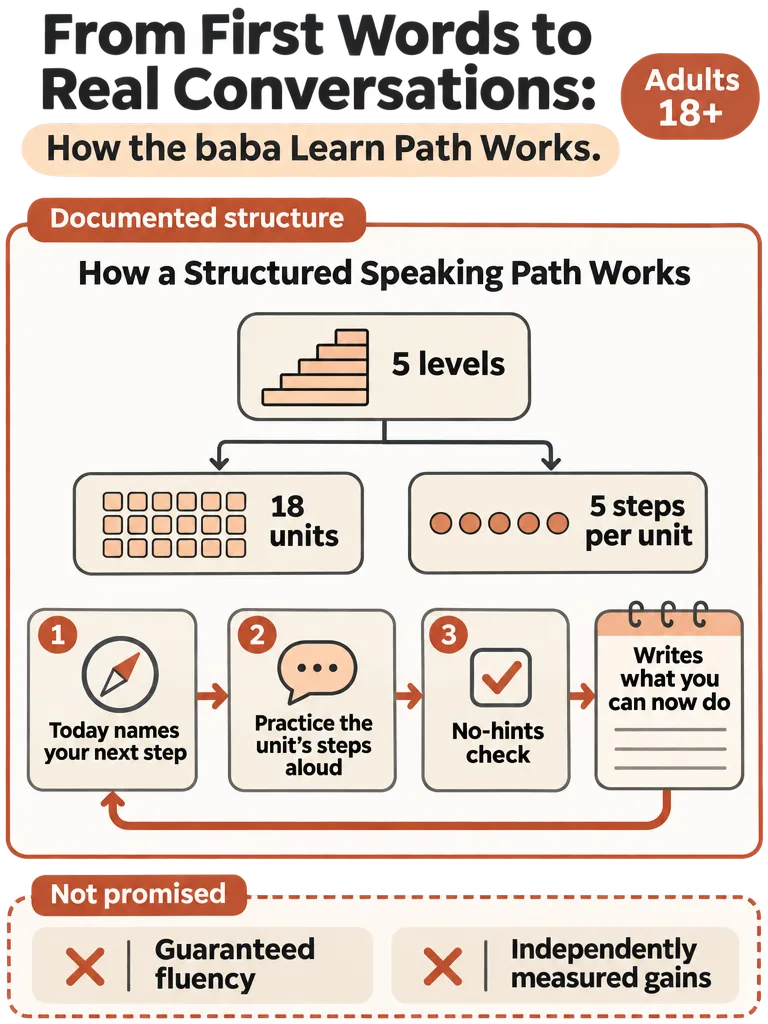
Yes, there is a structured path, not just free chat. To learn Hebrew step by step in baba Learn, you follow five levels and eighteen units of five steps each, according to Baba's own specification. Today names your next step, and each unit ends with a no-hints check that writes what you can now do.
Try this two-minute exercise with phrases from Baba's Learn hub:
Say נעים מאוד (naim meod), "Nice to meet you."
Order with אפשר קפה, בבקשה? (efshar kafe, bevakasha?), "A coffee, please?"
Imagine the barista replies too fast. Say לא הבנתי (lo hevanti), "I did not understand," then repeat your order.
You have just practiced opening, ordering, and asking for another try, which is the kind of small spoken task a unit builds on.
Baba's Learn hub describes the app as a private beta for iPhone and Android, and Baba's brief says it is for adults 18+ with an English-only interface. You practice by speaking with Maya and David, who are AI tutors. Free Talk conversation is one of the app's features. The difference the path adds is that Today picks the next step, so you aren't choosing a topic each time. No accreditation claim is made here.
What do five levels, eighteen units and five steps mean for your next session?
Levels, units, and steps organize each practice session: Today points to the next step, a unit groups five steps, and a no-hints check closes the unit. Baba's specification gives the counts as five levels, eighteen units, and five steps per unit, which works out to 90 steps.
Piece
Count
What it means for your session
Level
5
The largest stage of the path
Unit
18 in total
A block of five steps that ends with a no-hints check
Step
5 per unit
One piece of a unit; Today points you to the next one
Source: counts from Baba's article brief for the path; the descriptions in the right-hand column follow that brief's wording.
Baba's materials don't name the levels, list unit topics, or describe what each step involves. They also don't say whether the no-hints check is one of the five steps or an extra activity at the end. The café exercise above is an illustration built from phrases on Baba's Learn hub, not a documented unit.
Where do you look to know what to practice next?
Today is the area of the app that names your next step, so you don't have to pick a topic before you start. Baba's specification for the path states this. It is the practical difference from open chat, where you supply the topic yourself.
If open chat has ever left you staring at a blank prompt, this is the part of the path that removes that decision. You open Today and the next step is already named.
Baba's materials stop there. They don't explain placement tests, skipping units, or how units unlock, so none of those are described here. Treat Today as the answer to "what now?" and nothing more until Baba documents the rest.
What happens in the no-hints check at the end of a unit?
A no-hints check is a task at the end of a unit that you complete without hints, after which the path writes what you can now do. That is Baba's description. Pass thresholds, retries, and the exact wording of the write-up are not covered in the materials, so none are claimed here.
You can build a version of this yourself. This is a learner-created practice exercise, not a walkthrough of the app's controls:
Pick one situation you've practiced, such as ordering a coffee.
Say your lines aloud from memory, with no notes and no transliteration in front of you.
Write one can-do sentence yourself. Illustrative example: "I can ask for a coffee politely and say when I didn't understand."
Note any slip and drill it before your next session.
Gender is a good thing to include, as a hypothetical example of what such a self-made check could cover. Baba's milestones page shows "I love you" in two forms. A male speaker says ani ohev otcha / otach and a female speaker says ani ohevet otcha / otach. The speaker form (ohev or ohevet) and the listener form (otcha to a man, otach to a woman) change independently.
Do I need to read Hebrew before I start speaking?
You can speak Hebrew from your first session while you learn the alphabet. Baba's Learn hub says to begin with useful spoken phrases and transliteration, and that learning the letters later gives you another way to understand and remember what you hear.
The hub lays out five beginner moves:
Meet the letters: connect a shape to a sound.
Say a first phrase: begin with something useful.
Notice the forms: who is speaking, and to whom?
Answer out loud: give the words a purpose.
Use it in a conversation: try a question and a reply.
Baba's milestones page adds the trade-off. Learning the alphabet first is worth the few days it takes, because transliteration lets you speak but leaves you unable to read a sign, a menu, or a message. Doing both in parallel is a reasonable middle path.
If you'd rather follow a plan built around your reason for learning, Baba's 15 goal-based paths are a separate resource. Each is a 30-day plan for one goal, such as new olim, a trip to Israel, or dating an Israeli.
How is the in-app path different from the free guides and the translator?
Baba offers three kinds of resource built for different tasks: a speaking app with a unit path (in private beta), free guides and 15 goal-based paths that you read, and a separate translator for messages. Baba's Learn hub says the guides are free to read, the app is a separate speaking app in private beta, and the translator is a separate tool.
Resource
What it does
When you'd choose it
In-app path (private beta)
Speaking practice with Maya or David, explanations, corrections, saved practice, and the unit path
You want someone to answer and a sequence to follow
Free guides and 15 goal-based paths
Guides on letters, grammar, phrases, slang and culture; 30-day plans by goal
You want to read first, or pick a plan by your reason for learning
Baba Translation
Translates messages and other real Hebrew
You have a message to send or understand today
Source: Baba's Learn hub and goal-based paths page.
Keep the details of each separate. Baba's milestones page describes its translator as a translation tool, not a Hebrew course, and the translator's limits and plans don't carry over to the app.
How far does the path go, and how long will it take?
The structured Hebrew path reaches solid A2 with emerging B1, and nothing higher, according to Baba's own description. That is the publisher's stated scope, not an independent assessment, and it isn't a guaranteed result for any learner. The supplied materials include no validated proficiency alignment or measured learning gains.
The supplied materials do not establish an app completion timeline, so none is given here. For a realistic picture of general progress, Baba's milestones page (last updated July 28, 2026) breaks Hebrew into concrete abilities with wide bands:
Reading the alphabet: days to a few weeks
Handling a shop: weeks to a few months
Holding a short conversation: months
Handling a work email: many months to years
Those bands describe learning Hebrew in general, not this app. The page itself says no timeline on it is a prediction about any individual learner, and the same caution applies to the path. The materials also don't explain how Hebrew you already know changes where you start.
Can you try the app now, or do you join the waitlist?
The app is in private beta, according to Baba's Learn hub, and Baba's route in during the beta is a waitlist. Baba's materials don't confirm a public launch, store listings, ratings, or prices, so none are stated here.
What Baba does specify:
Who it's for: adults 18+, with an English-only interface, per Baba's brief.
Free start: per Baba's product summary, starting Classic lessons need no card, and the app shows the allocation.
Recordings: per Baba's brief, they are kept for 30 days to check a score, then deleted.
Limits: Baba says feedback can be wrong and word stress isn't scored.
Frequently asked questions
How do I start learning Hebrew?
Start with the Hebrew alphabet and a few phrases you actually want to use, then say them aloud. Notice how a sentence changes depending on who is speaking and who is listening. Baba's Learn hub suggests choosing a structured guide or course first, then adding conversation practice with a teacher, language partner, or AI tutor.
Is this modern Israeli Hebrew or Biblical Hebrew?
Baba's free guides focus on modern Israeli Hebrew: everyday conversation, current expressions, and cultural context. Biblical Hebrew has different texts, vocabulary, and learning goals. Learners who want it can use a separate route, such as the Biblical Hebrew in 90 Days path or the path for Christians reading the Hebrew Bible, both listed among Baba's 15 goal-based paths.
What is the hardest part of learning Hebrew for English speakers?
Gender agreement is usually the hardest part, according to Baba's milestones page. Hebrew conjugates verbs, adjectives, and possessives by speaker gender, listener gender, and subject gender, so gender shows up in nearly every sentence. English speakers have no habit of deciding who they are addressing before choosing a verb form, and building that habit takes time.
How do you say "I love you" in Hebrew?
A male speaker says אני אוהב אותך (ani ohev otcha) to a man or ani ohev otach to a woman. A female speaker says אני אוהבת אותך (ani ohevet otcha / otach). The speaker form (ohev or ohevet) and the listener form (otcha for a man, otach for a woman) change independently, so one English sentence has several correct Hebrew versions.
Which Hebrew learning path should I pick?
Pick by your reason for learning, not by level. Baba offers 15 goal-based paths, each a 30-day plan for one goal, such as new olim, a trip to Israel, or dating an Israeli, because these learners need different vocabulary in the first week. You can also spread the same path over 60 or 90 days with the study planner.
Who can use baba Learn, and what does it cost to start?
baba Learn is a speaking app for iPhone and Android, currently in private beta, for adults 18+ with an English-only interface. During the beta, the way in is a waitlist. Starting Classic lessons need no card, and the app shows the free allocation. Baba keeps recordings for 30 days to check a score, then deletes them.