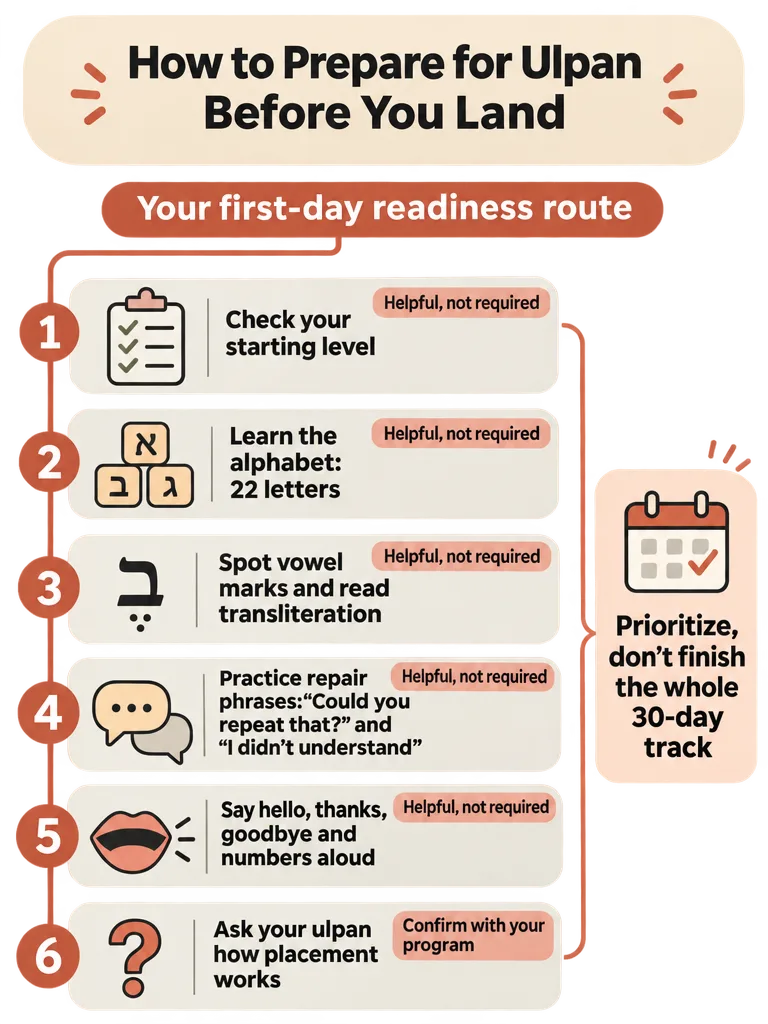
To prepare for ulpan, practice the 22 Hebrew letters and classroom phrases aloud, and check your starting level. Confirm your program's prerequisites.
What should I learn before ulpan starts?
To prepare for ulpan, learn the Hebrew letters, a few classroom repair phrases, and some sentences you can say aloud, and check your starting level. Hebrew University's Level Aleph syllabus, one example, has an absolute-beginner group that learns block and script letters in class, so this is a head start, not a gate.
Try this first: say efshar lachzor al ze? (אפשר לחזור על זה?, "Could you repeat that?") out loud three times. Follow it with lo hevanti (לא הבנתי, "I didn't understand"). The task is to ask for a repeat and say you didn't understand without looking at the page. Both phrases come from baba's ulpan guide, covered in the phrase section below.
The Hebrew University syllabus is one university program, so treat it as an example of how a beginner level can be built. Other providers may set different prerequisites, so confirm your chosen program's requirements before you decide what to study. Nefesh B'Nefesh encourages Hebrew study before aliyah, including for people more than a year from their intended arrival.
Four things are worth practicing:
Letters: enough to sound out a word on a sign or in a textbook.
Repair phrases: short lines for asking a teacher to repeat, explain, or spell something.
A starting-level check: so you can describe where you are when someone asks.
A few spoken sentences: say the phrases aloud, not just read them.
Do I need to know the Hebrew alphabet before ulpan?
At Hebrew University, no. Its Level Aleph syllabus splits into Aleph Beginners, for absolute beginners, and Aleph Advanced Beginners, for students who know the alphabet and a limited vocabulary. Absolute beginners learn to read and write in block and script letters during the course. Other programs may differ, so confirm your own program's prerequisites.
Learning the letters first is a recommended head start. The Hebrew alphabet has 22 letters, and Day 2 of baba's Hebrew for New Olim Path walks through all of them, and how Israelis name them out loud, in 20 minutes.
Two details help early on:
Vowel marks (nikud): these are mostly dots and lines under the letters. Textbooks use them, but everyday text drops them, according to baba's ulpan guide. Expect pointed pages in class and unpointed signs outside.
Transliteration: on Day 7 of the path, you match the Latin-letter spelling to the Hebrew letters you've just learned. Do the same: read the Latin spelling, then find each letter in the Hebrew.
A five-minute exercise: take לא הבנתי (lo hevanti, "I didn't understand"). Say it aloud with the transliteration visible. Cover the transliteration and read the Hebrew. Check yourself, then repeat with one more phrase from the next section.
Which classroom phrases should I practice so I can ask for help?
Baba's ulpan guide lists six classroom phrases that cover asking for a repeat, saying you didn't understand, asking what a word means, asking how to spell it, checking gender, and saying you're ready. They come from the phrase table in baba's ulpan guide. Where a form differs by gender, the guide gives the male form first.
English
Hebrew
Say it
Could you repeat that?
אפשר לחזור על זה?
efshar lachzor al ze
I didn't understand.
לא הבנתי.
lo hevanti
What does this word mean?
מה פירוש המילה הזאת?
ma perush ha-mila ha-zot
How do you spell it?
איך כותבים את זה?
eich kotvim et ze
Is it masculine or feminine?
זה זכר או נקבה?
ze zachar o nekeva
I'm ready.
אני מוכן / מוכנה.
ani muchan / muchana
Only the last row changes with your gender: muchan if you're a man, muchana if you're a woman. The other five forms are the same for everyone.
Say each phrase aloud three times. Then say it again as a quick reply to a made-up question, such as a teacher asking whether the class is ready.
How do I find out what the ulpan placement test will cover?
Ask your chosen ulpan and your absorption counselor directly about the assessment format, any speaking component, reassessment, and recommended preparation. The sources behind this article don't describe an entry placement test, so no format, scoring, or sample question is given here. The Hebrew University exams in the syllabus (midterm, final, level, and oral) are for enrolled students, not entry placement.
Questions to put to the program:
Is there an assessment before I'm placed, and is it written, oral, or both?
Is there a speaking component, and how long does it take?
Can I be moved to a different level if the placement feels wrong?
Is there a retest or reassessment policy?
What materials, if any, do you recommend before the first day?
How should I describe my level if I understand some Hebrew but rarely speak?
For that last question, plain words work: "I understand a fair amount, I read slowly, and I rarely speak." Say it that way rather than guessing a level name.
For a self-check, Day 1 of the New Olim Path is a 15-minute starting-level test. It shows you where to start the path. It is not the ulpan's test and shouldn't be treated as a preview of it.
Hebrew College's online Ulpan is one program that offers ten levels and asks learners to work out which fits them. Programs differ, so ask early.
How can I practice speaking before I land?
Rehearse four things aloud: a greeting, "I didn't understand," a request to repeat, and a number. The first and fourth come from topics in baba's New Olim Path, the second and third from the classroom phrase table in baba's ulpan guide. Say each one standing up, as if someone were in front of you.
Ulpan classes include speaking too. Hebrew University's syllabus lists conversation work and oral examinations, and Hebrew College teaches conversation skills. This routine is extra rehearsal you can do before the first class, on your own schedule.
Say hello, thanks, and goodbye. Day 8 of the New Olim Path frames them for the airport, the clinic, and the makolet.
Say you didn't understand. Repeat lo hevanti out loud.
Ask someone to repeat. Say efshar lachzor al ze? as a real question.
Say a number or a price. Day 10 drills the numbers 1 to 10, and Day 9 has you count money, buses, and apartment numbers out loud.
String two together. Follow "I didn't understand" with "Could you repeat that?"
baba Learn, Baba's speaking app for adults 18 and over with AI tutors named Maya and David, is in private beta with a waitlist. Its interface is English only, and its feedback can be wrong.
How long is ulpan, and what should I confirm instead of assuming?
Ulpan length depends on the program. Nefesh B'Nefesh describes public ulpan for olim as generally five hours a day, five days a week, for five months, roughly 420 to 450 hours. A university intensive or a municipal course can look quite different, so confirm the details for your own program.
Program
Schedule
Notes
Public olim ulpan
About five months, five days a week, five hours a day (approx. 420 to 450 hours)
Figures from Nefesh B'Nefesh. The supplied page is undated
Usually five days a week; mornings 8:00 AM to 1:00 PM, evenings roughly 4:30 PM to 8:00 PM
The page says the full course is 25 hours a week, but may vary. The specific timetables on it are dated 2019
Confirm placement, start dates, and subsidy eligibility with your absorption counselor. The 2019 guide says rules and programs change periodically.
Which first-month Hebrew lessons should I prioritize before my first ulpan class?
Prioritize six lessons from baba's Hebrew for New Olim Path before your first ulpan class: the Day 1 starting-level check, the Day 2 alphabet, Day 5 vowel marks, Day 7 transliteration, Day 8 greetings, and Day 10 numbers 1 to 10. You don't need to finish all 30 days first.
Day 1, starting-level check (15 minutes): see where you stand.
Day 2, the alphabet at a glance (20 minutes): see all 22 letters and hear how Israelis name them.
Day 5, vowels you will actually see: compare nikud in primers with unpointed signs on the street.
Day 7, read transliteration: match Latin spelling to the letters you've learned.
Day 8, hello, thanks, goodbye: say them out loud.
Day 10, numbers 1 to 10: drill the first ten.
Baba describes the path as a 30-day first-month track. Its apartment, clinic, and kitchen lessons can wait until after you land.
Frequently asked questions
How many hours a day is ulpan?
A standard subsidized ulpan for olim runs five hours a day, five days a week, for about five months. Shorter programs differ: Tel Aviv University's four-week intensive meets Sunday to Thursday, 8:30 AM to 1:00 PM. Hours vary by provider, so check the schedule of the specific program you plan to join.
Is ulpan free for new immigrants?
Yes, a standard Hebrew ulpan is listed by Nefesh B'Nefesh as a free aliyah benefit, and the Ministry of Aliyah and Integration (Misrad HaKlita) provides the referral. The window for starting the free course depends on your status and the rules in force when you made aliyah, so confirm yours with your absorption counselor.
How do I register for ulpan after making aliyah?
You register through the Ministry of Aliyah and Integration. At your first meeting, your absorption counselor gives you information about local programs and a referral or voucher, and the address on your Teudat Zehut decides which ulpan you're placed in. Classes usually start only with enough enrollment, so ask about start dates early.
Can I take ulpan online?
Yes. Hebrew College runs an online ulpan across ten levels, and some private ulpanim approved for Ministry vouchers teach on Zoom. Hebrewbyte, an online ulpan subsidized by the Ministry, can be taken alongside a classroom course. Subsidies depend on your status, so confirm eligibility with your absorption counselor before paying.
Can I work and study in ulpan at the same time?
Many olim do. Besides the full-time morning ulpan, evening courses (ulpan erev) are designed for people who work. Tel Aviv-Yafo's municipal evening program usually runs between 4:30 PM and 8:00 PM, depending on the level, and the city also lists part-time options for different schedules.
What do ulpan aleph and ulpan bet mean?
Ulpan aleph is the first level, for beginners, and is the standard five-month course. Ulpan bet is the next level, for people who finished aleph or already have some Hebrew. Ulpan hemshech is a continuation course, often held in the evening and usually paid. Providers label levels differently, so ask how yours is defined.