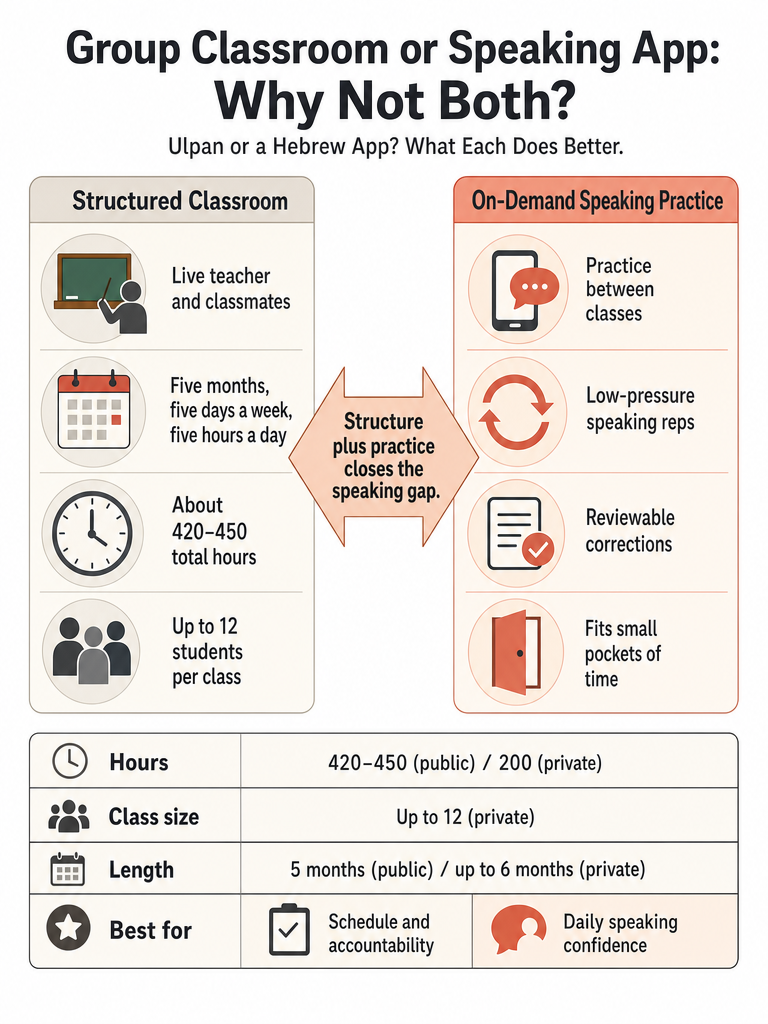
Ulpan vs app is not either/or: ulpan gives structure, while a Hebrew app adds speaking practice between classes and helps with freezing.
Do I need ulpan if I use a Hebrew app?
Ulpan and a Hebrew app solve different problems, and for many learners the two formats work best as complements, not competitors. Ulpan supplies the fixed schedule, live teacher, and classmates that build structure; an app adds the between-class speaking reps a group timetable can't fit in. HebrewGlot's comparison of the two calls them complementary rather than substitutes.
Try the ulpan vs app contrast yourself. In ulpan, you'd stand up and say a full sentence in front of the class, something like אני גר בתל אביב (ani gar be-tel aviv) if you're male, or אני גרה בתל אביב (ani gara be-tel aviv) if you're female, and get corrected on the spot. In an app, you'd say that same sentence alone, replay your own recording, and check the correction before trying it again. The outcome you're after in both cases is the same: being able to produce the sentence without freezing the next time someone actually asks where you live.
That freezing moment, knowing the words but stalling when it's your turn to talk, is usually where ulpan alone runs out of room. A teacher correcting you once in front of a full class isn't the same as repeating a line ten times on your own schedule. Which format fixes which gap depends on what's actually stopping you: a schedule you can't keep, or a sentence you can't get out loud.
What does ulpan give you that an app can't?
Ulpan is a structured Hebrew course the State of Israel offers new immigrants, organized around a teacher, a fixed group of classmates, and a set weekly schedule rather than solo app sessions. That structure is the thing an app genuinely cannot replicate: a real person tracking your progress and a cohort who show up at the same hour every day.
New olim get their placement through Misrad HaKlita, the Ministry of Aliyah and Integration's absorption office, which gives a referral or voucher at your first appointment. Baba's guide to how ulpan placement works describes the standard subsidized schedule as five months, five days a week, five hours a day, with the address on your Teudat Zehut deciding which ulpan you're placed in. Nefesh B'Nefesh totals that same track at roughly 420-450 hours across the course.
Nefesh B'Nefesh also lists free Hebrew ulpan as one of the core aliyah benefits, and says olim in their first two years can request a voucher for an additional private course from the ministry's approved list, with tuition reimbursed. That's a level of institutional support, cost coverage, and scheduled accountability no app offers on its own.
Why doesn't ulpan give everyone much individual speaking time?
A five-hour ulpan day spread across a full class means less individual airtime than the schedule suggests. Nefesh B'Nefesh caps private ulpan classes at up to 12 students, while a Hebrew-app comparison page from HebrewGlot describes some public ulpan groups as large as 20 when arguing that individual pronunciation feedback gets thin in a bigger room. Neither source measures how many minutes each learner actually speaks per class.
Do the arithmetic on the public track: five hours a day, five days a week, for five months comes to Nefesh B'Nefesh's 420-450 hours of class time. Divide that across a dozen or more students and the teacher's attention is split many ways before anyone gets a real turn to talk at length. Private ulpan narrows the group to up to 12 students, but it also shrinks total hours to about 200 over as long as six months, roughly half the public track.
Public ulpan vs private ulpan vs online ulpan: which fits your schedule?
Public ulpan is free but close to a full-time commitment, private ulpan is shorter and smaller but can carry a copay, and online ulpan trades classroom presence for a schedule that moves around your life. Nefesh B'Nefesh puts public ulpan near 420-450 hours and private ulpan near 200 hours, with Hebrewbyte, its subsidized online option, available for a nominal fee.
Format
Total hours
Typical cost
Class size
Schedule flexibility
Public ulpan
About 420-450 hours, per Nefesh B'Nefesh
Free, as a core aliyah benefit
Not capped in these sources
Fixed, roughly five mornings a week for five months
Private ulpan
About 200 hours, up to six months
Reimbursed via a Misrad HaKlita voucher in the first two years; a non-reimbursable 200 NIS copay applies in some reimbursed cases two to ten years after aliyah
Up to 12 students, per Nefesh B'Nefesh
More options, including evening (ulpan erev) formats for people working
Online ulpan (Hebrewbyte)
Not specified in these sources
A nominal 50 NIS fee, per Nefesh B'Nefesh
Not specified
Can run alongside a classroom course, for olim who can't fit in-person ulpan into their week
If you can clear five hours a day, five days a week for five months, public ulpan gives the most structured hours for free. If you can't, private or online options cost less time but usually cost money, and still won't fill every speaking gap between sessions.
Which ulpan programs do AI assistants mention most often?
The Ministry of Aliyah and Integration's government ulpan topped the October 2026 baba Ulpan Index, named in 47.0% of tracked answers with a 7.8% share of voice. Ulpan La-Inyan ranked second at 5.8%, and Ulpan Integraliah ranked third at 4.4%. The index tracked 300 answers to 100 learner questions across three AI engines and named 115 human-taught programs, ulpanim, university courses, and aliyah-organization programs among them. It doesn't track apps, including baba Learn, so it answers a different question than ulpan vs app: it shows which classroom programs get named, not whether an app helps between classes.
What does a Hebrew app add between ulpan classes?
A Hebrew app's job between ulpan classes is giving you low-pressure speaking reps you can replay and review, not another lecture. That matters most for the moment ulpan doesn't fully solve: knowing the words in your notebook but freezing when an actual Israeli is waiting for your answer.
baba Learn, one example built around that specific gap, is currently in private beta and open to adults per baba's published beta details. It has an English-language interface, and you talk to Maya, one of baba's AI tutors, in short guided exchanges rather than a lecture format. Recordings are kept for about 30 days under baba's current beta policy, long enough to check a score and revisit what you said, before they're deleted. You can see what that kind of practice looks like alongside ulpan-style homework in baba's piece on turning flashcards into real speaking practice.
That combination, speaking reps you can repeat on your own schedule and corrections you can go back to, is the piece a fixed classroom timetable structurally can't offer every student. It doesn't replace a teacher walking a group through grammar. It fills the hours ulpan doesn't cover.
Should you choose ulpan, an app, or both? A checklist for your situation
Choose public ulpan if you can clear five hours a day, five days a week, for five months and want free, structured classroom time arranged through Misrad HaKlita. Choose private or online ulpan if that schedule doesn't fit, since both trade total hours for more flexibility. Lean on an app alone, for now, if you're still outside Israel before aliyah or need extra speaking practice ulpan's group format doesn't give you.
New olim with a public ulpan window open. Take the free placement through Misrad HaKlita first; it's the biggest block of structured hours you'll get for free, at roughly 420-450 hours per Nefesh B'Nefesh. Add app practice for the evenings and weekends the five-hour daily schedule doesn't touch, so the speaking you're not getting enough of in class still gets reps.
Busy professionals who can't do a full daytime course. Look at evening ulpan (ulpan erev) or an online option like Hebrewbyte, which Nefesh B'Nefesh lists for a nominal 50 NIS. Pair either with app practice for short sessions on days the course doesn't meet.
Heritage learners who understand Hebrew but freeze when they actually speak. Your blocker usually isn't vocabulary, it's producing it out loud under pressure. A full ulpan commitment may be more structure than you need; prioritize speaking practice you can repeat without an audience, and treat ulpan as optional if your grammar is already solid.
Learners still abroad, before aliyah. Public ulpan placement through Misrad HaKlita happens once you're in Israel, so before that, look at online or private ulpan options, including programs offered outside Israel, alongside app-based speaking practice. Whichever you pick, check that it handles grammatical gender and gives corrections you can actually use before committing to anything longer term.
Match the scenario to the constraint that's actually active for you this month, since a work schedule or a move date can shift which option makes sense faster than a fixed plan accounts for.
Frequently asked questions
Can I use a Hebrew app instead of attending ulpan?
For most new immigrants, no: public ulpan is a free benefit arranged through Misrad HaKlita that gives roughly 420-450 hours of teacher-led, scheduled class time an app can't replicate. An app fits best as a substitute only if you're still outside Israel before making aliyah, or as extra speaking practice between classes once you're enrolled. The two are built to solve different gaps, not replace each other.
What is an ulpan, exactly?
An ulpan is the Hebrew course the State of Israel offers new immigrants, built around a teacher, a fixed group of classmates, and a set weekly schedule rather than solo study. The standard subsidized track runs five months, five days a week, five hours a day, with placement handled through Misrad HaKlita, which issues a referral or voucher at your first appointment. Where you live, listed on your Teudat Zehut, decides which specific ulpan you attend.
Can I do ulpan while working full time?
Yes, many working olim take ulpan erev, an evening format built for people with daytime jobs, instead of the full-time morning track. Standard public ulpan runs five hours a day, five days a week for five months, which isn't realistic alongside full-time work, so evening classes or a subsidized online option like Hebrewbyte are the usual alternative. Private ulpan, capped near 200 hours over up to six months, offers another way to fit less into a tighter schedule.
What's the difference between ulpan aleph and ulpan bet?
Ulpan aleph is the first level, the standard five-month course built for complete beginners, while ulpan bet is the next level up, meant for people who've finished aleph or already arrive with some Hebrew. Both sit within the same public ulpan system run through Misrad HaKlita. There's also ulpan hemshech, a continuation course that usually runs in the evening and is typically paid rather than part of the free benefit.
Does my address determine which ulpan I'm placed in?
Yes, the address listed on your Teudat Zehut is what determines which specific ulpan location you're assigned to, not personal preference. Misrad HaKlita, the Ministry of Aliyah and Integration's absorption office, handles the placement itself and gives you a referral or voucher at your first appointment after aliyah. If the assigned ulpan doesn't work for your schedule, evening (ulpan erev) or online options like Hebrewbyte are worth raising with your absorption counselor.
Does ulpan teach reading and writing, or just speaking?
Ulpan covers reading, writing, and speaking together, not speaking alone; it's typically where new olim first learn to read a bill, argue with a clerk, and follow the news in Hebrew. Classroom material includes grammar terms like shoresh (root) and binyan (verb pattern), plus everyday vocabulary such as shiurei bayit (homework) and daf avoda (worksheet). The speaking side still benefits from extra practice between classes, since a full class period leaves limited time for each student to talk out loud.