Get your Hebrew ready for a gap year in Israel by practicing food, buses and roommate conversations aloud. Check your program's requirements, too.
How do I get my Hebrew ready for a gap year or seminary?
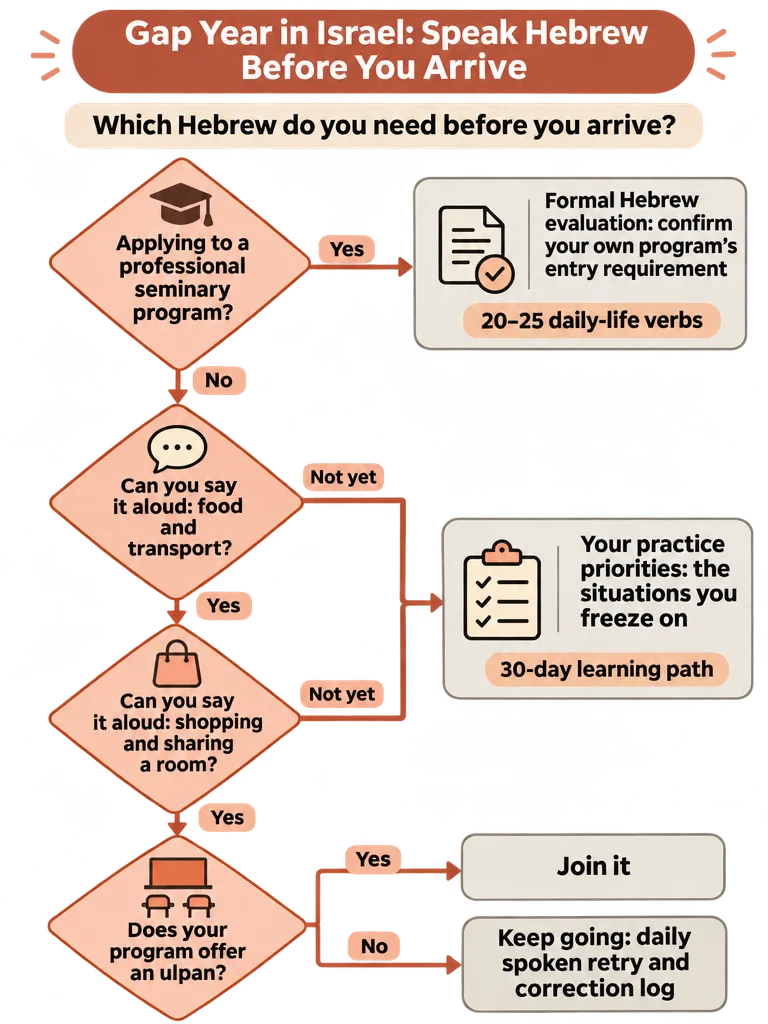
For gap year Israel Hebrew, run a quick aloud self-check first: try ordering food, asking for a bus, buying something and sharing a room, and mark where you freeze. Those moments become your practice list. Then confirm your own program's Hebrew requirement separately, because seminary prerequisites are a different task.
Everyday speaking readiness is the ability to handle a short, unscripted exchange aloud in daily life. Knowing words and producing them in conversation are different skills, and the aloud check targets the second one. Formal program prerequisites are institution-specific rules that an admissions office writes and checks.
Programs differ a lot. Hebrew University's gap-year program begins with an optional intensive ulpan and continues language study into the semester. Hebrew Union College-Jewish Institute of Religion (HUC) requires a Minimum Hebrew Capacity in Modern Hebrew from applicants to its Rabbinical School and Debbie Friedman School of Sacred Music. These are different kinds of requirement, and the next section lays them side by side.
Does my gap year or seminary program require Hebrew before I arrive?
Hebrew entry requirements are program-specific. Hebrew University's First-Year Study Abroad Program starts with an optional ulpan, while HUC's rabbinical and sacred music programs and the Jewish Theological Seminary's rabbinical program set formal Hebrew prerequisites for professional training. None of the three is a general gap-year rule. The excerpts of these pages used here show no publication dates, so check each page for current wording.
Program
What its own page says
What it means for you
Hebrew University, First-Year Study Abroad Program
Begins with an optional intensive Hebrew ulpan; language studies continue into the semester alongside two to three introductory courses (Hebrew University)
Hebrew is taught as part of the program, and the page lists no entry test
HUC, Rabbinical School and Debbie Friedman School of Sacred Music
Applicants must show Minimum Hebrew Capacity in Modern Hebrew. Criteria include active use of at least 20-25 daily-life verbs and conjugating pa'al, pi'el, hifil and hitpael in present and past (HUC)
A graduate admissions requirement for those programs, not a gap-year one
Jewish Theological Seminary (JTS), rabbinical program
The equivalent of at least two years of high-quality, university-level Hebrew to begin; it suggests classes, tutors, summer study at JTS or an ulpan in Israel (JTS)
A rabbinical-program prerequisite, not a gap-year one
If your program is not in this table, the research here cannot tell you its requirement. Ask the program directly about placement testing, any entry requirement, the language of instruction, and whether an ulpan is optional or mandatory.
Watch
Imagine your year. Now come live it - Gap Year & Semester
From AardvarkIsrael on YouTube
Which everyday situations should I practice before I leave?
Practice the situations you will repeat daily: ordering food and drinks, taking buses and asking directions, understanding prices and numbers, reading signs and menus, and, for a gap year, talking with roommates and shopping. Baba's 30-day Hebrew for a Trip to Israel path covers the visitor tasks, so use this section to find your own weak spots.
Write each situation on paper, say your answer aloud in Hebrew as far as you can get, and mark how it went:
Situation
Sample task
Smooth
Slow
Froze
Food and drinks
Order a coffee and ask for the bill
Buses and directions
Ask where a stop is and catch the answer
Prices and numbers
Understand a price in shekels
Signs and menus
Read a menu line without English
Roommate exchange
Offer to buy something for the flat and ask who does a chore
Shopping exchange
Ask for a size, the price, or a different one
Every "froze" is a practice priority. Redo only those rows until they move to "slow," then "smooth." This is a self-diagnostic, not a validated readiness threshold or a guarantee of improvement.
For the visitor rows, the trip path includes a starting-level check on Day 1, numbers and prices on Day 7, food words on Day 9 and getting around on Day 13. It is a curriculum structure, not a promise about where you will be after 30 days.
What Hebrew do I need for roommates and shopping?
Roommate and shopping Hebrew is short, repeatable speech: dividing chores, borrowing things, and asking for a size, a price or an alternative. It differs from visitor Hebrew because you will have these exchanges with the same people over a semester or a year, so getting the forms right once pays off repeatedly.
The research behind this article contains no language-reviewed roommate or shop dialogues, so the scenarios below are English prompts. Get the Hebrew lines from a teacher or native speaker, then drill them.
Roommate exchange
Prepare one line for each of these, in Hebrew:
Ask who is buying a shared item such as milk.
Say what you will buy or which chore you will do.
Ask to borrow something, such as a charger.
Say you will return it later today.
Shop exchange
Prepare one line for each of these:
Ask how much something costs.
Ask whether there is a smaller or larger size.
Ask the clerk to check the stockroom.
Ask for a different one.
Say you will take it.
Say it aloud, record it, retry
Say each prompt aloud in Hebrew.
Record yourself and listen back.
Mark the lines where you hesitated or were unsure of the ending.
Retry only those lines.
Treat gender as two separate choices. Your own first-person forms follow you, the speaker. Forms aimed at the listener, such as "can you check?", follow the person you are addressing, so practice those lines once to a man and once to a woman.
Is prayer or Biblical Hebrew enough, or do I need modern Hebrew?
Prayer and Biblical Hebrew study is a different task from modern conversation. JTS's Biblical Hebrew courses cover biblical grammar, translating verses and reading biblical literature, so speaking tasks like asking a price or talking with a roommate need their own practice.
Reading skills still count. HUC's page says that whether one enters the language through conversation with an Israeli or through classical texts, every encounter with the language supports the capacity to engage with other types of Hebrew. HUC also says its commitment goes beyond reaching classical texts: it expects students to encounter Hebrew as the living language of the Jewish people.
JTS's Biblical Hebrew I asks for basic knowledge of Hebrew pronunciation, meaning students should be able to read biblical verses aloud even if they cannot yet translate them. That is a reading-aloud skill, and it is useful, but the situations in the self-check above still need practice spoken in both directions.
Continued Hebrew practice during a gap year works best as a short routine: use your program's Hebrew classes, retry each day's real encounter aloud, keep a correction log, and rehearse the next hard conversation. This is editorial guidance, not a validated retention method; the research behind this article has no evidence on how to keep conversational Hebrew going.
Include your program's Hebrew classes in your routine. Hebrew University's program continues language study during the semester, so if yours offers something similar, build the rest of your practice around it. If no ulpan place is available, this post on building spoken Hebrew without an ulpan place is a place to start.
Turn each day's encounter into a retry. Pick one moment (the shop, the kitchen, the bus) and say aloud what you wish you had said.
Keep a correction log. Write each mistake, the fixed version, and a new sentence using it. Review it weekly.
Practice both forms of address. Say each useful line once to a man and once to a woman. Your own forms follow you; the forms aimed at the listener follow whoever you are talking to.
Rehearse the next scene. Before a conversation you expect to be hard, such as a roommate talk or a return at a shop, practice both sides aloud.
For step 5, baba Learn, currently in private beta, offers role-plays with its AI tutors, Maya and David, plus correction explanations and My Cards review. Its interface is English only, it is for adults 18 and over, and its feedback can be wrong, so check anything doubtful with a teacher.
Frequently asked questions
What is a gap year in Israel?
A gap year in Israel is a semester or full year spent in the country after high school, usually in a structured program. Hebrew University's academic gap year pairs Hebrew study with two to three introductory courses in fields such as Jewish studies, Israel studies and business. Kivunim, in Jerusalem, runs an academic-year program that teaches Arabic as well as Hebrew.
Do I need to know the Hebrew alphabet before a gap year in Israel?
Not necessarily. Hebrew University's gap year begins with an optional intensive ulpan, and its page lists no entry requirement. Knowing the letters still helps you read street signs and menus from the first day. Baba's 30-day trip path covers letters on signs on Day 2 in about 20 minutes. Confirm any placement test with your own program.
What does Minimum Hebrew Capacity mean at HUC?
Minimum Hebrew Capacity is the Modern Hebrew level that applicants to HUC's Rabbinical School and Debbie Friedman School of Sacred Music must demonstrate before enrolling. HUC's criteria include active use of at least 20-25 daily-life verbs and conjugating pa'al, pi'el, hifil and hitpael in present and past. The evaluation can be taken once the application is started and must be completed within one week of the admissions interview.
How much Hebrew does JTS expect for its rabbinical program?
JTS says you need the equivalent of at least two years of high-quality, university-level Hebrew to begin its rabbinical program. It suggests finding the best modern Hebrew classes and tutors near you, studying at JTS for a summer, or considering an ulpan in Israel. Other seminaries set their own standards, so check each admissions page.
Is there an online Hebrew course for seminary applicants?
Yes, HUC-JIR runs an online Seminary Hebrew Program for current and future applicants to its graduate programs, designed to help them meet Hebrew matriculation requirements. A September 2024 HUC article described it as in its fourth year, and one student reported two semesters of classes multiple times a week before taking the evaluation. Confirm current enrollment details with HUC.
How can I practice speaking Hebrew before I leave?
Say each real-life situation aloud, record yourself, and retry only the lines where you hesitated, such as ordering food, asking where a bus stop is, or asking a roommate to borrow a charger. For role-play practice, baba Learn, currently in private beta, offers AI tutors Maya and David with correction explanations. Its feedback can be wrong, so check doubtful points with a teacher.