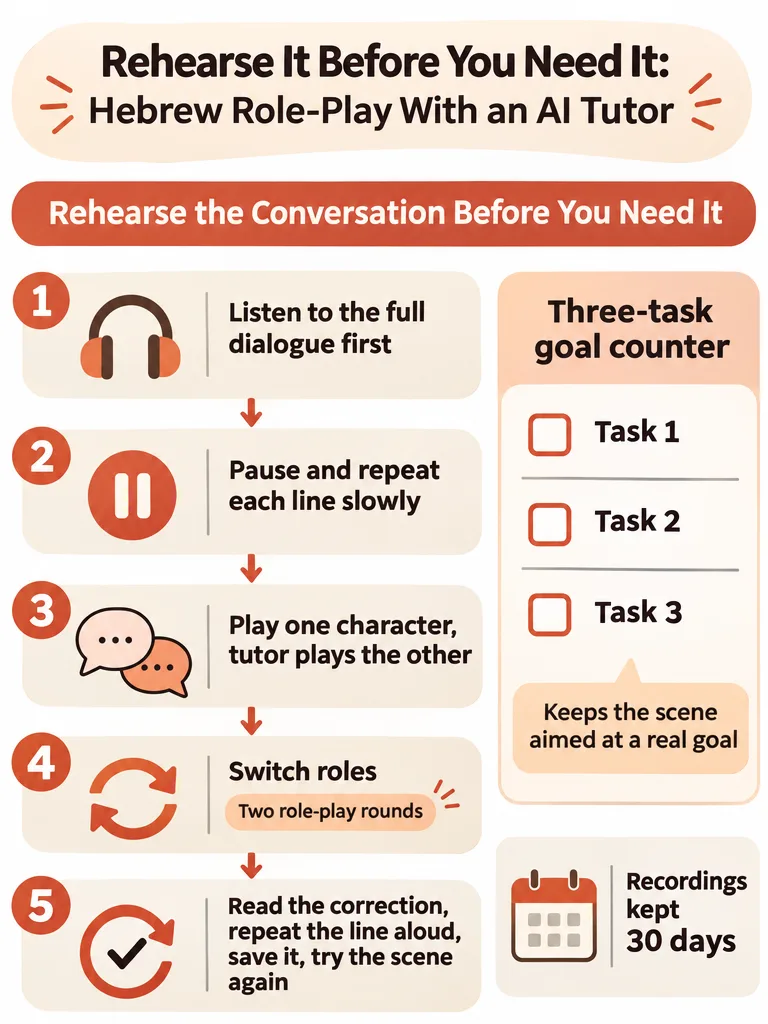
Hebrew role-play practice lets you rehearse a call, café order, or interview. Listen to a dialogue, speak one part, then switch roles.
Can I practice a specific real-life conversation in Hebrew?
Yes. Hebrew role-play practice lets you rehearse the exact conversation you expect, such as a call, a café order or an interview, by taking one role while a tutor or recording plays the other. In the video lesson Speak Hebrew With Me! Let's Roleplay, learners play both the technician and the customer in a broken air-conditioner call.
Here is a short exercise built on that lesson. Pick one exchange you expect to have, then:
Get the whole dialogue in front of you, written or recorded, and listen to it straight through.
Say one side aloud while a recording or a partner supplies the other.
Swap sides and say the other part.
A reasonable goal is to have spoken every line of that exchange aloud, in both roles, before the real one happens. That gives your mouth a first run at lines you would otherwise meet cold, which is the moment many learners freeze.
Baba Learn, a speaking app for adults 18+ learning modern Israeli Hebrew, offers role-plays with the tutors Maya and David. It is in private beta for iPhone and Android, and the interface is in English.
How does a Hebrew role-play rehearsal actually work?
A rehearsal has four moves: listen to the whole dialogue, repeat lines slowly, play one character, then swap. The Let's Roleplay lesson runs exactly this sequence, with two rounds so you speak both parts of the same conversation.
Listen to the full dialogue first. In the lesson, a customer named Nofar calls a technician named Yossi because her air conditioner isn't cooling in late August. The teacher reads the whole dialogue slowly and invites you to note new words and any sounds you want to practice.
Pause and repeat lines slowly. Before the practice rounds, the teacher says it's fine to stop the recording and say a sentence once or twice to build confidence.
Round one: play one character. The teacher is Nofar and you are Yossi the technician.
Round two: swap. You are Nofar and the teacher is Yossi.
Afterward, the teacher returns to the start of the dialogue and goes through useful expressions, including oy vavoy (אוי ואבוי), which the teacher describes as an expression of shock.
Here are lines from the dialogue to say aloud. The transliteration is added here, and the English is a plain gloss:
Hebrew
Transliteration
Meaning
המזגן שלי לא מקרר
hamazgan sheli lo mekarer
My air conditioner isn't cooling
אני גרה ברחוב הרצל מספר 15
ani gara berechov Herzl mispar 15
I live at 15 Herzl Street (Nofar, a woman, speaking)
איפה את גרה?
eifo at gara?
Where do you live? (Yossi asking Nofar)
The last two lines use forms for a woman speaking and a woman being addressed. The lesson doesn't show the masculine versions, so if you're playing a man, check those forms in a grammar guide before you rehearse them.
Should I use a role-play, an interview, or a debate?
Choose by the shape of the conversation you're preparing for: a role-play for an exchange with another person, an interview for a question-and-answer setting, a debate for giving opinions and reasons. The publisher's brief names all three modes in Baba Learn but doesn't document how each one runs, so the table describes the task, not the screens.
Mode
Best for
What you rehearse
Role-play
A specific exchange, like a phone call or a café order
Taking one role while the tutor plays the other
Interview
A question-and-answer setting, like a job interview
Answering questions aloud before the real one
Debate
Practicing opinions and reasons
Stating a view and giving your reasons
A phone call, a café order and a job interview are the three situations Baba has scheduled as separate pieces in this series. They're good candidates for your first scenes.
Other tools approach role-play differently, and each does something well, going by their own pages:
Antlang lets you pick a real-life scenario such as ordering coffee. Its tutor, Anto, plays the other person and shows corrections after each message.
HebrewPod101'sDialogue Role Play has you answer lines from its own lesson dialogues, by speaking or typing, with AI feedback after every line.
Scenario counts and access tiers on those pages change, so check them directly before you choose.
What are the three tasks in a scene, and how do I know I've finished them?
A three-task goal counter gives a role-play scene a concrete aim: three things to get done in the conversation. The publisher's brief names the counter but doesn't document how a task counts as complete, whether a task can be retried, or whether the counter reflects the accuracy of your Hebrew. Treat it as an aim for the scene, not a score.
The scene below is illustrative, not a recorded app scene. It uses only phrases from the Let's Roleplay lesson and Baba's learning hub. Say the tutor plays a technician, and your three tasks are:
Task
Hebrew
Transliteration
1. Report the problem
המזגן שלי לא מקרר
hamazgan sheli lo mekarer
2. Give your address (a woman speaking, as in the lesson)
אני גרה ברחוב הרצל מספר 15
ani gara berechov Herzl mispar 15
3. Say you did not understand
לא הבנתי
lo hevanti
Run it as a loop:
Say task one aloud and listen to the reply.
If you lose the thread, use task three: lo hevanti.
If an explanation or correction appears, read it and repeat the corrected line aloud.
Run the scene again and aim to cover all three tasks.
This walkthrough doesn't invent a tutor correction, because no verified Baba Learn transcript was available for this article. What a real correction says will depend on what you actually say.
Can I create a custom scene for my own situation?
Yes. The publisher's brief says custom scenes keep their own character. It doesn't explain the creation fields, the controls or how that character shows up in the dialogue, so this section sticks to what the feature is for: a conversation you already know is coming.
Before an appointment, write down two things:
Who you'll be talking to. That is the counterpart the tutor would play.
What you need to get done. That is your objective, and it's what your three tasks should cover.
Write your three tasks first, then choose the Hebrew phrases that serve them.
Do I need to read Hebrew before I start speaking?
No. Baba's learning hub says you can begin with useful spoken phrases and transliteration while you learn the alphabet. The letters then give you another way to understand and remember what you hear. Baba's resources focus on modern Israeli Hebrew, not Biblical Hebrew, which has different texts, vocabulary and learning goals.
Here are the three phrases the hub offers as ways in. Say each aloud three times:
Hebrew
Transliteration
Meaning
נעים מאוד
naim meod
Nice to meet you
אפשר קפה, בבקשה?
efshar kafe, bevakasha?
A coffee, please?
לא הבנתי
lo hevanti
I did not understand
The hub suggests noticing how a sentence changes for the speaker or listener, which is why the lesson's gara and at forms earlier are worth watching. Then use one phrase as the opening line of a short scene and answer the reply out loud.
How do I review a correction and try the conversation again?
Review in a loop: read the explanation, say the corrected line aloud, then run the conversation again. The Let's Roleplay teacher recommends the same habit of repeating a sentence once or twice until it feels steady. Use this checklist after any scene:
Find the line that went wrong. Write it down.
Read the explanation of why it was corrected.
Repeat the corrected line aloud, slowly, two or three times.
Keep it somewhere you'll see it again, in a review feature if your tool has one or in your own notes.
Run the scene again from the top.
On privacy, the publisher's supplied information says the app keeps recordings for 30 days to check a score, then deletes them.
Frequently asked questions
Where can I practice Hebrew conversation?
You can practice with a teacher, a language partner, or an AI tutor, since each gives you someone to answer. Baba Learn offers conversation with the tutors Maya and David in a private beta for iPhone and Android. Antlang, HebrewPod101 and 17-Minute Languages offer AI role-play of their own, so pick the one that fits the situation you are preparing for.
Is Hebrew role-play practice free?
Sometimes, depending on the tool. Antlang says some scenarios are free and the rest need Premium. HebrewPod101 lists Dialogue Role Play as a Premium PLUS tool. 17-Minute Languages says its role-plays need no subscription once unlocked, with a 31-day money-back guarantee. Plans change, so check each page on the day you sign up.
Does GCSE Biblical Hebrew have a role-play exam?
No. Pearson Edexcel GCSE Biblical Hebrew (specification 1BH0) is assessed through two written two-hour papers, with no speaking test or role-play. A role-play card usually points to a Modern Hebrew qualification such as AQA GCSE Modern Hebrew, whose speaking test includes a role-play, a photo card and a general conversation. Confirm the specification with your teacher.
Can an AI tutor correct my Hebrew during a role-play?
Yes, many do. Antlang says its tutor shows corrections and a short grammar note after each message, and 17-Minute Languages gives feedback and a replay task after each scene. Feedback can be wrong, though, and Baba Learn does not score word stress. If a correction seems off, check it with a teacher or an Israeli friend before you memorize it.
What do I say in Hebrew if I don't understand someone?
Say לא הבנתי (lo hevanti), which means "I did not understand." It is one of three starter phrases Baba's learning hub offers, alongside נעים מאוד (naim meod, nice to meet you) and אפשר קפה, בבקשה? (efshar kafe, bevakasha?, a coffee, please?). Use it as your way back into any rehearsed scene when you lose the thread.
Is Baba Learn available yet, and who is it for?
Baba Learn is in private beta for iPhone and Android, not a public launch, and its interface is in English. It is a speaking app for adults 18+ learning modern Israeli Hebrew. Recordings are kept for 30 days to check a score, then deleted.