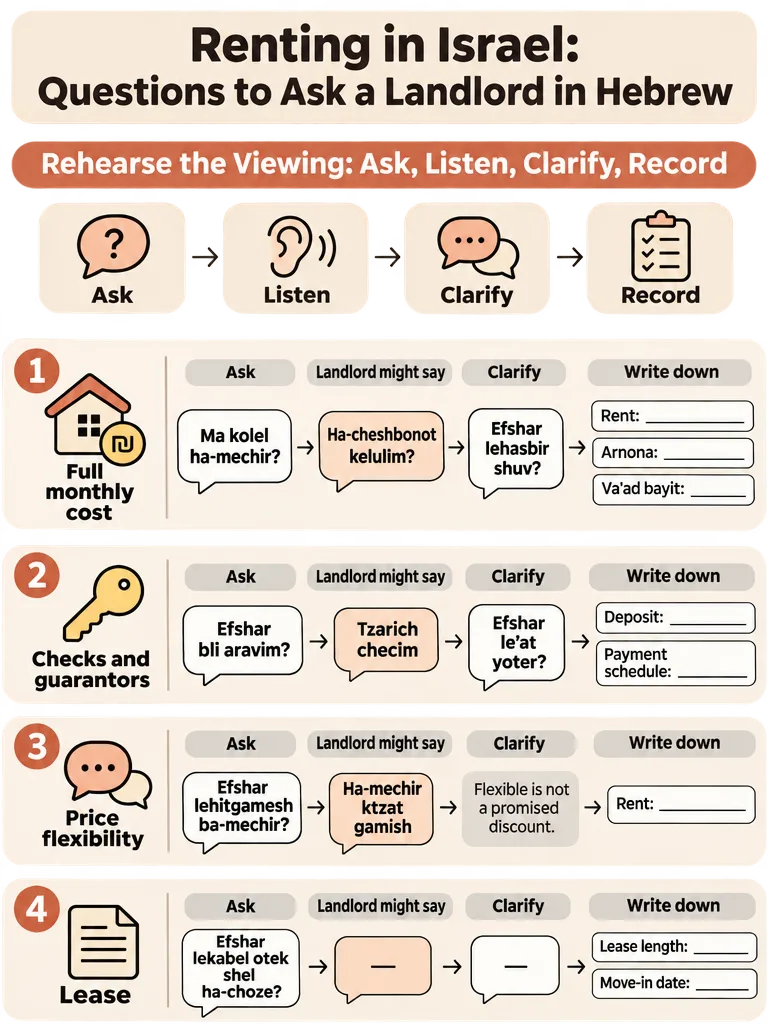
Ask your landlord in Hebrew about rent, arnona, va'ad bayit, the deposit and lease length. Practice phrases for renting an apartment in Israel.
What should I ask a landlord in Hebrew?
Hebrew for renting an apartment starts with four questions: what does the price include, how much are arnona and va'ad bayit, are checks, a deposit or guarantors required, and how long is the lease. Rothberg International School's housing checklist recommends asking about rent, va'ad bayit and payment terms before signing.
Try this three-line drill out loud before your first call. It's a starter set, not a full script.
Hebrew
Say it
Meaning
הדירה עדיין פנויה?
ha-dira adayin pnuya?
Is the apartment still available?
מה כולל המחיר?
ma kolel ha-mechir?
What does the price include?
כמה פיקדון צריך?
kama pikadon tzarich?
How much deposit is required?
When you add "I want to…", the gender split shows up. A man says ani rotze and a woman says ani rotza, and both are spelled רוצה. So "I want to see the apartment" is אני רוצה לראות את הדירה (ani rotze / rotza lir'ot et ha-dira).
The goal of the drill is to open a call, confirm availability, and ask about the price and the deposit in Hebrew without reaching for English first. Say each line three or four times, switching the gender form if it doesn't match you.
Which questions should I ask at the viewing?
At the viewing, ask about the money first, then the apartment's condition and systems: heating, hot water, A/C, safe room and damp. The Hebrew renting guide on Shotef lists the core questions, and the Rothberg checklist adds heating and water-heating questions that can change your bills. Write the answers down as you go.
Hebrew
Say it
English
What to write down
אני רוצה לבוא לראות
ani rotze / rotza lavo lir'ot
I'd like to come see it
Date and time
כמה שכר הדירה?
kama sechar ha-dira?
How much is the rent?
Monthly rent
מה כולל המחיר?
ma kolel ha-mechir?
What's included in the price?
Arnona, electricity, water?
יש ריהוט?
yesh rihut?
Is it furnished?
What stays
יש מזגן?
yesh mizgan?
Is there A/C?
Number of units
יש ממ״ד?
yesh mamad?
Is there a safe room?
Yes or no
יש בעיות עם רטיבות או עובש?
yesh be'ayot im retivut o ovesh?
Any dampness or mold problems?
Where, and the landlord's answer
אפשר לראות את החשבונות?
efshar lir'ot et ha-cheshbonot?
Can I see the bills?
Last electricity and water bills
איך מחממים את הדירה?
eich mechamemim et ha-dira?
How is the apartment heated?
Central, private, or room heaters
המים החמים בחשמל, בגז או בדוד שמש?
ha-mayim ha-chamim ba-chashmal, ba-gaz o be-dud shemesh?
Is hot water electric, gas or solar?
Water-heating type
Rothberg notes that apartments with a high va'ad bayit are often centrally heated. Otherwise you may need room heaters, which can be expensive to run. It says the hot-water type can also change your electricity or gas bill significantly.
Spot a broker before you go. The Hebrew word תיווך (tivuch) on a listing means a broker, not a private landlord. Rothberg notes that realtors behind newspaper listings charge around one month's rent as commission. Ask early: zo dira be-tivuch? (זו דירה בתיווך?). Baba's guide to translating Hebrew apartment listings without missing red flags covers the other signs to check before you message anyone.
How do I find out the full monthly cost: rent, arnona and va'ad bayit?
The full monthly cost is rent plus arnona (municipal property tax), va'ad bayit (the building committee fee) and any utilities not already covered. Rothberg advises budgeting for electricity, water, gas, arnona and va'ad bayit on top of rent. Ask for each line separately, then add them yourself.
Rent.Kama ha-sechirut? (כמה השכירות?). Rothberg adds that rent may be quoted in dollars linked to the exchange rate, but it says landlords can't legally demand payment in actual dollars.
Va'ad bayit.Kama va'ad bayit? (כמה ועד בית?). Often combined: Kama ha-sechirut ve-kama va'ad bayit?
Arnona. Ask who pays, how much, and how often the bill comes: Mi meshalem arnona? (מי משלם ארנונה?), Kama arnona? (כמה ארנונה?), Kol kama zman magia ha-cheshbon? (כל כמה זמן מגיע החשבון?). Baba's arnona guide says the tenant usually pays unless the lease says otherwise, so check the contract too.
Utilities.Ha-cheshbonot kelulim? (החשבונות כלולים?). For any that aren't included, ask to see recent electricity and water bills.
To total them, convert every amount to a monthly figure first, since arnona bills may cover a different period. Then add only the charges that aren't already included in the rent. If the landlord says "it's all included," ask which items, one by one, so you don't count something twice.
What does the landlord mean by checks, guarantors and immediate move-in?
Common Hebrew rental replies include tzarich cheqim (you need checks), tzarich aravim (you need guarantors) and knisa miyadit (immediate move-in). Shotef's renting guide lists all of them as phrases heard in rental conversations. Each one should trigger a follow-up question, not a nod.
Landlord says
Say it
Meaning
Ask next
צריך צ׳קים
tzarich cheqim
You need checks
Kama cheqim, ve-le-eize tarichim? How many, and for which dates?
צריך ערבים
tzarich aravim
You need guarantors
Efshar bli aravim? Is it possible without?
כניסה מיידית
knisa miyadit
Immediate move-in
Matai efshar lehikanes? When can I move in?
יש עוד מתעניינים
yesh od mit'anyenim
Others are interested
Ad matai efshar lachshov? Until when can I think about it?
המחיר קצת גמיש
ha-mechir ktzat gamish
The price is a bit flexible
See the next section
Those words only tell you what was said. The actual requirements vary, so confirm them for your apartment. Rothberg says landlords often ask for several months in advance, with the first and last month's rent as the standard request. Baba's listing guide, citing Scoutr, describes landlords often expecting Israeli guarantors, deposits held directly by the landlord and rent paid with 12 post-dated checks at signing. Ask for the actual schedule instead of assuming either pattern.
Don't mix up tenant and landlord. Per Shotef's landlord guide, the tenant is socher (m.) or socheret (f.), and the landlord is maskir (m.) or maskira (f.). Streetwise Hebrew separates the verbs: liskor is to rent as a tenant, lehaskir is to rent out. In everyday speech people may also say baal ha-dira for the landlord.
Can you be flexible on the price? How to negotiate in Hebrew
You can ask whether the price is flexible with Efshar lehitgamesh ba-mechir? (אפשר להתגמש במחיר?). A landlord reply of ha-mechir ktzat gamish (המחיר קצת גמיש) means "the price is a bit flexible," which isn't a promised discount. Ask for one specific thing at a time.
You:Efshar lehasbir shuv? (אפשר להסביר שוב?) Then say the rent figure you're hoping for, in numbers, and listen for the landlord's answer.
Security requirements are a separate conversation. Flexibility on price doesn't tell you anything about guarantors or checks, so ask about those on their own: Efshar bli aravim? (אפשר בלי ערבים?). A possible reply is Ani tzarich lachshov (אני צריך לחשוב, "I need to think"), and a woman landlord would say ani tzricha lachshov.
If your ask is a move-in date, add ani rotze / rotza lehikanes me-ha-rishon la-chodesh (אני רוצה להיכנס מהראשון לחודש). Whether a landlord actually moves on the price, and what a contract can or can't include, are outside what these sources cover, so this isn't legal advice.
What do I say when the landlord talks too fast?
Slow the conversation with three phrases from Shotef's guide: Efshar lehasbir shuv? (אפשר להסביר שוב?, "Can you explain again?"), Efshar le'at yoter? (אפשר לאט יותר?, "Can you speak more slowly?"), and Ani rotze / rotza levade she-hevanti nachon (אני רוצה לוודא שהבנתי נכון, "I want to make sure I understood correctly").
Then repeat the landlord's actual number or date back to them, ending with nachon? (נכון?, "right?"). Do this for the rent, the deposit and each date. Saying figures aloud gives the landlord a chance to correct a mishearing on the spot. You don't need perfect Hebrew for this, only the habit of confirming.
Which lease and deposit questions should I settle before I sign?
Before you sign, settle the lease length, move-in and move-out dates, the deposit amount and when it comes back, a copy of the contract, who pays for repairs, and whether a lawyer's fee applies. These are questions to ask, not legal advice. Say them out loud and ask for the answers in writing.
Contract copy:Efshar lekabel otek shel ha-choze? (אפשר לקבל עותק של החוזה?)
Move-in date:Matai efshar lehikanes? (מתי אפשר להיכנס?)
Move-out date:Matai tzarich lefanot et ha-dira? (מתי צריך לפנות את הדירה?)
Repairs:Mi meshalem al tikunim? (מי משלם על תיקונים?) And to report one: Ha-mizgan lo oved (המזגן לא עובד), then Efshar lishlo'ach mishehu letaken et ze? (אפשר לשלוח מישהו לתקן את זה?)
Lawyer's fee: Rothberg suggests checking whether one applies: Kama ola ha-orech din, im yesh? (כמה עולה עורך הדין, אם יש?)
The sources here don't establish deposit limits, repair deadlines or notice periods, so don't treat any figure you hear as a rule. Confirm those with a lawyer or an official source before signing.
How can I rehearse a viewing before the real conversation?
Rehearse by playing both sides aloud: you read your line, then say the landlord's possible reply, then say what you'd write down. Every landlord reply below is invented for practice, not market data or a sourced answer. Use it with a pen, and say each line twice.
Step
You say
Landlord might reply (practice)
Write down
Availability and viewing
ha-dira adayin pnuya? efshar lavo lir'ot? (הדירה עדיין פנויה? אפשר לבוא לראות?)
ken, pnuya (כן, פנויה)
Whether it's available; viewing time, once you ask matai efshar lehagia?
Price and va'ad bayit
ma kolel ha-mechir? kama ha-sechirut ve-kama va'ad bayit? (מה כולל המחיר? כמה השכירות וכמה ועד בית?)
ze kolel arnona / chashmal / mayim, then two numbers (זה כולל ארנונה / חשמל / מים)
What's included, rent, va'ad bayit
Arnona
mi meshalem arnona? kama arnona? kol kama zman magia ha-cheshbon? (מי משלם ארנונה? כמה ארנונה? כל כמה זמן מגיע החשבון?)
toda, ani rotze / rotza lachshov al ze. ad matai efshar lachshov? (תודה, אני רוצה לחשוב על זה. עד מתי אפשר לחשוב?)
yesh od mit'anyenim, then a date (יש עוד מתעניינים)
Decision deadline
If you lose the thread mid-script, use the rescue phrases from the section above and repeat each number back.
For a rehearsal partner who answers back, baba Learn is a speaking app for adults, currently in private beta, with role-plays and AI tutors Maya and David.
Frequently asked questions
How do you say "I want to rent an apartment" in Hebrew?
Say אני רוצה לשכור דירה (ani rotze / rotza liskor dira). Rotze is the man's form and rotza is the woman's, though both are spelled רוצה. Liskor is the verb for renting as a tenant, while lehaskir means renting out, so liskor is the one to use when you're the person looking.
What is the word for rent in Hebrew?
Rent is שכר דירה (sechar dira) or שכירות (sechirut). Renters ask כמה השכירות? (kama ha-sechirut?) to find out the monthly price. A tenant is socher (m.) or socheret (f.), and a landlord is maskir (m.) or maskira (f.), though many people still say baal ha-dira in everyday speech.
Who pays arnona, the landlord or the tenant?
In most rentals the tenant pays arnona, the municipal property tax, unless the lease says otherwise. Read the contract to confirm, then ask the municipality for a change of occupant (חילופי מחזיקים) so the account moves into your name. Nefesh B'Nefesh says that step keeps you from paying a previous tenant's debt.
Do new immigrants get a discount on arnona?
Yes. Olim can get an arnona discount on up to 100 square meters, for one 12-month period within the first 24 months after aliyah. Nefesh B'Nefesh says the rate is customarily 50 to 90 percent, set by each municipality. The discount is not retroactive, so it only runs from the date you apply.
What does תיווך mean on a rental listing?
תיווך (tivuch) means a broker or realtor listed the apartment, not a private landlord. Rothberg International School notes that realtors behind newspaper ads charge around one month's rent as a commission. Ask early with זו דירה בתיווך? (zo dira be-tivuch?) so the fee is part of your budget before you book a viewing.
Do foreigners need Israeli guarantors to rent an apartment?
Often, yes. Scoutr reports that landlords commonly expect Israeli guarantors (ערבים, aravim) from foreign renters, and that rent is often paid with 12 post-dated checks at signing. Requirements differ by landlord, so ask אפשר בלי ערבים? (efshar bli aravim?) and ask exactly how many checks are needed and for which dates.