Learn Hebrew with ChatGPT by setting the topic and instructions. A tutor app can add explained corrections and saved review; a teacher can check wording.
Why pay for a Hebrew tutor when ChatGPT is free?
You can learn Hebrew with ChatGPT if you supply the topic, the instructions and the follow-through; Heb4You's Yaron says it works as a tutor only when prompted the right way. Whether paying is worthwhile depends on the task: a packaged workflow or human guidance can add what you'd otherwise arrange yourself.
Start with one exercise: a five-minute café scene. Ask a question you'd use in Israel, answer in Hebrew, and ask why any correction was made. The outcome to aim for is one corrected phrase you can say aloud today and still find tomorrow. For many learners who know the words but freeze when speaking, that last step is where practice usually breaks down.
The "free" part needs a caveat. The research behind this article doesn't establish current ordinary-consumer ChatGPT pricing, free voice allowances or plan limits as of 11/12/2026. The only official OpenAI page reviewed describes a free plan for verified U.S. K–12 educators, which says nothing about what an adult learner gets. Check your own account before you plan around it.
Put these words into a conversation
A Hebrew speaking app with Maya and David, AI tutors who hold conversations, explain corrections and help you practise what you need to say. Private beta on iPhone and Android. Public store launch is still ahead.
ChatGPT handles open-ended topics, role-play, vocabulary lists and grammar explanations well, and it never runs out of patience. Baba's comparison of ChatGPT Voice and baba Learn says a general voice assistant suits you when you want to supply your own topic and learning instructions. It describes ChatGPT's Voice guide as covering natural spoken interaction, including asking for a different language.
Learners and teachers report the same strengths:
Patience and range. Times of Israel blogger John Jeffay writes that it is "always available, endlessly patient" and will compile vocabulary lists and test him on them. His complaints are a terrible accent and that it talks over him.
Writing and grammar. Heb4You says language models can write grammatical Hebrew, correct mistakes, explain grammar and role-play conversations. Yaron also warns they can mix up a gender here and there, and calls the colloquial slang "a bit stiff."
Variety.eHebrew suggests scenarios such as ordering food or asking directions, plus grammar quizzes, flashcards and explanations of idioms.
These are opinions from individual writers, not tests. Heb4You's remark that pronunciation is "text only" comes from a September 2024 post, so it isn't a verified current limit.
How do you run a real Hebrew speaking task with ChatGPT?
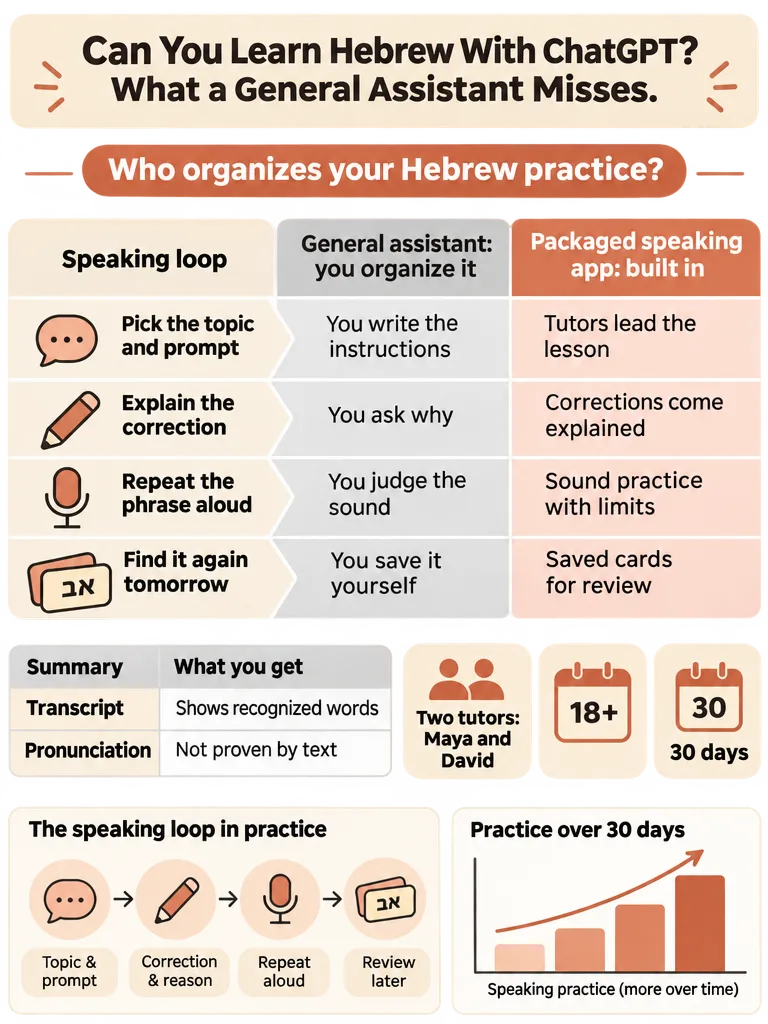
A real café task with ChatGPT follows this article's four-part checklist: speak, explain, retry and retrieve. Ask a question you'd use in Israel, answer in Hebrew, ask why you were corrected, say the fixed phrase aloud, then check tomorrow whether you can find it. Baba's comparison page suggests this same test.
Set the scene. Tell ChatGPT it is a café worker in Tel Aviv. Ask for simple modern Hebrew with nikud and transliteration (the style Heb4You's prompt uses), and say whether you are a man or a woman and who you're talking to.
Ask and answer in Hebrew. Order something, then answer its question.
Request one follow-up. Ask it to push the conversation one step further.
Ask why. If it corrects you, ask for the reason in one sentence, not just the fixed version.
Say it again. Repeat the corrected phrase aloud, then use it in a new reply.
Retrieve it tomorrow. First try to say the phrase unaided. Then check whether the correction exists somewhere you can find it, such as a saved note, a flashcard or your chat history, and whether you can revisit it. Forgetting a phrase is normal. What matters is that there's a review item to return to.
Baba's page also says to check the speaker and listener forms, the help you can reveal, and whether the useful phrase is easy to find later.
The supplied sources don't include a verified, worked Hebrew dialogue for this scene, so none is printed here. Let ChatGPT generate the lines, then have a teacher or fluent speaker check any you plan to keep.
What does ChatGPT miss that a Hebrew learner needs?
A general assistant leaves a Hebrew learner to check four things: a learning path, sound-level feedback, remembered mistakes and review. The supplied sources don't establish whether ChatGPT does these, and missing documentation isn't proof a capability is absent. Baba's Voice page lists what a packaged speaking app, baba Learn, builds in.
Learner need
With ChatGPT
What a packaged speaking app provides (per baba's Voice page)
Learning path
You choose topics and write instructions. Heb4You advises a specific task every time.
Classic conversations, role-plays, Read and Talk, Free Talk, letter practice, daily words
Sound-level feedback
Baba's page says a spoken reply or correct transcript alone doesn't demonstrate word-level scoring. eHebrew describes text-to-speech playback and typed phonetic spelling.
Listen, record and compare words or phrases, with feedback on sounds the app heard differently
Memory of recurring mistakes
Not established in the sources reviewed. Verify in your own account, or keep notes.
The tutor remembers selected facts and recurring weak spots; recaps and history
Grammatical gender
State speaker and listener gender yourself and check the forms; Heb4You notes occasional mix-ups. Persistent setup isn't established in the sources.
Hebrew address follows your grammatical gender
Review of saved phrases
Ask for flashcards or quizzes, as eHebrew suggests. Scheduling isn't established in the sources.
My Cards: review by revealing, typing or saying; saved reviews stay free
Two caveats apply. Baba says it has not conducted a comparative performance study, so this table compares published product information, not results. And the baba vs ChatGPT page tests Hebrew translation, not teaching, so its results don't show which one teaches better.
Does a transcript prove your Hebrew pronunciation is right?
No. A correct transcript shows the words a speech recognizer selected, not that every sound was pronounced correctly, according to baba's Voice page. Four different things get lumped together under "pronunciation practice":
Voice conversation: you talk and the tutor talks back.
Transcription: your speech becomes text.
Audio playback: you hear a model pronounce a phrase.
Sound assessment: feedback on specific sounds you made.
eHebrew's own list splits the first and last jobs. It recommends ChatGPT Voice for speaking practice, but for pronunciation feedback it falls back on text-to-speech playback and typed phonetic spelling.
Baba's page describes its sound practice as listening, recording and comparing words or phrases, with feedback on sounds the app heard differently. It also says that feedback can be wrong and that word stress isn't assessed. For wording that matters, such as a speech or a legal form, ask a teacher or fluent speaker.
Is there an AI Hebrew tutor built for speaking practice?
baba Learn is an AI Hebrew speaking app built to turn what you understand into things you can say. Per baba's product page, checked 10/30/2026, it is in private beta on iPhone and Android, and a public store launch is still ahead. You choose between two tutors, Maya and David, and practice through Classic conversations, Israeli role-plays, Read and Talk and Free Talk.
Hebrew address follows your grammatical gender, and you can reveal English or transliteration when needed. When you make a mistake, the app shows a more natural phrase and explains the reason. You can return to it in Fix Your Mistakes and save useful phrases to My Cards. To see how a first session feels, read what happens in your first Hebrew lesson with Maya.
The limits:
The interface is English only.
It isn't an accredited course and promises no particular level.
According to Baba's supplied product information, the app is for adults 18 and older, and recordings are kept 30 days to check a score, then deleted.
How to choose between ChatGPT, an AI tutor app and a human teacher
Choose ChatGPT if you're happy to design your own practice and verify the Hebrew yourself. Choose a dedicated tutor app if you want conversation, explained corrections and saved review packaged together. Choose a human teacher if the wording is high-stakes. Whichever you consider, run the same Hebrew task in each option before paying, starting from your goal: travel phrases, family conversations or aliyah.
ChatGPT suits you if you enjoy writing prompts, keep your own notes and will do the retrieval step without being asked.
An AI tutor app suits you if you want explained corrections, a spoken retry and saved review without setting them up. Check that the app does each one.
An individual teacher suits you if wording is high-stakes (official forms, a toast, a work email). Heb4You calls real conversation with a human the gold standard for speaking confidence.
A group ulpan class suits you if you prefer a class format with other learners. The Times of Israel blogger above weighs ChatGPT against both paid teachers and ulpan, virtual or face-to-face.
On cost, baba's page says baba Learn has free starting Classic lessons with no card (the app shows your allocation). Pro includes a monthly AI usage allowance, and saved reviews stay free. While the app is in beta, you can join the waitlist and try the same task there.
Frequently asked questions
Can you learn Hebrew with ChatGPT?
Yes, if you supply the topic, the instructions and the follow-through. Heb4You's Yaron says ChatGPT works as a Hebrew tutor only when prompted the right way, with a specific task each time, such as ordering coffee at a café. Without that structure, a general assistant tends to give generic lesson plans and textbook sentences nobody actually says.
Is ChatGPT free for learning Hebrew?
The research reviewed does not confirm what a free ChatGPT account includes for Hebrew practice today, including voice allowances or limits. The only official OpenAI page checked covers ChatGPT for Teachers, which is free through June 2028 for verified U.S. K–12 educators and is not for students. Check your own account's plan before building a routine around it.
Can I use ChatGPT Voice to practice speaking Hebrew?
Yes, as a general voice assistant. OpenAI's Voice guide describes natural spoken interaction and the ability to ask for a different language, and eHebrew recommends it for speaking practice. That is not documentation of a dedicated Hebrew course or pronunciation assessment, so verify the Hebrew you get and involve a teacher or fluent speaker for wording that matters.
Does ChatGPT get Hebrew grammatical gender right?
Only if you specify it. Heb4You warns that language models can mix up a gender here and there, and baba's comparison page says speaker and listener gender must be supplied in the prompt. In baba's published translation test (08/02/2026), ChatGPT returned the masculine form of "I miss you" when no roles were given. State both genders every time and check the verb and pronoun forms.
How do I keep track of my Hebrew mistakes when practicing with ChatGPT?
Ask for the reason behind each correction in one sentence, say the fixed phrase aloud, then save it somewhere findable, such as a note, a flashcard or your chat history. The next day, try to say it unaided before looking. The sources reviewed do not establish that ChatGPT tracks recurring mistakes for you, so verify in your own account or keep your own notes.
What is baba Learn, and can I use it now?
baba Learn is an AI Hebrew speaking app with two tutors, Maya and David, offering Classic conversations, role-plays, Read and Talk and Free Talk. Per baba's product page checked 10/30/2026, it is in private beta on iPhone and Android, with public store launch still ahead. The interface is English only, it is for adults 18 and older, and it is not an accredited course. Free starting Classic lessons need no card.