
baba
Free, no AIHebrew-English guide 97 of 100

Israeli Trail Markings, in Plain English

What Israel's colored trail blazes and the Shvil Yisra'el mark mean.

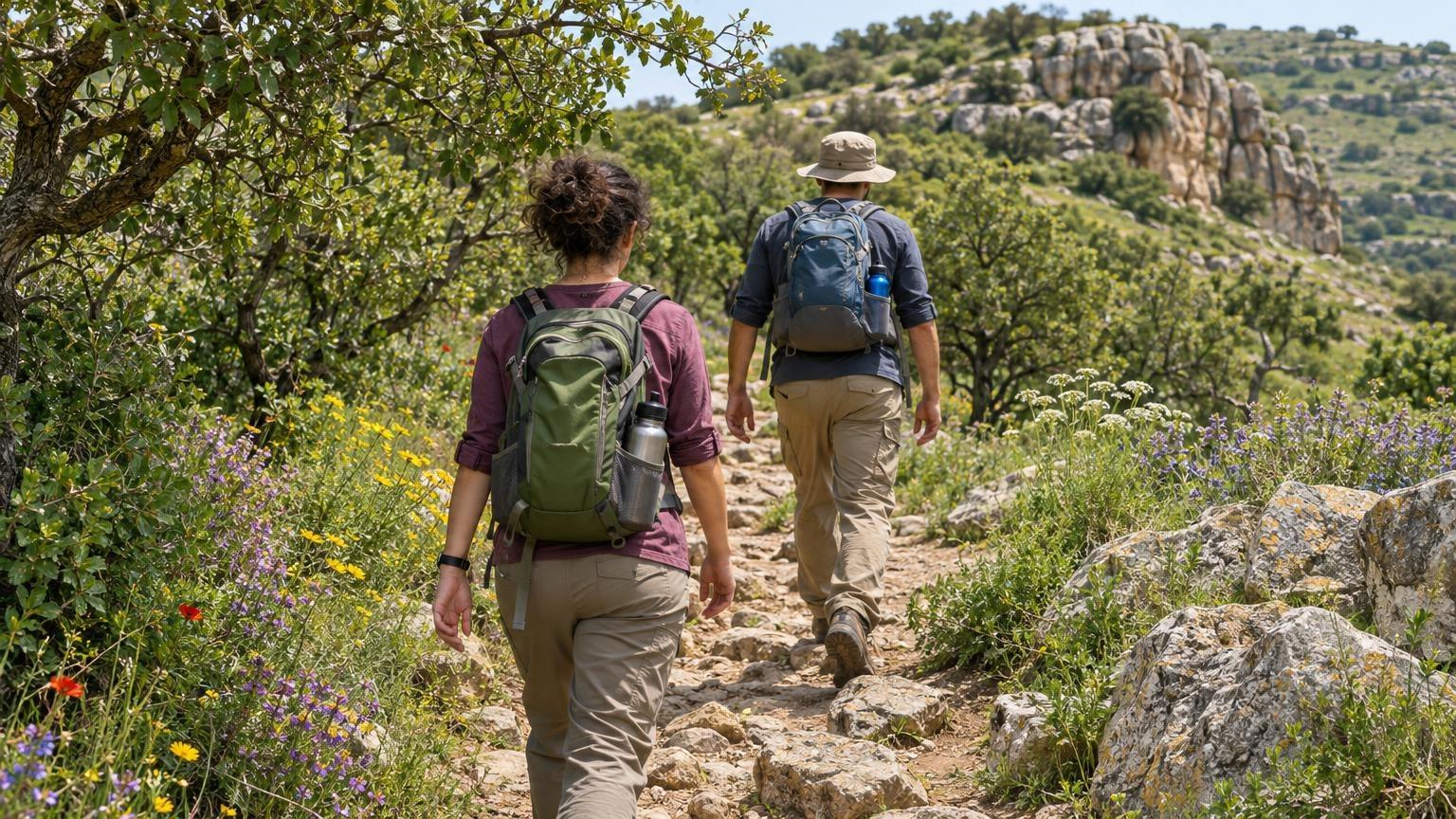
Hikers on a trail in the Galilee hills

Mix-Ups to Avoid

  1. Do not read the blaze color as difficulty. Black, red, blue and green only tell nearby routes apart, so a black trail is not the hardest one.
  2. Do not read the Shvil Yisra'el mark left to right. Look for the raised end: white points north toward Hermon and orange points south toward Eilat.
  3. Do not rely on paint alone. SPNI advises carrying a map, and its live update page lists reroutes that printed maps have not caught up with.
In This Guide23 entries

The Basic System

סימון שביליםTrail marking system

simun shvilim

US English

Trail blazing; trail marking

UK English

Waymarking

What it is

Simun shvilim is the Israeli trail marking system. The SPNI Israel Trails Committee marks and maintains the network with hand-painted marks on rocks, boulders, posts, fences, and sometimes utility poles.

The difference

US and UK trail color meanings do not carry over to simun shvilim. In Israel the standard mark is a colored center stripe with white on both sides.

Common mistake

Do not expect foreign color codes or use simun shvilim as a substitute for a current map.

סימון שביל / סימן שבילTrail blaze

simun shvil / siman shvil

US English

Trail blaze or trail marker

UK English

Waymark or waymarker

What it is

A simun shvil is a single painted mark that confirms the route. The standard simun shvil is a rectangle of about 15 × 20 cm, with the route color in the center and white on both sides.

The difference

A simun shvil is a three-part rectangle, not one solid painted bar. Marks are meant to be read in both directions of travel.

Common mistake

Do not look only forward; SPNI advises looking back for the reverse-direction simun shvil when the next forward mark is hard to see.

שביל מסומןMarked trail

shvil mesuman

US English

Blazed or marked trail

UK English

Waymarked trail

What it is

A shvil mesuman is an officially marked route. A Nature and Parks Authority guide defines a shvil mesuman as a route marked by the Israel Trails Committee that appears in the field and on a 1:50,000 trail marking map.

The difference

Not every visible footpath is a shvil mesuman. An official route has a sequence of matching field marks and a matching line on the map sheet.

Common mistake

Do not assume a trodden path is a shvil mesuman; check for matching marks and the route on the map.

The Four Route Colors

שביל שחורBlack trail

shvil shakhor

US English

Black-blazed trail

UK English

Black-waymarked trail

What it is

A shvil shakhor is a route marked with a white, black, and white rectangle. Black is one of the four ordinary route colors.

The difference

Black identifies the route against nearby routes. A shvil shakhor says nothing about difficulty, distance, direction, or whether the route is a loop.

Common mistake

Do not read a shvil shakhor as the most difficult trail, as on a ski slope; black is only the route's name color.

שביל אדוםRed trail

shvil adom

US English

Red-blazed trail

UK English

Red-waymarked trail

What it is

A shvil adom is a route marked with a white, red, and white rectangle. Red is one of the four ordinary route colors.

The difference

Red on a shvil adom is route identity, not a warning or a closure. SPNI has recolored some red routes because its red paint lasted poorly, so an older guide may name a color that is no longer current.

Common mistake

Do not treat a shvil adom as dangerous or closed, and check a current map if an older guide names a red route.

שביל כחולBlue trail

shvil kakhol

US English

Blue-blazed trail

UK English

Blue-waymarked trail

What it is

A shvil kakhol is a route marked with a white, blue, and white rectangle. Blue is one of the four ordinary route colors.

The difference

A shvil kakhol is not an easy or intermediate trail and does not automatically follow water.

Common mistake

Do not import a foreign blue code, such as a UK blue bridleway arrow, onto a shvil kakhol.

שביל ירוקGreen trail

shvil yarok

US English

Green-blazed trail

UK English

Green-waymarked trail

What it is

A shvil yarok is a route marked with a white, green, and white rectangle. Green is one of the four ordinary route colors.

The difference

A shvil yarok is not an easy trail and not an environmentally certified trail.

Common mistake

Do not choose a shvil yarok expecting the easiest route; check the route description for difficulty.

Shapes On The Rock

שביל “שקוף”Uncolored side spur

shvil shakuf

US English

Uncolored spur or short side trail

UK English

Uncolored spur or short link path

What it is

A shvil shakuf is a short branch of up to about 150 metres from a marked trail to a nearby point of interest. The mark is two white side stripes with the center left unpainted.

The difference

Shakuf means transparent, which is trail jargon for the empty center, not a see-through path. A shvil shakuf is normally missing from the printed map because of scale.

Common mistake

Do not look for a color in the center or walk past the point of interest; a shvil shakuf usually returns the same way.

סימון כניסה לשבילTrail entry mark

simun knisa la-shvil

US English

Trail entry or trailhead blaze

UK English

Start waymark

What it is

Simun knisa la-shvil is the official field symbol that shows where a marked route begins. The simun knisa is a geometric arrangement of the route's colored and white bars, not a written start sign.

The difference

The Israeli simun knisa is not the common North American three-blaze start symbol.

Common mistake

Do not use a North American blaze chart; the Israel Trails Committee symbol chart shows the simun knisa.

פנייהTurn mark

pniya

US English

Turn blaze

UK English

Turn waymark

What it is

A pniya mark is the route stripe bent into an L shape to show that the marked route turns. A pniya is a direction shape, not a new trail color.

The difference

A hiker can notice the color of a pniya mark and miss its bent shape.

Common mistake

Do not walk straight past a pniya mark; turn, then confirm with the next mark.

On the label or sign

צומת T
T-junction
צומת מרובעת
four-way junction

צומת שביליםTrail junction

tzomet shvilim

US English

Trail junction; T-junction; four-way junction

UK English

Path junction; T-junction; crossroads

What it is

A tzomet shvilim is a place where marked routes meet or split. The official symbols include T-shaped and cross-shaped arrangements, often with a signpost.

The difference

At a tzomet shvilim each onward route keeps its own color, and the crossing colors do not show difficulty. Route descriptions often say tzomet shvilim and then name the color to follow.

Common mistake

Do not follow the most visible branch at a tzomet shvilim; match your planned route's color and direction.

סימון סוף שבילTrail end mark

simun sof shvil

US English

Trail end or dead-end blaze

UK English

End-of-route waymark

What it is

Simun sof shvil is the official end mark for a no-through trail or a route from which hikers must turn back.

The difference

A simun sof shvil is not a warning that the terrain is closed; it marks where the marked route stops.

Common mistake

Do not keep going past a simun sof shvil just because a trodden line continues.

Israel National Trail

On the label or sign

ש״י
abbreviation for Shvil Yisra'el

שביל ישראל / ש״יIsrael National Trail

Shvil Yisra'el / Shin-Yod

US English

Israel National Trail or Israel Trail

UK English

Israel National Trail or Israel Trail

What it is

Shvil Yisra'el is Israel's national long-distance walking route, also abbreviated INT. Current official sources describe about 1,100 km in 56 sections from Mount Hermon to Eilat.

The difference

An official planning paper records Israel Trail as the formal English name, and Israel National Trail is widely used. Shvil Yisra'el opened in 1995 and has been extended and rerouted; since September 2023 it begins at Mount Hermon.

Common mistake

Do not trust an old guide that starts Shvil Yisra'el at Dan or Tel Hai; use current SPNI maps and the live update page.

סימון שביל ישראלIsrael National Trail blaze

simun Shvil Yisra'el

US English

Israel National Trail blaze

UK English

Israel National Trail waymark

What it is

The simun Shvil Yisra'el is a white, blue, and orange mark, often stepped rather than a plain rectangle. The raised white end points north toward Hermon, and the raised orange end points south toward Eilat.

The difference

Unlike the four ordinary colors, the simun Shvil Yisra'el shows direction. Blue is not the direction cue, and the colors are not a difficulty grade.

Common mistake

Do not assume orange always means go right and white always means go left; read the raised end of the simun Shvil Yisra'el.

חפיפת שביליםShared trail stretch

khafifat shvilim

US English

Concurrent trails; shared alignment

UK English

Concurrent routes; shared alignment

What it is

Khafifat shvilim is a stretch where a long trail shares the same path with an ordinary local route. The long trail mark is painted beside the ordinary blaze.

The difference

During khafifat shvilim both marks describe the same stretch, and current INT directions often say to follow the INT together with a black, red, blue, or green route.

Common mistake

Do not think Shvil Yisra'el has ended when an ordinary color appears; during khafifat shvilim look for both marks side by side.

מקטעTrail section

mikta

US English

Section or stage

UK English

Section or stage

What it is

A mikta is one planned portion of a long trail. SPNI divides the Shvil Yisra'el guide into 56 sections, and section numbers and endpoints appear in its maps and guide pages.

The difference

A mikta is a planning unit, not a separate blaze color, and the field still uses the same INT blaze. Section numbers shifted when two Hermon to Tel Hai sections were added in 2023.

Common mistake

Do not look for a mikta number painted in the field or trust section numbers in a book from before the Hermon extension.

שביליסט / שביליסטיתIsrael Trail hiker

shvilist / shvilistit

US English

INT hiker; thru-hiker when walking end to end

UK English

Long-distance trail walker; thru-hiker

What it is

A shvilist is a person hiking Shvil Yisra'el, and shvilistit is the feminine form. The Nature and Parks Authority notes that shvilist is used especially for people who complete the trail as one continuous journey.

The difference

Many people walk Shvil Yisra'el in separate sections. A shvilist is a person, not a route symbol.

Common mistake

Do not call every day hiker a thru-hiker; keep thru-hiker for an end-to-end continuous shvilist.

Other Long Trails

שביל הליכה ארוךLong-distance trail

shvil halikha arokh

US English

Long-distance trail

UK English

Long-distance trail

What it is

A shvil halikha arokh is the standard class for newer long-distance routes. A 2023 Israel Trails Committee account says these routes use a purple or orange center stripe.

The difference

Where a shvil halikha arokh shares an ordinary route, a small purple or orange dot is added beside the local blaze. Purple and orange identify the long route and do not grade difficulty.

Common mistake

Do not assume every orange mark is Shvil Yisra'el; a white, orange, and white mark can be another shvil halikha arokh.

שביל הגולןGolan Trail

Shvil HaGolan

US English

Golan Trail

UK English

Golan Trail

What it is

Shvil HaGolan is a named regional long-distance trail with its own older special mark. SPNI's 2025 trail map describes the Shvil HaGolan mark as green, blue, and white.

The difference

Shvil HaGolan is not an ordinary green trail. At the Hermon trailhead, Shvil HaGolan briefly overlaps Shvil Yisra'el before the two separate.

Common mistake

Do not assume a green, blue, and white mark is part of Shvil Yisra'el; that mark is Shvil HaGolan.

שביל סובב כנרתSea of Galilee circuit trail

Shvil Sovev Kinneret

US English

Sea of Galilee circuit trail

UK English

Sea of Galilee circuit trail

What it is

Shvil Sovev Kinneret is a named lakeside trail with its own blue, purple, and white mark close to the shore.

The difference

Official route descriptions document stretches of Shvil Sovev Kinneret that need a short walk in water and stretches that have been closed. The paint does not prove every part of the circuit is passable.

Common mistake

Do not assume circuit means a dry, fully open loop; check current notices before walking Shvil Sovev Kinneret.

שביל ישראל לאופנייםIsrael Bike Trail

Shvil Yisra'el le-ofanayim

US English

Israel Bike Trail

UK English

Israel Bike Trail

What it is

Shvil Yisra'el le-ofanayim is a separate national mountain bike route with its own marks: a blue circle shaped as a directional arrow with a cyclist inside.

The difference

Shvil Yisra'el le-ofanayim is not the walking Shvil Yisra'el, and its blue symbol does not mean an ordinary blue hiking trail.

Common mistake

Do not follow the blue cyclist arrow on foot thinking it is the white, blue, and orange Shvil Yisra'el mark.

Maps

מפת סימון שביליםTrail marking map

mapat simun shvilim

US English

Trail map or topographic hiking map

UK English

Walking map or topographic route map

What it is

A mapat simun shvilim is a numbered 1:50,000 regional map sheet used with the field marks. The map's line styles separate walking routes, roads for all vehicles, and 4×4 roads.

The difference

Paint color alone does not tell you the permitted user or the surface. SPNI's live update page lists field changes that have not yet reached printed editions of the mapat simun shvilim.

Common mistake

Do not treat paint as the whole map or follow an old printed line; match color, route number, line style, and current online updates.

On the label or sign

שחור 11003
black route number 11003

מספר שבילTrail number

mispar shvil

US English

Trail or route number

UK English

Path or route reference number

What it is

A mispar shvil is a serial number printed beside a colored route on the map and quoted in official directions, for example שחור 11003.

The difference

A mispar shvil tells one route apart more precisely than color alone. The number is not a distance, an elevation, or a difficulty rating.

Common mistake

Do not read a mispar shvil as kilometers or a grade; use the number with the color to find the route on the map.

You May Expect This. in Israel It Means This.

You may expect this. In Israel it means this.
Common assumptionIsraeli markKeep in mind
Black means hardestשביל שחורshvil shakhorRoute identity only.
Red means dangerשביל אדוםshvil adomRoute identity only.
Blue means intermediateשביל כחולshvil kakholRoute identity only.
Green means easyשביל ירוקshvil yarokRoute identity only.
National trailשביל ישראלShvil Yisra'elWhite, blue, orange; raised white end points north.
Side trail to a viewpointשביל “שקוף”shvil shakufWhite edges, blank center.
Long-distance trailשביל הליכה ארוךshvil halikha arokhPurple or orange center stripe.
Bike routeשביל ישראל לאופנייםShvil Yisra'el le-ofanayimBlue circle arrow with a cyclist.

Knowing the word is half of it. Say it out loud.

A Hebrew speaking app with Maya and David, AI tutors who hold conversations, explain corrections and help you practise what you need to say. Private beta on iPhone and Android. Public store launch is still ahead. Free Classic lessons to start, no card needed.

Explore baba Learn

How we checked this guide

By the baba team. Checked on against 25 sources, mostly Israeli retailers, manufacturers and government pages, and updated . Products, labels and rules change, so check the pack or the office before you rely on a detail. Our methodology.

Frequently Asked Questions

Do trail colors in Israel show difficulty?

No. The black, red, blue, and green center stripes only tell nearby routes apart. They say nothing about difficulty, distance, or direction.

What does the Israel National Trail marking look like?

The Shvil Yisra'el mark is white, blue, and orange, often stepped. The raised white end points north toward Mount Hermon, and the raised orange end points south toward Eilat.

Where does the Israel National Trail start now?

Since September 2023, Shvil Yisra'el begins at Mount Hermon. Current SPNI material describes about 1,100 km in 56 sections from Mount Hermon to Eilat.

What is a shvil shakuf?

A shvil shakuf is a short uncolored spur of up to about 150 metres to a nearby point of interest. The mark has two white stripes with an unpainted center, and the spur is normally not on the printed map.

Is the blue cyclist arrow part of the Israel National Trail?

No. The blue circle arrow with a cyclist marks Shvil Yisra'el le-ofanayim, the Israel Bike Trail. The walking trail uses the white, blue, and orange mark.

More Hebrew-English Guides

All guides