You don't need to lose your Hebrew accent to be understood. Practice the sounds and gender endings that make listeners ask you to repeat yourself.
Do I need to lose my Hebrew accent to be understood?
Being understood matters more than losing your Hebrew accent. Start with the sounds or endings that make a listener ask you to repeat yourself, and leave the rest alone. The University of Bristol's research briefing says the consensus goal of pronunciation teaching is helping speakers be understandable and get their message across.
Here is a small exercise to try first, using a phrase from a Hebrew pronunciation guide: מה שלומך, ma shlomkha (to a man) or ma shlomekh (to a woman).
Listen to the whole phrase before you read the transliteration.
Record yourself at a comfortable pace.
Play the model and your recording back to back.
Name one feature that may need attention: a sound, the ending, or where the emphasis falls.
You're not scoring yourself. The outcome is a single thing to retry. The research in the next section is about English, so this exercise is Hebrew practice drawn from the guide, not a ranking proven by a study.
This article covers modern spoken Israeli Hebrew. Hebrew accents in the Bible-text sense, meaning niqqud and cantillation marks (vowel signs and chanting symbols), are a different topic.
Accent vs. understanding: what the research does and doesn't say
Accentedness is how different a speaker sounds from a native speaker. Comprehensibility is how easy the speech is to understand. Second-language speech research treats them as separate things, and Talia Isaacs's pronunciation-assessment chapter identifies getting the message across, not eliminating a foreign accent, as the central goal.
The Bristol briefing shows the split in practice. Forty-five international university students (15 with Chinese, 15 with Hindi/Urdu, 15 with Farsi as their first language) told a picture story in English. Ten native English listeners rated the first 30 seconds of each story for accentedness and comprehensibility. They also rated 10 additional variables covering pronunciation, fluency, vocabulary, grammar, and discourse.
Accentedness was linked to pronunciation for every language group. Comprehensibility drew on a much wider range of factors, and which ones mattered depended on the speaker's first language. For Chinese-speaking learners, vowel and consonant errors affected understandability. For Hindi and Urdu speakers, vocabulary and grammar mattered instead.
The University of Illinois Speakers Workshop gives similar advice to international students. It says you do not need to eliminate your accent and recommends a comfortable pace, pauses between important ideas, and emphasis on key words.
All of this evidence is about English. None of it ranks Hebrew sounds, so treat it as support for the distinction between accent and understanding, not as a Hebrew checklist.
Watch
Explaining why Hasidic men have an accent 🥸
From Frieda Vizel on YouTube
Which Hebrew sounds should I work on first?
Work first on whichever difficulty makes a listener ask for clarification, because no study here ranks Hebrew sounds. The pronunciation guide names three possible areas to investigate: the kh sound (ח, and sometimes כ), the Israeli resh (ר), and unfamiliar vowel patterns. It says the challenge depends on the learner and the Hebrew they hear, and it gives no single difficulty ranking for everyone.
The kh sound (ח, and sometimes כ). The guide compares it to the ch in Bach.
The Israeli resh (ר). Try it inside a phrase and compare your recording with the model. For more on this sound and kh, see the walkthrough on how to practice Hebrew r and kh.
Unfamiliar vowel patterns. The guide suggests noticing the vowels, the rhythm, and where the speaker places emphasis before you record.
Here is the guide's own example. The word חוּמוּס (hummus) is KHU·mus. In its sample feedback, a learner who said h where the AI tutor Maya says kh is told to listen for the kh sound and try again. That is one illustrative substitution the guide shows, not a measured pattern among learners.
Is it an accent, a gender ending, or a word-stress problem?
Three different things can make Hebrew sound "off," and each needs a different fix. A sound difference is about how you say a consonant or vowel. A gender-ending slip is a spoken form that doesn't match the grammatical gender of the person it depends on: the addressee in some phrases, the speaker in others. A stress question is about which syllable carries the emphasis. Everyday Hebrew is often written without vowel marks, so the same spelling can have different spoken forms.
The guide's examples show it clearly:
Hebrew
Masculine
Feminine
מה שלומך
ma shlomkha
ma shlomekh
אני רוצה
ani rotse
ani rotsa
בשבילך
bishvilkha
bishvilekh
In מה שלומך and בשבילך, the person you address determines the ending. In אני רוצה, the person speaking determines the form.
A quick diagnostic, using your recording:
Does the ending match the grammatical gender of the person it depends on? If the form belongs to a different gender than the addressee's or the speaker's, that is a gender-ending slip. For a wider look at learner errors, see the Hebrew mistakes English speakers make most.
Is it a sound you swap for an English one, such as h for kh? That is a sound difference.
Are the sounds right but the emphasis feels off? That is a stress question.
For stress, check the actual word and learn the emphasis from recordings. One grammar resource gives a last-syllable default but notes exceptions, and it describes Biblical Hebrew, so don't import it as a blanket rule for conversation. Ask a teacher or fluent speaker, since Hebrew pronunciation varies across speakers and communities.
What should I fix now, and what can I leave for later?
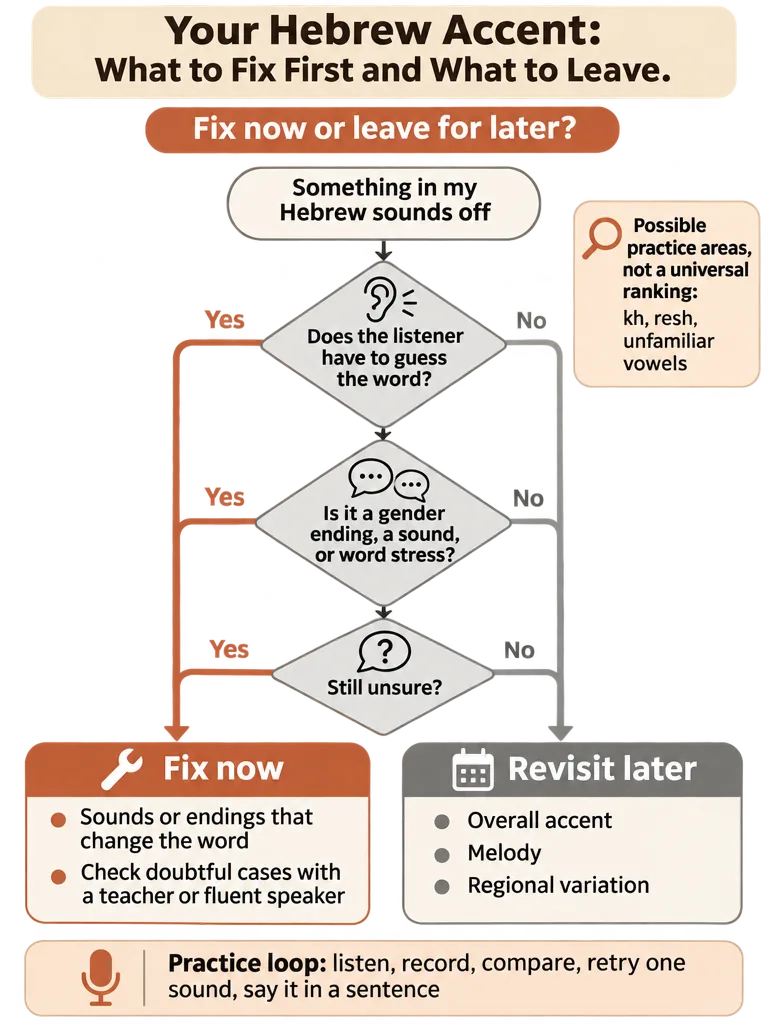
Fix now the Hebrew pronunciation features that change the word or make your listener guess. Defer anything that isn't getting in the way of being understood. No study here ranks Hebrew errors by impact, so this is a practical triage built on the accent-versus-understanding distinction, not a proven order.
Fix now
A sound swap that turns one word into another, or leaves the listener unsure which word you meant.
A gender ending that doesn't match the intended speaker's or addressee's grammatical gender.
Anything a Hebrew speaker has asked you to repeat more than once.
Doubtful cases: check them with a teacher or fluent speaker before drilling.
Revisit later
Individual sounds, stress, and sentence melody that aren't obstructing understanding. The test is the same for each: do listeners follow you?
Your overall accent.
Regional and community variation. The pronunciation guide notes that Hebrew varies across speakers and communities, so don't treat one version as the only correct one.
The Illinois advice fits here: speak at a comfortable pace, pause between ideas, and put emphasis on key words. Slowing down is a change you can make today without altering a single sound.
How do I practice Hebrew pronunciation without turning every chat into a drill?
Practice Hebrew pronunciation in short, separate bursts, then put the phrase straight back into a normal reply. The pronunciation guide lays out a five-step sequence: listen, record, compare, retry, use. Limiting each round to one sound keeps the drill from taking over the conversation.
Listen to the whole word or phrase before you read the transliteration.
Record it at a comfortable pace.
Compare your recording with the model.
Retry one sound, not three.
Use it in a short reply, then change the sentence (a different object, a different person) so you practice retrieving the phrase, not only repeating it.
Once you can say the phrase after hearing it, cover the English letters and listen instead. The guide advises listening to the model rather than assuming an English spelling tells the whole story.
One tool that follows this sequence is baba Learn, which the guide describes (checked 10/30/2026) as in private beta on iPhone and Android with an English interface. Its sound practice can flag sounds it heard differently from a target. The same guide says that feedback can be wrong and does not assess word stress, so check doubtful cases with a teacher or fluent speaker.
Is a correct transcript the same as good pronunciation?
A correct transcript does not prove good Hebrew pronunciation. A transcript shows which words a system interpreted, and the pronunciation guide says a correct-looking one doesn't settle every pronunciation question. Background noise, recording quality, and the model's interpretation can all affect an attempt. Different kinds of feedback answer different questions:
Feedback
Useful for
What it does not establish
Transcription
Checking what the system heard
That every sound was pronounced as intended
Target sound feedback
Finding parts of a recorded phrase to retry
A complete assessment of accent or word stress
Conversation correction
Considering grammar and natural phrasing
That the recording matched every target sound
Teacher feedback
Discussing a specific pronunciation question
That one answer applies to every regional accent
Say the transcript looks right but the sound still feels off. Replay the model and your recording back to back, pick one sound, and retry it. If you still can't tell, ask a teacher or fluent speaker.
Can you lose your accent completely, and should you try?
The sources here don't establish whether an adult learner can lose an accent completely. The Bristol briefing calls sounding like a native speaker an unrealistic goal for most adult learners. It also says a speaker who sounds different from a native speaker is not necessarily communicating ineffectively.
So the exercise from the start of this article is the next step. This week, say ma shlomkha or ma shlomekh, whichever fits the person, to a real listener or in a voice message. Change one thing about the sentence the next time you say it. If the listener asks you to repeat something, that sound or ending is your next recording. When you want another phrase to work with, the free Hebrew guides cover everyday phrases and grammar.
Frequently asked questions
Do I need to lose my Hebrew accent to be understood?
No. Being understood matters more than sounding native. The University of Bristol research briefing says the consensus goal of pronunciation teaching is helping speakers be understandable and get their message across, and calls native-like sound an unrealistic goal for most adult learners. Fix what makes listeners ask you to repeat yourself.
Can you lose your accent completely as an adult?
The sources here don't establish whether an adult learner can lose an accent completely. The University of Bristol briefing calls sounding like a native speaker an unrealistic goal for most adult learners. It also says a speaker who sounds different from a native speaker is not necessarily communicating ineffectively.
Which Hebrew sounds should I practice first?
Start with whichever sound makes listeners ask for clarification, because no study ranks Hebrew sounds for everyone. English-speaking learners often investigate three areas: the kh sound (ח, and sometimes כ), the Israeli resh (ר), and unfamiliar vowel patterns. Difficulty depends on the learner and the Hebrew they hear.
Should I copy Hebrew transliteration or listen to the audio?
Use transliteration to get started, then let the audio decide. English letters can't represent every Hebrew sound consistently, and the same sound may appear as kh in one resource and ch in another. Once you can say a phrase after hearing it, cover the English letters and listen instead.
Is a correct transcript the same as good Hebrew pronunciation?
No. A transcript shows which words a system interpreted, not whether every sound was pronounced as intended. Background noise, recording quality, and the model's interpretation can all affect the result. If a transcript looks right but a sound still feels off, replay the model and your recording back to back and ask a fluent speaker.
Is a wrong ending an accent problem or a grammar problem in Hebrew?
A wrong ending is usually a gender-form slip, not an accent issue. Hebrew often changes the spoken ending with grammatical gender: מה שלומך is ma shlomkha to a man and ma shlomekh to a woman. The listener's gender sets that ending, while in אני רוצה (ani rotse or ani rotsa) the speaker's gender does.