Hebrew sounding wrong? This Hebrew pronunciation guide helps you check three things: sounds like r and kh, gendered endings, and word stress.
Why does my Hebrew sound wrong to Israelis?
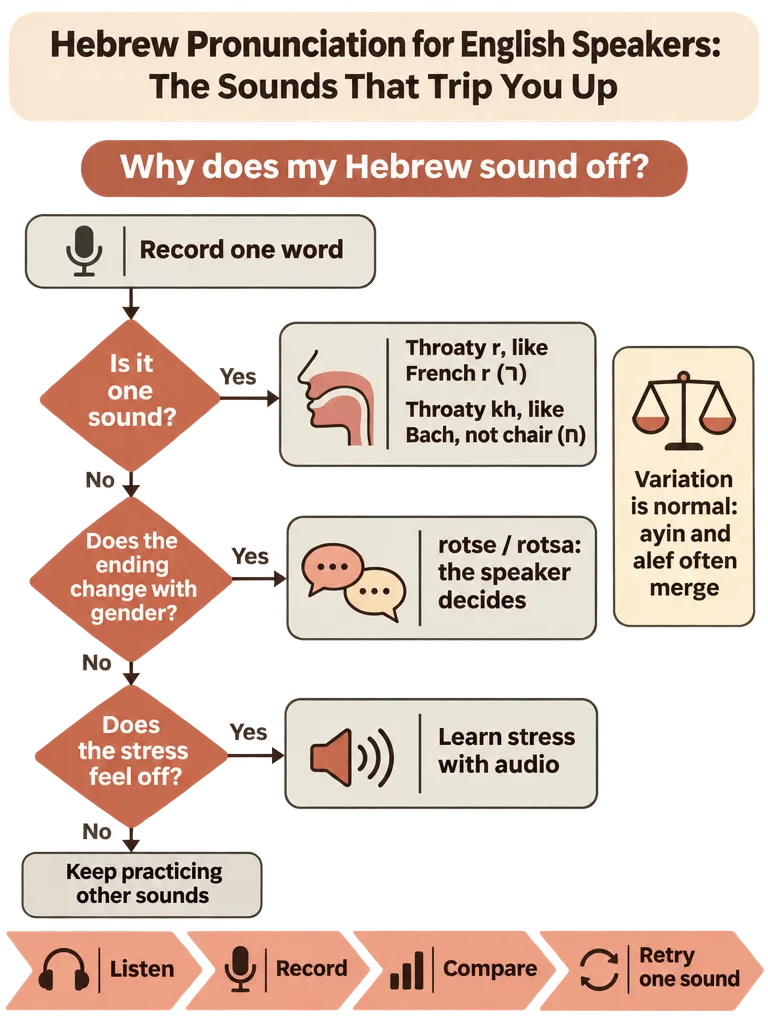
A Hebrew pronunciation guide can sort the problem into three checks: a sound (such as the Israeli r or the throaty kh), a spoken ending that doesn't match the speaker's or listener's gender, or stress on the wrong syllable. Haaretz's StreetWise Hebrew podcast says some learner mistakes sound more grating to Israelis than others.
Try this two-minute self-check:
Record yourself saying a sentence you actually use, such as ani rotse or ani rotsa ("I want").
Play it back and sort what you hear: a sound (r, kh), a spoken ending (masculine or feminine form), or stress (which syllable carries the emphasis).
Pick one of those and revisit only that one in the sections below.
The result is a single, specific thing to practice instead of a vague sense that your Hebrew is off.
Keep variation in mind while you listen. Israelis don't all speak the same way, and no source here shows that one error bothers every listener. The same episode's word list covers grammar and word choice as well as sounds, so a sentence can sound off for reasons beyond accent.
Put these words into a conversation
A Hebrew speaking app with Maya and David, AI tutors who hold conversations, explain corrections and help you practise what you need to say. Private beta on iPhone and Android. Public store launch is still ahead.
Practice with three words from the resh page. Say each one slowly, then at normal speed:
Hebrew
Transliteration
Meaning
רֹאשׁ
rosh
head
רַק
rak
only
רְחוֹב
rechov
street
Say each word five times and listen for a sound made at the back of the mouth rather than with the tip of the tongue. Rechov also contains the throaty sound covered next.
Should chet (ח) and chaf (כ) sound the same?
Yes, in the usual modern pronunciation. Chet is the throaty "ch" of Bach or loch, never the "ch" of chair. The IPA chart gives modern chet and chaf without a dot the same sound, a raspy χ like the Scottish "loch." A kaf with a dot inside (כּ) is a plain k.
Practice with three words from the chet page:
חַג (chag), holiday
חַם (cham), hot
חָבֵר (chaver), friend
To find the sound, think of the throat-clearing the WORD in HEBREW instructions describe: they call kh a guttural sound, like clearing out your throat. Say the word and feel for friction at the back of the mouth.
The linked pages use different transliteration conventions. The resh page writes rechov, the chet page writes chag, and the pronunciation page writes hummus as khu·mus. Each "ch" and "kh" there stands for the same sound.
One swap to listen for is an English "h" where "kh" belongs, as in humus instead of khu·mus. The pronunciation page uses that as its example.
Do I need a separate ayin and alef sound?
Ayin (ע) and alef (א) don't need separate sounds if you follow the merged pronunciation that most Hebrew speakers use. Roey J. Gafter of Ben-Gurion University of the Negev, in a 2018 talk at Brown University.pdf), says most speakers merge the pharyngeals with their non-pharyngeal counterparts. In his diagram, ayin joins alef as a glottal stop or no sound, and het joins the kh sound.
Gafter identifies two pharyngeal consonants, one in maʕagal (circle) and one in maħar (tomorrow). The IPA chart notes that some Sephardi, Mizrahi and Arab speakers still distinguish them. Gafter cautions that not all Mizrahi speakers use pharyngeals, so a single pronunciation can't be assigned to a whole community.
That means the two letters can come out as a brief catch in the throat (the middle of "uh-oh") or as nothing at all, but they are not "always silent." The merged pronunciation is the one Gafter describes for most speakers, and the pharyngeals are a documented variant.
If you want a single target while learning, imitating one model speaker is a practical strategy. It is optional, not a rule.
Do vowel length and word stress matter in Israeli Hebrew?
The IPA key for Hebrew maps older long i, o and u to modern i, o and u without length marks, and it shows stress separating two words: אֹכֶל (ˈʔoχel, food) and אוֹכֵל (ʔoˈχel, eating). The available sources don't give a full account of Modern Hebrew vowel duration or of how English vowels carry over, so the steps below stay within what they support.
Use a sound-by-sound reference, not English spelling. The IPA key gives English approximations for each vowel, and it lists alternatives for some, such as e or ei/ey for tsere-yod. Treat any English comparison as approximate.
Learn the stressed syllable with each word, from audio. The pronunciation page advises listening to the full word in context and asking for another example if the emphasis is unclear. Don't assume every word is stressed on the last syllable. The corpus doesn't establish a general stress rule.
Ask a teacher or fluent speaker about stress. The same page recommends this for stress and for regional pronunciations you want to understand.
Why does the same Hebrew spelling sound different for men and women?
Grammatical gender in Hebrew changes the spoken ending even when the unpointed spelling stays the same, because everyday Hebrew often leaves out vowel marks and context tells readers which form to say. The pronunciation page lists five unpointed phrases with different masculine and feminine readings:
Hebrew
Masculine
Feminine
מה שלומך
ma shlomkha
ma shlomekh
אני רוצה
ani rotse
ani rotsa
בשבילך
bishvilkha
bishvilekh
אמרת
amarta
amart
שלך
shelkha
shelakh
The speaker decides forms like rotse or rotsa, and the person addressed decides forms like shlomkha or shlomekh.
Treat this as a spoken-ending fix. Say both versions of each pair aloud, then say only the form that matches you (ani rotse or ani rotsa) or the person you're speaking to (ma shlomkha or ma shlomekh). The Haaretz podcast's word list includes the rotse and rotsa pair too.
Should I copy transliteration or listen to Hebrew?
Use transliteration to get started, then switch to listening. English letters can't represent every Hebrew pronunciation consistently, and the same sound may appear as kh in one resource and ch in another. A transliteration alone can't tell you which sound is meant.
Try a two-pass routine:
Read once. Look at the transliteration to get the shape of the word.
Listen and repeat. Play the audio, cover the transliteration, and say the word again.
How do I practice one sound and get feedback on it?
Practicing one Hebrew sound works as a five-step loop: listen to the whole word, record it, compare with the model, retry one sound, then use the word in a sentence. Automated feedback can help with the compare step, but a transcript only shows which words a system interpreted, and a flagged sound can be wrong.
Listen to the whole word before reading the transliteration.
Record it at a comfortable pace.
Compare your recording with the model.
Retry one sound only.
Use the word in a short sentence.
Take hummus, khu·mus. If feedback says you said "h" where "kh" belongs, listen to the model again, retry only that sound, then say a short sentence with the word in it.
A correct-looking transcript doesn't prove every sound was right. Conversation correction answers a different question from target-sound feedback, and neither replaces a person for stress or regional pronunciation.
Baba Learn is a speaking app for adults 18+, in private beta on iPhone and Android with an English interface. Its target-sound feedback can flag sounds it heard differently from a target, but it can make mistakes and doesn't assess word stress, so check doubtful feedback with a teacher or fluent speaker. Recordings are kept 30 days to check a score, then deleted. The Hebrew pronunciation app page explains how the feedback works.
Frequently asked questions
Which Hebrew sounds are hardest for English speakers?
There is no single ranking, because difficulty depends on the learner and the Hebrew they hear. English speakers often work on chet and chaf (ח, כ), resh (ר) and unfamiliar vowel patterns. Chet is the throaty "ch" of Bach or loch, never the "ch" of chair, and the Israeli r is made in the throat, like French. Pick the one sound you miss in a recording and drill only that.
Why is the same Hebrew sound spelled "kh" in one place and "ch" in another?
English letters can't represent every Hebrew sound consistently, so each resource picks its own convention. The throaty sound appears as "ch" in chag (holiday) and as "kh" in khu·mus (hummus), yet both stand for the same sound. Treat transliteration as a first look at a word, then listen to a model to confirm the sound.
Do all Israelis pronounce Hebrew the same way?
No. Researcher Roey Gafter of Ben-Gurion University said in a 2018 talk that most speakers merge the pharyngeal sounds of ayin and het with their non-pharyngeal counterparts. He also cautioned against assigning one pronunciation to a whole community. Wikipedia's Hebrew IPA key likewise notes that some letters are transcribed differently depending on the speaker's background, so pick one model speaker to imitate.
How do I learn which syllable to stress in a Hebrew word?
Learn the stressed syllable together with each word, by listening to the full word in context and asking for another example if the emphasis is unclear. Stress can separate words: אֹכֶל (ˈʔoχel) means food, while אוֹכֵל (ʔoˈχel) means eating. The sources here give no general stress rule, so ask a teacher or fluent speaker when unsure.
Is speech recognition the same as pronunciation feedback?
No. A transcript only shows which words a system interpreted, while pronunciation feedback compares aspects of the sound. Neither one alone establishes that every feature of a phrase was correct, so a clean-looking transcript doesn't prove each sound was right. Background noise and recording quality can also affect how an attempt is read.
Can I try Baba Learn's Hebrew pronunciation practice yet?
Baba Learn is in private beta on iPhone and Android with an English interface, and its public store launch is still ahead. You can join the waitlist on the app page. Its sound practice can flag sounds it heard differently from a target, but feedback can be wrong and word stress isn't assessed. It's for adults 18+, and recordings are kept 30 days to check a score, then deleted.