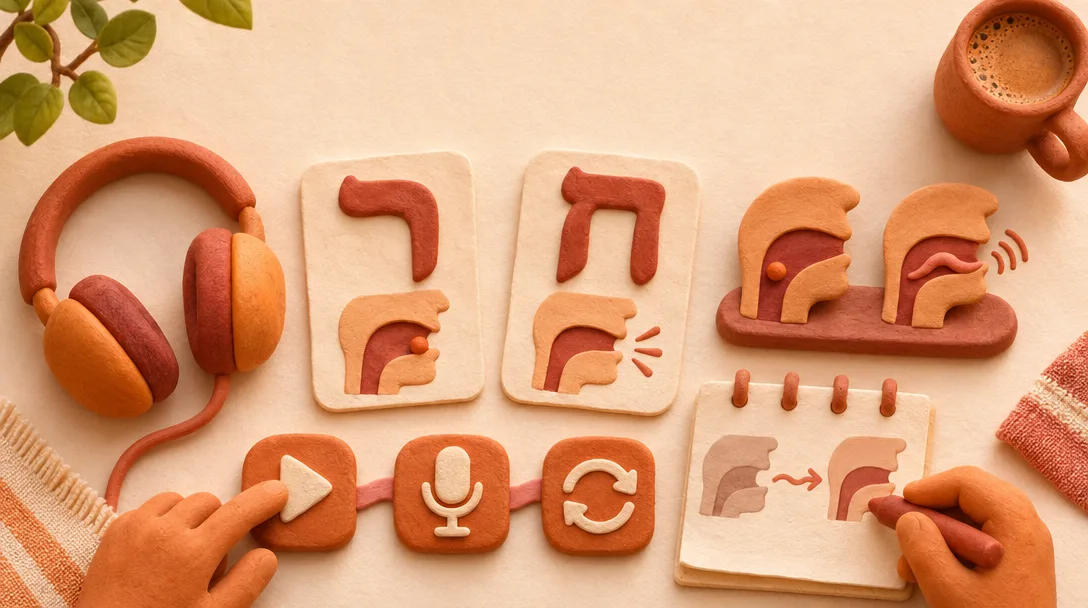
Hebrew R pronunciation starts at the back of the mouth, like the French R. Practice the R and the ch of Bach with syllables and words.
How do you pronounce the Hebrew R?
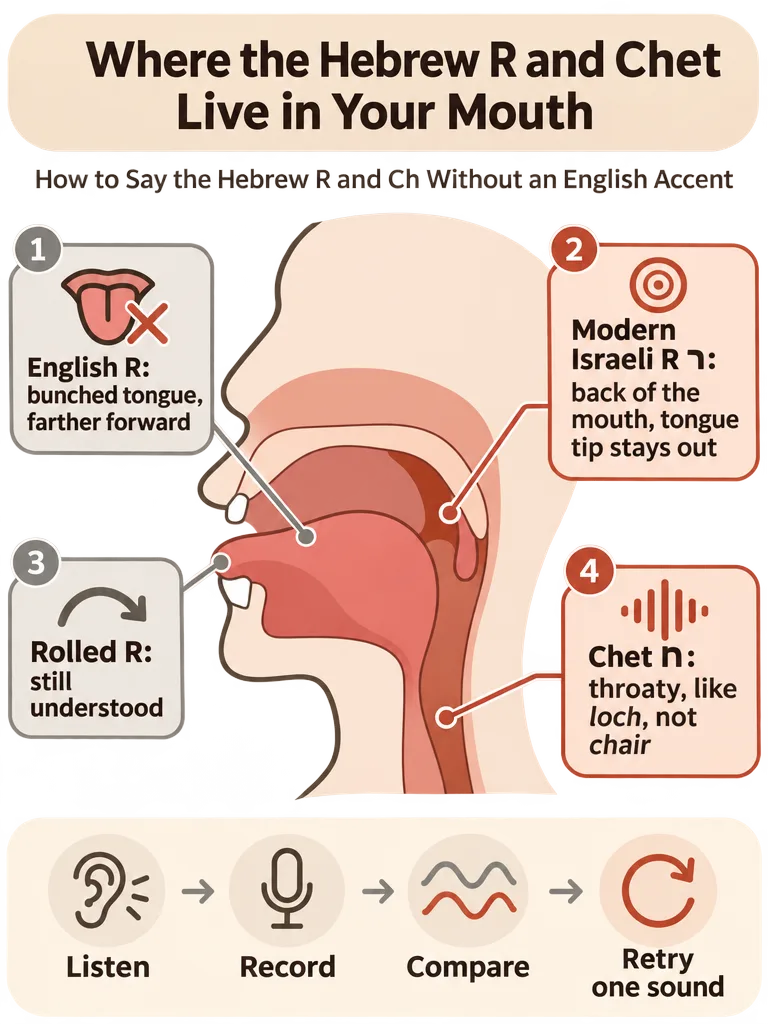
Hebrew R pronunciation in modern Israeli speech is a throaty sound at the back of the mouth, closer to the French R than the English one, and a rolled R is understood too. Chet (ח) is the throaty ch of Bach or loch, never the ch of chair. Nearly all Israeli Jews use the uvular R, Modern Hebrew phonology reports.
Try this first: say ra the English way, then say it again with the sound made in your throat, as in French. Record both and listen back. The goal is to hear a clear difference between your English R and the back-of-mouth R. Then say the kh of Bach or loch and follow it with chag.
Resh (ר) is the letter that writes this R. Wikipedia's Resh entry lists the voiced uvular fricative as the most common modern Hebrew pronunciation. It also notes that native English speakers sometimes replace it with the English-style approximant. This article practices those specific substitutions, so don't expect it to promise that an English accent disappears.
Where in your mouth does the Israeli R go?
The Israeli R is made at the back of the mouth, near the soft palate and uvula, with no tongue-tip movement. Elon.io describes the English R as a bunched or curled tongue sitting farther forward. For most learners, the placement cue is to move the sound back and keep the tongue tip out of it.
Try this sequence:
Say the kh of Bach or loch. Notice that it happens deep in the mouth, not at the lips or the front of the tongue.
Leave the tongue tip alone. It doesn't curl up or tap. Elon.io treats tongue-tip movement as the sign you're making the wrong sound.
Add voice in the same general area. Hold the kh position and switch your voice on, so the buzz comes from the back. Modern Hebrew phonology's consonant table lists the kh sound and the Israeli R in the same velar/uvular column, with the R as the voiced one. Elon.io offers this kh-to-R route as a teaching cue. It isn't a claim that the two sounds are the same.
Shrink it into a syllable. Go from a long buzz to a quick ra, then ri.
Compare it to a native recording. Replay a model, then try again.
The baba Resh page sums up the target as an R in the throat, like French.
Is a rolled R still acceptable Hebrew?
A rolled R is acceptable Hebrew, and Israelis understand it. The uvular R is the modern Israeli target, so it's what to aim for if you want to sound like most Israelis today. If you already roll your R, you're not blocked from being understood.
Real Hebrew has a range of Resh sounds:
Oriental accents: Modern Hebrew phonology says elder Oriental speakers tend to use an alveolar trill.
Ashkenazi speakers: Wikipedia's Resh entry says they sometimes use a uvular trill or an alveolar trill.
Sephardic and Mizrahi speakers: The same entry lists an alveolar trill, an alveolar flap or a uvular trill.
Media and music: Modern Hebrew phonology notes that poetry, folk music and standardized media Hebrew sometimes use an alveolar R.
So don't label every trill wrong. The English R is the sound to retrain, since it differs from all of these.
How do you say Hebrew Chet without the CH in chair?
Chet (ח) is the throaty ch of Bach or loch, never the ch of chair. The baba Chet page says so in its first line. English spelling is the trap, because a ch on the page invites a sound at the front of your mouth.
The second common slip is a plain H. Baba's pronunciation page shows it with khumus (חוּמוּס). Its example feedback, from Maya, an AI tutor, reads "You said h where Maya says kh." In your own mouth, H is a breath, and kh is friction at the back of the throat.
Three words from the Chet page make good practice:
Hebrew
Transliteration
Meaning
חַג
chag
holiday
חַם
cham
hot
חָבֵר
chaver
friend
Chet isn't the only letter with this sound. Teach Me Hebrew says the kh sound is represented by כ, ח or ך. Modern Hebrew phonology adds that in modern Hebrew, ח has merged with the kh of כ into a single sound. That merger is the common modern Israeli target, and some older Mizrahi speakers still keep the two apart. For most learners, one kh drill covers all of these letters.
Which mistakes do English speakers make with R and Ch?
English speakers commonly make three substitutions: the English R for the Hebrew R, a plain H for Chet, and the ch of chair for Chet. Each has a specific fix. A fourth row below is a practice challenge rather than a substitution.
Substitution or challenge
What it sounds like
Quick fix
English R for Hebrew R
An English-style approximant, which Wikipedia's Resh entry says native English speakers sometimes use
Move the sound back, leave the tongue tip alone, and start from kh
Plain H for Chet
A breathy h, as in humus instead of khumus
Add friction at the back of the throat, like Bach
Chair-style CH for Chet
A tch at the front of the mouth
Drop the t, keep the airflow continuous, and say it in the throat
Practice challenge: connected speech
A word that feels easy alone can feel harder inside a sentence, per baba's pronunciation page
Say the word in a short reply, then change the sentence and try again
Which sound is harder depends on the learner and the pronunciation model they're hearing. Teach Me Hebrew and Elon.io rank R and kh differently, and baba's pronunciation page offers no single ranking. Work on the one that trips you.
Which Hebrew words should I practice first?
Practice Hebrew R and Ch in a ladder: syllables such as ra, re, ri and kha, khe, khi, then rosh, rak and rechov for R, then chag, cham and chaver for Chet, then a short phrase. The words come from baba's Resh and Chet pages. The syllable drills come from Teach Me Hebrew's recordings by a native Israeli. Listen to each item before you say it.
R before vowels:ra, re, ri, ro, ru.
R after vowels:ar, er, ir, or, ur.
Kh before and after vowels:kha, khe, khi, kho, khu, then akh, ekh, ikh, okh, ukh.
Alternating contrast drills: Switch between the two sounds, like ra-kha, ri-khi, ro-kho. These aren't minimal pairs, since they don't pair real words that differ by one sound.
R words from the Resh page:rosh (head), rak (only), rechov (street). Note that rechov (רְחוֹב) has both sounds.
Chet words from the Chet page:chag (holiday), cham (hot), chaver (friend).
A short phrase:ani rotse (אני רוצה) when a man is speaking, and ani rotsa when a woman is speaking. Baba's pronunciation page lists these as the masculine and feminine readings of the same unpointed phrase. The speaker's gender decides the form.
Should I copy the CH or KH spelling, or listen to the Hebrew?
Listen to the Hebrew first, then look at the spelling. The same sound appears as kh in some resources and ch in others, and English letters are an incomplete guide, as baba's pronunciation page says. Transliteration conventions vary, so a spelling alone can't tell you which sound to make.
The pages used in this article show the problem. The Chet page spells the words chag and cham. The pronunciation page spells khumus with KH. Both spellings point to the same throaty sound.
A workable habit is to play the model, say the word, and only then glance at the transliteration. When you see ch, check the spelling against the recorded Hebrew before you decide which sound it stands for.
What if I can say it alone but lose it in conversation?
Carry a sound into conversation by looping five steps: listen to a model, record yourself, compare the two, retry one sound, then use the word in a new sentence. Baba's pronunciation page lists this same sequence, and it works with any recorder.
Listen to the whole word or phrase before reading the transliteration.
Record it at a comfortable pace.
Compare your recording with the model.
Retry one sound only, either R or kh.
Use the word in a new sentence, such as ani rotse plus something you actually want.
baba Learn, currently in private beta, includes recording and target-sound feedback, with Maya and David, its AI tutors, as conversation partners. That feedback can flag sounds it heard differently, but it can be wrong.
The same caveats apply to any tool. Word stress isn't scored in baba Learn's sound feedback, and a correct transcript doesn't prove every sound was right. Target drills and open conversation also use different criteria. If feedback seems doubtful, ask a teacher or a fluent speaker.
Frequently asked questions
Is the Hebrew R the same as the English R?
No. Most Israelis use a voiced uvular fricative made at the back of the mouth, not the English-style approximant that Wikipedia's Resh entry says native English speakers sometimes substitute. Baba's Resh page describes the Israeli R as sitting in the throat, like French, and adds that a rolled R is understood too.
Which Hebrew letters make the kh sound?
The kh sound is written with כ, ח or ך, according to Teach Me Hebrew. In modern Hebrew, ח has merged with the kh of כ into a single sound, so one kh drill covers all three. Some older Mizrahi speakers still keep ח and כ distinct.
Which is harder for learners, the Hebrew R or the kh sound?
There is no single ranking. Teach Me Hebrew calls R and kh the two hardest sounds for learners and says kh is less problematic than R. Baba's pronunciation page says difficulty depends on the learner and the Hebrew they hear. Practice whichever sound you miss when you record yourself.
What does Resh mean in Hebrew?
Resh (ר) is the 20th of the 22 Hebrew letters and is worth 200 in gematria. Its name is usually assumed to mean "head," like the Biblical Hebrew word rosh (רֹאשׁ). That makes rosh a handy first practice word, since it starts with the Israeli R.
Can an app tell me if my Hebrew R is right?
Only partly. Baba Learn's private beta includes recording and target-sound feedback that can flag sounds it heard differently from a target. That feedback can be wrong and does not assess word stress. A correct transcript doesn't prove every sound was right, so check doubtful feedback with a teacher or fluent speaker.