Common Hebrew mistakes English speakers make include translating “I have” word for word and mixing gender forms. Practice five patterns with examples.
What mistakes do English speakers make in Hebrew?
Common Hebrew mistakes English speakers make fall into five groups: small words English adds or drops, possession, speaker and listener gender, article and agreement habits, and sounds or verb-preposition pairs, as documented by Elon.io, TalkIvrit and HebrewPod101. This is a repair guide, not a frequency ranking.
Try a say-correct-repeat exercise first. Take one slip, such as ani yesh sefer, and say the corrected yesh li sefer out loud. Repeat it with two other nouns from TalkIvrit's examples, yesh li zman (I have time) and yesh li she'ela (I have a question). Then add a detail, as in Elon.io's yesh li sefer bediyuk al ze (I've got a book on exactly that). The aim is to say the whole corrected chunk without stopping to rebuild it.
Some caveats apply. This guide does not use Baba lesson data, and the publisher's hold on lesson-based counts is unresolved. The sources above don't establish which mistake is most common. TalkIvrit says no single list describes every learner, because your first language, your study history and the situations you speak in all matter. Elon.io's list of nine errors is ordered by when a beginner meets them, not by how often they occur.
Elon.io also draws a line that shapes the rest of this guide. Some wrong versions are not Hebrew at all, so someone stops you quickly. Others are perfectly good sentences with a different meaning, and those can survive for years.
How do you say "I'm tired" and "I have a book" without translating word for word?
Hebrew has no present-tense "am," and it expresses "I have" with yesh li, not a conjugated verb. English adjective statements like "I am tired" need a word in the "is" slot, so learners fill the gap or conjugate the wrong word. Elon.io corrects both habits: ani ayef is already a complete sentence, and yesh never changes form.
English habit
What learners say
What Hebrew says
Why
"I am tired" needs an "is" word
אני הוא עייף ani hu ayef
אני עייף ani ayef (m.) / אני עייפה ani ayefa (f.)
hu links two nouns for identity, so an adjective gives it nothing to identify
"I have a book" puts the owner first, as a subject
אני יש ספר ani yesh sefer
יש לי ספר yesh li sefer
The thing exists "to me," so the owner sits in a le- phrase and yesh stays fixed
TalkIvrit's practice advice for possession is to drill the whole phrase with several nouns: yesh li zman (I have time), yesh li she'ela (I have a question), yesh li pgisha (I have a meeting).
When do you need את, and how do "the" and adjectives work?
Et is a marker Hebrew places before a definite direct object, such as a particular film, the book you mentioned or a person's name. English has no equivalent, so there is nothing in the source sentence to translate. An indefinite direct object takes no marker. Elon.io and TalkIvrit give the same contrast.
ראיתי את הספר ra'iti et hasefer: I saw the book.
ראיתי ספר ra'iti sefer: I saw a book.
ראיתי את הסרט ra'iti et haseret: I saw the film (TalkIvrit).
Listen for the difference between a specific thing and any thing of that kind. The marker belongs to the object of the verb, so check that the word after et is what the subject saw, met or took.
Adjectives add a second habit to break. An adjective agrees with its noun in gender and number, and TalkIvrit suggests learning each new noun with one adjective, such as מילה חדשה milah khadashah (a new word). In a definite phrase, the article repeats on the adjective.
Elon.io's example is best treated as a question about meaning, not right versus wrong:
הבית גדול habayit gadol: the house is big (a full sentence).
הבית הגדול habayit hagadol: the big house (a noun phrase).
Ask yourself which one you meant to say. English puts one "the" at the front of "the big house" and stops, which is how a phrase accidentally becomes a sentence.
Whose gender changes the form: yours or the person you're talking to?
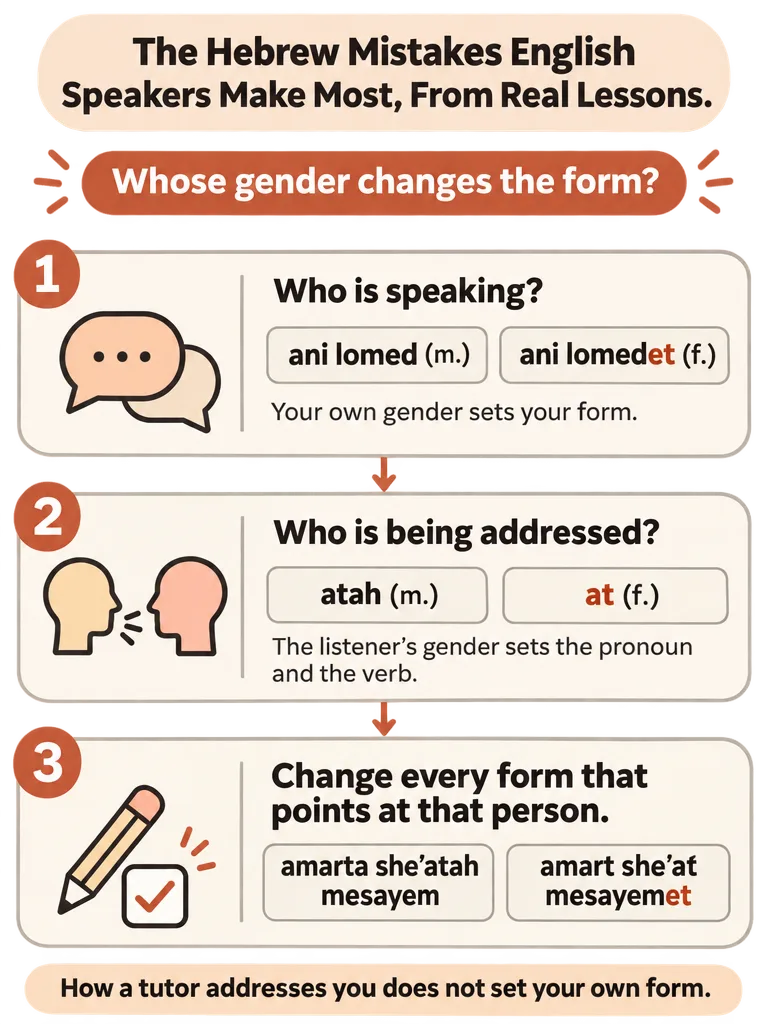
Your own gender sets the forms that refer to you, and the listener's gender sets the forms that refer to them. The sources show this in separate examples: TalkIvrit covers the speaker side and Elon.io covers the listener side. Run both checks before you speak.
Ask who is speaking. Choose your own form and keep it consistent: אני לומד ani lomed (masculine speaker) or אני לומדת ani lomedet (feminine speaker). TalkIvrit notes that the way a tutor or another person addresses you does not change the form you use for yourself.
Ask who is being addressed. Use atah for a man and at for a woman. In Elon.io's pair, the verb that describes the listener moves with the pronoun: אמרת שאתה מסיים amarta she'atah mesayem (to a man) and אמרת שאת מסיימת amart she'at mesayemet (to a woman, "you said you finish").
Change every form that points at that person. Check the pronoun, the verb and any adjective or ending that describes them. A mix, such as a feminine at with a masculine verb, is the classic slip.
Now say one sentence four ways, "I'm learning, and you?":
Speaker
Listener
Hebrew
Transliteration
Man
Man
אני לומד, ואתה לומד?
ani lomed, ve'atah lomed?
Man
Woman
אני לומד, ואת לומדת?
ani lomed, ve'at lomedet?
Woman
Man
אני לומדת, ואתה לומד?
ani lomedet, ve'atah lomed?
Woman
Woman
אני לומדת, ואת לומדת?
ani lomedet, ve'at lomedet?
Elon.io makes the sharpest point here: saying atah to a woman is flawless Hebrew when said to a man, which is why nothing alerts you. For help reading these forms by sound, see this Hebrew transliteration guide for English speakers.
Which preposition goes with the Hebrew verb?
Hebrew prepositions do not always match English ones, so learn each Hebrew verb together with its preposition as a pair, then practice it in a complete phrase, as TalkIvrit advises. Its examples are mekhake le- (wait for) and khoshev al (think about).
מחכה ל־ mekhake le- (wait for): אני מחכה לאוטובוס, ani mekhake la'otobus, "I'm waiting for the bus" (m.). A woman says ani mekhaka la'otobus.
חושב על khoshev al (think about): אני חושב על השיחה, ani khoshev al hasikha, "I'm thinking about the conversation" (m.). A woman says ani khoshevet al hasikha.
TalkIvrit's advice is to keep a short list of the verb-plus-preposition pairs you actually use, with one example sentence for each.
Is a mispronounced ח a mistake or just an accent?
HebrewPod101 reports that many learners replace the throaty khet/khaf sound with a soft English "h," and that this substitution can sometimes produce a different word. Its example is לך lakh ("to you," feminine) versus לה lah ("to her"). Swaps that can change the word are a sensible practice priority, though they don't define pronunciation accuracy as a whole.
HebrewPod101 adds that the vast majority of native speakers pronounce khet and khaf identically, so you only need to learn one sound. It compares that sound to the "ch" in Loch Ness and says most modern speakers produce the resh from the back of the throat, unlike the English "r."
A quick record-and-compare exercise:
Record HebrewPod101's practice sentence: אני הולך להרים מחר ani holekh laharim makhar, "I am going to the mountains tomorrow" (m. speaker). A woman says ani holekhet laharim makhar.
Listen for the two kinds of sound. The ח/כ in holekh and makhar should be the throaty kh, and the ה in laharim should stay a light h. The aim is to keep the two apart, not to turn every kh into an h.
If you can't tell whether a word came out as the one you meant, ask a teacher to listen to the recording rather than guessing.
How can you tell if it's an error, a different meaning, or just spoken Hebrew?
A Hebrew correction falls into one of three categories: an ungrammatical sentence, a valid sentence that means something else, or a spoken form that differs from the standard written one. Which category it is decides whether you fix it, rephrase it, or simply learn to recognize it. Ask three questions of any correction:
Is it ungrammatical?Ani yesh sefer and the spaced le ani are not Hebrew in any register, according to Elon.io. Fix them.
Is it a valid sentence with a different meaning?Habayit gadol is fine as "the house is big." Change it only if you meant "the big house."
Is it a spoken form versus the standard form? Elon.io's construct-chain note says standard Hebrew puts one article on the last word (beit hasefer hekhadash). It reports that the Academy of the Hebrew Language lists fronted-article forms such as hayom huledet among forms to avoid, yet calls them everyday Israeli speech. Elon.io's advice: write the standard form, recognize the other, and don't correct anyone's speech with it.
The Israeli Hebrew Institute publishes similar word-level examples, such as ani lo yode'a ("I don't know," m.; ani lo yoda'at for a woman) with lo before the verb. Treat these as one teacher's view, not universal rules.
For a human teacher's call on edge cases, the baba Ulpan Index is a starting point. Its October 2026 edition lists the human-taught programs that three AI engines named across 300 answers, 115 in all. It shows which programs assistants name, not how well any of them teach.
How do you fix one mistake and keep the conversation going?
Hebrew mistake correction works best one pattern at a time: say the corrected sentence, repeat it naturally, add one new detail and keep talking. That is the loop TalkIvrit recommends, and it avoids turning the conversation into a test.
Pick one pattern from your own speech, such as yesh li, et, or your own gender form. Choose the one that matters most for what you want to say next.
Say the corrected sentence three ways. Vary the noun: yesh li zman, yesh li she'ela, yesh li pgisha.
Repeat it naturally, at conversation speed rather than drill speed, as if you were telling a friend.
Add one new detail, like when, where or who: yesh li pgisha, then what the meeting is about.
Use a repair phrase when you slip: התכוונתי ל־... hitkavanti le-... ("I meant..."), or just try the sentence again. A correction helps most when it gives you a clearer way to say what you meant and lets you continue.
For a place to run this loop out loud, baba Learn, a speaking app in private beta for iPhone and Android, offers conversations with its AI tutors Maya and David plus explanations, corrections and saved practice; feedback can be wrong, so check disputed corrections with a teacher.
Frequently asked questions
Is Hebrew hard for English speakers?
Hebrew has specific hurdles for English speakers rather than one overall wall. HebrewPod101 says English speakers often struggle with the throaty sounds. The grammar habits that trip people up are gender agreement, the object marker את (et), and saying "I have" with יש לי (yesh li). Picking one pattern from your own speech and practicing it in a few sentences works better than trying to fix everything at once.
When do you use את in Hebrew?
Use את (et) before a definite direct object, such as a particular film, the book you mentioned, or a person's name. ראיתי את הסרט (ra'iti et haseret) means "I saw the film," while ראיתי סרט (ra'iti seret) means "I saw a film." English has no matching word, so the marker is never translated. Listen for whether you mean a specific thing or any thing of that kind.
How do you say "I have" in Hebrew?
Say יש לי (yesh li), literally "there is to me," followed by the thing you have. English speakers often produce אני יש ספר (ani yesh sefer), but יש never takes a subject or changes form. Practice the whole phrase with several nouns: yesh li zman (I have time), yesh li she'ela (I have a question), and yesh li pgisha (I have a meeting).
Does the gender of the person I'm talking to change the Hebrew I use for myself?
No. Your own gender sets the forms that refer to you, and the listener's gender sets the forms that refer to them. A man says ani lomed and a woman says ani lomedet, whoever is listening. To ask "and you?" you change the listener's form: ve'atah lomed to a man, ve'at lomedet to a woman. A tutor's way of addressing you does not change how you refer to yourself.
How do you pronounce ח in Hebrew?
Make it from the back of the throat, like the "ch" in Loch Ness, close to the movement of clearing your throat. HebrewPod101 says most native speakers pronounce ח and כ/ך identically, so you only need to learn one sound. Replacing it with a soft English "h" can change the word: לך (lakh, "to you," feminine) turns into לה (lah, "to her").
What can you say when you make a mistake while speaking Hebrew?
Say התכוונתי ל־... (hitkavanti le-...), meaning "I meant...," or simply try the sentence again. TalkIvrit notes that a small grammar slip usually does not stop a conversation. A correction helps most when it gives you a clearer way to say what you meant and lets you keep talking.