A Hebrew speaking score is one signal of progress, not a verdict. Repeat the same task aloud and count pauses to see what has changed.
How do I know if my Hebrew is actually improving?
Your Hebrew is improving when you can do things now that were hard a month ago, like answering a short question without a script. A Hebrew speaking score from a lesson recap (grammar, vocabulary, fluency, pronunciation) is one extra signal. The scales and calculation rules behind those four fields are not documented.
Try this once this week: pick one task, such as ordering a coffee or replying to a voice note. Do it aloud today and again in a few days. Count the pauses and the moments you reached for English. If both dropped, you have evidence of progress that you can see for yourself.
IVRA's guide to Hebrew difficulty describes progress in similar terms. It lists being able to understand a short question and reply without a script, and being able to change a sentence when the speaker or the time changes. Shotef's progress guide uses daily-life examples: replying faster in a shop or on WhatsApp, using a word correctly in conversation, and needing less help from English.
What do the grammar, vocabulary, fluency and pronunciation scores tell you?
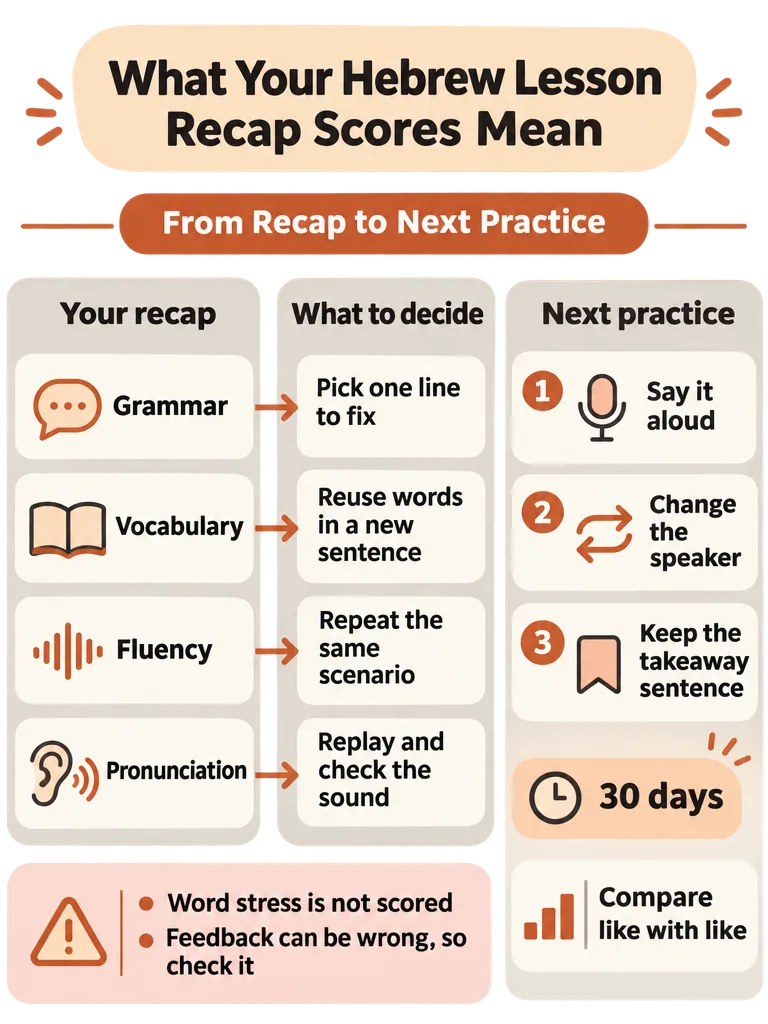
The four lesson-recap scores (grammar, vocabulary, fluency, pronunciation) come without published definitions: no scale, weight, threshold or calculation method for any of them appears in the sources behind this article. baba Learn's recap shows those four scores alongside lines to fix, a takeaway sentence and points.
The table lists what is documented for each field. The last column is an editorial suggestion, not an app feature.
Recap field
What is documented
What you can't conclude
Suggested practice (editorial)
Grammar
Listed as a recap field; no definition or method
What the number reflects, or whether a repeated mistake is fixed
Open the correction explanation for the line, then say the corrected sentence aloud
Vocabulary
Listed as a recap field; no definition or method
How many words you know, or which words were counted
Pick two or three words from the lesson and use them in a real situation
Fluency
Listed as a recap field; no definition or method
Any proficiency level, or how you'd handle fast group chat
Repeat the same scenario and count your pauses
Pronunciation
The score is listed with no definition. Sound-level feedback is a separate documented feature, and it does not assess word stress
Whether the number says anything about stress, or how accurate your sounds are
Practice the sound the feedback names, and ask a teacher or Hebrew speaker to check your stress
Fluency in research is a different measure. Gitit Kavé's norms for adult Hebrew speakers count how many words people produce from three letters (bet, gimel, shin) and three categories (animals, fruits and vegetables, vehicles). They cover 369 participants aged 18 to 85. Of these, 269 completed both tests and the rest completed only the category test. That is a different task from holding a conversation, and no source says a recap's fluency score uses it.
Which line should I fix first, and what is the takeaway sentence for?
Start with the line you are most likely to need in a real conversation this week. Say it aloud three times, change who you imagine speaking or listening, then keep the recap's takeaway sentence as a warm-up for your next session. This describes an exercise; how the app selects or saves lines is not documented.
Pick one line to fix. Choose the one tied to a conversation you expect to have. A coffee order is a good candidate: אפשר קפה, בבקשה? (efshar kafe, bevakasha?), "A coffee, please?"
Say it aloud three times. Go slowly the first time, then at normal speed.
Change the listener. Say it as if to a barista, then to a friend, then ask for another try: לא הבנתי (lo hevanti), "I did not understand." The learning hub advises noticing how a sentence changes for the speaker or listener. It lists one form for each of these phrases. If your own line has separate masculine and feminine forms, check them in the correction explanation or with a teacher.
Save the takeaway sentence. As a suggested exercise, write it where you'll see it and say it first at the start of your next session.
Lesson-recap points are separate from the four speaking scores (grammar, vocabulary, fluency, pronunciation), and how points are earned is not documented. Nothing says whether they reward performance, participation or both, so a points total is not proof that your speaking improved.
Whether scores from different lesson types or difficulty levels can be compared is also undocumented. A greeting and a harder role-play may not be scored on the same footing.
Compare what you can observe instead. Repeat the same scenario and the same task, then look at what changed: fewer pauses, fewer repeated corrections, a line you no longer need to fix. Whether a score is numerically comparable between two runs is undocumented too, so treat any number as a note beside those observations.
What does a good week of Hebrew practice look like?
A good week of Hebrew practice leaves you with evidence that you used Hebrew in real situations. No source establishes a validated weekly recap-score target or a meaningful score-change threshold, so judge your week against your own life. Shotef's guide suggests a short weekly note on your phone:
3 new words you used in real life
1 thing you understood without translation
1 situation that felt easier than before
1 thing that still felt hard
Then add two things of your own:
Repeat one speaking task. Run the same scenario twice in the week and note what got easier.
Check the recap scores as one data point. Look at them after your log.
Shotef's real-task benchmarks include ordering coffee, asking for directions, replying to a WhatsApp message and understanding a short voice note. If one of those is still hard, that is your next practice target.
Is a recap score the same as a CEFR level or a YAEL score?
No. A lesson recap score is not a Common European Framework of Reference for Languages (CEFR) level, an ulpan placement or a YAEL score, the Hebrew proficiency test from the National Institute for Testing and Evaluation (NITE). No source documents any validation of recap scores against these assessments or any mapping to their levels, and a recap is not an official proficiency test.
The NITE document and the Lenguia page show no date in the text reviewed, so check each page directly for current details before relying on it.
Placement is a separate matter. Bar-Ilan University's international school determines Hebrew levels with either the YAEL exam or its own internal exam. A recap number stands in for neither.
What if the feedback doesn't match what I said?
When lesson-recap feedback doesn't match what you said, check your intended meaning against the correction before changing how you speak. Feedback can be wrong, so decide what you meant to say first. Then see whether the correction explanation addresses that sentence or a different one.
Restate your intended sentence. Say or write what you were trying to say before you read the correction.
Compare with the correction explanation. See whether it responds to your intended sentence.
Ask for help if you're still unsure. A teacher or a proficient Hebrew speaker can look at the sentence with you.
Retry. Say the line again and see whether the feedback changes.
Recordings are kept for 30 days to check a score, then deleted. The app is for adults 18 and older. No in-app process for disputing a score is documented in the sources behind this article, so use the steps above.
How do I turn a recap into next week's practice?
To turn a Hebrew lesson recap into next week's practice, choose one concrete goal, pick one line to fix, run the same scenario again and write down one thing you can do now. The site's learning hub recommends a concrete next goal, such as reading a menu or holding a short conversation, and using it to decide what to study next.
Write the goal on a card. For example, a short coffee-shop exchange.
Copy one line from the recap onto the same card. Use the line you chose with the three-times-aloud drill.
Run the scenario again. Afterward, add a log entry: which scenario, and whether you needed the line.
Name one thing you can do now. Compare it with last week's entry.
There is no single number, because it depends on your starting point, which skills you practice, and the support you use. IVRA's guide notes that the letters take days, while reading without vowel marks takes months. Pick a concrete next goal, such as reading a menu or holding a short conversation, and judge your progress against that goal instead of a deadline.
How can I test my Hebrew language level?
For an official result, take the YAEL, the Hebrew proficiency test from NITE. It reports multiple-choice, composition and total scores on a 50 to 150 scale, with no pass or fail score. For a quick free estimate, Lenguia's speaking test has 15 items from A1 to C1, is AI-assessed, and needs no signup. Bar-Ilan University places students with either YAEL or its own exam.
How often should I check my Hebrew progress?
Check every 2 to 4 weeks, and keep a short weekly note in between. Shotef's progress guide suggests picking 4 or 5 categories, such as reading, listening, speaking, vocabulary and confidence. The weekly note lists 3 new words you used in real life, 1 thing you understood without translation, 1 situation that felt easier, and 1 thing that still felt hard.
Does the pronunciation score check word stress in Hebrew?
No. baba Learn's sound-level pronunciation feedback does not score word stress, so a high pronunciation number says nothing documented about whether your stress is right. Feedback can also be wrong. Ask a teacher or a Hebrew speaker to listen to your stress, and use the app's feedback to practice the individual sounds it names.
Does baba Learn keep my speaking recordings?
baba Learn keeps recordings for 30 days to check a score, then deletes them. The app is for adults 18 and older. If a correction seems off, say or write what you meant to say first, then compare it with the correction explanation and ask a teacher or proficient Hebrew speaker if you are still unsure.
Can I try baba Learn before paying?
Yes. baba Learn's free starting Classic lessons require no card, and the app shows how many you get. The app is in private beta and the interface is English only. If you want access, join the waitlist on the baba Learn page. It is not a complete course or a guaranteed route to fluency.