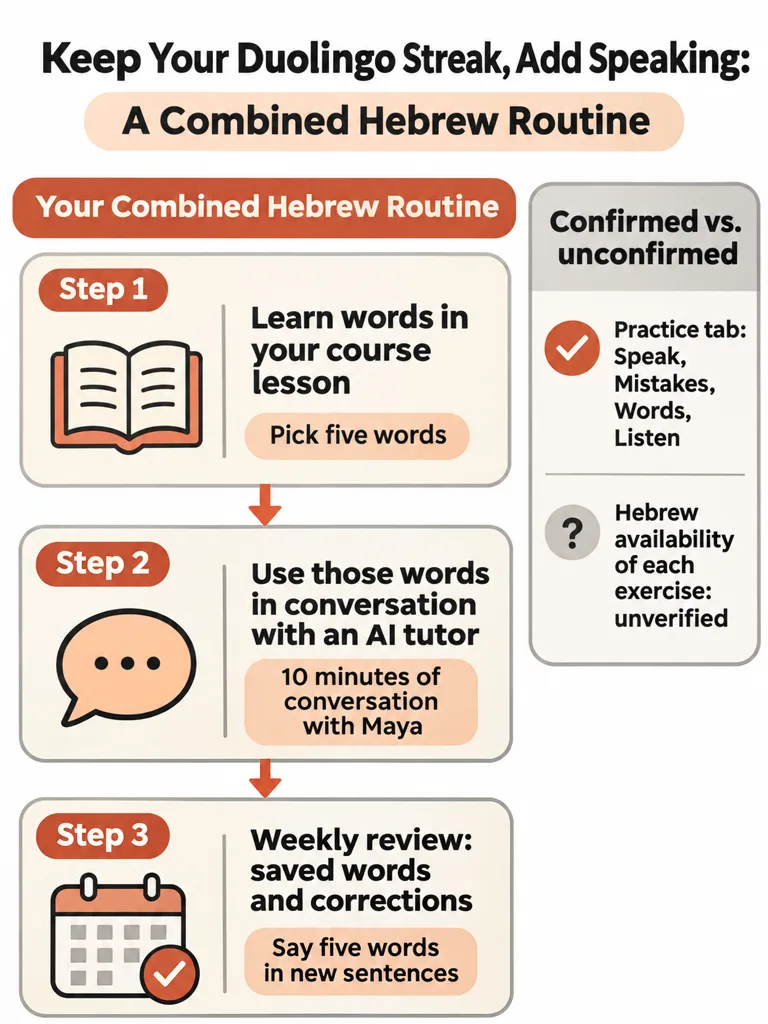
For Duolingo Hebrew speaking practice, use five lesson words in a suggested 10-minute conversation, then review your words and mistakes weekly.
How do I add speaking to my Duolingo routine?
Keep Duolingo for vocabulary, say those same words in a suggested ten-minute Hebrew conversation, and review them once a week. This Duolingo Hebrew speaking practice routine is an editorial suggestion, not a tested threshold, and it comes with no proficiency timeline.
Learn. Finish your usual Duolingo lesson and write down five words you want to use.
Speak (about ten minutes). Say those five words in a conversation with a teacher, a language partner, or an AI tutor, anyone who answers back.
Review (once a week). Revisit your saved words and mistakes, then say them again in new sentences.
How do I use Duolingo for speaking practice in Hebrew?
Duolingo's guide places Speak practice in the Practice tab, but it documents that tab for mobile courses in general and does not list which exercises exist in the Hebrew course. As of 11/18/2026, treat the exact Hebrew exercise inventory as unverified and check your own app.
What the guides do say: Duolingo's Practice tab guide, published 02/18/2026, lists Speak, Mistakes, Words, and Listen. It says skill lessons are available for all language courses on iOS and Android and announced the practice sessions as free for all learners. To open the tab, tap the barbell icon, or the three-dot menu if you don't see the barbell.
Duolingo's speaking-skills post adds that many writing exercises let you tap the microphone and say your answer instead of typing it. It also describes Video Call and Roleplay, but only as conversation tools for Duolingo Max subscribers in general. Hebrew availability for those is unverified. A 2021 review of the Hebrew course reported no recording exercises. That is a dated observation, not a description of today's app.
Duolingo does two things well here. The same 2021 reviewer called it fun, stress-free, and good at building a regular habit, and praised the course's native-speaker audio. Treat the daily lesson as the place to collect words. Then carry those words into a back-and-forth where someone has to understand you and reply, which a single vocabulary prompt doesn't ask of you. Baba's post on Duolingo Hebrew versus an AI Hebrew tutor suggests trying the same café scenario in both formats to compare unscripted replies, correction explanations, and saved review.
How do I use my Duolingo words in a ten-minute conversation?
A ten-minute vocabulary conversation has four steps: choose five words, say each in a sentence, use them in a short café-style exchange, and fix one thing. Baba's learning guide recommends putting each new word into a sentence you can say aloud, then adding conversation practice. The timings below are suggested allocations, not observed completion times.
The guide's example phrases make a safe starting frame:
Hebrew
Transliteration
Use
נעים מאוד
naim meod
Meet someone ("Nice to meet you")
אפשר קפה, בבקשה?
efshar kafe, bevakasha?
Order something ("A coffee, please?")
לא הבנתי
lo hevanti
Ask for another try ("I did not understand")
Choose five words (about 1 minute). Pick them from today's Duolingo lesson.
Say each in a sentence aloud (about 2 minutes). Keep the sentences short, and say them out loud rather than in your head.
Run a café exchange (about 5 minutes). Open with efshar kafe, bevakasha? and answer your partner's replies using at least one of your five words. If a reply goes by too fast, say lo hevanti.
Fix one thing (about 2 minutes). Choose one correction from the exchange, ask why it was a correction, and say the corrected sentence again.
The goal is to reuse the five words in a real reply, not only recognize them on a screen. The sources behind this article don't include a verified worked dialogue with contrasting gender forms, so this exercise sticks to phrases the guide itself lists.
What should I change when a sentence needs a different form for the speaker or listener?
Notice who is speaking and who is being addressed. Baba's guide lists this as its "notice the forms" step, and its FAQ says to pay attention to how a sentence changes for the speaker or listener. Treat it as a question to ask of every Duolingo sentence you plan to say aloud.
The same Duolingo review points at why this matters: it notes there are four different "you" forms, depending on gender and number. It also says the course sometimes accepts only certain translations, so you may need to remember two or three accepted ways to say one sentence.
Here is a practical way to use that:
Before you say a Duolingo sentence in conversation, ask who is saying it and to whom.
If the sentence addresses someone, check which "you" fits the person you're talking to.
If your partner corrects a form, ask for the reason, then repeat the sentence with the corrected form.
Can I start speaking Hebrew while I'm still learning the alphabet?
Yes, Hebrew speaking can start before you know the letters. Baba's learning guide FAQ says you can begin with useful spoken phrases and transliteration while you learn the alphabet, and that the letters give you another way to understand and remember what you hear.
Try this two-minute exercise:
Say לא הבנתי (lo hevanti, "I did not understand") aloud three times, at a normal pace.
Pick one new word from today's Duolingo lesson and say it aloud.
Say it again inside a short sentence of your own.
Look at the letters of both and match each sound to a shape.
When a reply is unclear, say lo hevanti and ask for another try. If a move is on your horizon, Baba's speaking-first plan for the year before aliyah opens with a five-minute exercise: saying and recording three words for appointments and documents.
How do I review saved words and corrections each week?
A weekly review of 15 to 20 minutes covers both halves of the routine: the Duolingo side and the conversation side. Like the ten-minute speaking block, that length is a suggestion. Duolingo's Practice tab guide names Mistakes, which reviews previous errors, and Words, which studies recommended vocabulary. Check that both appear in your Hebrew course.
Try this checklist:
Mistakes (about 5 minutes). Open the Practice tab and work through your recent mistakes, if your Hebrew course offers them.
Words (about 5 minutes). Study the recommended words and mark any you couldn't yet say aloud.
Conversation corrections (about 5 minutes). Reread the corrections and explanations from your speaking sessions, whether you wrote them down or saved them in an app.
New sentences (about 3 minutes). Choose five reviewed words and say each in a sentence you haven't used before.
If one word keeps tripping you up, make it the topic of your next conversation. Baba's post on what to do after finishing the Duolingo Hebrew course pairs a café exercise, which shows where you get stuck, with a daily practice loop built around real replies and corrections.
How long should I use Duolingo per day?
Duolingo's own Hebrew course page pitches five minutes a day, and this routine suggests a ten-minute speaking block. Both are suggestions, not measured thresholds. Try a split: a short lesson to gather words, then a conversation to use them.
Can Duolingo alone make you fluent? No source gathered for this article supports that claim, and none measures speaking gains or sets a timeline. Linguist Dr. Taylor Jones, who finished all 84 Hebrew units, says in his video that Duolingo can be an incredible resource but "not out of the box." He built his own supplementary flashcards to make it work.
To decide your next step, set a concrete goal, such as reading a menu or holding a short conversation, as Baba's guide suggests. If you recognize words but freeze when someone replies, add more speaking. For other formats, the best Duolingo alternatives for Hebrew compares tutors, audio courses, language exchanges, and ulpan by learning goal.
Where can I practice Hebrew conversation alongside Duolingo?
Hebrew conversation practice can come from a teacher, a language partner, or an AI tutor, according to Baba's learning guide. Each gives you someone to answer. Choose whichever you can realistically arrange, and bring your five Duolingo words to it.
Baba Learn is one option for the conversation block, not the only one. It is a separate speaking app from Baba, with conversation with the AI tutors Maya or David, explanations, and saved practice. It is in private beta for iPhone and Android, so it may not be open to everyone yet, and its interface is English. Baba's product notes say it addresses learners with grammatical gender in mind, that feedback can be wrong, and that word stress is not scored. Check any correction against its explanation.
Frequently asked questions
How do I turn on speaking practice in Duolingo?
Tap the microphone in a writing exercise to say your answer instead of typing it, or open the Practice tab and choose Speak. Per Duolingo's February 2026 guide, tap the barbell icon in the bottom menu, or the three-dot menu if the barbell isn't visible. Duolingo doesn't document which speaking exercises the Hebrew course includes, so check your own app.
Is the Duolingo Practice tab free?
Yes. Duolingo's February 18, 2026 guide says the Practice tab's practice sessions are free for all learners, and its skill lessons are available for all language courses on iOS and Android. Video Call and Roleplay are different: Duolingo describes them as Duolingo Max features, and their availability for Hebrew is unverified.
Can you become fluent in Hebrew with Duolingo alone?
Nothing in the sources reviewed supports that claim, and none measures speaking gains or sets a timeline. Linguist Dr. Taylor Jones, who finished all 84 Hebrew units, says Duolingo can be an incredible resource but "not out of the box," and he built his own supplementary flashcards. Pairing lessons with conversation where someone replies fills the speaking gap.
Does the Duolingo Hebrew course have recording exercises?
A 2021 review of the course reported only translation and dictation exercises, with no recording, but that is a dated observation. Duolingo's 2026 posts describe speaking exercises and a microphone option for its app in general without listing the Hebrew course's exercises, so check your own app before relying on either source.
What are my options for practicing Hebrew conversation?
A teacher, a language partner, or an AI tutor can all work, because each gives you someone who answers back. Baba Learn is one AI option: conversation with the tutors Maya or David, explanations, and saved practice, in private beta for iPhone and Android with an English interface. Its feedback can be wrong, and word stress is not scored.
What do I say in Hebrew when I don't understand a reply?
Say לא הבנתי (lo hevanti), which means "I did not understand," and ask for another try. It is one of three starter phrases in Baba's beginner guide, alongside נעים מאוד (naim meod, "Nice to meet you") and אפשר קפה, בבקשה? (efshar kafe, bevakasha?, "A coffee, please?"). You don't need a perfect sentence to keep a conversation going.