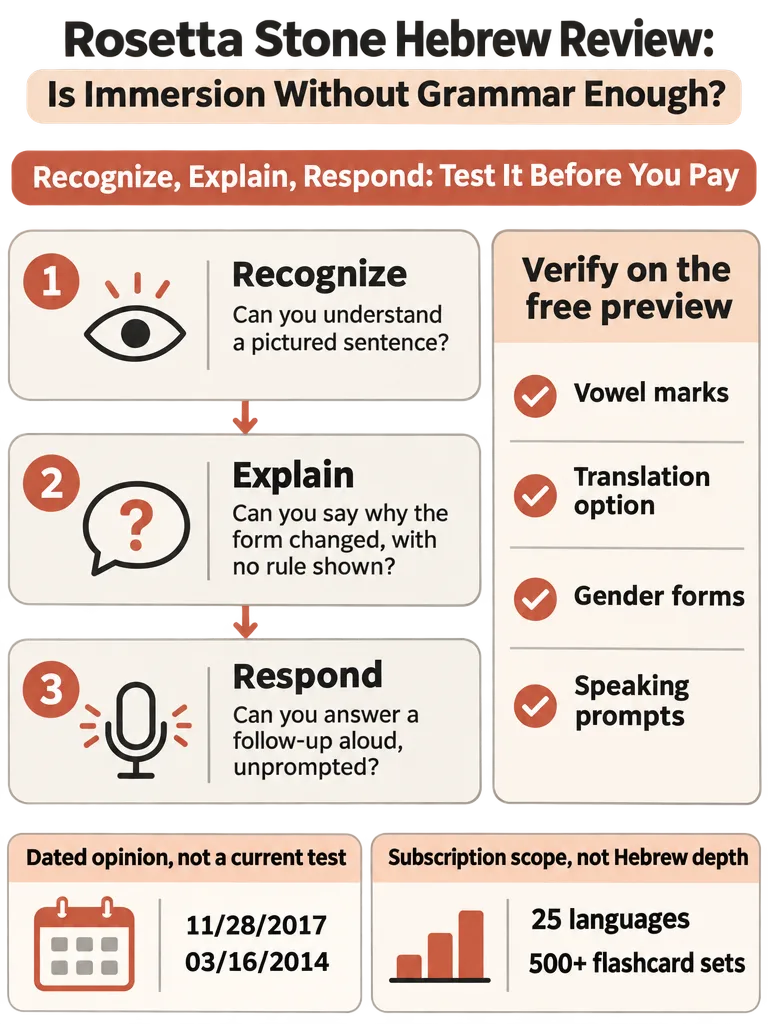
Rosetta Stone Hebrew can suit beginners who like picture-and-audio immersion. This source-based review offers a three-step grammar and speaking test.
Is Rosetta Stone good for Hebrew?
Rosetta Stone Hebrew can suit a beginner who likes picture-and-audio immersion and a structured routine, according to Rosetta Stone's own page and Live Fluent's 11/28/2017 review. Add explanations or reply practice if you want complex grammar or conversation, where the evidence is thin. The verdict is source-based, not hands-on.
The sources vary in age. Live Fluent's 2017 verdict is a reviewer's opinion about a 2017 product, and Learning Hebrew's 2014 review describes a software package. Neither measures today's course. Only Rosetta Stone's page describes the current offering.
Before any review, try a quick test with phrases from Baba's free Hebrew guides. This drill is separate from Rosetta Stone's lessons:
Recognize. Read or hear one phrase and say what it means: נעים מאוד (naim meod, nice to meet you), אפשר קפה, בבקשה? (efshar kafe, bevakasha?, a coffee, please?) or לא הבנתי (lo hevanti, I did not understand).
Explain. Ask the guide's own question: who is speaking, and to whom? Check whether any word would change for a different speaker or listener.
Respond. Have someone, or a recording, say something back. Answer aloud in your own words without looking.
The drill shows which of the three steps you can't yet do. The checklist later in this review uses the same three steps to judge any course.
Does Rosetta Stone teach Hebrew without explicit grammar?
Dated reviews describe Rosetta Stone teaching Hebrew grammar implicitly, and its current Hebrew page does not say whether any lesson states a rule. Learning Hebrew's 2014 review describes no grammar rules or translations, with learners inferring patterns from audio, images, words and sentences. Live Fluent's 2017 review says that no-English method struggles as grammar gets more complex.
Rosetta Stone's Hebrew page says vocabulary and sentence structures are "presented in context, allowing learners to recognize patterns and meaning without relying on translation." Its guide also lists grammar (root patterns and sentence structure) among core Hebrew skills, but does not say how the course teaches it. In plain terms, the reviewers describe rules picked up by noticing, not rules stated outright.
That can suit a beginner who enjoys spotting patterns. Live Fluent argued the other way: Hebrew is a Semitic language whose grammar follows predictable patterns, so learners who see the rules can make leaps sooner.
An archived 2022 learner account on the Duome forum praised the deductive style and the speaking practice. That is one person's experience, not a typical outcome.
Can you learn the Hebrew alphabet and Modern Hebrew on Rosetta Stone?
Rosetta Stone's page says its activities introduce the Hebrew alphabet and right-to-left reading with audio and visual support. Live Fluent's 2017 review said the course "doesn't help much with Hebrew script" and described a Modern Hebrew course only. The supplied sources don't confirm today's script depth or Modern-versus-Biblical scope.
Class Central's 2026 Hebrew guide picks Rosetta Stone as its "best app-based immersion" option. The same guide lists a separate Udemy course, Know the Hebrew Alphabet, that teaches all 22 letters in 57 minutes, without vowel signs.
If reading matters to you, a dedicated letters resource is a sensible add-on. Baba's free Hebrew guides include a first-letters guide on the alphabet, sounds and page direction.
How good is Rosetta Stone's speech recognition for Hebrew speaking?
Rosetta Stone says its immersive lessons include its TruAccent speech tool, but the supplied sources contain no independent test of TruAccent on Hebrew. Nothing covers recognition accuracy, Israeli accents, sound-level detail, or whether a good score predicts a good conversation.
One user review on OurKidsMom liked the loop: you hear a phrase, repeat it, and see which words were off. The reviewer received the product free, and the post doesn't test accuracy.
Repeating a prompt and answering a question are different tasks. During a trial, check which one the lessons ask for. Rehearsing both sides of a scene aloud, with a tutor or a recording, then reviewing corrections and trying again, is one way to practice replying.
Recognize, explain, respond: how to test Rosetta Stone Hebrew before you pay
The recognize, explain, respond test checks three separate skills in any trial or preview. Can you understand a pictured sentence (recognize)? Can you say why a form changed for the speaker or listener without a rule shown (explain)? Can you answer a follow-up aloud, unprompted (respond)? Run the drill from the top of this review, then use the list below to judge what the lessons show.
If the official page offers a trial or preview when you look, verify these points:
Recognize: Do pictures and audio alone carry each sentence's meaning? Is a translation available anywhere? The OurKidsMom reviewer couldn't find one.
Script: Does Hebrew appear with vowel marks (nikud) or plain letters, and is a transliteration offered?
Explain: Does any lesson show how forms change with speaker or listener gender and verb endings, or must you work that out alone?
Respond: Do speaking prompts ask you to answer a question, or only to repeat what you heard?
A preview that answers all four tells you more than any review. Anything it leaves open is a gap to fill elsewhere.
Is Rosetta Stone worth it for Hebrew in 2026, and what does it cost?
Rosetta Stone Hebrew is worth paying for only if its beginner immersion routine fits your goal, and the supplied sources do not establish a verified current checkout price. Live Fluent's 2017 review said the courses were "still a little on the expensive side" after a price cut, which dates that remark. Check Rosetta Stone's checkout page for today's cost.
Rosetta Stone's page advertises access to 25 languages and 500+ flashcard sets in its subscription. Neither figure shows how deep the Hebrew course is, and the page gives no date or Hebrew-specific flashcard count.
The page lists Chat Missions and Sapphire Studio under its subscription. Its Hebrew section also describes live tutoring on the website with guided conversation practice. Whether Chat Missions, Sapphire Studio and the flashcards are available for Hebrew is unresolved, as is whether tutoring is included in a subscription or costs extra.
For a daily habit and beginner basics, the cost question is mostly about price. For speaking, the open question is what you'd add.
What is the best program to learn Hebrew if immersion alone isn't enough?
Pick the program that fills the gap your trial exposed. If you couldn't explain a changed form, add grammar explanations. If you froze on the reply step, add a source of unscripted answers, such as a teacher or tutor. If reading was the weak spot, add a letters resource.
Option
What it does well
What it leaves out
Best for
Rosetta Stone
Live Fluent (2017) found it user friendly, structured and good for absolute beginners. The official page describes immersive lessons and TruAccent.
Live Fluent (2017) criticized complex grammar and script help and found it less useful past lower-intermediate. Those are 2017 criticisms, not confirmed current gaps.
Beginners and casual learners who like immersion
Pimsleur
Mezzoguild says it is audio-based and relies on recall, and may work if your goal is speaking.
Mezzoguild notes no visual component, so little reading or writing practice.
Learners who want to speak by ear
Duolingo
Class Central calls it a free, low-friction daily habit.
Class Central says it won't make you conversational alone and explains little grammar.
A free daily habit
Teacher (for example, an italki tutor)
Live Fluent (2017) describes italki as one-on-one lessons with professional Hebrew teachers.
The supplied sources give no current details on pricing or scheduling.
Learners who want a person to answer them
baba Learn
Baba's learning hub describes conversations with Maya or David, explanations, corrections and saved practice.
It is in private beta, feedback can be wrong, and it is not a complete accredited course.
Practicing replies after a course
Beginners, new olim, partners of Israelis and heritage learners can all use the same method: run the recognize, explain, respond test on each option and add what it misses. For deeper comparisons, see the Pimsleur Hebrew review and Duolingo alternatives for Hebrew.
What should you add if you recognize Hebrew but freeze when speaking?
If you recognize Hebrew but freeze when speaking, add practice where someone asks you something unscripted, you answer aloud, and you review the corrections. Baba's free learning hub says a teacher, language partner or AI tutor can give you someone to answer. It also suggests using a course or teacher for study sequence.
baba Learn is a speaking app for adults 18+, in private beta for iPhone and Android, built for that step. You hold conversations with Maya or David and get explanations, corrections and practice you can return to. It addresses you using grammatical gender. The interface is English only, and feedback can be wrong, so check anything that surprises you with a teacher.
How much does Rosetta Stone Hebrew cost per month?
Mezzoguild's 2026 Hebrew course roundup lists Rosetta Stone as starting at $6.49 a month. That is a third-party starting figure, not a confirmed checkout price for Hebrew. Live Fluent's 2017 review called the courses "a little on the expensive side," which is dated. Confirm today's price and what Hebrew includes on Rosetta Stone's checkout page before subscribing.
How does Rosetta Stone compare with Duolingo and Pimsleur for Hebrew?
They do different jobs, and the sources don't crown a winner. Class Central picks Rosetta Stone as best app-based immersion and Duolingo as a free daily habit that won't make you conversational on its own. Mezzoguild describes Pimsleur as audio-based with no visual component, which suits learners who want to speak by ear.
Is Rosetta Stone Hebrew only for beginners?
Mostly, according to the one review that addresses it. Live Fluent's 2017 review says the courses are designed for beginners and typically lose value past the low-intermediate level. That is a reviewer's opinion about a 2017 product, not a test of the current course. Class Central's 2026 guide positions Rosetta Stone for people who want a structured daily habit.
Does Rosetta Stone Hebrew translate anything into English?
Reviewers say it mostly doesn't. Learning Hebrew's 2014 review describes lessons with no translations or grammar rules, and one OurKidsMom reviewer couldn't find a translation anywhere. Rosetta Stone's own page says vocabulary is presented in context without relying on translation. If you want to confirm what you're saying, check a trial for a translation option first.
Does Rosetta Stone teach Biblical Hebrew?
The supplied sources point to Modern Hebrew only. Live Fluent's 2017 review says Rosetta Stone offers only a Modern Hebrew course, and Class Central describes its current Hebrew program as Modern Hebrew. Class Central also notes that Modern and Biblical Hebrew are learned from almost entirely different courses, so confirm the scope on Rosetta Stone's page before buying.
How can I practice speaking Hebrew alongside Rosetta Stone?
Add someone who asks you unscripted questions and lets you answer aloud. Baba's free Hebrew guides suggest a teacher, language partner, or AI tutor for this. baba Learn offers conversations with Maya or David, with explanations and corrections. It is in private beta for adults 18+, the interface is English only, and feedback can be wrong.