After Duolingo Hebrew, practice speaking daily: try a café conversation, get one correction, and compare tutors, partners, and speaking apps.
I finished the Duolingo Hebrew course and still can't hold a conversation. What now?
After Duolingo Hebrew, keep the app for light review and make speaking your main activity. Baba's learning guide suggests choosing a concrete goal, such as a short conversation, to decide what to study next. The plan: speak aloud daily, fix one verb at a time, and get a real reply from a person or tutor.
Finishing the course guarantees no particular level and no timeline, and the sources assign it none. Baba's learning guide says progress depends on your starting point, the skills you practice, and the support you use. Shotef's guide puts the gap plainly: Duolingo is enough to begin Hebrew, but not to make you confident using it in Israel.
Try this café exercise first. You need a tutor, a language partner, or a Hebrew-speaking friend to play the person behind the counter, because the point is a reply you didn't script.
Ask your partner to answer in Hebrew in their own words. Tell them you're ordering coffee.
Open with a phrase you know. אפשר קפה, בבקשה? (efshar kafe, bevakasha?): "A coffee, please?"
Listen, then answer their reply as best you can, even if it's only a few words.
Ask for another try if you lose the thread. לא הבנתי (lo hevanti): "I did not understand."
Ask for one correction, then retry once with only that change.
Write down where you stalled. That note is an observation, not a test result, and it tells you what to work on next.
Is Duolingo enough for Hebrew, and should I keep it for review?
Duolingo is enough to begin Hebrew, but not to make you confident using it in Israel, according to Shotef's assessment. Shotef credits it with a daily routine, basic vocabulary, simple grammar patterns, and quick review. In the same guide, Shotef says Duolingo "does not fully" prepare you to make your own sentences freely or handle real conversations where people interrupt, shorten words, or speak casually.
The audio is a more complicated story. In his review of finishing the course, linguist Taylor Jones describes the course he completed as having native-speaker audio, cultural references, and "blazingly fast" casual speech. That is one learner's account, not a current audit of the audio. Understanding supplied audio is still different from answering an unscripted reply.
Two cautions on currency:
Jones says he finished 84 units, but his video is undated, so that is not the current course length.
The sources supplied do not establish the current syllabus or any current speaking features. Check inside your own app.
One learner's published notes, also undated, call the course much harder than the European courses they had finished. They found binyan lessons hard because learning conjugation patterns and many new verbs at once competed for attention.
The practical rule: keep Duolingo as light review if it helps you show up daily, and keep it separate from speaking practice. App exercises are scripted. A real reply is not.
Watch
I finished Hebrew Duolingo. Then I made it better.
From languagejones on YouTube
What can I say out loud right now to find where I'm stuck?
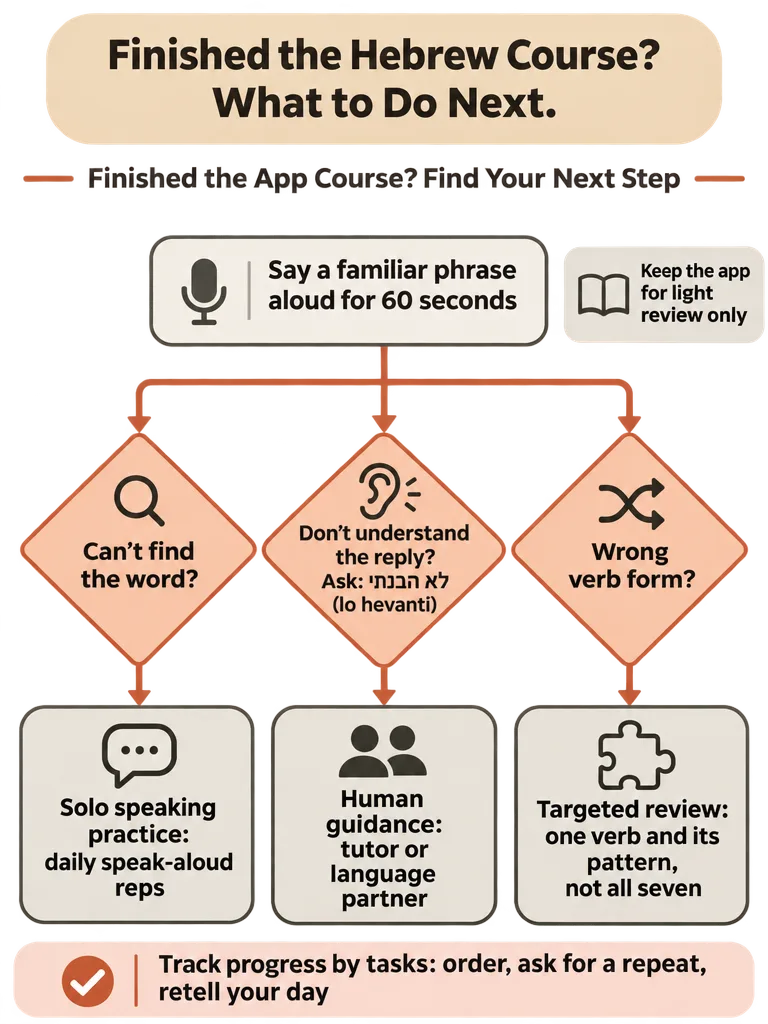
Say one familiar phrase, answer a real reply, ask for a repeat with lo hevanti, and note where you stall. Baba's free guide offers these starter phrases, and Shotef and LanguagePath suggest what to practice next. Match what happened in the café exercise above to the table.
What happened
Likely problem
Next move
You knew the phrase but couldn't produce it
Word retrieval
LanguagePath's roadmap suggests answering aloud for 60 seconds a day without stopping to fix mistakes (an exercise suggestion, not a proven minimum)
You couldn't follow the reply
Listening to unscripted speech
Practice lo hevanti, then listen to real Hebrew: Shotef says even 10 minutes a day helps train your ear
The sentence came out but a verb felt wrong
Verb form or binyan
Fix one verb, with its binyan, as described in the verb section below
The 60-second prompt comes from LanguagePath's after-the-app roadmap, which calls its own timings rough guides. Treat the prompt as a practice prescription, not a proficiency timeline.
For a verb problem, the study-versus-teach pair is a good test: if you said "he studied me Hebrew" when you meant "he taught me Hebrew," you chose the wrong verb, not the wrong word.
Hebrew forms can change with who is speaking and who is addressed, which Baba's guide calls "noticing the forms." Ask your tutor or partner which forms in your exchange change for you.
Should I choose a tutor, a language partner, or a speaking app next?
Choose a tutor when you need personalized guidance, a language partner when you need a real person to reply, a speaking app when you need solo reps, and a short grammar guide when one pattern keeps failing. Ulpan La-Inyan describes private tutoring as suited to focused goals such as professional Hebrew, exam preparation, or daily conversation, and still recommends real conversation practice alongside lessons.
This table is a set of questions to ask, not a ranked finding. Arrangements vary, and the sources supplied don't compare outcomes.
Your need
Best-fit option
Question to ask
Personalized guidance
Private tutor or ulpan class
Does each session include an agreed plan, corrections, and practice between sessions?
A real person replying
Language partner or Hebrew-speaking friend
Will they reply in Hebrew and point out one correction each time?
Solo speaking reps
Speaking app
Can you revisit the corrections afterward, and do you also have access to a real human?
Targeted grammar review
Short grammar guides, such as Baba's free ones
Will you say the pattern aloud afterward?
Shotef notes that a tutor, teacher, or Hebrew-speaking friend can catch mistakes that apps miss, which matters if you want to sound natural. The difference between the options is simple: solo app practice is practice on your own, while a tutor or partner gives you access to a real human.
Before you commit, answer three questions:
What can you do aloud today, based on the café exercise?
How often will you get a real reply?
How will you review corrections afterward?
Should I review all seven binyanim, or just the verbs I need in conversation?
Start with the verbs you reach for when speaking. A binyan is a vowel-and-prefix template applied to a root, and Baba's guide names seven: pa'al, nif'al, pi'el, pu'al, hif'il, huf'al, hitpa'el. Two verbs that share a root are related, not interchangeable.
Here is a mistake worth fixing early. הוא למד אותי עברית ("he studied me Hebrew") becomes הוא לימד אותי עברית (hu limed oti ivrit): "He taught me Hebrew." Lamad is pa'al and means studied. Limed is pi'el and means taught.
Learn each verb together with its binyan and its English gloss, rather than guessing a meaning from the pattern name. The guide says pattern meanings are tendencies, and not every root appears in every binyan.
The guide says pu'al and huf'al, the passives, can wait until you need passives in running text. Spend your first review time on the verbs from your own conversations.
How do I move past pointed text and read unpointed Hebrew?
Unpointed Hebrew is Hebrew written without vowel marks, and the sources supplied give no step-by-step method for moving to it from pointed text. They support two modest points: learn the letters, and read small amounts of real Hebrew you already know.
Baba's free guide says you can begin with useful spoken phrases and transliteration while you learn the alphabet, and that learning the letters gives you another way to understand and remember what you hear. Shotef recommends reading real Hebrew in small amounts, such as menus, signs, WhatsApp messages, and short posts, over endless app exercises.
Expect some spelling variation along the way. The Duolingo learner quoted above found that vav and yud are used for vowels in ways the course never fully explained, and that some exercises accepted two spellings. The same notes call Hebrew's spellings "irregular and sometimes inconsistent." Baba's free learning guides cover the alphabet, grammar, and everyday phrases.
What should daily practice look like, and how do I know it's working?
A daily Hebrew practice loop is a short cycle that starts with your last correction and ends with you speaking. Each pass turns one correction into a card, then into a new sentence you say aloud or a reply you give. You judge progress by tasks you can complete, such as ordering or asking for a repeat, not by a level label.
Review your last correction, one item only.
Add it to spaced-repetition cards (Anki or similar), alongside any new vocabulary. Taylor Jones found that getting ahead of Duolingo with Anki flashcards helped him get more out of the course.
Speak aloud on a simple topic, reusing that correction in a new sentence.
Answer a reply from a person, a tutor, or a voice note.
Check progress with concrete questions:
Can you order something without switching to English?
Can you ask for a repeat with lo hevanti instead of freezing?
Can you retell your day in a few sentences?
Can you answer a voice note?
Can you use last week's correction in a new sentence without a prompt?
These are practical checks, not validated measures of proficiency.
Where does baba Learn fit, and what does private beta mean?
baba Learn is a speaking app for adults learning modern Israeli Hebrew, and as of 11/14/2026 it is in private beta for iPhone and Android. It supports phrase-to-conversation practice: you bring a phrase, such as the café order above, into a conversation with Maya or David, the app's AI tutors, then review explanations and corrections afterward.
Beta details:
The interface is English only.
The app is for adults 18+.
Recordings are kept 30 days to check a score, then deleted.
It shows Hebrew with nikud and optional English or transliteration.
Correction explanations and My Cards reviews let you revisit mistakes.
It also has limits. Feedback can be wrong, and word stress is not scored. It is not a complete course, and it does not guarantee a particular proficiency level. Maya and David are AI tutors, so for a human's judgment, a tutor or language partner remains the alternative from the comparison above.
You can read more on the baba Learn page.
Frequently asked questions
Will I be fluent if I finish the Duolingo Hebrew course?
No. Finishing the course guarantees neither fluency nor a particular level. Shotef's assessment is that Duolingo is a useful way to start Hebrew but not enough by itself for real-life use in Israel. Baba's learning guide says progress depends on your starting point, the skills you practice, and the support you use. Pick a concrete goal, such as ordering a coffee, and practice it aloud.
What doesn't Duolingo prepare you for in spoken Hebrew?
According to Shotef, Duolingo does not fully prepare you for fast spoken Hebrew, different accents and speaking speeds, understanding Hebrew without hints, making your own sentences freely, or casual conversations where people interrupt or shorten words. It does help with a daily routine, basic vocabulary, and simple grammar patterns, so many learners keep it for light review.
What can I say in Hebrew when I don't understand a reply?
Say לא הבנתי (lo hevanti), which means "I did not understand." It asks the other person for another try, so you don't freeze or switch to English. Pair it with a phrase you already know, such as אפשר קפה, בבקשה? (efshar kafe, bevakasha?), "A coffee, please?", and note where you stalled.
Where can I practice Hebrew conversation after Duolingo?
A teacher, language partner, or AI tutor can give you someone to answer. Shotef notes that a tutor, teacher, or Hebrew-speaking friend can catch mistakes apps miss. baba Learn, currently in private beta for iPhone and Android, offers conversation with its AI tutors Maya and David, plus explanations and corrections you can revisit afterward.
How do I learn Hebrew verbs without memorizing all seven binyanim at once?
Learn each verb together with its binyan and its English meaning, rather than guessing the meaning from the pattern name. For example, למד (lamad) is pa'al and means "studied," while לימד (limed) is pi'el and means "taught." Baba's grammar guide says the passives, pu'al and huf'al, can wait until you need them in running text.
Is baba Learn a complete Hebrew course?
No. baba Learn is a speaking app for adults 18+ learning modern Israeli Hebrew, currently in private beta on iPhone and Android, with an English-only interface. It is not a complete course and guarantees no proficiency level. Feedback can be wrong, word stress is not scored, and recordings are kept 30 days to check a score, then deleted.