Pimsleur Hebrew review: 3 levels, 90 lessons, and about 48 hours of audio for spoken Modern Hebrew. See what it teaches and what it skips.
Is Pimsleur worth it for learning Hebrew?
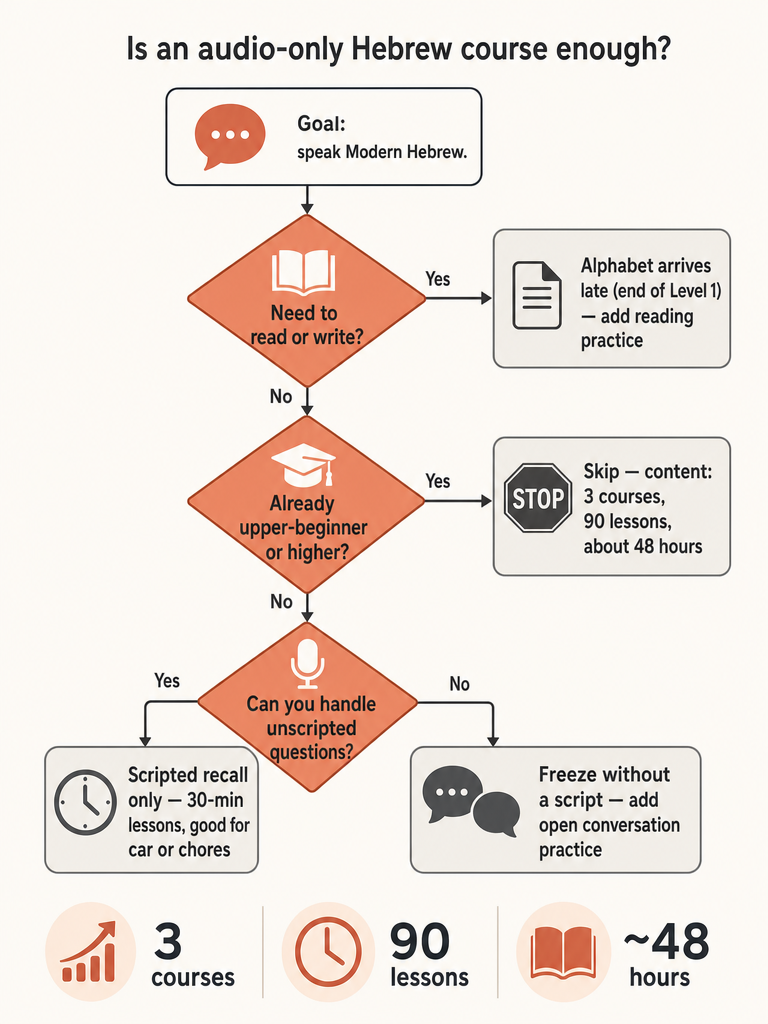
Pimsleur Hebrew is worth paying for if you're a true beginner who wants spoken Modern Hebrew habits built through listening and repetition, but it's a weak fit if your goal is reading, writing, grammar explanations, or Biblical Hebrew. Most Pimsleur Hebrew reviews point to the same limit: the course tops out at three levels, which Live Fluent's review calls the program's biggest shortcoming.
The course earns its reputation with people who have never spoken a word of Hebrew. Dr. Paul Pimsleur's listen-and-repeat method, documented in Lingtuitive's 2026 overview of the method, gets a new speaker producing short, functional phrases within the first few lessons. That's a real win for anyone who knows vocabulary on paper but freezes the second a real conversation starts.
Where it struggles is depth. Someone planning aliyah, filling out forms, or reading a lease needs letter recognition early, not as an afterthought. Someone who already understands some Hebrew and wants to push past upper beginner will outgrow all three Hebrew levels fast. And anyone studying Biblical or liturgical Hebrew for its own sake should look elsewhere, since the lessons deal almost exclusively with the spoken modern language.
What does a Pimsleur Hebrew lesson actually teach you?
Each lesson runs 30 minutes and leans entirely on listening, recall, and speaking out loud, with no textbook involved. Dr. Paul Pimsleur built the format on principles like graduated interval recall and the principle of anticipation, which space out vocabulary so you retrieve it from memory instead of just hearing it again, according to Lingtuitive's 2026 breakdown of the method. Every session opens with a short dialogue, breaks it into pieces, then prompts you to say words and full sentences into the silence before playing the "correct" version.
That syllable-by-syllable breakdown has a specific payoff for Hebrew: Live Fluent's review points to difficult sounds like het, ayin, and resh as ones the method handles well, because it isolates them before asking you to reproduce a full word. Because every lesson is audio-only, it fits into a commute, a walk, or a sink full of dishes without a screen in front of you.
How many levels does Pimsleur Hebrew have, and what level can you reach?
Three. The course offers 90 lessons split across three levels, about 48 hours of audio in total according to Lingtuitive's 2026 breakdown of Pimsleur's full catalog, and most learners finishing all three land at upper beginner to low intermediate rather than fluent conversation, per Live Fluent's Hebrew-specific review. Hebrew caps out at three levels, while several of Pimsleur's larger languages run to five, which limits how far the course alone can take you.
Top Consumer Reviews says finishing all three Hebrew levels builds low-intermediate conversation skills for everyday scenarios like ordering food, giving directions, or making small talk, but leaves grammar, advanced vocabulary, and writing underdeveloped. That lines up with Live Fluent's conclusion that most learners end up closer to upper beginner than to genuine fluency once the dialogues run out.
If you started hoping 90 lessons would carry you to confident, wide-ranging conversation, recalibrate that expectation now. What the course buys you is a working set of everyday phrases and the listening reflexes to use them, and then it stops.
Does Pimsleur Hebrew teach you to read and write Hebrew?
No, not as part of the core lessons. Top Consumer Reviews says the Hebrew alphabet shows up only at the end of Level 1, delivered through a separate reading booklet rather than woven into the audio format, and writing practice isn't part of the lessons at all. That gap lands harder on Hebrew than on many of Pimsleur's other languages, because Hebrew uses its own alphabet and reads right to left.
A new immigrant filling out a form at a government office, a heritage learner trying to read a grandparent's letter, or anyone trying to make sense of a street sign needs letter recognition well before Level 1 ends, not after it. The audio-first design means you could finish an entire level able to hold a spoken exchange about directions or ordering coffee while still unable to sound out the words on the sign in front of you.
Public detail on how much reading the course builds across all three levels combined is limited as of this writing. The booklet at the end of Level 1 is the clearest documented entry point into the script that the available sources describe.
Is Pimsleur Hebrew Modern Hebrew or Biblical Hebrew?
Modern Hebrew, almost exclusively. The course teaches the everyday spoken language used across Israel today, not the Biblical Hebrew found in religious texts, according to Live Fluent's review of the Hebrew-specific course. Anyone studying Biblical or liturgical Hebrew for prayer, text study, or scholarship should expect limited value from these lessons.
Live Fluent's review says plainly that learners focused on Biblical Hebrew are probably not going to get much out of the course. The vocabulary and dialogue scenarios are built around street Hebrew: ordering coffee, asking directions, meeting people, not parsing verses. Knowing some Modern Hebrew can still help a Biblical Hebrew student recognize shared grammar roots, but that's a side effect of the course, not what it's designed to teach.
How much does Pimsleur Hebrew cost right now?
Premium pricing for the course sits at $19.95 a month as of November 2026, according to Top Consumer Reviews' dated review, with All Access priced slightly higher at $20.95 a month. Both figures sit well above the $14.95-a-month price an older 2017 Live Fluent review quoted, and far from the $335 flat fee for all 90 lessons listed in a 2013 archived review. Anyone comparing against either of those older numbers is pricing against a version of the course that no longer exists in that form.
Plan
Monthly price
Annual price
Trial
Refund window
Premium
$19.95
$150-$165
7 days free
30-day subscription refund
All Access
$20.95
$164.95
7 days free
30-day subscription refund
Top Consumer Reviews rates the Hebrew course 3.5 out of 5 in its Hebrew lessons comparison, while citing Trustpilot's broader customer base averaging the brand at 3 stars, pointing to complaints about repetition and the reading and writing limits covered above. Treat the 7-day free trial, not the later 30-day subscription refund, as your actual no-risk window before paying.
Does Pimsleur Hebrew include AI conversation practice, or just scripted recall?
Premium's AI Voice Coach adds guided role-play transcripts, flashcards, quizzes, and cultural notes on top of the core audio lessons, according to Top Consumer Reviews' description of the add-on. The available sources confirm those features but don't spell out how far the AI Voice Coach goes toward genuinely open-ended conversation versus structured review of material the course already taught, so that distinction stays unconfirmed rather than settled.
What is clear is the shape of the core lessons themselves: they're built on scripted dialogues you listen to, break apart, and repeat. A learner who can recite a scripted "where is the bus station" exchange perfectly, then freezes the moment someone answers with something the script never covered, has run into the limit of that design. Scripted recall builds muscle memory; whether the AI Voice Coach extends that into true back-and-forth is something the public documentation doesn't settle.
For comparison, baba Learn, currently in private beta, is built around open exchanges with Maya or David, two Hebrew-speaking tutors, where the reply depends on what you actually say rather than a fixed script. What happens in your first Hebrew lesson with Maya walks through what that kind of open exchange looks like, including the correction and recap that follow it.
How to decide: use Pimsleur alone, or add real conversation practice?
A new oleh who can recite the course's airport dialogue word for word, then stalls when a government clerk asks a question the lessons never scripted, has a concrete decision to make: keep going with audio alone, add a speaking tool alongside it, or move to open conversation practice now. The right answer depends on how often that freeze happens and how close it is to a real deadline.
Notice where the freeze actually happens. If it's only at the outer edge of what a lesson covered, replaying that specific dialogue a few more times may be enough.
Finish the level you're in before switching tools. The spaced-repetition structure depends on completing the sequence; stopping mid-level wastes the recall design the course is built on.
Test yourself with one unscripted question. Ask a friend, a tutor, or an AI conversation partner something the course never covered, and time how long it takes you to answer.
If the pause runs longer than a few seconds, add open conversation practice alongside the audio, not after it.Turning a Hebrew news paragraph into a speaking exercise covers one way to convert material you've already memorized into language you can produce on the fly.
Before subscribing to any Hebrew tutor app to close that gap, run the same quick checks on it that you'd run on this course. Does it explain corrections, does it track gendered forms, can you review what you got wrong later. How to check an AI Hebrew tutor before you subscribe lays out that checklist in full.
A learner who freezes rarely can stay with the audio course through all three levels. A learner who freezes constantly needs conversation practice running at the same time, not bolted on at the end.
Frequently asked questions
Is there a free trial for Pimsleur Hebrew?
Pimsleur Hebrew offers a 7-day free trial on both the Premium and All Access plans, according to Top Consumer Reviews' November 2026 pricing breakdown. After the trial, Premium bills at $19.95 a month and All Access at $20.95 a month. A separate 30-day subscription refund window also exists, but the 7-day trial is the only truly no-risk period before a monthly charge hits your card.
What rating does Pimsleur Hebrew get from reviewers?
Pimsleur's Hebrew course scores 3.5 out of 5 in Top Consumer Reviews' Hebrew-specific lesson comparison, while Trustpilot's broader rating across all Pimsleur languages averages 3 stars. Reviewers cite repetition and the limited reading and writing instruction as recurring complaints. The Hebrew-specific score reflects strengths like pronunciation drilling for difficult sounds such as het, ayin, and resh that don't show up as clearly in the brand-wide average.
How long does it take to finish all 90 Pimsleur Hebrew lessons?
Finishing all three Hebrew levels means working through 90 lessons at 30 minutes each, about 48 hours of audio total, according to Lingtuitive's 2026 breakdown of Pimsleur's catalog. At one lesson a day, that's roughly three months; doubling up cuts it to six or seven weeks. Most learners land at upper beginner to low intermediate by the end, not fluent, wide-ranging conversation.
Is Pimsleur Hebrew a good fit if you already know some Hebrew?
Not really, since Pimsleur is built for complete beginners. Lingtuitive's 2026 guide to using the method says there's little need for it once you're already an upper beginner or lower intermediate speaker. Heritage learners who understand some Hebrew but want speaking reps may find the early lessons too slow, since the course starts from zero rather than placing you partway through its 90-lesson sequence.
What's the actual price difference between Pimsleur Premium and All Access for Hebrew?
Premium costs $19.95 a month and includes the AI Voice Coach add-on with role-play transcripts, flashcards, quizzes, and cultural notes, according to Top Consumer Reviews' November 2026 review. All Access costs $20.95 a month, a $1 jump from Premium. Annual pricing runs $150 to $165 for Premium and $164.95 for All Access, and both tiers share the same 7-day free trial.
Can baba Learn complement Pimsleur Hebrew for speaking practice?
Yes, the two cover different gaps rather than competing directly. baba Learn, currently in private beta, offers open-ended conversation with two Hebrew-speaking tutors, Maya and David, where the reply depends on what you actually say rather than a fixed script. Pimsleur's scripted dialogues build the listening reflexes and pronunciation habits that transfer well into those open exchanges once a learner is ready to move past rehearsed phrases.