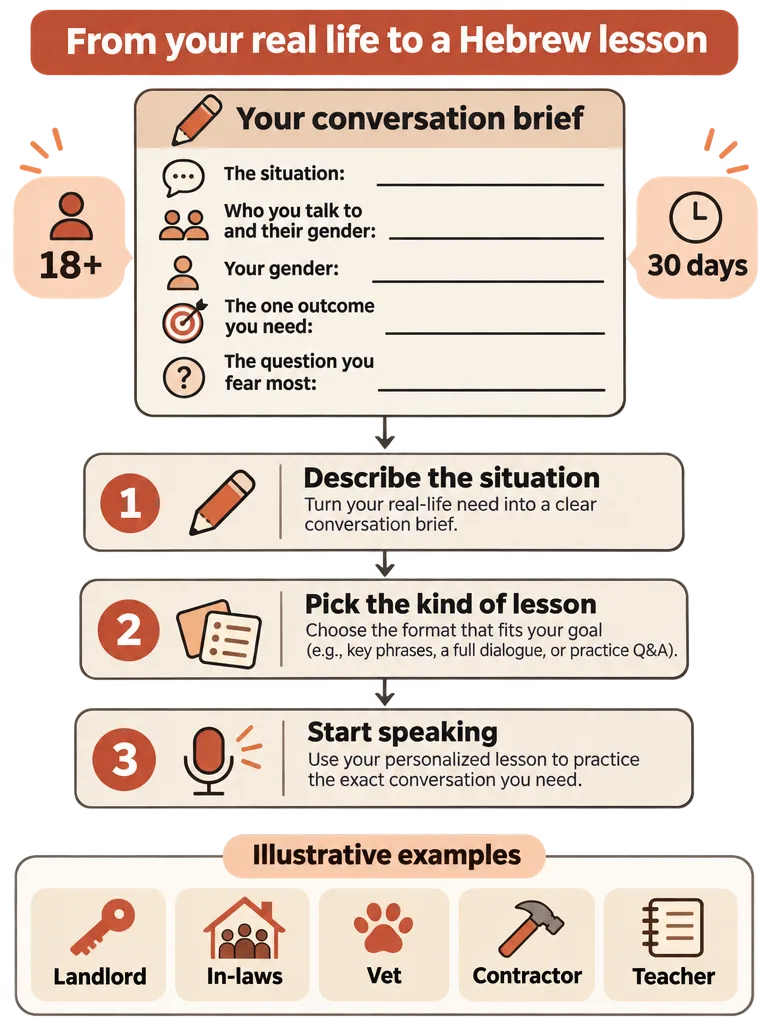
A custom Hebrew lesson lets you rehearse an upcoming conversation aloud. Describe the situation, choose a lesson format, and start speaking.
Can you practice the exact conversation coming up in your life?
Yes. A custom Hebrew lesson turns the conversation coming up in your life into spoken practice with Maya or David, the AI tutors in baba Learn, before the real one happens. Baba's brief for the feature has three moves: describe the situation, pick the kind of lesson, start speaking.
Try this first, before you build anything. Say aloud the first sentence you would need, such as "Hi, I'm calling about the leak in the bathroom." Use whatever Hebrew you have, and mix in English if you must. Notice where you freeze: a missing word, a verb form, or not knowing whether to address a man or a woman. That freeze is the first thing your lesson should fix.
This is rehearsal for speaking. It is not legal, veterinary, construction or school advice, and it won't tell you what to decide in any of those conversations.
What goes into a good brief for a custom Hebrew lesson?
A good brief for a custom Hebrew lesson fits on five lines: the situation, who you're talking to and their gender, your gender, the one outcome you need, and the question you fear most. Hebrew verbs and adjectives change with both speaker and listener, so these details change the practice itself.
Fill in these five lines:
Situation: "My landlord, about a leaking bathroom."
Who and their gender: "Landlord, a man."
Your gender: "I'm a woman."
One outcome: "A repair date, confirmed out loud."
Question I fear most: "Can you explain the problem again, slowly?"
Lines 2 and 3 matter because forms differ. These are illustrative sentences written for this article:
English
To or from a man
To or from a woman
Can you repeat that?
אתה יכול לחזור על זה? atah yachol lachzor al ze?
את יכולה לחזור על זה? at yechola lachzor al ze?
I'm a bit confused.
אני קצת מבולבל ani ktsat mevulbal
אני קצת מבולבלת ani ktsat mevulbelet
A tutor listing rarely gives you a reusable brief like this. If you want to see the idea of playing both sides aloud, rehearse it before you need it walks through it.
How do you create your own Hebrew lesson: describe it, pick the kind, start?
You create your own Hebrew lesson in three steps, following the publisher's brief for baba Learn: describe the situation, pick the kind of lesson, and start speaking. Exact screen names, lesson-type labels and input limits aren't covered by the sources I have, so check the app for those.
Describe it. Paste or type your five-line brief: who, what, which outcome, which dreaded question.
Pick the kind. Choose the lesson format that fits, for example a role-play of the scene, over a general lesson.
Start speaking. Talk to Maya or David out loud, then review the explanations and corrections afterward.
Availability, as of November 22, 2026: baba Learn is in private beta on iPhone and Android, so the way in is the baba Learn waitlist, not a public launch. It is for adults 18 and older, and the interface is English only. Recordings are kept for 30 days so a score can be checked, then deleted.
What would a custom lesson look like for a landlord or a contractor?
A landlord lesson targets a repair request and a confirmed date. A contractor lesson targets a quote, a schedule, and the right to ask someone to slow down. Both use short, reusable sentences plus one rescue phrase: לא הבנתי lo hevanti ("I didn't understand"), which appears on Baba's learn page.
Landlord
Contractor
You talk to
Your landlord
A contractor quoting work
Outcome
A repair visit, with the date confirmed
A price and a start date you understood
Key phrase
יש נזילה באמבטיה. אפשר שמישהו יגיע השבוע? yesh nezila ba'ambatya. efshar shemishehu yagia hashavua?
אפשר לדבר קצת יותר לאט? efshar ledaber ktsat yoter le'at?
Rescue
לא הבנתי lo hevanti
לא הבנתי lo hevanti
Forms that change
אתה / את יכולה לחזור על התאריך? atah yachol / at yechola lachzor al hata'arich?
אני צריך / צריכה הצעת מחיר ani tsarich / tsricha hatsa'at mechir
Ask Maya or David to play the other person and push toward the awkward parts: a date that changes, or a price you need repeated. The sentences above are illustrative, written for this article, and are not extracted evidence or legal or building advice.
How do you rehearse a conversation with a vet, a teacher or your in-laws?
Rehearse each one with a three-line brief: who, what you need, and the sentence you dread. Then practice one starter sentence aloud until it's automatic. These examples are illustrative, written for this article, and cover language only, not veterinary or education advice.
The vet. Brief: a vet, a man or woman; describe symptoms; understand instructions. Starter: הכלב לא אוכל מאתמול hakelev lo ochel me'etmol ("The dog hasn't eaten since yesterday"). With a cat it becomes החתולה לא אוכלת hachatula lo ocheleth. To ask for a repeat, say תוכל להסביר שוב? tuchal lehasbir shuv? (to a man) or תוכלי להסביר שוב? tuchli lehasbir shuv? (to a woman). For a clinic scene, see rehearsing a Kupat Cholim appointment.
The teacher. Brief: parent-teacher exchange; ask one question; confirm the next step. Starter: יש לי שאלה על שיעורי הבית yesh li she'ela al shiurei habayit. Confirm with אז אני צריך / צריכה לשלוח לך מייל, נכון? az ani tsarich / tsricha lishloach lecha / lach mail, nachon? (lecha to a male teacher, lach to a female one).
The in-laws. Brief: a warm, relaxed family conversation where register matters. Starter: אני שמח / שמחה להיות כאן ani sameach / smecha lihyot po ("I'm glad to be here"). Ask Maya or David for a casual, family tone rather than a textbook one.
Can you start if you still need transliteration or can't read Hebrew yet?
Yes. Baba's learn page says you can begin with useful spoken phrases and transliteration while you learn the alphabet. Learning the letters later gives you another way to understand and remember what you hear. The focus is modern Israeli Hebrew, covering everyday conversation and current expressions, not Biblical Hebrew, which has different texts and goals.
So the conversation you need can come first. Read the Hebrew when you can, and lean on transliteration (lo hevanti) when you can't. Nothing about the brief in this article requires reading Hebrew letters.
What should you do after the practice conversation?
After the scene, spend five minutes turning mistakes into reusable sentences. Don't promise yourself a result or a timeline. Practice reduces freezing for that one conversation, nothing more.
Say the fixed sentence aloud again. Say it three times, in the voice you'd use on the day.
Save phrases for later review. Keep the two or three you'll need, such as your rescue phrase.
Re-run the scene. Start from your brief again and see whether the freeze point moved.
Feedback can be wrong. If a correction seems off, check it with a teacher or an Israeli friend. Also note that word stress isn't scored. For the most common slips, see the Hebrew mistakes English speakers make most.
How is a custom lesson different from a private tutor or a general course?
A custom lesson repeats your one conversation. A private tutor adapts live to you. A structured course gives you sequence. Each does something the others don't, so use them together.
Option
Does well
Limits
Private tutor
A human who adapts as you speak
Price and scheduling vary by tutor
Structured course or ulpan
Order: what to learn next
Not built around your single upcoming conversation
Custom lesson in baba Learn (private beta)
Repeats your scene as often as you want
Feedback can be wrong; no human judgment
On cost, Superprof's US Hebrew tutor page shows prices set by each tutor. In the profiles shown when I reviewed it, they ranged from $20 to $55 an hour. Check the live page before budgeting. Some tutors describe their lessons as tailored, so you can also bring your five-line brief to a human.
For a fuller look at the trade-offs, read ulpan or a Hebrew app: what each does better.
Frequently asked questions
Where can I practice Hebrew conversation before a real one?
A teacher, a language partner, or an AI tutor can give you someone to answer. In baba Learn, you talk with Maya or David, the AI tutors, and get explanations and corrections afterward. It is in private beta on iPhone and Android, so you join the waitlist. It has not launched publicly.
How do I ask an Israeli to repeat something or speak more slowly?
Say לא הבנתי (lo hevanti), "I didn't understand," then ask אפשר לדבר קצת יותר לאט? (efshar ledaber ktsat yoter le'at?) to slow things down. To ask for a repeat, use אתה יכול לחזור על זה? (atah yachol lachzor al ze?) to a man or את יכולה לחזור על זה? (at yechola lachzor al ze?) to a woman.
Do I need to read Hebrew letters before I start speaking?
No. Baba's free learn guide says you can begin with useful spoken phrases and transliteration while you learn the alphabet. Learning the letters gives you another way to understand and remember what you hear. The focus is modern Israeli Hebrew, meaning everyday conversation and current expressions, not Biblical Hebrew.
How much does a private Hebrew tutor cost in the US?
Private Hebrew tutor prices are set by each tutor. On Superprof's US listing, the profiles shown ranged from $20 to $55 an hour, and each advertised a free first lesson. Prices change, so check the live page before budgeting. You can also bring a short written brief of your upcoming conversation to a human tutor.
Can I download baba Learn right now?
Not publicly. As of November 22, 2026, baba Learn is in private beta on iPhone and Android, and the way in is the waitlist. It is for adults 18 and older, the interface is English only, and the free starting Classic lessons need no card, with the allocation shown in the app.
Is AI tutor feedback on my Hebrew always correct?
No. Feedback in baba Learn can be wrong, and word stress is not scored. If a correction looks off, check it with a teacher or an Israeli friend before relying on it. Use the explanations to find the one change that mattered, such as a gender ending, and practice that sentence again.