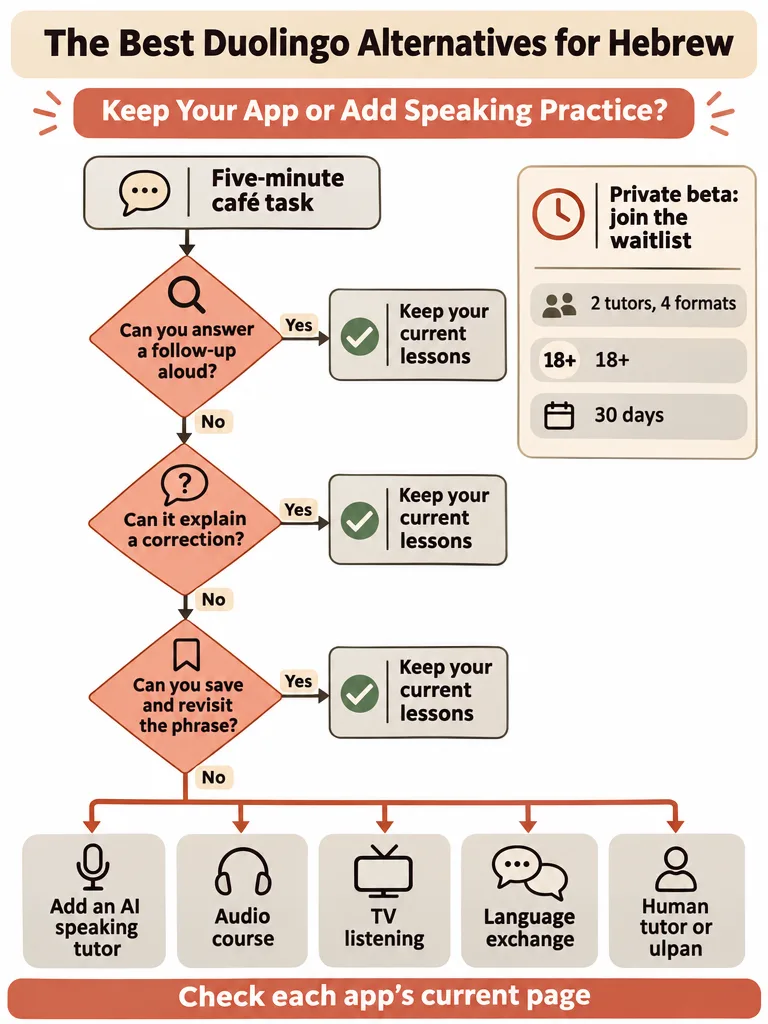
Choose a Duolingo alternative for Hebrew based on your goal: try a speaking tutor for conversation, audio for listening, or a class for structure.
What should I use instead of Duolingo for Hebrew?
The best Duolingo alternative for Hebrew depends on the skill you're missing. Duolingo pitches Hebrew in 5 minutes a day, for free, so keep it for basics, then test a speaking resource: order אפשר קפה קטן, בבקשה? (efshar kafe katan, bevakasha?, "a small coffee, please"), then answer an unrehearsed follow-up.
If you can answer, your current practice is carrying over to speech. If you freeze, you need conversation practice, not more vocabulary. baba Learn is one private-beta option for that, with access through a waitlist.
Other goals call for other formats. To train your ear, look at audio courses or TV. To talk with real people, look at a language exchange, a human tutor, or an ulpan. The sections below sort those options by goal. They also give you a five-minute test you can run on any of them.
Should I replace Duolingo or keep it and add something?
Keep Duolingo if it gets you to practice every day and your only gap is speaking. Switch, or add a second tool, if you recognize words but can't answer a follow-up question aloud.
Duolingo describes its Hebrew course as free, built from quick, bite-sized lessons where you earn points and unlock levels. It also lists game-like features, challenges, and reminders to build a language-learning habit. Judge it by that format: short daily lessons that make starting easy.
A guide from Shir-ly Songs, which builds a competing song-based tool, reaches a similar view. It calls Duolingo a good alphabet and vocabulary warm-up and says to treat it as one source, not your only one.
Match the alternative to the missing skill. Speaking gaps call for a tutor or conversation partner, listening gaps for audio or TV, and accountability gaps for a human teacher or class. Entries marked "category-level" below rest on no official product page in the research for this article, so check each product's own page before you commit.
Goal
Format
What it does well
What to verify
Speak and get corrected
AI Hebrew tutors (Israelingo, Fluently and others, covered in the next section)
Hebrew conversation; correction, review and sound-practice features differ by product, per Baba's comparison, checked 10/30/2026
Can you pick Hebrew as the learning language? What does the sound feedback measure?
Say sentences aloud without freezing
Audio course (Pimsleur)
Shir-ly describes it as drilling spoken sentences until they come out automatically
Current Hebrew course, trial and price on Pimsleur's own page
Listen to real Hebrew
TV (Lingopie)
Category-level only: watching video in the language
Hebrew catalog, subtitle tools, devices and terms on Lingopie's own page
Practice with real people
Exchange (HelloTalk)
Category-level only: chatting with native speakers
Preply describes live one-on-one lessons with a real Hebrew tutor
Tutor fit, schedule and rate on the current listing
Follow a structured class
Ulpan
Category-level only: teacher-led structure
Placement, schedule, eligibility, tuition
Vocabulary is a separate niche. Milo's own page says it is an iPhone vocabulary tool for people who already read Hebrew, not a beginner course or conversation tutor. It recommends a beginner course or ulpan if you're starting from zero.
Which Hebrew AI tutor gets me speaking instead of tapping?
Hebrew AI tutors differ mainly in what happens after you speak. Baba's comparison of eight AI Hebrew tutors, checked 10/30/2026, says Israelingo offers Hebrew voice and text conversation, with corrections you request from a message. It says Fluently offers modern Hebrew conversations, session notes, and separate sound drills.
Baba builds baba Learn, so this is an editorial comparison based on published product information, not an independent test of tutor accuracy.
Two caveats from that comparison help set expectations:
Israelingo: the public listing doesn't establish every sound-practice or review feature.
Fluently: its Hebrew FAQ says learners with no Hebrew may find the first conversations demanding, and it has no course for reading or writing the alphabet.
baba Learn pairs two tutors, Maya and David, with four conversation formats: Classic, role-play, Read and Talk, and Free Talk. Baba's pages say corrections come with explanations, Fix Your Mistakes returns you to a correction to practice it, and My Cards keeps phrases for later. English, transliteration, and suggested replies are optional.
Limits Baba states for the app:
Private beta on iPhone and Android, with an English-only interface.
AI conversation has usage limits.
Baba says it is for adults 18 and older, and that recordings are kept 30 days to check a score, then deleted.
As of November 17, 2026, it isn't publicly available. Baba describes public store launch as still ahead, and access runs through a waitlist on the baba Learn page. Baba's comparison marks Israelingo and Fluently as "check current plan," so verify access and plans on each provider's own page.
How can I test any Duolingo alternative with one five-minute Hebrew task?
This is a speaking-resource test: run the same café scene in each tool, and judge it by what happens after your first sentence. A tool that only checks one scripted line hasn't tested an unrehearsed response.
Your target phrase comes from Baba's tutor pages: אפשר קפה קטן, בבקשה?efshar kafe katan, bevakasha? (A small coffee, please?)
Say a request. Order the coffee aloud instead of tapping an answer.
Answer an unscripted follow-up. Ask a partner or tutor to reply with something you haven't rehearsed, then answer aloud. With an app, see whether it asks one.
Ask why a correction changed. You should see the reason (the form, the word, the context), not just a new sentence.
Revisit and save the phrase. Come back to the correction and practice it again, and see whether you can keep the phrase for later.
Baba's five-check list for choosing a tutor uses the same logic: can you answer a follow-up about your own situation, see why wording changed, and find useful phrases after the session?
Essential checks, for Duolingo, a tutor app, a human tutor, or an exchange partner:
Pass: it asked something you hadn't rehearsed, and you answered aloud.
Pass: you could explain the correction in your own words.
Pass: when a reply depends on who is speaking or being addressed, the right form appeared or was explained.
Fail: you could only repeat memorized lines.
Optional review conveniences: the phrase came back for practice, or you could save it, without much manual work. Treat these as a bonus, since a notebook or a flashcard you build yourself also works.
For audio courses or TV, which don't talk back, use goal-appropriate checks. Can you say the lines aloud and recall them later? Can you replay and follow what's said?
Does the app actually teach Hebrew, and what does its pronunciation feedback measure?
A Hebrew menu doesn't mean an app teaches Hebrew. An interface can be translated into Hebrew while the course teaches another language, so check which language you can select to learn. Then confirm the activity you need exists in Hebrew mode.
15 are English-focused or don't list Hebrew in the offer Baba reviewed. These include Duolingo Max, which the directory marks as Hebrew absent from the reviewed language list.
Two have unconfirmed Hebrew support.
Two are general voice assistants.
A multilingual badge doesn't prove every feature works the same in Hebrew.
Ask what the sound feedback measures. Speech transcription shows which words a recognizer picked. It doesn't prove every sound was right.
Questions to put to any provider:
Can I select Hebrew as the language to learn?
Does Hebrew mode have the same conversation and feedback features as other languages?
Does sound feedback score sounds, or only transcribe?
Can I see why a correction changed?
Baba lists the same limit for its own app: sound feedback can make mistakes, and it doesn't assess word stress.
What is the best free option, and what should I verify before paying?
For free, start with Duolingo's Hebrew course, add free listening, then test one speaking tool before paying. Shir-ly's guide says free tools cover the alphabet, vocabulary, and plenty of authentic audio. It says money mainly buys structured grammar explanation and a human who corrects your speaking, so pay once you know which of those you're missing.
Before paying for anything, check each of these on the provider's own current page:
What the free tier includes, and for how long.
Trial limits, and whether a card is required.
Usage allowances. Many AI tutors cap conversation time.
The current price and the date you checked it. Prices change, so don't rely on a roundup's figure.
Whether Hebrew is selectable as a learning language.
baba Learn's free starting Classic lessons need no card, and the allocation is shown in the app. Pro has usage allowances.
Don't treat any proficiency timeline as a guarantee, whatever the source. For a wider free list, see the best free apps to learn Hebrew.
Frequently asked questions
Is Duolingo good for learning Hebrew?
Duolingo works well for Hebrew basics. It offers a free course of quick, bite-sized lessons and promises Hebrew in 5 minutes a day. A Shir-ly Songs guide calls it a good alphabet and vocabulary warm-up, but says the Hebrew course is shorter than the Spanish or French ones, sentences are often artificial, and nikud disappears early.
What is the best app for learning Hebrew if I want to speak confidently?
No single app fits every learner, so match the tool to your gap. Shir-ly describes Pimsleur as drilling spoken sentences until they come out automatically. Preply describes live one-on-one lessons with a Hebrew tutor. AI tutors add conversation practice. Test any of them by answering an unrehearsed follow-up question aloud.
Can I learn Hebrew without a tutor?
You can cover the basics without one. Shir-ly's guide says free tools handle the alphabet, vocabulary, and plenty of authentic audio. What money mainly buys is structured grammar explanation and a human who corrects your speaking. A tutor, class, or conversation partner matters most once correction is the skill you're missing.
Which AI tutors support Hebrew?
Baba's directory of 32 products, checked 10/30/2026, lists 13 that advertise Hebrew, including Israelingo, Fluently, Talkpal, Talkio AI, Memrise, LingoLooper, and Langotalk. An advertised language doesn't mean every feature works the same in Hebrew, so confirm you can select Hebrew as the learning language and check the feedback in that mode.
Is Milo a good replacement for Duolingo's Hebrew course?
No. Milo's own page calls it a vocabulary tool for people who already read Hebrew, not a beginner course or conversation tutor. It shows a few words at a time with nikud, root, and example sentences. Milo says it can complement Duolingo but doesn't replace a full course, and points beginners starting from zero to a beginner course or ulpan.
Is baba Learn available to download now?
Not publicly. As of November 17, 2026, baba Learn is in private beta on iPhone and Android, with an English-only interface, and public store launch is still ahead. Access runs through a waitlist on the baba Learn page. Baba says the app is for adults 18 and older, and AI conversation has usage limits.