This HebrewPod101 review finds it worth paying for audio lessons, but not as your only speaking practice. Reviewers list Basic at about $4/month.
Is HebrewPod101 worth paying for?
HebrewPod101 is worth paying for as a low-cost audio and video library with the alphabet, niqqud, and cultural context. It is not worth paying for as your only route to speaking: Benny Lewis's HebrewPod101 review for Fluent in 3 Months (August 13, 2026) found almost no live speaking practice, even at the top tier.
Two things decide it: your goal and your tier. If the goal is understanding Hebrew by ear and learning to read with vowel points, the library does that job. Fluent in 3 Months rates it 4.2/5 as an audio-first course. The Mezzofanti Guild review calls it possibly the only comprehensive Hebrew course online and praises its low price. Top Consumer Reviews says it can take you from almost nothing to lower-intermediate.
If the goal is answering people out loud, the tier matters. Only the top tier adds teacher support, and the sources disagree on what that support looks like (see the pricing section below). No source measures whether the course improves spontaneous speaking, so treat any promise on that point as unproven.
What do you actually get in the HebrewPod101 library?
HebrewPod101 is an online Hebrew course from Innovative Language, built from short audio and video lessons by native speakers and grouped into pathways from Absolute Beginner to Advanced. No audited total lesson count turned up. The official figures below are for individual pathways, not the whole library, and the page is undated.
Pathway or series
Lessons
What it trains
Level 5 Hebrew (recommended advanced pathway)
25 lessons, 38 assessments, 1 hr 18 min
Curated advanced path, labelled C1-aligned
Flexing your Fluency
57
Native-speed Hebrew
Listening Comprehension for Advanced Learners
25
Listen to a dialogue, answer a question, get a breakdown
Video Culture Class: Israeli Holidays
25
Israeli holidays with Yaara, at native speed
Reading Comprehension for Advanced Learners
10
Watch a video, answer questions
Top 10 series (Writers, Films, Holidays and Festivals, Regions)
10 each
Cultural context
The official advanced library page says Level 5 is aligned with level C1 of the CEFR, the European framework for language levels. That is a course label, not evidence of what learners achieve.
Reviewers split on depth. Mezzofanti Guild's Donovan Nagel praises the beginner-to-advanced spread but notes far more lower-level material than intermediate or advanced. Fluent in 3 Months calls the advanced content thinner and less organized than the beginner levels.
Is HebrewPod101 free, and what does a lesson feel like?
HebrewPod101's free podcast feed on Apple Podcasts is a sampling tool, not the full course. The Apple Podcasts listing shows 60 episodes and a 4 out of 5 rating from 113 ratings. Fluent in 3 Months says the free account gives the first 3 lessons of every pathway; confirm that on the official site.
Recent episode types show the range:
Fast Hebrew Conjugation with Gestures: present-tense verbs such as lavo (to come), at 3:15.
Daily Conversations for Beginners #16: "Is That Israeli Flight Delayed?", a 1:28 video on understanding an announcement.
Words of the Week: five words on one topic, such as currency exchange.
Culture Class: Israeli holidays, such as Jerusalem Day.
Top Consumer Reviews says lessons run roughly 5 to 15 minutes, with transcripts and notes.
How much does HebrewPod101 cost, and which tier do you need?
HebrewPod101's Basic tier costs about $4 a month according to third-party reviews, with a free tier below it. These are reviewer figures, not current official prices. Fluent in 3 Months (August 13, 2026) lists them below, and the Mezzofanti Guild also says pricing starts at $4 a month.
Tier
Third-party price
What Fluent in 3 Months says it includes
Free
Free forever
First 3 lessons of every pathway, vocab resources, Word of the Day, the app, 7-day Premium trial
Basic
About $4/month
Everything in Free, plus all audio and video lessons and PDF lesson notes
Top Consumer Reviews lists higher tiers: Premium at $10 a month and Premium Plus at $23 a month, each on a 2-year subscription. It says Premium adds line-by-line audio, assessments, a Word Bank, and spaced-repetition flashcards. I found no official source for these prices or for renewal terms.
The two reviews also disagree about Premium Plus. Fluent in 3 Months says the top tier's teacher feedback is written. Top Consumer Reviews describes teacher support for writing, pronunciation, and guided speaking practice.
Why does listening alone leave you frozen when someone talks to you?
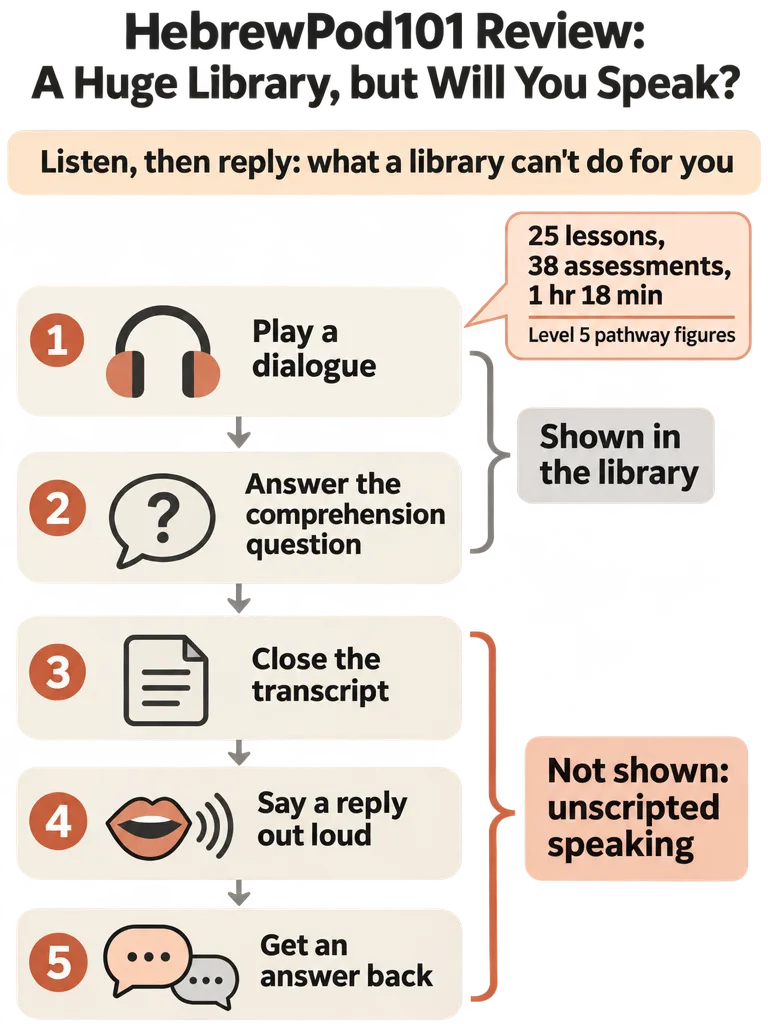
Listening alone can leave you frozen because understanding a recording and producing an unscripted reply are different tasks, and the sourced activities mostly test the first. The official library describes listening to a dialogue, answering a question, and getting a breakdown, plus reading, then answering questions. Mezzofanti Guild adds that the audio lessons let you record your voice and compare it with the native audio. None of the sources measures spontaneous speaking, confidence, or pronunciation outcomes.
Here is a listen-then-reply checklist that adds the missing step. It is a practice routine, not a proven result.
Play one dialogue, such as the 1:28 airport-announcement video, with the transcript hidden.
Answer the comprehension question, then read the breakdown.
Close the transcript.
Say a reply aloud that isn't a line from the lesson.
Get something or someone to answer back, then reply again without a script.
How do you turn HebrewPod101 lessons into speaking practice?
Turn a lesson into speaking practice by taking one dialogue, saying its lines aloud, then using a few phrases in a real exchange. Baba's learning hub recommends using a course or teacher for the study sequence and adding conversation practice to turn recognized language into language you can use. The exercise:
Pick one short dialogue and listen to it twice.
Say each line aloud, then swap roles and play the other speaker.
Add three phrases from Baba's learning hub, in the table below.
Say them to a person or tutor, and answer whatever comes back.
Hebrew
Transliteration
Meaning
נעים מאוד
naim meod
Nice to meet you
אפשר קפה, בבקשה?
efshar kafe, bevakasha?
A coffee, please?
לא הבנתי
lo hevanti
I did not understand
The learning hub gives one form for each phrase and doesn't mark separate masculine and feminine versions.
Someone has to answer you. Options are a teacher, a language partner, an ulpan class, or an AI tutor. This comparison of Hebrew AI tutors shows how to test a few.
Baba, which publishes this site, makes one of those options. baba Learn is a speaking app for adults 18 and over, with AI tutors Maya and David and an English interface. It is currently in beta, and corrections can be wrong, so check disputed ones with a teacher. You can join the baba Learn waitlist.
Who should pay for HebrewPod101, and who should pick something else?
Pay for HebrewPod101 if you want structured listening, the alphabet with niqqud, and Israeli culture on a budget. Pair it with speaking practice, or pick something else, if you need speaking reps or corrections you can review later. Both are sourced from the reviews above.
Pay if you:
want to learn the alphabet and niqqud properly. Fluent in 3 Months says it does this with no transliteration crutch.
learn well by ear. Fluent in 3 Months also praises the native-speaker audio, a gesture-based conjugation series, and downloadable lesson-note PDFs.
want a low entry price and a free tier to test first.
Skip it, or pair it, if you:
need a grammar reference. Fluent in 3 Months says it is weak, so the binyanim (verb patterns) need a companion resource.
want advanced content. Both Fluent in 3 Months and Mezzofanti Guild call it thinner.
dislike heavy English explanations, which Top Consumer Reviews flags.
need to practice replying out loud. Fluent in 3 Months found almost no live speaking practice.
Is HebrewPod101 free, or can I try it before paying?
HebrewPod101 has a free tier, but it is a sampler. Fluent in 3 Months says a free account includes the first 3 lessons of every pathway, vocab resources, Word of the Day, the app, and a 7-day Premium trial. Full audio and video lessons start at the Basic tier, about $4 a month according to reviewers. Confirm current prices on the official site.
Will HebrewPod101 help me speak Hebrew in real conversations?
Not on its own. Fluent in 3 Months found almost no live speaking practice, and even the top tier's teacher feedback is written. Top Consumer Reviews describes teacher support for pronunciation and guided speaking, so the sources disagree. None of them measures whether the course improves spontaneous speaking, so add practice with someone who answers back.
Does HebrewPod101 teach the Hebrew alphabet and niqqud?
Yes. Fluent in 3 Months says HebrewPod101 teaches the alphabet and niqqud (the vowel points) properly, with no transliteration crutch. Top Consumer Reviews adds that the alphabet is introduced gradually, starting with modules such as Hebrew Alphabet Made Easy and Level 1 practice lessons. Everyday Hebrew is usually written without niqqud, so reading practice still needs to move beyond learner material.
Is HebrewPod101 good for learning Hebrew grammar?
It teaches grammar through dialogues, but it is a weak grammar reference. Top Consumer Reviews says grammar is woven into dialogues with optional explanations. Fluent in 3 Months calls the reference weak and says the binyanim, Hebrew's verb patterns, need a companion resource. Mezzofanti Guild describes grammar instruction as minimal. Pair it with a grammar guide if you want rules laid out.
Is HebrewPod101 enough for advanced Hebrew learners?
Probably not on its own. Fluent in 3 Months calls the advanced content thinner and less organized than the beginner levels, and Mezzofanti Guild notes far more lower-level material than intermediate or advanced. The official advanced library lists pathways such as Flexing your Fluency (57 lessons) and a Level 5 path labelled C1-aligned. That label describes the course, not what learners achieve.
How long are HebrewPod101 lessons?
Lessons usually run about 5 to 15 minutes, according to Top Consumer Reviews, with transcripts and notes. Recent free episodes are shorter: a 1:28 video conversation about understanding an airport announcement, and 3:15 verb-conjugation videos. The short format suits daily listening, but it is mostly listening and reading, not conversation.