Hebrew for lone soldiers: No minimum level was verified in the sources reviewed. Practice responding to commands, base-life questions, and calls.
How much Hebrew do I need before the army?
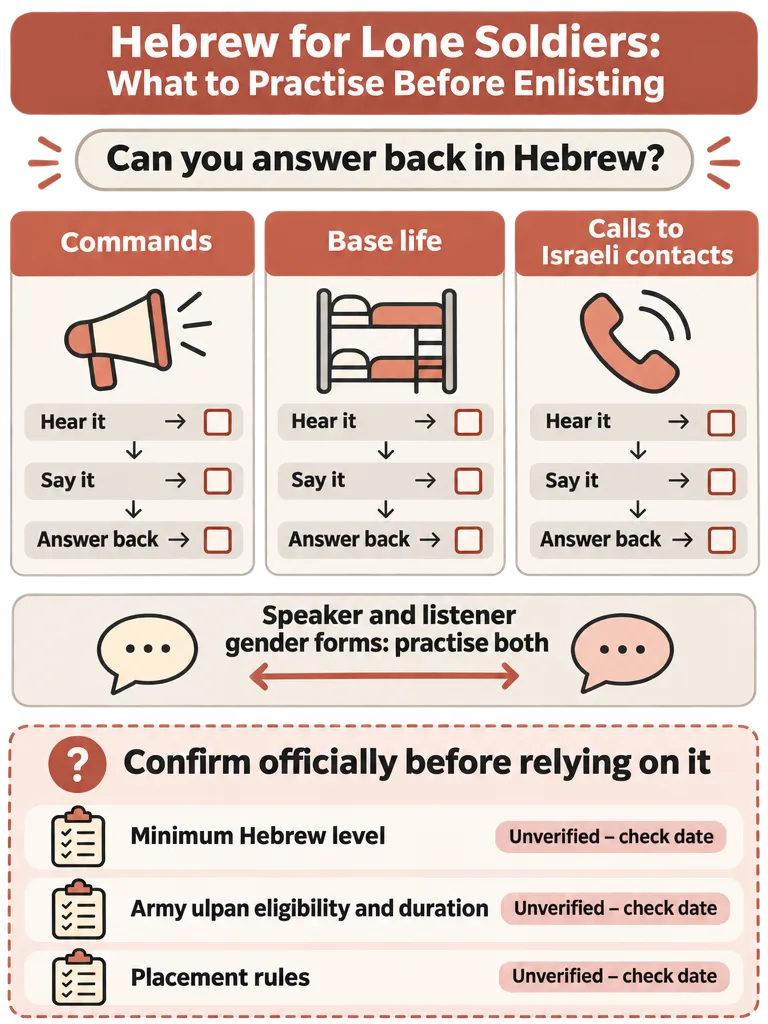
No verified minimum Hebrew level for enlisting appears in the sources reviewed here, so the practical goal for Hebrew for lone soldiers is being able to respond aloud in three situations: commands, base life, and calls to Israeli contacts. Confirm official placement requirements directly with a recruiting body or lone-soldier program.
Here is a 10-minute self-check you can run today. Pick one scenario. Ask a tutor, a native-speaking friend, or a recording to give you one spoken line in Hebrew. Answer aloud in Hebrew without reading anything. Record yourself, then listen back. If you can reply without a long pause, that scenario is in good shape. If you freeze, you now know what to practice next.
A lone soldier, per Wikipedia, is a member of the Israel Defense Forces (IDF) who does not have support in Israel. The advice in draftidf.co.il's tips for lone soldiers is to learn "as much Hebrew as you possibly can." None of the supplied sources give a vocabulary target, a test score to reach, or a timeline, so treat the self-check as a way to find your weak spots, not as a pass/fail test.
What should lone soldiers practice before enlisting?
Practice responding aloud, not recognizing words on a screen. For each of three scenarios (commands, base life, calls to Israeli contacts), run the same loop: hear it, say it, answer back. The loop works when you can complete all three steps without stopping to look anything up.
Commands
- Hear it: have someone say a short, two-part instruction in Hebrew, or play a recording of one.
- Say it: repeat the instruction aloud, word for word.
- Answer back: state what you're about to do, aloud, in Hebrew.
Base life
- Hear it: have someone ask you a routine question, such as where you're from or whether you're new.
- Say it: repeat the question to yourself, then ask it back to them.
- Answer back: give a one-sentence reply, then add one follow-up of your own.
Calls to Israeli contacts
- Hear it: play a short voice message or have someone call you.
- Say it: greet them and say who you are.
- Answer back: respond to what they said, and keep the exchange going for one more turn.
Hebrew changes verb, adjective, and pronoun forms depending on who is speaking and who is being addressed, as Baba's guide to English-to-Hebrew daily chats explains. So run each scenario twice: once as yourself, and once imagining you're addressing a man and then a woman. Ask your tutor or a native speaker for the exact phrases and the forms that change.
To go further, rehearse it before you need it by playing both sides of a conversation aloud, then reviewing what tripped you up and running the scene again. Among apps, baba Learn, which is in private beta, offers role-plays for this kind of rehearsal; it isn't an army-specific course, and you can find it at /learn-app.
Can I follow commands and base-life Hebrew if I only know words?
Not reliably, because knowing words doesn't guarantee you can follow a fast instruction. Hebrew verbs, adjectives, and pronouns shift with the speaker and the listener, so one English sentence can need several Hebrew forms. Drill forms and responses, not only vocabulary.
Picture someone giving you a quick instruction and walking away. You need four rescue moves, and each one should come out aloud without thinking:
Rescue move
How to drill it
Gender question to ask a native speaker
Say you didn't understand
Say it aloud right after hearing a recorded instruction
Does this phrase change with my gender?
Ask for a repeat
Ask, wait for the repeat, then respond
Does the "you" form change if I'm asking a man or a woman?
Ask them to slow down
Say it, then listen to a slower replay
Does this change by the listener's gender?
Confirm what you caught
Say back the instruction in your own words
Which verb form fits my gender?
The sources supplied for this article don't include checked Hebrew phrases for these moves, so get them from a native speaker or tutor. Ask for both the masculine and feminine versions, and write down which one fits you and which fits the person you're talking to.
For a custom drill, create your own Hebrew lesson for the one exchange you dread most, then practice it in both gender forms.
What should I rehearse for phone calls to Israeli contacts?
Rehearse a five-step call script: greet, say who you are, ask them to slow down or repeat, confirm what you heard, and close. A phone call gives you no gestures or visual cues, so your spoken response has to carry everything.
Greet: open with a short, friendly greeting and ask how they are.
Say who you are: state your name in one short sentence, and say how you know them if needed.
Ask for slower speech or a repeat: ask them to slow down or say it again. Ask a native speaker how this changes when you address a man versus a woman.
Confirm what you heard: say back the key detail (a time, a place, a task) in your own words and ask if you got it right.
Close: thank them and say you'll talk later.
Ask a native speaker or tutor for the exact Hebrew for each step, and record both the masculine and feminine address forms. Then run the script aloud three times, once for each person you might call.
For voice notes, use a simple four-step routine: listen for the gist, draft a short reply, rehearse it aloud, then send. A short reply you can say well beats a long one you half-remember. For more on this, see practice a reply before you press send.
What is the army ulpan, and what should I confirm before relying on it?
In this article, "army ulpan" means a Hebrew course connected to service, and the sources here don't describe it fully. draftidf.co.il mentions a three-month Hebrew course, but the available text cuts off before saying who takes it. A Reddit thread on r/IDF claims soldiers with a placement score (סימול) under 6 are sent to a base in the north. Both are unofficial. Neither supplied excerpt includes a verifiable date. Treat them as leads, not current policy.
Ask a recruiting body or lone-soldier program these questions, and note the date of each answer:
Who is eligible, and is the course required or optional?
How is placement decided, and what does a score mean?
How long does it last, and is the length the same for everyone?
What does the curriculum cover: general Hebrew, military vocabulary, speaking?
Where is it held, and does it change your service timing?
Whatever the answers, extra speaking practice alongside any course is optional but can help you find weak spots. For ideas on turning class time into speech, see how to prepare for ulpan before you land.
Where can lone soldiers get support before service?
Two programs appear in the sources. The Nefesh B'Nefesh Lone Soldiers Program describes itself as the address for every lone soldier in Israel before, during, and after IDF service. Gar'in Tzabar is described in a Shivat Zion overview as a program supporting lone soldiers making aliyah.
The sources don't say what language help either program offers. Ask each one directly:
Do you offer or recommend Hebrew speaking practice before enlistment?
Which official source should I use for current Hebrew placement rules?
Can you connect me with soldiers who went through the same process recently?
If you're also planning your move, see learning Hebrew in the year before aliyah. The army families learning path covers a related audience.
Frequently asked questions
What is a lone soldier in Israel, and what is the Hebrew term?
A lone soldier (Hebrew: חַיָּל בּוֹדֵד, Ḥayal Boded) is a member of the Israel Defense Forces who does not have support in Israel, according to Wikipedia. The Nefesh B'Nefesh Lone Soldiers Program describes itself as the address for every lone soldier before, during, and after IDF service.
Can I join the IDF if I don't speak Hebrew?
The sources reviewed don't state a verified minimum Hebrew level for enlisting, so confirm placement requirements directly with a recruiting body or a lone-soldier program. One lone-soldier tips page on draftidf.co.il advises learning "as much Hebrew as you possibly can" before you go.
How long will it take to learn enough Hebrew for the army?
No source reviewed gives a timeline or a target level, and nobody can honestly promise one. A better measure is whether you can reply aloud without a long pause in three situations: commands, base life, and calls to Israeli contacts. A 10-minute self-check on each shows what to practice next.
Do lone soldiers have to take a Hebrew course?
Possibly, but the sources don't settle it. A draftidf.co.il tips page mentions a three-month Hebrew course, though the available text cuts off before saying who takes it. A Reddit thread claims a placement score under 6 sends soldiers to a base in the north, but it is unofficial. Confirm eligibility and dates with a recruiting body.
Can an app help me practice speaking Hebrew before I enlist?
An app can give you spoken rehearsal, but not official military instruction. baba Learn, currently in private beta, offers role-plays where you answer aloud with AI tutors Maya and David. It isn't an army-specific course, its interface is English only, and feedback can be wrong, so check key phrases with a native speaker.
What is Yom Siddurim for lone soldiers?
Yom Siddurim is an errands day that lone soldiers get once a month, according to a Times of Israel blog by a lone soldier. Some soldiers use it for down time, while for others it is vital for getting personal errands done.