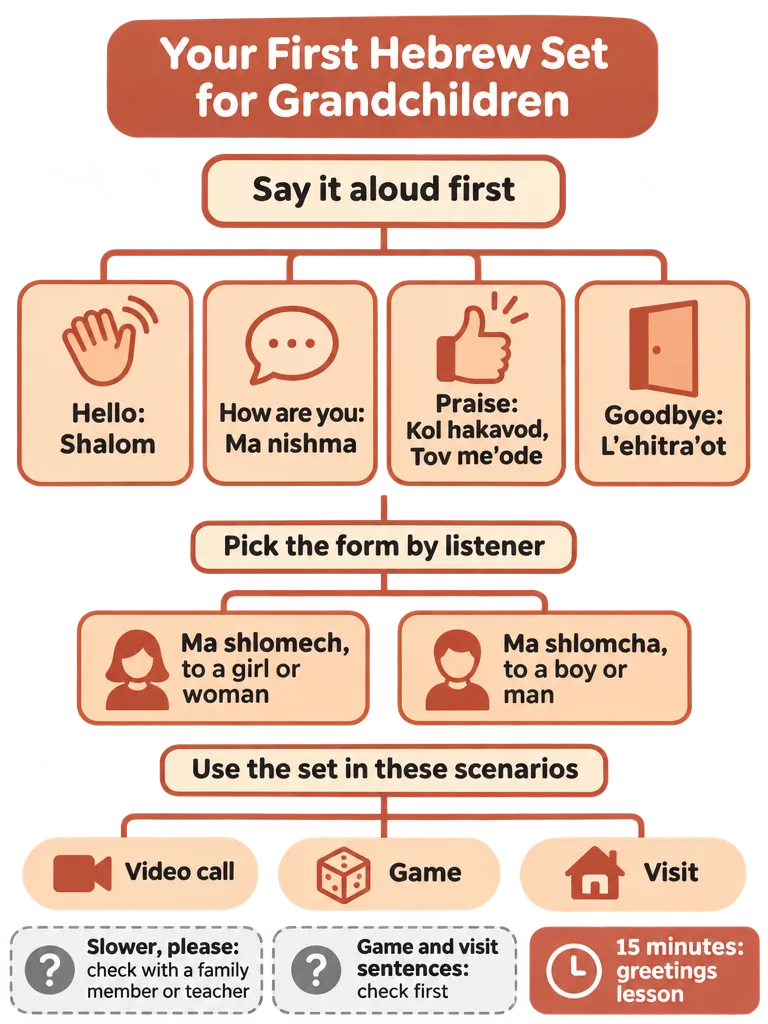
To speak Hebrew with grandchildren, rehearse four lines aloud: hello, how are you, great job, and see you later. Use them on calls or visits.
How can I talk to my Israeli grandkids in Hebrew?
To speak Hebrew with grandchildren, rehearse one short set aloud: a greeting, a how-are-you, one piece of praise and a goodbye. Before choosing any form, decide whether you're addressing a grandson, a granddaughter or several children, because Baba's family Hebrew guide says Hebrew inflects to both speaker and listener.
The set used through this article comes from the Hyman Brand Hebrew Academy's Mini-Hebrew Dictionary, which lists each phrase with its Hebrew spelling and meaning:
Shalom (שלום): hello
Ma nishma? (מה נשמע): how are you?
Kol hakavod! (כל הכבוד): great job!
L'ehitra'ot (להתראות): see you later
Say all four aloud once now. Then follow them through three moments: a video call, a game and a visit. Where the supplied sources do not confirm a Hebrew line, the article says so and points you to a family member or teacher.
What Hebrew should I say first on a video call?
Start with Shalom, Ma nishma, Kol hakavod and L'ehitra'ot: hello, how are you, great job and see you later. The Mini-Hebrew Dictionary lists each with its Hebrew spelling. Boker tov covers a morning call, and Todah covers thanks.
English
Transliteration
Hebrew
Who it fits
Hello / goodbye / peace
Shalom
שלום
Anyone; opening or closing a call
Good morning
Boker tov
בוקר טוב
A morning call
How are you?
Ma nishma
מה נשמע
General how-are-you, no gender label in the dictionary
How are you? (to a woman)
Ma shlomech
מה שלומך
Family guide example, addressed to an older woman
How are you? (to a man)
Ma shlomcha
מה שלומך
Family guide example, addressed to an older man
Great job
Kol hakavod
כל הכבוד
Praise at any point in the call
Thank you
Todah
תודה
Anyone
See you later
L'ehitra'ot
להתראות
Closing the call
Baba's family Hebrew guide prints one unvowelled spelling for both shlomech and shlomcha, so the transliteration carries the difference. The supplied extract doesn't show which form to use with a particular grandchild, so confirm that with a family member or teacher before using either. The script below uses Ma nishma, which the dictionary lists without a gender label.
Your four-line call script, said aloud:
Shalom! (or Boker tov! in the morning)
Ma nishma?
Kol hakavod!
L'ehitra'ot!
Rehearse with the transliteration first, then look back at the Hebrew text. That is the order Baba's seniors path uses: Latin spelling as a safety net, then back to the Hebrew. Its greetings lesson is allocated 15 minutes and asks you to say hello, thank you and goodbye aloud. That is an editorial lesson length, not a promised result.
How do you say grandchildren in Hebrew, and what changes for a grandson or granddaughter?
The supplied sources do not verify a Hebrew word for grandson, granddaughter or grandchildren. They do verify nearby terms: Savta and Saba for grandma and grandpa, yeled and yalda for boy and girl, and ha-yeladim and ha-yeladot for groups of children.
Hebrew
Transliteration
Meaning
Source
סבתא
Savta
Grandma
Baba family guide; Hyman Brand dictionary
סבא
Saba
Grandpa
Baba family guide; Hyman Brand dictionary
ילד
Yeled
Boy
Hyman Brand dictionary
ילדה
Yalda
Girl
Hyman Brand dictionary
הילדים
Ha-yeladim
The kids: boys, or a mixed group
Baba family guide
Spelling not shown on the page
Ha-yeladot
The kids: girls only
Baba family guide
A video titled "Hebrew Word of the Day - Grandchild" exists, but the page text supplied does not show the word. Ask a family member or teacher, and don't guess a spelling.
Speaker and listener both matter because the same line can change depending on who is talking and who is being addressed. The family guide's rule is to set both before you pick a verb. Its how-are-you example shows shlomech for a woman and shlomcha for a man, and the guide addresses that example to an older woman or man. The supplied extract does not say how to apply it to a child.
What can I say during a game or a visit?
During a game or visit, Kol hakavod (great job) praises a good move, Tov me'ode (very good) praises good work, and Bevakasha (you're welcome) answers thanks. Yom huledet sameach (happy birthday) and Mazal tov (congratulations) mark events, and L'ehitra'ot (see you later) closes the visit. All come from the Hyman Brand Hebrew Academy's Mini-Hebrew Dictionary.
Moment
Transliteration
Hebrew
Meaning
Praising a good move
Kol hakavod
כל הכבוד
Great job
Praising a drawing or an answer
Tov me'ode
טוב מאוד
Very good
Replying to thanks
Bevakasha
בבקשה
You're welcome
Receiving something
Todah
תודה
Thank you
A birthday
Yom huledet sameach
יום הולדת שמח
Happy birthday
A happy event
Mazal tov
מזל טוב
Congratulations
Leaving
L'ehitra'ot
להתראות
See you later
This is a praise-and-closings set, not a broad beginner list. It gives you something true to say while a child plays, shows you a drawing or leaves at the end of the afternoon.
The supplied sources contain no verified Hebrew sentences for taking turns in a game or arranging a visit, such as "whose turn is it?" or "when are you coming?" Take those lines to a teacher or family member before you use them. Baba's Hebrew-for-family page covers the family words that come up around the table.
What if my grandchild talks too fast?
Choose one repeat-or-slow-down request before the call, say it aloud until it feels ordinary, and keep it as your rescue line. The supplied sources do not verify a Hebrew phrase for "slower, please" or "say it again," so get the exact words from a teacher or family member rather than guessing.
Ulpan La-Inyan's article on learning Hebrew to talk to grandchildren depicts grandchildren speaking "fast, fluent, effortless Hebrew" about kindergarten and a cartoon. If you know words but freeze when someone answers at that speed, you're in the situation it describes. For the freezing itself, see Baba's post on understanding Hebrew but freezing when you speak.
Listen for one familiar word. Don't chase the whole sentence. A name or todah is an anchor.
Ask for a repeat without apologizing. Use the repetition request your family member or teacher confirmed, in a calm, ordinary voice.
Match your reply to what you understood. Praise like Kol hakavod fits when you know what the child did. If you didn't follow, use the confirmed repetition request instead, because praise may have nothing to do with the child's question or story.
Is it too late to learn Hebrew in my 60s or 70s?
Learning Hebrew in your 60s or 70s is not too late, according to two Hebrew teaching providers, Ulpan La-Inyan and Hebrew by Inbal. Both sell Hebrew courses, so their answers are encouragement from people who teach this group, not independent research on age and language learning.
Ulpan La-Inyan answers the question with "No" and says mature learners often bring motivation, heart and lived experience. It also says learning may take more time and that you'll mix up words. Hebrew by Inbal says on its homepage that it teaches people in their 70s and 80s, and that some now help their grandkids with Hebrew.
If your worry is that your memory is the worst, use a low-pressure routine rather than a promise. Baba's seniors path suggests setting a small daily flashcard pile and stopping when tired. If three cards is what today allows, three cards is a complete session.
How can I practice before the call without feeling rushed?
To prepare for a video call in Hebrew, rehearse the same four lines aloud: Shalom, Ma nishma, Kol hakavod and L'ehitra'ot. Say them from the transliteration first, look back at the Hebrew, then run through them once more shortly before the call. This is a suggested exercise, not a tested method.
Write the four lines. Put the transliteration and the Hebrew side by side, using the table above.
Say each line aloud, slowly. Use the transliteration.
Check against the Hebrew. Look at the letters once, look away, and say the line again.
Settle the question for your listener. Ask a family member or teacher to write out the complete how-are-you question for a grandson, a granddaughter and a group. Shalom yeladim ("Hello children") is a group greeting from the dictionary. A plural how-are-you question is a different task, and the supplied sources don't give its form.
Repeat just before the call. One run-through, then stop.
For adults who want a private place to rehearse out loud, baba Learn is a speaking app for adults 18+, currently in private beta, with role-plays and optional transliteration for your own speaking practice.
Frequently asked questions
What are grandparents called in Israel?
Israeli grandmothers are called Savta (סבתא) and grandfathers Saba (סבא). Both words appear in the Hyman Brand Hebrew Academy's Mini-Hebrew Dictionary and in Baba's family Hebrew guide, which says Savta is a family name rather than a formal title like "Mrs." Learning these two first gives you the words your grandchildren will use for you.
How do Israelis say hello?
The standard greeting is Shalom (שלום), which means hello, goodbye and peace. Boker tov (בוקר טוב) means good morning, and Ma nishma (מה נשמע) asks how are you. Shalom yeladim means "hello children" and works as a greeting to a group of kids. All of these are listed in the Hyman Brand Hebrew Academy's Mini-Hebrew Dictionary.
What is the Hebrew word for grandchildren?
None of the sources reviewed confirm a Hebrew word for grandchildren, so guessing a spelling is risky. The verified nearby words are yeled (boy), yalda (girl), ha-yeladim (the kids, boys or a mixed group) and ha-yeladot (girls only). Ask a family member or Hebrew teacher to write out the exact word for a grandson, a granddaughter and grandchildren together.
Does Hebrew change depending on whether I'm talking to a grandson or a granddaughter?
Yes. Hebrew inflects to both the speaker and the listener, so the same line can change depending on who is addressed. For example, how are you is Ma shlomech (מה שלומך) to a woman and Ma shlomcha to a man. Baba's family Hebrew guide shows those examples for older adults, so have a family member confirm the right form for a child.
Can I practice Hebrew with transliteration instead of Hebrew letters?
Yes, you can start by sound. Baba's 30-day Hebrew for Seniors path puts transliteration on Day 5 as a Latin-spelling safety net, then has you look back at the Hebrew, with greetings on Day 6. Hebrew by Inbal also advertises speaking without reading. Rehearse phrases like Shalom and Ma nishma aloud first, then match them to the letters.
What if I don't have anyone to practice Hebrew with?
You can rehearse speaking aloud in a private app. baba Learn is a speaking app for adults 18+, currently in private beta, with role-plays, AI tutors named Maya and David, and optional transliteration. The interface is English only. Its feedback can be wrong, so check any phrase you plan to use with your grandchildren against a family member or teacher.