For Hebrew at the shuk, say Slicha, ask the price, say what you want, and finish with toda. Practice quantities and check the total.
What do I say at an Israeli market?
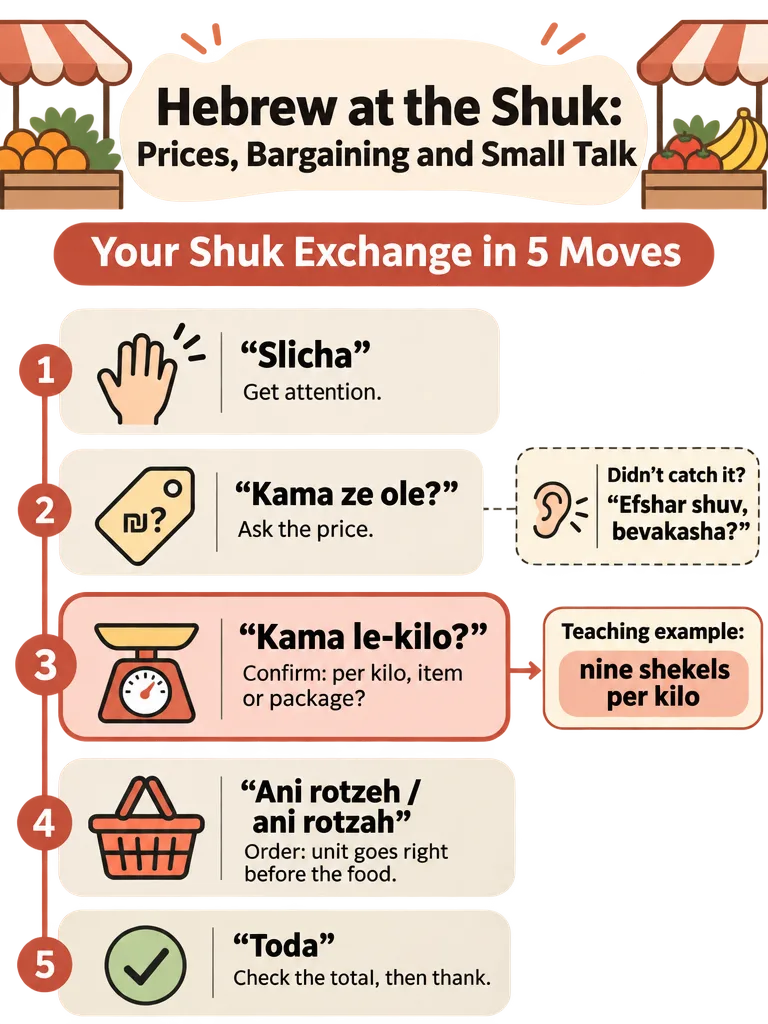
Hebrew at the shuk takes four short moves: say "Slicha" (excuse me), ask "Kama ze ole?" (how much is this?), say what you want with "ani rotzeh" (man speaking) or "ani rotzah" (woman speaking), then finish with "toda" (thank you). Say the exchange aloud once before you go, so the order comes out without a freeze.
HebrewPod101 teaches "Slicha" as almost always the first thing to say to a shop clerk. A shuk is an Israeli market, and Masa Israel describes it as more than a place to shop: a social hub where friends catch up and strangers strike up conversations.
Move
Hebrew
Transliteration
Get attention
סליחה
Slicha
Ask the price
כמה זה עולה?
Kama ze ole?
Say what you want
אני רוצה
Ani rotzeh (man) / Ani rotzah (woman)
Close
תודה
Toda
How do I ask the price and check whether it's per kilo, per item or per package?
Ask the price, then confirm the unit before you order. The Aleph & Apricot market guide (updated July 2026) says prices may be posted by item, package, weight, or quantity, so the number alone doesn't tell you what you'll pay. Here is the sequence:
Get attention. Say Slicha (סליחה).
Ask the price. Use Kama ze ole? (כמה זה עולה?) for one item, or name the food. Heb4You gives Kama ha-agvaniyot? (כמה העגבניות?), "How much are the tomatoes?"
Check the weight price. Heb4You also lists Kama le-kilo? (כמה לקילו?), "How much per kilo?" Ask it when the stall sells by weight.
Check per item or per package. The sources supply no Hebrew phrase for this check. Aleph & Apricot only says to ask how the price is calculated before ordering. A workable fallback is to point at the exact item or pack and ask Kama ze ole? again, so the answer covers that one thing.
Say the amount before the vendor weighs. For example, Chatzi kilo, bevakasha (חצי קילו, בבקשה), "Half a kilo, please." Aleph & Apricot says to state the amount first and watch the scale.
Listen for the answer. Heb4You says vendors usually reply with a number plus shekel, such as eser shekel (ten) or esrim shekel (twenty).
Heb4You names Shuk HaCarmel and Shuk Levinsky as Tel Aviv's main shuks, so they're natural places to try this. For the first phrases to learn, see Hebrew for travel.
Watch
Shopping at the Shuk • Everyday Conversations in Hebrew
From Rosetta Stone on YouTube
How do I order a kilo, half a kilo or 100 grams in Hebrew?
Put the unit directly before the food, with no word for "of." Elon.io's market dialogue illustrates this with a kilo of tomatoes, half a kilo of olives, and a hundred grams of cheese. Kilo agvaniyot is literally "kilo tomatoes."
Quantity
Hebrew
Transliteration
English
Kilo
קילו
kilo
one kilo
Half a kilo
חצי קילו
chatzi kilo
500 g
Quarter kilo
רביע קילו
rivi'a kilo
250 g
100 grams
מאה גרם
meah gram
100 g
The kilo, half-kilo, and quarter-kilo words come from Heb4You, which also lists echad, shnayim, shalosh, arba, chamesh for counting items one to five. Elon.io's dialogue is the source for the 100-gram request. Number agreement with the noun is a separate issue that the supplied sources don't fully cover, so treat that list as Heb4You's counting words, not a complete system.
Two different genders are in play:
Your gender decides ani rotzeh (man) or ani rotzah (woman).
The vendor's gender decides "give me." The Shotef produce guide gives ten li (תן לי) to a man and teni li (תני לי) to a woman.
Shotef notes that Efshar...? (אפשר...?), "Can I get...?", sounds a little softer. It also spares you from choosing between ten and teni: Efshar kilo tapuchim, bevakasha?
What will the vendor say back, and what if I don't catch the price?
Listen for three things: a question, a weight, and a total. The Shotef guide lists Od mashehu? (עוד משהו?), "Anything else?", plus the weight reply זה קילו וחצי ("That's a kilo and a half") and the spoken total זה עשרים ושמונה שקלים ("That's 28 shekels"). The guide gives those two lines in Hebrew script only, so listen for the number words and shekalim.
If you miss the number, use one of these:
Efshar shuv, bevakasha? (אפשר שוב, בבקשה?): "Can you say that again, please?"
Ma ha-mechir? (מה המחיר?): "What's the price?"
Zehu, toda (זהו, תודה): "That's enough, thank you." Use it when the vendor keeps adding produce.
Finish with a total check from Heb4You: Kama ze be-sach ha-kol? (כמה זה בסך הכל?), "How much is that in total?" Elon.io's practice dialogue adds up to 59 shekels: nine for tomatoes, twenty for olives, thirty for two packs of cheese. To practice, add the three amounts yourself, or have a partner read them aloud and total them before you check.
What small talk do vendors make, and how do I answer?
Vendor chatter is something to recognize first and answer second. Elon.io's practice dialogue has a vendor asking "Anything else?", offering cheese, and inviting the customer to taste. The iCenter describes Machane Yehuda on a Friday morning as full of vendors calling out their wares in many languages.
You may hear
Short reply
Od mashehu? (anything else?)
Ken, chatzi kilo zeitim (yes, half a kilo of olives) or Zehu, toda (that's enough, thanks)
An offer to taste
Ken, toda (yes, thanks) or Lo, toda (no, thanks)
An offer of something extra
Ken, toda (yes, thanks) or Zehu, toda (that's enough, thanks)
If an extra might cost money, ask Kama ze ole? before you say yes. Free extras and banter aren't guaranteed, so don't treat them as part of the script. If a sample is delicious, Heb4You suggests chaval al ha-zman (חבל על הזמן), a local compliment that means "amazing."
Can you bargain at an Israeli shuk, and how do you stop politely?
Bargaining at an Israeli shuk depends on the stall. The Aleph & Apricot guide says posted-price groceries, bakeries, and prepared-food counters may have fixed prices, while flea-market goods, souvenirs, and larger purchases may allow discussion. Ask once, pleasantly, and accept the answer.
The sources disagree on how much room there is. Heb4You says prices are often negotiable and that fruit and vegetable stalls usually won't budge. It also says discounts sometimes come at the end of the day. The newer 2026 guide says neither an earlier nor a later visit guarantees lower prices, so don't count on timing-based discounts. It does say timing affects how crowded and easy to browse a market is. This article follows the narrower, newer guidance.
How to ask once:Yesh hanacha? (יש הנחה?), "Is there a discount?" The guide says not to pressure a vendor after a price or refusal. Heb4You also offers Efshar zol yoter? (אפשר זול יותר?), "Can it be cheaper?" Its third phrase, "What if I take two?", uses a masculine speaker form and isn't paired with a feminine one, so skip it. Use one question, not several.
Where to try: Heb4You points to Shuk HaPishpeshim, the Jaffa flea market, where clothing, accessories, and crafts often move on price. No source here gives discount percentages, so don't expect a number.
How to stop:Zehu, toda or simply Toda works as a polite close.
Can I choose, taste or pay by card at a stall?
At an Israeli shuk stall, choosing produce, tasting, and paying by card all depend on the vendor. The Aleph & Apricot guide says some vendors let you pick each piece while others select and bag it themselves. Don't sample unless it's offered. Cash and card acceptance vary by vendor and market.
Efshar livchor? (אפשר לבחור?): "Can I choose?" Watch the first few transactions, or ask.
Efshar litom? (אפשר לטעום?): "Can I taste?" Heb4You calls tasting normal at cheese, olive, and spice stalls, but the Aleph & Apricot guide says not to sample unless it's offered. Ask first and don't assume.
Efshar leshalem bekartis? (אפשר לשלם בכרטיס?): "Can I pay by card?"
Ask before a large order. Heb4You warns that many smaller stalls are cash-only or set a minimum for cards. Confirm the item, quantity, unit price, and total before you pay.
How do I rehearse a shuk exchange before I get there?
To rehearse a shuk exchange, say a three-turn script aloud: ask the price of tomatoes, confirm the unit and order half a kilo, then check the total and say thanks. Record yourself, then repeat only the turn that caused difficulty. Use the gender forms that fit you, not a vendor's.
Attention and price:Slicha, kama le-kilo?
Unit and order:Ani rotzeh / rotzah chatzi kilo, bevakasha. (Pick the form for your gender.)
Total and thanks:Kama ze be-sach ha-kol? Toda.
Once the script feels steady, add a vendor line you can't predict, such as Od mashehu? or a price you must ask to hear again.
Baba Learn is a speaking app for adults learning modern Israeli Hebrew, currently in private beta. It offers role-play practice with AI tutors Maya and David and explains corrections, though app feedback can be wrong. This article doesn't assume a ready-made shuk lesson, since the script above works in any speaking practice.
A shuk (שוק) is an Israeli open-air market, and the word covers more than shopping. Masa Israel describes it as a social hub where friends catch up and strangers strike up conversations. Shuks exist in cities and towns across Israel, and many sell food, from fresh produce to falafel and pastries.
Which markets in Israel are called shuks?
Jerusalem's shuk is Machane Yehuda, which The iCenter describes as busiest on Friday morning before Shabbat, with vendors calling out in many languages. In Tel Aviv, Heb4You names Shuk HaCarmel and Shuk Levinsky as the main ones. Jaffa has Shuk HaPishpeshim, a flea market where clothing, accessories, and crafts often move on price.
How do you say "how much is this?" in Hebrew?
Say Kama ze ole? (כמה זה עולה?). Kama means "how much," ze means "this," and ole is the verb "to cost." HebrewPod101 teaches Slicha (excuse me) as almost always the first thing to say to a shop clerk, so open with that. When a stall sells by weight, ask Kama le-kilo? (how much per kilo?).
How do I ask for something at a shuk without getting the gender wrong?
Say ani rotzeh (אני רוצה) if you're a man and ani rotzah if you're a woman. To ask a vendor to give you something, ten li (תן לי) is for a man and teni li (תני לי) is for a woman. Shotef notes that Efshar...? (אפשר...?), "Can I get...?", avoids that choice and sounds a little softer.
Do I need good Hebrew to buy fruit and vegetables at a market?
No. Shotef says a few clear words are usually enough at a market, a greengrocer, or a supermarket produce section. The most useful things to know are item names, how to ask for a quantity, and how to understand the price. Short, direct Hebrew is normal there, and pointing while you say the item name often works.
How do I say "half a kilo" in Hebrew?
Say chatzi kilo (חצי קילו), and add bevakasha (please): Chatzi kilo, bevakasha. To order a specific food, put it right after the unit, as in kilo agvaniyot (a kilo of tomatoes). Heb4You gives rivi'a kilo for a quarter kilo. Aleph & Apricot advises stating the amount before the vendor weighs.