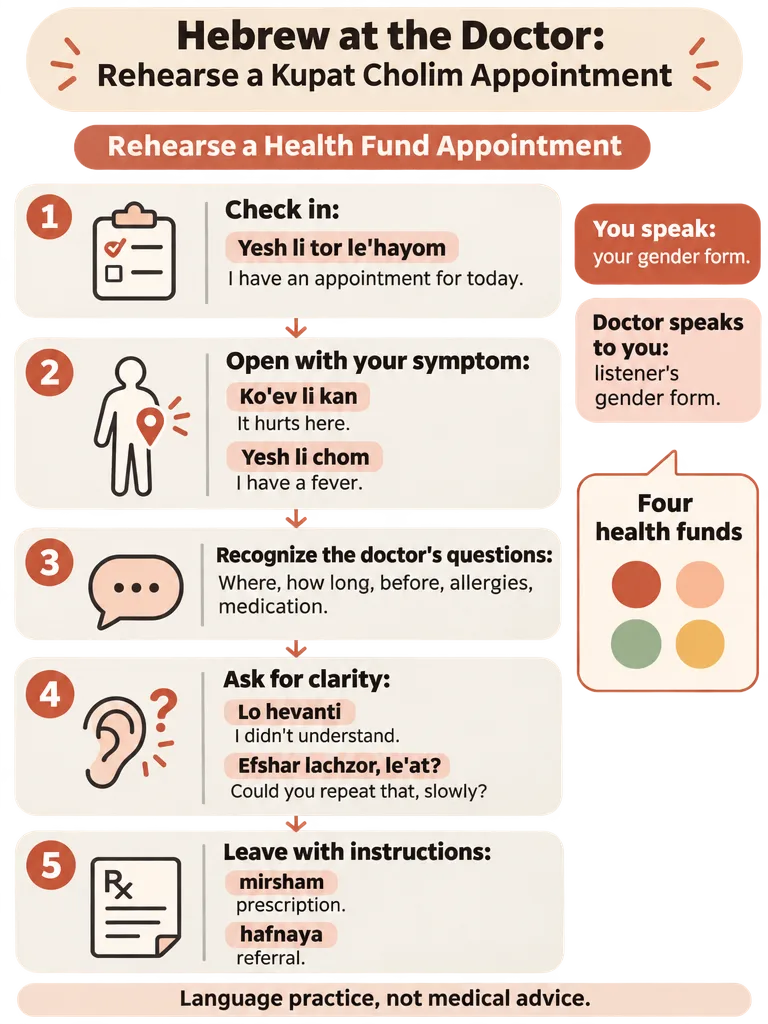
Hebrew doctor appointment phrases: say where it hurts, what you have, and how long. Start with Ko'ev li kan: “It hurts here.”
How do I explain symptoms to an Israeli doctor?
Hebrew doctor appointment phrases for symptoms are short and present-tense: say where it hurts, what you have, and how long. Dr Dylan Mergui's newcomer healthcare guide gives Ko'ev li kan (כואב לי כאן, "It hurts here"), Yesh li chom (יש לי חום, "I have a fever"), and Yesh li ke'ev rosh (יש לי כאב ראש, "I have a headache").
You can chain two symptoms with "and." The Shotef Hebrew-for-urgent-care page models it as Yesh li chom ve-ke'ev garon (יש לי חום וכאב גרון, "I have a fever and a sore throat"). If you're unsure how long it has lasted, "since yesterday" is Me'az etmol (מאז אתמול), also from Shotef's dialogue.
Shotef's urgent-care guide adds one rule of order: say the most urgent symptom first, and keep it short. Its examples of what comes first are chest pain, trouble breathing, heavy bleeding, and fainting. It also says clarity matters more than perfect grammar in a medical setting.
How do you say "appointment" in Hebrew, and what do you say at check-in?
"Appointment" at the doctor is tor (תור), not pgisha, the general word for a meeting. The medical phrase sources use tor throughout. HebrewPod101 gives Yesh li tor le'hayom (יש לי תור להיום, "I have an appointment for today"). Mergui's guide gives the booking line.
Yesh li tor le'hayom (יש לי תור להיום): "I have an appointment for today." Same for any speaker.
Ani rotze likbo'a tor (אני רוצה לקבוע תור): "I would like an appointment," said by a man. A woman says Ani rotza likbo'a tor. The Hebrew spelling is identical, and only the vowel at the end changes.
At the desk, expect to show a member card or ID. The sign reads יש להציג כרטיס חבר או תעודת זהות ("Please show your member card or your ID card"), and Shotef also advises bringing ID and insurance details. The four health funds are Clalit, Maccabi, Meuhedet, and Leumit.
For membership words, booking in your fund's app, and asking for an English-speaking doctor, see our guide to registering with a kupat cholim, in Hebrew. Fund-specific booking steps and costs aren't covered here, because the research behind this article doesn't verify them.
What will the doctor ask me, and how do I answer?
Expect six or seven standard questions: where it hurts, whether you have a fever, how long, whether it has happened before, allergies, and medication. The questions below come from Transparent Language and Shotef. Replies are short on purpose. Transliteration is simplified.
Doctor asks
Hebrew
Say it
Your short reply
Where does it hurt?
איפה כואב לך?
Eifo koev lecha (to a man) / lach (to a woman)
Ko'ev li kan
Do you have a fever?
יש לך חום?
Yesh lecha / lach chom?
Yesh li chom
How long have you been like this?
כמה זמן זה כבר נמשך?
Kama zman ze kvar nimshach?
Me'az etmol (since yesterday)
Have you had this before?
זה כבר קרה לך בעבר?
Ze kvar kara lecha ba'avar?
Ken / Lo (yes / no)
Are you allergic to anything?
אתה אלרגי למשהו? / את אלרגית למשהו?
Ata alergi / At alergit lemashehu?
Ken, ani alergi / alergit...
Do you take medication?
אתה לוקח תרופות? / את לוקחת תרופות?
Ata loke'ach / At lokachat trufot?
Ani loke'ach et ha-trufa ha-zot (see the next section for the woman's form)
Here is the routine visit as one short dialogue. The lines come from the sources above, but the arrangement is new, so have a teacher or Hebrew-speaking friend check it.
You, at check-in: Shalom, yesh li tor le'hayom. (שלום, יש לי תור להיום.)
Doctor: Ma ha-be'aya? (מה הבעיה? "What's the problem?")
You: Yesh li chom ve-ke'ev garon. (יש לי חום וכאב גרון.)
Doctor: Me'az matai? (מאז מתי? "Since when?")
You: Me'az etmol. (מאז אתמול.)
Doctor: Yesh lecha alergiyot? (יש לך אלרגיות? "Do you have allergies?")
You: Ken, ani alergi lepenitzilin. (כן, אני אלרגי לפניצילין. A woman says alergit.)
The sources give only "since yesterday" as a spoken duration reply. Other durations need a reliable source or a teacher before you use them.
Which Hebrew phrases change with my gender, and which with the doctor's?
Your gender sets the forms you say about yourself, and the gender of the person addressed sets the forms you hear or ask. Sources handle this unevenly: Transparent Language splits male and female versions of the doctor's questions, while others leave several phrases masculine only. This table pulls the pairs together.
Meaning
You say (speaker: man / woman)
You hear or ask (listener: man / woman)
I feel / Do you feel
Ani margish / margisha
Ata margish / At margisha
I'm allergic / Are you allergic
Ani alergi / alergit
Ata alergi / At alergit
I need a doctor
Ani tzarich / tzricha rofe
n/a
I'd like an appointment
Ani rotze / rotza likbo'a tor
n/a
I take / Do you take
Ani loke'ach / lokachat (needs review)
Ata loke'ach / At lokachat
Mergui's phrasebook shows the gap. It writes Ani lo medaber ivrit (אני לא מדבר עברית, "I don't speak Hebrew") in the masculine, and the source doesn't spell out the woman's form. Treat any such form as needing review until a teacher or a sourced guide confirms it. For more on how gender shapes Hebrew in context, see our grammar guides.
What if I don't understand? How do I ask the doctor to repeat slowly?
Use rescue phrases in order, from smallest to biggest. Each one is a complete sentence, so you can stop at the first that works.
Lo hevanti (לא הבנתי): "I didn't understand." Shotef lists it as the first phrase to use. The form is the same for a man or a woman speaking.
Efshar lachzor, le'at? (אפשר לחזור, לאט?): "Could you repeat that, slowly?" This is Mergui's wording. It uses efshar and an infinitive, so there's no you-form to switch for a male or female doctor.
Efshar be-anglit? (אפשר באנגלית?): "Can you do it in English?" This is from Shotef.
Yesh rofe o rofa she-medabrim anglit? (יש רופא או רופאה שמדברים אנגלית?): "Is there a doctor who speaks English?" This is from our kupat cholim guide.
What instructions might I hear before I leave the appointment?
Before you leave, expect an instruction, a prescription, or a referral. Two words to know: a mirsham (מרשם) is a prescription, and a hafnaya (הפניה) is a referral to a specialist. Mergui's guide says specialists sometimes require a hafnaya from your family doctor, and that prescription medications are partially reimbursed.
Mirsham (מרשם): the prescription. At the pharmacy, Mergui gives Yesh li mirsham (יש לי מרשם, "I have a prescription").
Hafnaya (הפניה): the referral to a specialist.
Kach et ha-trufa ha-zu ve-hakped al menucha (קח את התרופה הזו והקפד על מנוחה): "Take this medicine and rest." HebrewPod101 marks it as addressed to a man, and the sources give no female form.
Ana chazor ba'shavua haba le'bdika (אנא חזור בשבוע הבא לבדיקה): "Please come back next week for a check up." This is also addressed to a man.
The sources don't verify Hebrew questions for confirming dose, frequency, or how long to take a treatment. So don't improvise those from a word list. Ask the doctor or pharmacist to write the instructions down, and bring the paper to someone who can read it with you. This is language practice, not medical advice.
How do I rehearse a Kupat Cholim appointment before I go?
You can rehearse in five minutes by saying the lines aloud once. The outcome is less freezing at the desk, because your mouth has already made the sounds. This follows the same idea as rehearsing it before you need it: practice both sides, then repeat.
Check in. Say "Shalom, yesh li tor le'hayom" aloud, twice.
Say your symptom in your own form. Pick "Yesh li chom" or "Yesh li ke'ev rosh," then add one gendered line such as "Ani margish" or "Ani margisha."
Answer three questions. Read the doctor's questions from the table, or record them on your phone, and answer each one aloud.
Practice one rescue phrase. Say "Lo hevanti, efshar lachzor, le'at?" as if you really didn't catch the answer.
Repeat an instruction back. Say "ba'shavua haba" after a pretend "Ana chazor ba'shavua haba le'bdika."
If you'd like someone to answer back, baba Learn is a speaking app for adults learning modern Israeli Hebrew. You can practice the same scene with the tutors Maya or David and review corrections afterward. It's in private beta on iPhone and Android, with an English interface, and feedback can be wrong, so check anything you're unsure about with a teacher. Join the baba Learn waitlist if you'd like early access. For free Hebrew guides, start at the Baba Learn hub.
Frequently asked questions
How do you say "appointment" in Hebrew?
At the doctor, "appointment" is tor (תור), not pgisha, which is the general word for a meeting. To say you have one, use Yesh li tor le'hayom (יש לי תור להיום, "I have an appointment for today"). To book one, a man says Ani rotze likbo'a tor and a woman says Ani rotza likbo'a tor.
Do I need perfect Hebrew to see a doctor in Israel?
No. Shotef's urgent-care guide says clarity matters more than perfect grammar in a medical setting. Name the most urgent symptom first, such as chest pain, trouble breathing, heavy bleeding, or fainting, and keep it short. Pointing and saying Ko'ev li kan (כואב לי כאן, "It hurts here") is often enough to get started.
How do I ask for an English-speaking doctor in Hebrew?
Ask Yesh rofe o rofa she-medabrim anglit? (יש רופא או רופאה שמדברים אנגלית?), which means "Is there a doctor who speaks English?" If you only need the current conversation in English, Efshar be-anglit? (אפשר באנגלית?) works. Neither phrase changes with your gender, so a man and a woman say them the same way.
What should I bring to a doctor's appointment in Israel?
Bring your health fund member card or an ID. A common clinic sign reads יש להציג כרטיס חבר או תעודת זהות ("Please show your member card or your ID card"), and Shotef also advises bringing insurance details. Dr Dylan Mergui's guide says to keep your card with you, physical or in the fund's app.
How do I say "I'm allergic" in Hebrew if I'm a man or a woman?
A man says Ani alergi (אני אלרגי) and a woman says Ani alergit (אני אלרגית). Add the substance after le-, as in Ani alergi lepenitzilin ("I'm allergic to penicillin"). The doctor's question also changes: Ata alergi? goes to a man and At alergit? goes to a woman.
What is a hafnaya in Israel, and do I need one?
A hafnaya (הפניה) is a referral from your family doctor to a specialist, and Dr Dylan Mergui's guide says specialists sometimes require one. A mirsham (מרשם) is a prescription, and the same guide says prescription medications are partially reimbursed. Rules differ by case, so ask your fund which one applies to you.