AI language tutors show promise in other subjects, but the research reviewed doesn't prove they improve adult spoken Hebrew. Use them for extra practice.
Are AI language tutors effective? What the research can and can't tell you
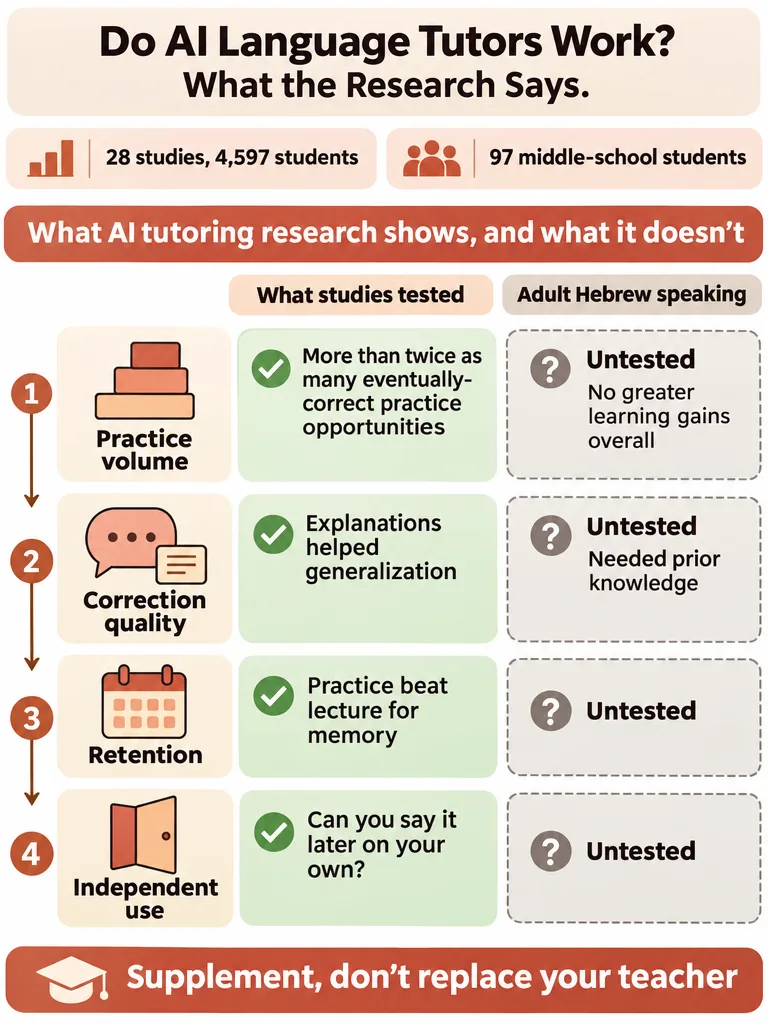
In the research reviewed here, AI tutoring looks promising, but none of it shows that AI language tutors are effective for adult spoken Hebrew. A 2025 npj Science of Learning review of 28 studies and 4,597 K-12 students found generally positive effects of intelligent tutoring, with weaker benefits when compared with non-intelligent tutoring systems.
An intelligent tutoring system, the term that review uses, is software that detects a learner's progress and adapts practice to it. Brookings notes that these systems traditionally relied on rule-based AI, while generative AI can now produce natural dialogue and tailored explanations. Those are related but different categories. Results for older systems don't establish results for today's AI speaking apps. The three primary studies covered below tested physics, linear graphs and linear regression, so treat AI as supplemental speaking practice, not a replacement for a teacher or course.
Here is a short exercise for checking an unaided spoken attempt. Say אפשר קפה, בבקשה? (efshar kafe, bevakasha?), "A coffee, please?" Then say לא הבנתי (lo hevanti), "I did not understand," as if the reply came too fast. Repeat both without looking. It shows you what you can produce on your own. No source here tests it, so it isn't a promise of improvement.
What do the studies actually show about AI tutoring?
AI tutoring research has tested physics, linear graphs and linear regression, plus a K-12 review across school subjects, and results depend on tutor design and comparison group. The primary experiments cited here don't test Hebrew or any spoken language. The table separates experiments, a systematic review and policy guidance, because each answers a different question.
Source and evidence type
Population and subject
Tutor design and comparison
Reported result or recommendation
Limit for Hebrew speaking
Scientific Reports, Greg Kestin and colleagues (randomized controlled trial)
194 Harvard undergraduates, physics
Custom AI tutor built on pedagogical best practices vs an in-class active learning lesson, crossover design
Students learned significantly more in less time and felt more engaged and motivated; median learning gains were over double the in-class group's
One course, one custom-built tutor. The authors also warn that AI tutors can be confidently wrong
Intelligent tutoring systems vs various comparisons, including non-intelligent tutoring systems
Generally positive effects, but weaker when compared with non-intelligent tutoring systems; authors call for longer interventions and more diverse samples
Children in school settings; not adult speaking
Brookings, Mary Burns, 01/27/2026 (analysis of four randomized trials)
Generative-AI tutoring platforms; subjects not itemized in the excerpt
Comparison conditions not shown in the excerpt
Reports learning gains, motivation and efficiency; flags accuracy, pedagogical judgment and possible dependence, and recommends a hybrid of teachers and AI
A recommendation built on other studies, not a Hebrew test
Maps AI tutoring models against human-led high-impact tutoring
AI-led software offers potential for supplemental practice but doesn't yet meet the evidence base for high-impact tutoring
Guidance for schools, not an experiment on language learners
The sources supplied here don't establish that AI tutoring works for adults' spoken Hebrew. They can't say how much an AI conversation partner will improve your speaking, how quickly, or whether it carries over to a real café.
Watch
AI Tutors Just Got Smarter for Language Learning | Praktikai
From Charlotte Jade on YouTube
What makes problem-solving practice effective with an AI tutor?
More practice isn't the same as more learning. In a 2023 study of 97 students practicing linear graphs, working with an intelligent tutor gave students more than twice as many eventually-correct practice opportunities as paper did. Tutor practice still didn't produce greater learning gains overall.
The authors list possible reasons: students gaming the system, a lack of transfer to an unfamiliar test format, potentially ineffective tutor design, and learning affordances of paper. They also conclude that the link between opportunities and learning gains emerges only when the instruction itself is effective. The study was about math, not language.
For a speaker, the takeaway is to count what you can say later on your own, not minutes logged or exercises completed. A streak measures showing up. Try the same café scene tomorrow, cold, with no hints. If you can say the sentence, that is a limited personal check that this one sentence stuck. It doesn't show your conversations have improved. To test tools this way, run one scenario in a gamified app and in an AI tutor and see which leaves you able to say more unaided.
Does feedback with an explanation help more than just the right answer?
In linear-regression experiments, explanations mattered for applying what was learned, not for remembering it. In Michael W. Asher and Paulo F. Carvalho's 2026 study (two experiments, 597 participants, published 01/26/2026), both correct-answer feedback and explanatory feedback beat lecture for memory. For generalization, feedback had to include explanations, and learners needed sufficient prior knowledge to benefit.
That finding comes from statistics, not Hebrew, so it is a clue, not proof. The Hebrew application below is editorial advice, not an established result. If you tend to get corrected, nod, and make the same mistake next week, try asking why the form changed (who is speaking, and to whom). Then build a new sentence with that reason instead of only repeating the corrected line.
The prior-knowledge condition matters too. If a correction explanation reads like gibberish, a course or teacher can supply the groundwork. Timing is a separate choice, and choosing how your Hebrew tutor corrects you, now or at the end of the lesson, is worth setting deliberately.
Can AI practice help if you know the words but freeze when speaking?
AI speaking practice may help with freezing, but the sources reviewed here contain no evidence that it reduces speaking anxiety, carries over to live conversation with people, or improves grammatical-gender accuracy in Hebrew. Any claim that it does goes beyond these studies.
What the research suggests is narrower. The college randomized trial reported that students felt more engaged and motivated with the AI tutor. Brookings argues that AI tutors let students voice confusion without fear of judgment, since they respond with "infinite patience." Those findings come from other subjects. Low-stakes, repeatable attempts are a plausible reason to try AI practice, but plausible isn't proven.
To test it yourself, run the café exercise from the top of this article with a tutor, then once more alone with no hints. If the unaided version still stalls, that tells you which phrase to rehearse next. For a fuller scene, see how to rehearse a Hebrew conversation with an AI tutor.
What should you do when an AI tutor corrects you wrongly?
When an AI tutor's correction looks wrong, check it against a teacher, your course, or a language partner before accepting it. The Scientific Reports authors describe AI tutors' "uncanny confidence" when giving an incorrect answer or marking a correct reply as incorrect, and Brookings lists accuracy as a core concern. This self-check is an editorial exercise, not a validated Hebrew intervention.
Say the sentence aloud before reading any feedback, so you know what you actually produced.
Read the explanation, not just the corrected line. If you can't restate the reason in one sentence, flag it.
Test it against a second source: a teacher, your course, or a language partner.
Retry without looking a day later.
Keep a short list of corrections you can't explain, and bring it to your teacher or course.
How should you use an AI tutor alongside a teacher or course?
Use AI for extra speaking repetitions and saved review, and keep a course or teacher for sequence. That matches Stanford's reading that AI-led software offers supplemental practice, Brookings' call for a hybrid of teachers and AI, and the advice in Baba's free Hebrew learning guides to use a course or teacher for a study sequence and add conversation practice.
Course or teacher: what to learn next, and a second opinion on corrections.
AI tutor: repeating a scene, trying a sentence you're nervous about, reviewing what you got wrong.
You: retrying cold a day later and counting what you can say.
For one example of a speaking app, baba Learn is in private beta on iPhone and Android for adults 18 and over, with an English interface, conversations with Maya or David, explanations and saved practice. Its feedback can be wrong and word stress isn't scored, and those are feature descriptions, not evidence of outcomes. To weigh other routes, see the best Duolingo alternatives for Hebrew.
Frequently asked questions
Is there research proving AI tutors work for learning spoken Hebrew?
No. The studies reviewed here tested physics, linear graphs, linear regression and K-12 school subjects, and none tested Hebrew or any spoken language. A 2025 systematic review of 28 studies and 4,597 K-12 students found generally positive effects of intelligent tutoring, but weaker ones when compared with non-intelligent tutoring systems. Treat AI speaking practice as something to test yourself, not a proven method.
Can an AI tutor replace a human teacher?
Not according to current evidence. Stanford's SCALE brief says high-impact tutoring remains defined by live human-led instruction, and AI-led software offers potential for supplemental practice without yet meeting that evidence base. Brookings likewise recommends a hybrid where teachers and AI work together. Use a course or teacher to set your sequence, and add AI for extra speaking repetitions.
What's the difference between an intelligent tutoring system and a generative AI tutor?
An intelligent tutoring system is software that tracks a learner's progress and adapts practice, and these systems have traditionally relied on rule-based AI. Generative AI tutors can produce natural dialogue, feedback and tailored explanations, according to Brookings. The two are related but different categories, so results for older systems don't establish results for today's conversational AI apps.
Do AI tutors give wrong corrections?
Yes, they can. No source reviewed here gives an error rate, but the risk is documented: the Scientific Reports authors describe AI tutors' "uncanny confidence" when giving an incorrect answer or marking a correct reply as incorrect, and Brookings lists accuracy as a core concern. When a correction looks off, check it with a teacher, your course, or a language partner before accepting it.
How can I tell if practicing with an AI tutor is working?
Count what you can say later without hints. Repeat a scene, such as ordering with אפשר קפה, בבקשה? (efshar kafe, bevakasha?), a day after practicing. Producing the sentence cold shows that one sentence stuck, not that your conversations improved. Minutes and streaks measure showing up: in a 97-student math study, tutor practice gave more practice opportunities than paper but no greater learning gains overall.
Is baba Learn proven to work?
No. None of the research cited here tested baba Learn, and no learning results are claimed for it. It is a speaking app in private beta on iPhone and Android for adults 18 and over, with an English interface and conversations with the tutors Maya and David. Its feedback can be wrong and word stress isn't scored, so test it on a scene you can retry unaided.