No ulpan place? Ask the Ministry about a referral, confirm eligibility and funding, and try a five-minute Hebrew speaking drill.
What can I do if I can't get into ulpan?
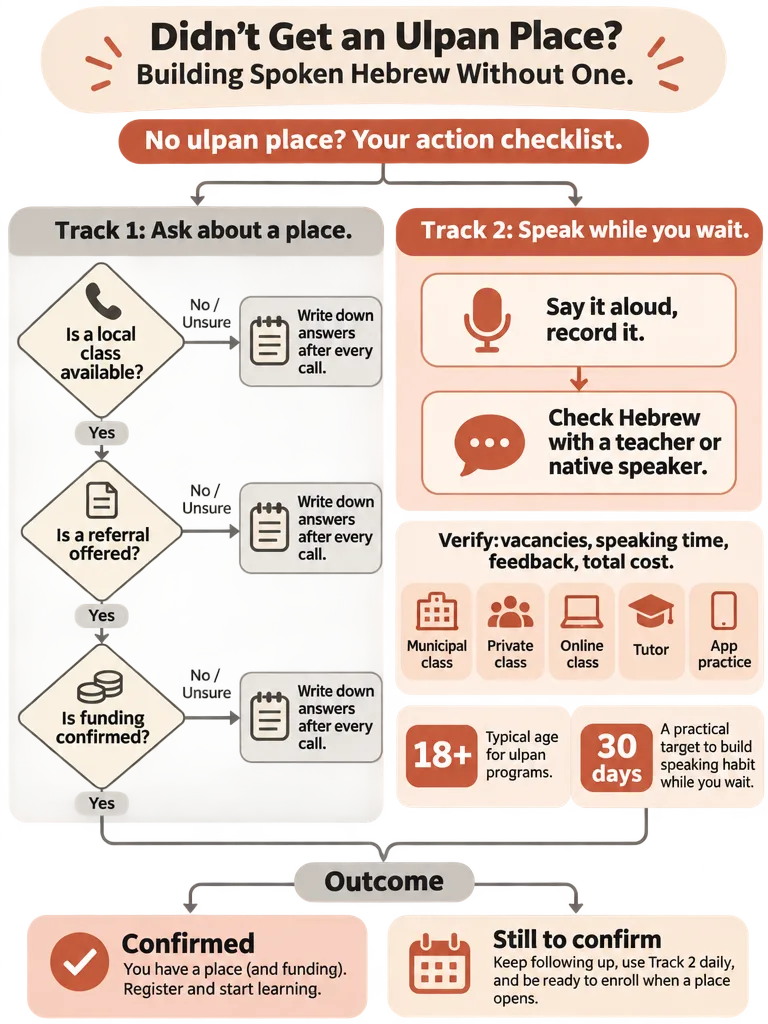
If you have no ulpan place, ask the Ministry of Aliyah and Integration about a referral. Its public-ulpan page says a new immigrant is referred when no local classes are available. Confirm eligibility and funding before paying for anything else, and start speaking practice now instead of waiting.
Start with a five-minute exercise today. This is an editorial suggestion, not a method from the sources reviewed. Record one minute of yourself saying, in whatever Hebrew you have, who you are and what you need. Play it back and mark every place you went silent. The outcome is observable: a short list of the exact spots where you freeze, which you can bring to a teacher, a tutor, or a native speaker.
The Ministry describes ulpan as a framework for learning the Hebrew language. You now have two separate jobs: getting a seat in a structured program, and getting daily speaking reps. Waiting on the first doesn't have to delay the second.
The Ministry excerpt reviewed for this article cuts off before it says where a referral leads or how to request one. Treat the steps below as questions to confirm as of 11/23/2026, not as established rules. The Ministry's own page, and a call to the Ministry, outrank anything here.
What does the Ministry's referral mean when no local class is available?
The Ministry of Aliyah and Integration's public-ulpan page says that if there are no local classes available, a new immigrant is referred to a different option. The excerpt supplied for this article ends before naming that destination, a timeline, or funding terms. Each of those becomes a question you ask directly and write down.
A no-place checklist for your next call or visit:
Ask whether a referral applies to your situation. The page's wording is "If there are no local classes available," so say plainly that your area has no available class.
Ask what you're eligible for today. Rules and funding can change, so request the current conditions rather than relying on a forum post or an older guide.
Ask about your eligibility window. Find out whether the clock is running while you wait for a place.
Ask which documents you need. Get the list in writing if possible.
Ask about funding conditions. Does the referral cover the cost, and does a private course you pay for in the meantime affect that?
After each call, record the date, the person's name, what they said, and the next step they gave you.
That log helps you track and compare answers if two people tell you different things. For the wider picture of the process, see the site's aliyah ulpan guide.
Which ulpan alternatives are worth checking first?
Municipal ulpan, private ulpan, online classes, tutors, and app practice are the five options to check, and the first to pursue is whichever gives you a confirmed start date, regular speaking time, and a funding answer. No source reviewed here compares these formats on current vacancies or tuition, so the table lists what to verify, not established differences.
Option
Vacancies and start date
Schedule
Speaking time and feedback
Cost and funding
Municipal ulpan
Is there a waiting list, and where do you stand?
Days and hours that fit work
How many students per class?
Is it covered for you?
Private ulpan
Next intake date?
Fixed or flexible?
Who corrects you, and when?
Total price, and is it recognized for funding?
Online classes
Rolling or fixed start?
Time zone and live vs. recorded
Is there live talking, or mostly listening?
Per-course or subscription?
Tutor
Weekly slots open now?
Can you reschedule?
One-to-one corrections?
Hourly rate and cancellation terms
App practice
Can you start today?
Anytime
Is feedback explained, and can it be wrong?
Free tier limits and paid allowances
Two providers describe themselves in their own words. This is not an Ulpan calls itself a language school teaching Hebrew and Arabic in Tel Aviv, Jerusalem and online. Ulpan B'Ivrit is presented by Hebrew tutor Karen Ashram, who offers classes in Brooklyn, NYC and online. Neither excerpt gives vacancies or prices, so ask them directly. For a longer look at the trade-offs, read ulpan or a Hebrew app: what each does better.
What should I ask a class or tutor before I commit?
Before you commit to any Hebrew class or tutor, get written answers on start dates, weekly hours, speaking time, error correction, total cost, and funding recognition. Enrollment details change and differ between providers, so asking the same questions of each one lets you compare them side by side.
When is the next start date, and is there a waiting list? Ask how long the list has been in practice.
How many hours per week, and on which days?
How much of a session do students actually speak? Ask for a rough split of teacher talk and student talk.
How are mistakes corrected? Ask whether you get corrections on the spot, afterward, or in writing.
What is the total cost? Include materials, registration, and cancellation terms.
Does the provider say the program is recognized for funding? Funding recognition is a question for the Ministry, so check the answer with it rather than relying on the provider alone.
Is teaching actually in Israel, or online from abroad?Mezzo Guild notes that some online platforms and Hebrew courses call themselves ulpans even when teaching doesn't take place in Israel.
Ask for the answers by email or message, not only by phone. Request the start date, weekly schedule, total price, cancellation terms, and the provider's own statement about funding in one reply you can save. If you're still abroad or early in the process, how to prepare for ulpan before you land covers practicing how to ask a teacher to repeat something, and what to ask about placement and schedules.
How can I practice speaking Hebrew while I wait for a place?
You can practice speaking Hebrew without a class place by recording yourself, replaying the recording, and logging where you stalled. The sources reviewed for this article don't validate a particular independent routine. The steps below are an editorial suggestion, and none of them depends on enrollment.
A five-minute recording drill:
Pick one real situation from your week, such as asking someone to repeat something, ordering food, or introducing yourself (1 minute).
Say out loud what you want to say, using whatever Hebrew you have, and fill any gap with English (2 minutes).
Record yourself saying it once more, start to finish (1 minute).
Play it back and write down each spot where you stopped or switched to English (1 minute).
Next session, retry the same situation and see which gaps remain.
The outcome is a running list of gaps. Take that list to a teacher or native speaker and ask them to give you the correct Hebrew, including the right form for who is speaking and who is being addressed. No source reviewed here supplies checked Hebrew phrases, so let a person you trust supply the wording.
A speaking app can cover one narrow gap: rehearsing spoken Hebrew out loud between enrollment steps. It is not an accredited course, and it doesn't replace any public-ulpan entitlement or funding you may have. Check those with the Ministry.
baba Learn, currently in private beta, offers role-plays with its tutors Maya and David and correction explanations you can review afterward, so it is one way to run the recording drill above as a conversation.
Some limits to know. The publisher's brief says the app is for adults 18 and older and that recordings are kept for 30 days to check a score, then deleted. That is publisher-supplied product information, not independently verified. The interface is English only. Feedback can be wrong, so keep a teacher or native speaker as the tiebreaker, and word stress isn't scored. Pro has usage allowances, so it isn't unlimited.
What is the quickest way to learn Hebrew if I can't get a spot?
No source reviewed here establishes a fastest way to learn Hebrew without an ulpan place, and any promise of one would be a guess. The weekly routine below is an editorial suggestion, not a research finding. It combines one structured option, daily speaking reps, and a correction log.
One structured option. Take whichever class, tutor, or online course you can confirm using the checklists above.
Short daily speaking reps. Run the recording drill or one role-play, aloud, for five to ten minutes.
A correction log. Each time someone fixes a sentence, write the corrected version and say it again the next day.
One real exchange per week. Order something, ask a question, or call someone, then log what went wrong.
If you're weighing other tools for the daily-rep part, the best Duolingo alternatives for Hebrew compares tutors, audio courses, language exchanges and ulpan by learning goal.
Frequently asked questions
What does "ulpan" mean?
Ulpan is a framework for learning the Hebrew language, according to Israel's Ministry of Aliyah and Integration. The Ministry's public-ulpan page also says a new immigrant is referred to a different option when no local classes are available. The page text reviewed cuts off before naming that option, so confirm the details with the Ministry directly.
Do all new immigrants get a free five-month intensive ulpan?
No dated official source reviewed confirms a free five-month intensive ulpan as a universal entitlement, so treat that claim as unverified. Eligibility and funding depend on your individual case. Ask the Ministry of Aliyah and Integration for your current conditions, and get the answer in writing before you pay for any alternative.
If I pay for a private Hebrew course, will I lose ulpan funding?
No source reviewed answers this, so ask before you pay. Whether a private course affects a referral or funding is a question for the Ministry of Aliyah and Integration, not for the course provider. Ask in writing, and log the date, the person's name, and exactly what they told you.
Are online Hebrew courses that call themselves an ulpan the real thing?
Not necessarily. Mezzo Guild notes that some online platforms and Hebrew courses call themselves ulpans even when teaching does not take place in Israel. Ask any provider where the teaching happens, how much of each session you speak, and whether the program says it is recognized for funding, then verify that with the Ministry.
How do I find out where I freeze when speaking Hebrew?
Record one minute of yourself saying who you are and what you need, using whatever Hebrew you have. Play the recording back and mark every place you went silent or switched to English. The result is a short list of exact gaps, which a teacher, tutor, or native speaker can fill with the correct wording and gender forms.
Can I download baba Learn today?
baba Learn is in private beta, so it is not publicly launched and you join the waitlist instead of downloading it freely. The app is for adults 18 and older, and its interface is English only. It is a speaking-practice tool, not an accredited course, and it does not replace any ulpan entitlement.