Choose a Hebrew-first app for natural sentences, gender-correct grammar, slang, and transliteration; use broad apps for offline, camera, and voice.
What is the best app for translating Hebrew to English on iPhone?
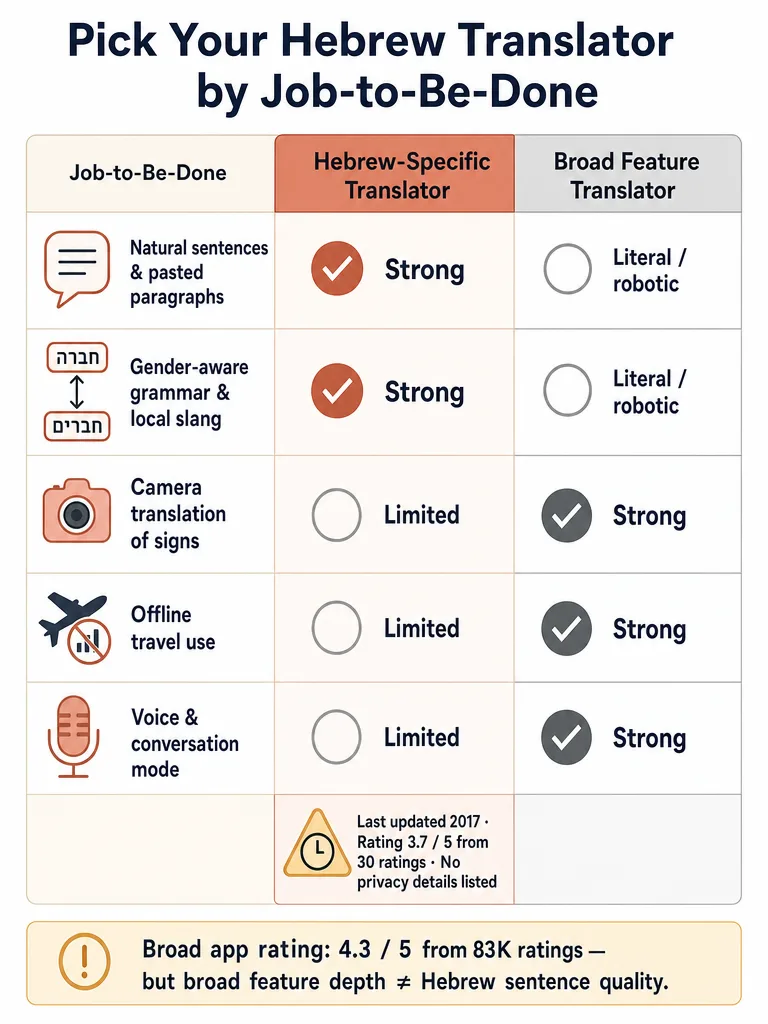
The best iPhone app depends on the job. For natural Hebrew sentences, gender-correct grammar, Israeli slang, and transliteration, a Hebrew-first tool like baba Hebrew Translator is the right pick. For offline packs, camera reads, and voice conversations across many languages, a broad general-purpose app covers more ground. The honest answer is that "best" splits by what you're actually translating.
Most roundups rank translation apps by feature count. That's the wrong lens for Hebrew. A translator can list camera mode, offline packs, and hundreds of languages and still hand you masculine grammar when you're talking to a woman, or invert an idiom like "חבל על הזמן," which reads literally as "a shame about the time" but actually means something is excellent. baba's own Hebrew evaluation guide is built around exactly these problems: gender, slang, idioms, cultural context, tone, and transliteration.
The general apps still earn a place on your phone. iTranslate's App Store listing says it covers over 100 languages with camera, voice-to-voice, and website translation. Broad general-purpose apps add offline packs and instant camera reads across dozens of languages. Those are travel features, not Hebrew-quality guarantees.
So keep two tools if your needs are split: one for Hebrew that sounds native, one for offline and camera moments on the road.
Hebrew quality vs iPhone travel features: how should you choose?
Separate two questions before you install anything: does the app produce Hebrew that sounds native, and does it cover the travel mechanics you need? Those are different scorecards. Feature-heavy apps win on breadth, Hebrew-first apps win on output. The table below splits the criteria so you can match each app to your real job instead of a longer feature list.
Buying criterion
Why it matters for Hebrew
Who tends to win
Gender-correct grammar
Hebrew verbs, adjectives, and pronouns change by speaker and listener; generic tools guess masculine
Hebrew-first tools with role controls
Slang and idioms
Terms like "סבבה" and "תכלס" shift yearly and rarely map word-for-word
Hebrew-specialized tools
Natural full sentences
Literal engines read grammatically correct but not like an Israeli
Sentence-level tools
Transliteration
Reading Hebrew sounds in English letters helps learners and travelers
iTranslate lists it; baba builds it in
Camera / signs
Reading printed Hebrew signs and menus
Broad travel apps, iTranslate
Offline mode
No-signal travel in Israel
Broad travel apps, iTranslate
Voice conversations
Two-way spoken exchanges
Broad travel apps, iTranslate
Ratings and maintenance
Active updates and privacy transparency
Varies (see later sections)
Ratings give a rough signal. iTranslate lists 4.7 out of 5 from 524K ratings, while the RustyBrick Hebrew/English Translator shows 3.7 from 30. High volume tells you an app is popular and maintained, not that its Hebrew reads naturally. That gap is the whole point of this guide.
Watch
How to set up App Translate on IPhone
From How to on YouTube
Which app is best for Israeli slang specifically?
Slang is a context problem, not a dictionary problem. The word that trips up generic tools isn't rare vocabulary, it's everyday speech where tone flips the meaning. "חבל על הזמן" reads literally as "a shame about the time" but means something is excellent, as baba's Hebrew translator guide explains. A word-for-word engine inverts it. That's why slang needs a tool that translates meaning, not tokens.
Modern Israeli Hebrew borrows from Arabic, Yiddish, English, and Russian and adds loanwords every year. Terms like "סבבה," "תכלס," and "וואלה" rarely land right in a translator built for formal text. "וואלה" alone shifts between surprise, agreement, and mild sarcasm depending on how it's said.
For slang, pick a tool that reads tone and context, not a dictionary that swaps words one at a time.
What is the best Hebrew translation app for travel in Israel?
For travel in Israel, match the app to the moment: reading signs and menus, translating chats, holding a spoken exchange, or working with no signal. Broad general-purpose apps and iTranslate both cover the mechanics well, and iTranslate's App Store listing backs that up. Neither guarantees Hebrew that sounds like a local, so pair a broad travel app with a Hebrew-first tool for conversation.
Here's how the travel jobs split by feature, drawn from what each listing supports:
Travel job
Broad general-purpose apps
iTranslate
Signs and menus (camera)
Instant camera + photo translation
Lens for menus and signs
Spoken exchanges
Conversations, dictation, transcribe
Voice-to-voice conversations
No signal
Offline translation packs
Offline mode
Reading Hebrew websites
Text translation
Website translation
Language breadth
Very wide
Over 100 languages
Travel + Leisure reports the most comprehensive travel app it tested offers offline packs for more than 60 languages and voice translation in at least 70. iTranslate's listing adds transliteration and a phrasebook of over 250 predefined phrases, useful for rehearsing what to say out loud.
Which iPhone app is best for full sentences and pasted paragraphs?
Full sentences and pasted paragraphs need a sentence-level translator, not a single-word dictionary. Dictionary tools return definitions and roots; conversation and paragraph work needs a tool that reads context across a whole passage. The RustyBrick Hebrew/English Translator lists both "single words or full sentences," but its output leans on the translation API behind it.
The need is real and specific. A Reddit user in r/hebrew asked for a tool that could paste paragraphs, not just sentences, noting that dictionary-style sites weren't enough. That's the line between looking up a word and translating a message.
A dictionary is genuinely useful for isolated words, roots, and conjugations. For a WhatsApp reply, an apartment listing, or a work email, you need meaning across the sentence, including gender and tone. We break that split down in baba vs dictionary-only Hebrew tools for real sentences.
Can Hebrew translation apps handle camera, voice, offline, and website text on iPhone?
Yes, the mainstream apps cover camera, voice, offline, and website text, though the strength varies by app and language. Broad general-purpose apps name typed text, offline translation, instant camera translation, photo translation, dictation, conversations, transcription, and handwriting. iTranslate's listing adds voice-to-voice conversations, a camera Lens, website translation, and offline mode. Feature support varies by language on both.
Here's what the listings support, mapped to the four jobs:
Feature
Broad general-purpose apps
iTranslate
RustyBrick Hebrew/English
Camera / photo
Yes
Yes (Lens)
Not listed
Voice conversation
Yes
Yes
Not listed
Offline
Yes
Yes
No (requires internet)
Website text
Text translation
Yes
Not listed
Transliteration
Not listed for Hebrew
Yes
Not listed
The broader entities people ask about, DeepL, Microsoft Translator, Reverso Context, Morfix, ChatGPT, Claude, and Gemini, each fit different jobs. baba's ranked Hebrew translator guide points to DeepL for document files, Reverso Context for usage examples, and Morfix for dictionary lookup. None of these listings prove Hebrew that reads naturally, only that a feature exists.
Public detail on this is limited. A Cult of Mac guide says Apple Translate supports 19 languages and offers downloadable languages for offline use, but the current source set does not include an Apple primary source confirming Hebrew is among them. Treat Hebrew support as unverified until Apple's own documentation confirms it.
The same guide notes that on iOS 18.4 or later, Apple lets you change the iPhone's default translation app to another updated third-party option. That matters: even if you prefer a different Hebrew tool, you can route your system-level translations to it.
Until Apple states Hebrew support directly, don't assume the built-in Translate app handles gender or slang any better than the general tools above. The safer move is to test a Hebrew-first translator against your own real sentences.
Is a simple Hebrew-English iPhone app still worth installing?
A lightweight Hebrew-English app can be enough for occasional single-word lookups, but check maintenance and privacy before you rely on it. The RustyBrick Hebrew/English Translator is free and handles single words or full sentences, yet its App Store listing raises real flags for a daily tool: it requires internet access, and it shows a 3.7 rating from 30 ratings.
The listing details are worth reading closely:
Latest listed version is 2.0.4 dated 12/10/2017, so it hasn't shipped a visible update in years.
It requires iOS 9.0 or later, an old baseline.
The app is 9.9 MB, small and simple.
The developer, RustyBrick, has not provided privacy practice details to Apple, so the listing shows "No Details Provided."
That combination (internet-only, dated, no privacy disclosure) makes it a weak choice if you translate Hebrew regularly or handle anything sensitive. For a quick, rare lookup it may still do the job. For chats, work messages, or gendered phrasing, a maintained Hebrew-first tool is the safer install.
What is the best English to Hebrew translator for natural sentences?
Going the other direction, English to Hebrew, is where sentence quality matters most, because Hebrew forces choices English hides. A natural translator has to set speaker and listener gender, pick tone, and can add transliteration so you know how to say it. baba Hebrew Translator is built around exactly these controls, per its ranked translator guide.
The trap is gendered grammar. Hebrew verbs, adjectives, and possessives all shift by who's speaking and who's being addressed. A tool with no role controls guesses, and it almost always defaults masculine, which sounds wrong the moment you're writing to or as a woman. We cover why in common errors in gendered AI translation and why Hebrew AI struggles with gender.
What is the best AI Hebrew translator for cultural context?
Cultural context comes down to Hebrew-specific factors: slang, idioms, gender roles, and tone, not raw language breadth. An AI tool that nails French idioms can still miss what "וואלה" means in a given sentence or default a group message to masculine grammar. The right choice treats these as first-class controls rather than afterthoughts.
baba's published Hebrew evaluation protocol, version 1.0 run on 2026-08-02, reports it passed 5 of 5 objective modern-Hebrew test items with verbatim outputs published, while the best-scoring compared tool passed 2 of 5. Every item is re-runnable, so you can check the claim yourself rather than take it on faith.
For Hebrew cultural context, pick the tool that controls gender, slang, and tone, not the one with the most languages.
Want Hebrew that sounds native instead of literal? Try the free web translator: Try the free web translator.
Frequently asked questions
Which app is best for Israeli slang specifically?
Slang is a context problem, not a dictionary problem. Terms like "וואלה" shift between surprise, agreement, and mild sarcasm depending on tone — a word-swap engine can't catch that. Modern Israeli Hebrew borrows from Arabic, Yiddish, English, and Russian, adding new loanwords every cycle. A Hebrew-first tool that reads meaning across the full sentence handles these correctly; a generic translator built for formal text consistently misses them.
Best app for translating Hebrew to English on iPhone — what actually works?
The right answer splits by job. For gender-correct grammar, Israeli slang, idioms, and natural-sounding output, a Hebrew-first tool beats any general-purpose app. For offline packs, camera reads on signs and menus, and voice conversations, iTranslate covers those mechanics well — it carries a 4.7 rating from 524K App Store reviews and supports over 100 languages. Most users in Israel end up keeping both: one for Hebrew quality, one for travel features.
Best English to Hebrew translator for natural sentences — what handles gendered grammar?
Hebrew forces choices English hides: verbs, adjectives, and possessives all shift by who's speaking and who's being addressed. A tool with no gender controls defaults to masculine, which sounds wrong the moment you're writing to or as a woman. Natural sentence-level output requires setting speaker and listener gender before translating — without that control, even a grammatically correct sentence can read as rude or simply off to a native speaker.
Best Hebrew translation app for travel in Israel — which features actually matter?
Match the app to the moment. For signs and menus, iTranslate's Lens feature handles camera reads; for spoken exchanges, its voice-to-voice mode works offline too. For natural Hebrew conversation — understanding a landlord's message or texting locals — a Hebrew-first tool handles tone and idioms that broad travel apps miss. Travel + Leisure notes the most comprehensive option tested offers offline packs for more than 60 languages and voice translation in at least 70.
Best AI Hebrew translator for cultural context — what should I look for?
Cultural accuracy shows up in small, high-stakes moments: holiday greetings that change by audience, mixed-gender group messages, idioms like "חבל על הזמן" that mean the opposite of their literal words. An AI translator built around Hebrew-specific controls — gender roles, slang handling, tone — outperforms one with broad language coverage but no Hebrew-first design. In baba's published evaluation protocol (v1.0, run 2026-08-02), it passed 5 of 5 objective modern-Hebrew test items; the next-best tool passed 2 of 5.
Is the RustyBrick Hebrew-English iPhone app still worth using?
Only for the most occasional single-word lookups. The App Store listing shows version 2.0.4 dated 12/10/2017 — no visible update in years — a 3.7 rating from just 30 reviews, requires an internet connection to function, and the developer has not provided any privacy practice details to Apple. For regular chats, work messages, or anything involving gendered phrasing, a maintained Hebrew-first tool is the safer install.