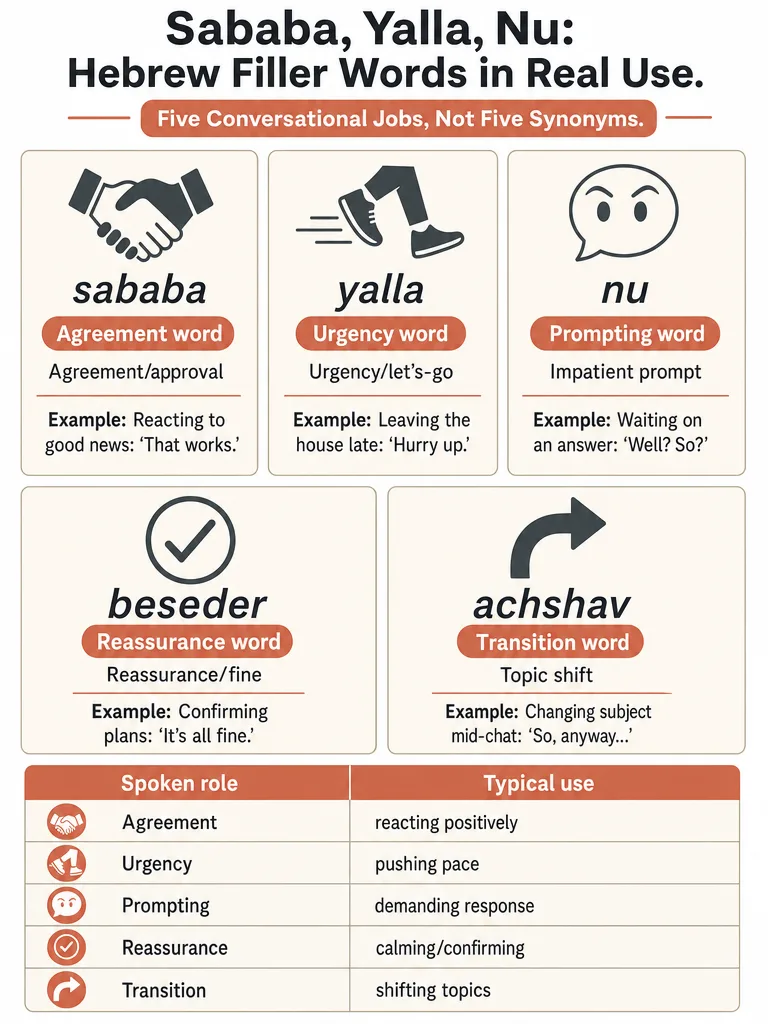
Sababa means cool, yalla means let’s go, and nu means come on. See how each Hebrew filler word works in real conversation.
What Do Sababa, Yalla, and Nu Mean in Hebrew?
Sababa means cool, great, or no problem; yalla means let's go, hurry up, or okay, bye; and nu is an impatient well? or so? that pushes someone to answer or move faster. These three Hebrew filler words, sababa, yalla, nu, handle separate conversational jobs rather than one interchangeable function.
Hebrew filler words are the short words and sounds that fill the gaps in spoken Hebrew, the same way "um," "like," and "well" fill gaps in English. HebrewPod101 lists several real reasons Israelis reach for them in conversation: to buy a second while thinking of what to say, to cover nervousness, and to show the other person they're still actively engaged even mid-pause. None of that is about dictionary meaning. It's about keeping the conversation moving.
That's the trap for English speakers learning Hebrew: treating sababa, yalla, and nu as synonyms for "cool" because a phrasebook lists them together. In real use, each one answers a different question: agreement, urgency, or impatience. Mixing them up is the fastest way to sound like you memorized a list instead of talking.
What Does Sababa Mean, and How Is It Different From Beseder?
Sababa is Hebrew slang for cool, great, awesome, no problem, or alright, with roots in Arabic words for desire or longing, according to Unpacked's rundown of Hebrew words worth knowing. baba's Hebrew slang dictionary lists the same core senses among its current collection of 186 Israeli Hebrew slang words.
Beseder, by contrast, literally means "in order" and works as Hebrew's all-purpose okay, according to Heb4You's breakdown of these filler words: it covers "I'm fine," "okay, got it," and "alright, moving on," depending on tone. Sababa does lighter work. Heb4You describes it as friendlier and more casual than beseder, the word people reach for when a plan sounds good rather than just acceptable.
The clearest contrast shows up in hakol sababa versus hakol beseder. Discover Discomfort describes hakol sababa, "everything's cool," as the slangier version of hakol beseder, "everything's fine," and notes that younger Israelis reach for the sababa version more often.
Sababa agrees with energy, where beseder just agrees. Use sababa where you want to sound relaxed and friendly, and save beseder for anything closer to a plain confirmation.
What Does Yalla Mean, and What Does Yalla Bye Mean?
Yalla covers three different jobs in one word: let's go, hurry up, and a casual way to end a phone call or chat. Unpacked describes yalla as a quintessential Hebrew slang word meaning "c'mon," "hurry up," or "let's go," and notes that Israelis also say "yalla, bye" when hanging up the phone.
Like sababa, yalla is originally Arabic. Discover Discomfort traces it back to a phrase meaning "oh God," now flattened into Hebrew's go-to call-to-action word. The site also lists yalla kadima, a mix of Arabic yalla and Hebrew kadima (forward), used the same way as plain yalla when someone's urging a group to get moving.
Context decides which job yalla is doing. "Yalla, nelech" (come on, let's go) is an invitation, drawn from a real Tel Aviv exchange that Heb4You uses to show how Israelis combine these words. "Yalla yalla," repeated and sped up, means hurry up, the phrase parents yell at kids running late. A single "yalla" right before hanging up, paired with bye, closes out the conversation instead of starting anything.
That range is exactly what trips up word-by-word translation and makes texting in Hebrew feel stiff. If you're translating Hebrew WhatsApp messages without losing tone, knowing which yalla you're looking at matters more than knowing the dictionary entry.
What Does Nu Mean in Hebrew Slang?
Nu is an impatient prompt, closer to "well?" or "come on" than to a neutral filler, and it carries Yiddish roots. Heb4You's rundown of Hebrew filler words lists nu among a handful of "cousins" worth knowing, defining it simply as "come on" or "well?" and tracing it back to Yiddish.
A WordReference discussion on modern Hebrew filler words makes the same distinction from the English-learner side: nu isn't a stand-in for every use of "well." Contributors in the thread point out that nu is mainly used to express urgency, speed someone up, or push for an answer, the way "come on!" works in English when you're waiting on someone. One example in the thread shows נו swapping in for the formal ובכן (well) in a spoken line like "Well, what do you have to say for yourself?" A hesitant "well... I just thought..." doesn't translate to nu at all; that calls for a softer filler like em (um).
So nu shows up when someone's taking too long to answer a question, finish a story, or get out the door. Say it to a friend who's stalling and it reads as friendly nudging. Say it in a sharper tone, and it reads as genuine impatience, which is usually exactly the point.
What Other Hebrew Filler Words Do People Use in Modern Speech?
Beyond sababa, yalla, and nu, Israelis lean on a handful of other fillers to keep conversation moving. The same WordReference thread on modern Hebrew filler words, with native-speaker contributors weighing in, lays out the most common ones:
Az (אז): "so," used to open a sentence or shift topics, as in "Az, ma kore itcha?" (so, what's up with you?)
Ke'ilu (כאילו): "like" or "as if," used the same loose way English speakers drop "like" mid-sentence.
Kacha / kaze (ככה / כזה): "like this" or "like that," pointing at something without naming it directly.
Epesse (אפעס): a Yiddish-derived filler meaning roughly "something, anything," mostly heard from older Ashkenazi speakers today.
HebrewPod101 sorts fillers like these into categories: some carry no real semantic meaning on their own, some just signal the speaker is still thinking, and some, like nu, are aimed directly at the listener to prompt a reaction.
Sababa vs. Yalla vs. Nu vs. Beseder: Five Different Conversational Jobs
Each of these words does a specific job, and Israelis often stack several in one exchange. A real Tel Aviv conversation, laid out by Heb4You, shows how naturally they combine: one friend asks if the other is coming tonight, the answer is sababa, the plan gets set with yalla, confirmed with beseder gamur, and closed out with yalla bye.
Word
Literal meaning
Conversational job
Example
Sababa
Desire, longing (Arabic root)
Agreement with energy
"Ata ba ba-erev?" / "Sababa, ani ba." (You coming tonight? / Cool, I'm coming.)
Yalla
Oh God (Arabic root)
Urgency or call to action
"Yalla, be-shmone." (Let's go, at eight.)
Nu
Well? So? (Yiddish root)
Impatient prompt
"Nu, ma yesh lecha lomar?" (Come on, what do you have to say?)
Beseder
In order
Plain confirmation
"Beseder gamur." (Totally fine.)
Az
So
Topic transition
"Az, ma kore itcha?" (So, what's up with you?)
None of these five words are interchangeable, even though most slang lists group them together. Sababa reacts to something with approval, yalla pushes a plan forward, nu demands a faster answer, beseder just confirms, and az opens a new thread. Swap sababa in where nu belongs and you'll sound agreeable when you meant to sound impatient, a mismatch that's common when learners memorize these words off a single list instead of hearing them in context.
Can You Drop Sababa and Yalla Into English Sentences?
Yes. Some English speakers in Israel drop sababa and yalla into English sentences rather than switching fully into Hebrew. A Secret Tel Aviv community post describes the familiar moment: barely knowing any Hebrew but already dropping "yalla" and "sababa" into the middle of English sentences. A Taglit Birthright post boils the two down the same way for beginners: sababa for "chill, cool, all good," yalla for "let's go, hurry up, go go go."
That mixing works for casual, spoken English among friends, tourists, or expats who've picked up some Israeli flavor. It's different from a full Hebrew exchange, where sababa and yalla sit alongside words like nu, az, and beseder, each handling its own job, the way Heb4You's Tel Aviv exchange shows above. On how sababa and yalla hold up in work email, official forms, or customer-facing Hebrew specifically, the sources behind this article don't weigh in, so that's worth asking about directly rather than assuming either way.
If you're curious how slang choices like these carry over into translation generally, translating Hebrew slang without sounding robotic covers the broader approach: translate by meaning and tone, not by swapping words one for one. The same logic applies to everyday texting: when you're figuring out English to Hebrew for texts, dates, and daily chats, sababa and yalla belong in the casual pile, next to achi and balagan, two more informal words Unpacked groups with them.
Frequently asked questions
What does yalla balagan mean?
Yalla balagan combines yalla (let's go) with balagan (mess or chaos) to mean something like "alright, chaos" or "let's go, whatever happens," usually said with irony when a situation is already out of control. Heb4You lists it among the yalla variations Israelis use beyond plain yalla or yalla bye. It's closer to a shrug at disorder than an actual plan, so it fits parties, traffic, or any situation spinning out of hand.
Are sababa and yalla originally Arabic words?
Both are Arabic loanwords, not native Hebrew. Sababa comes from an Arabic word for desire or longing, and yalla comes from an Arabic phrase meaning "oh God," according to Unpacked's rundown of Israeli slang and Discover Discomfort's breakdown of common Hebrew phrases. Modern Israeli Hebrew borrows heavily from Arabic this way, alongside Yiddish imports like nu, which shapes how casual these words sound next to more formal Hebrew vocabulary.
What's the difference between yalla and yalla yalla?
Yalla on its own usually means "let's go" or "okay," while repeating it as yalla yalla raises the urgency to "hurry up, now." Heb4You's breakdown of Hebrew filler words gives the example of parents yelling "yalla yalla" at kids who are slow getting ready, compared to a single "yalla, nelech" used as a calm invitation to leave. The doubling is what turns a casual suggestion into a push to move faster.
Is nu a Hebrew word or borrowed from Yiddish?
Nu comes from Yiddish, not Hebrew. Both Heb4You's list of Hebrew filler words and a WordReference thread among native speakers trace it to that root. It kept its original job in Israeli Hebrew: nudging someone to answer faster or stop stalling, closer to "come on" than a neutral "well." That mix of Yiddish nu and Arabic sababa and yalla is typical of how everyday Israeli slang actually formed.
How does achla compare to sababa in Hebrew slang?
Achla and sababa overlap but aren't identical. Achla describes something as great, awesome, or the best, while sababa leans toward agreement or "no problem" in response to a plan. Unpacked's list of Hebrew slang gives "achla yom" (an awesome day) as a typical use, describing a thing rather than reacting to it. You'd say the movie was achla, but you'd answer an invitation with sababa, not achla.
What's the difference between ke'ilu and nu?
Ke'ilu means "like" or "as if," used the loose way English speakers drop "like" mid-sentence, while nu is a pointed prompt meaning "well?" or "come on." A WordReference thread on modern Hebrew filler words lists ke'ilu among words with little real semantic meaning beyond a verbal pause, unlike nu, which specifically pushes the listener toward a response. Swap one for the other and a casual filler turns into an impatient demand.
Tags:Hebrew slangsababayallanubeseder
Enjoyed this article? Share it with others!
Share:
Hebrew Heartbeat, Tuesdays
One Israeli word and this week’s Hebrew dates. Not a blog digest. Unsubscribe anytime.
Join our community of Hebrew learners. Unsubscribe anytime.