Hebrew nicknames diminutives usually clip a name and add -i. Learn when Israelis use -ush, -ik, -le, or -ka, and when not to guess.
How Do Israelis Turn a Name Into a Nickname?
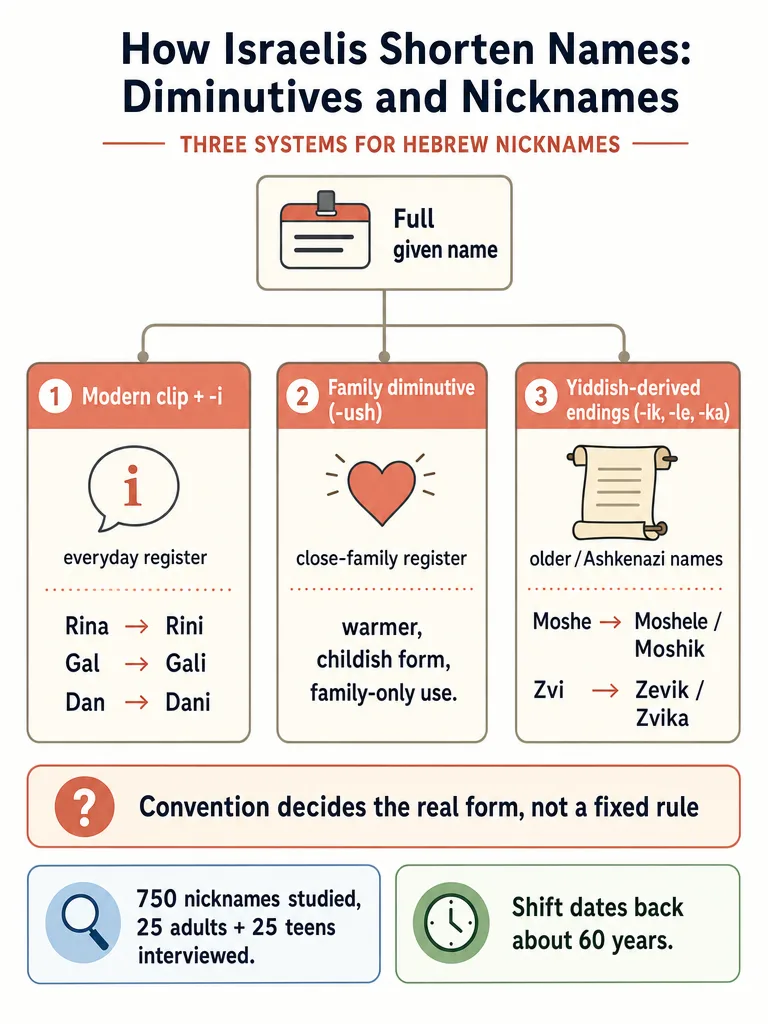
The default pattern behind Hebrew nicknames and diminutives clips a name to its first syllable or two and adds an -i sound, turning Dan into Dani or Gal into Gali. Two other systems run alongside it: affectionate family diminutives like -ush, used mostly within close family, and older Yiddish-derived endings such as -ik, -le, and -ka.
Almost every common Israeli first name has a short form that family and friends actually use, and the full name often gets reserved for paperwork and formal introductions. Three separate systems cover most of what you'll hear:
Pattern
Feel
Where you'll hear it
Example
Clip + -i
Everyday, friendly
General conversation, the default
Dan → Dani, Gal → Gali
-ush / -ushi
Soft, childish
Mostly within close family
Names ending in a vowel or soft consonant
-ik / -le / -ka
Older, Yiddish-derived
Older or Ashkenazi names
Moshe → Moshele, Zev → Zevik
Which of these applies to a given name is a matter of convention more than a fixed rule, according to baba's Hebrew Nickname Generator reference. The rest of this guide walks through each system with the specific names it actually governs, rather than one formula you can apply to anything.
Why Do So Many Hebrew Nicknames End in -i?
The -i ending is Israeli Hebrew's default diminutive suffix: cut a name back to its first syllable or two and add an "i" sound. That same reference compares it to how English shortens Katherine to Kathy or Robert to Robbie, the same logic in a different language.
The model cases are simple once you see the pattern. Rina becomes Rini. Gal becomes Gali. Dan becomes Dani. In each one, the first syllable stays intact and the -i sound replaces whatever came after it, which is why the result still sounds unmistakably like the original name rather than an unrelated pet name. This is the form you'll hit most often in ordinary Israeli conversation, texts, and group chats, far more than the family-only or Yiddish-derived endings covered below.
What Do -ush and Other Family Nicknames Sound Like?
The -ush and -ushi endings mark a warmer, more childish diminutive than the everyday -i form, and Israelis use it mostly within close family rather than general conversation, according to baba's Hebrew Nickname Generator reference. It attaches most naturally to names that already end in a vowel or a soft consonant, which is also why it doesn't apply as broadly as the clip-and-i pattern.
Beyond that general register difference, the available sources don't spell out detailed rules for exactly when an -ush form reads as endearing versus out of place outside the family, in a workplace or with someone you've just met. What they do establish is the basic contrast: an -i nickname like Dani or Gali is the everyday form you'll hear across contexts, while an -ush form belongs more to the household, between parents and children or among siblings. Treat that as the dividing line the research supports, and know that the finer social-register judgment calls fall outside what's documented here.
What Does -ik, -le, or -ka Mean in a Hebrew Nickname?
Three more endings, -ik, -le, and -ka, carry Yiddish roots and mostly attach to older or Ashkenazi names, a separate system from the modern clip-and-i pattern. Moshe can become Moshele or Moshik, Zev can become Zevik, and Zvi can become Zvika. Cultural Atlas lists the Moshe and Zvi forms directly, and the nickname reference introduced earlier gives the same -ik pattern for Zev and for Yitzhak, which becomes Itzik.
JewishGen traces these suffixes back further than modern Israeli Hebrew. Its reference on Jewish given names from 1795 to 1925 describes Yiddish nicknames as a distinct category from regular Yiddish names, built with diminutive and familiar suffixes borrowed mostly from German, Slavic, Polish, and Belorussian sources, with Slavic suffixes making up the larger share. Eastern European Jewish communities produced enormous numbers of these forms, far more than the regular Yiddish names they modified, as an expression of family and community closeness.
It's worth separating this from the academic study of Hebrew diminutives generally. Linguist Noam Faust describes diminutivization as a genuinely productive process in Israeli Hebrew, built predominantly through suffixes, but his central example, the -on and -onet pattern, applies to common nouns rather than personal names. The -ik/-le/-ka family covered here is a naming tradition carried over from Yiddish, not the mechanism Faust documents for everyday vocabulary.
Are Hebrew Nicknames Predictable, or Do You Just Have to Know Them?
Hebrew nickname choice is largely conventional, not something you can derive from a rule every time. Dr. Ruth Burstein of David Yellin College of Education studied this directly: her research, summarized by Babel Street, examined 750 nicknames gathered from questionnaires, yearbooks, literature, newspapers, and media, plus interviews with 25 adults and 25 teenagers.
That scope matters because it shows how entrenched usage, not formula, decides which short form counts as "the" nickname for a given name. The nickname reference introduced earlier makes a similar point from a practical angle: common names are handled from a curated list of forms Israelis actually use, while anything outside that list only produces a generated guess based on the most common rule, flagged as a guess rather than a confirmed nickname.
That gap between "follows the pattern" and "is the nickname people actually say" is the single most useful thing to internalize about Hebrew diminutives. The pattern predicts a plausible shape; usage decides the real one.
Why Do Some Biblical Names Get Nicknames While Modern Names Often Don't?
Long Biblical names picked up nicknames historically because they were perceived as long and heavy, while many modern Israeli names are already short enough that shortening adds little. Adam Fisher, writing about Israeli naming culture, notes that Biblical names can run roughly 2,500 years old, a scale that made abbreviation useful for everyday speech long before modern Hebrew nicknaming conventions existed.
Names like Yosef or Tzipora carry multiple syllables and formal, scriptural weight, and the short form tends to get used far more often in daily life than the full name. Modern nature-based and unisex names skip that step almost entirely. Fisher points to Yuval, Amit, Tal, and Bar as examples of names that are already brief, drawn from words like stream, friend, dew, and wild rather than from ancestral Biblical figures, and he notes that for many Israelis under about 25, these short, unisex names no longer even signal gender the way older names did. The shortening habit tracks name length and formality more than it tracks any fixed linguistic rule, which is why three-letter modern names like Tal or Bar have nowhere left to clip.
How to Use a Hebrew Nickname Without Getting It Wrong
Checking a nickname before you use it comes down to two steps: confirm it's a real form Israelis use rather than a rule-generated guess, then match its register to the relationship before you say or write it.
Check whether it's a confirmed nickname or a generated guess. Common names have real, established short forms; less common names may only produce a rule-based guess that sounds plausible but isn't actually used. Treat the two differently, especially in writing.
Match the register before you use it. An everyday -i form like Dani or Gali works broadly across casual contexts. A family-style -ush form or an older -ik/-le/-ka form can read as more intimate or more dated outside the setting it comes from, and the available research doesn't spell out a precise rule for every relationship, so use judgment when you're not sure.
Getting the nickname right is a small piece of a bigger pattern: Hebrew rewards knowing the convention, not just the rule, and that's as true of names as it is of everyday phrasing.
Frequently asked questions
What's the difference between a Hebrew nickname and an English nickname?
Hebrew nicknames follow the same clipping logic as English ones—cutting a name to its first syllable and adding a sound, the way Robert becomes Robbie—but Hebrew also layers on family-only endings like -ush and older Yiddish-derived forms like -ik, -le, and -ka that don't map onto English nicknaming at all. The result is a layered system: one everyday form, one childish family form, and sometimes a third Yiddish-rooted option, all for the same name.
Can one Hebrew name have more than one real nickname?
Yes, several Hebrew names carry more than one accepted short form, split across different systems. Moshe can become Moshele or Moshik, Zev can become Zevik, and Zvi can become Zvika, forms drawn from Yiddish-derived -ik, -le, and -ka suffixes rather than the everyday -i pattern. Which one gets used often comes down to family habit or regional tradition more than a single correct answer.
Is there a reliable way to check whether a Hebrew nickname is actually used by Israelis?
The surest check is whether the form comes from a list of nicknames Israelis actually use rather than a rule applied blindly. baba's Hebrew Nickname Generator pulls common names from a curated list of real short forms and flags anything else as a rule-generated guess, since a form that follows the -i pattern perfectly can still be one nobody says out loud.
Do Israelis use nicknames in formal or professional settings?
Full given names, not nicknames, are the default in paperwork, job applications, and formal introductions in Israel. Short forms like Dani or Gali belong to everyday conversation among family, friends, and colleagues once a relationship is established, while the full name on a resume or official document stays unshortened. Using a nickname too early in a professional context can read as presumptuous rather than friendly.
Do family nicknames like -ush ever get used outside the home?
Rarely. The -ush and -ushi endings mark a softer, more childish diminutive that Israelis use mostly within close family, such as between parents and children or among siblings, rather than in general conversation. It attaches most naturally to names ending in a vowel or soft consonant. Hearing it from a coworker or new acquaintance would be unusual outside that family context.
Why do old Yiddish-style suffixes like -ik and -le still show up in modern Israeli names?
Suffixes like -ik, -le, and -ka survive in modern Israeli names because they travelled from Eastern European Yiddish naming tradition into Hebrew rather than being invented by modern Hebrew grammar. JewishGen's research on Jewish given names from 1795 to 1925 notes that Eastern European Jewish communities created these diminutive forms in large numbers, borrowing suffixes mostly from German and Slavic languages, and the pattern stuck for older and Ashkenazi names.