Walla meaning depends on tone: it can mean really, wow, no way, yes, or filler. Learn how Israelis use וואלה in real conversation.
What does walla mean in Hebrew?
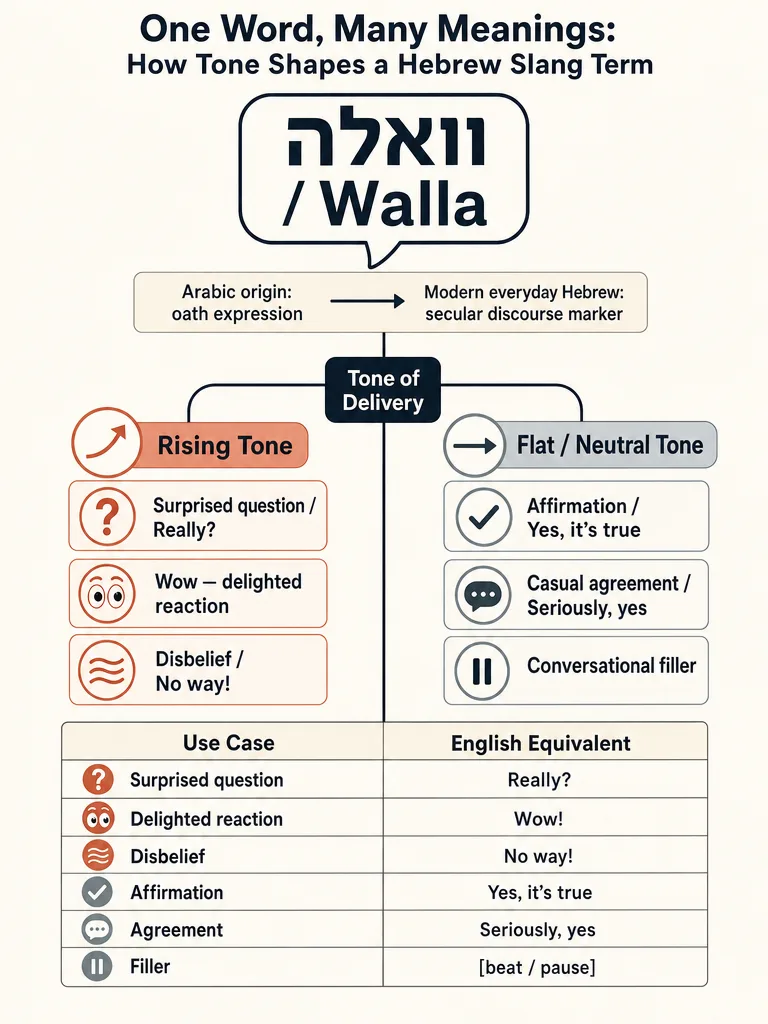
Walla (וואלה, pronounced WAH-lah) is a tone-driven Israeli exclamation that can mean "really?," "no way!," "wow!," "seriously," a plain yes, or even a conversational filler, depending entirely on how it's said. It's one of the most common words in modern spoken Hebrew. According to the Forward, walla comes from the Arabic term for "by god" and has been part of the Hebrew wordbook for decades.
That range is exactly why a single English gloss never fits. Israelis reach for walla to react to news, to confirm something is true, or just to signal they're still listening. The Hebrew-learning dictionary Milog lists five distinct functions: surprise or disbelief, affirmation, general reaction, filler, and casual agreement.
Walla is best understood as a discourse marker, not a fixed word with one meaning. Learn to read the tone and you'll know which walla you're hearing.
Does walla mean really or wow?
Both "really?" and "wow" are correct translations of walla, but each one only captures a slice of how Israelis actually use it. The Rosen School of Hebrew calls walla the closest an Israeli word gets to "wow" or "oh, really?" Milog, which tracks Hebrew slang, backs this up but adds that the same word also works as plain affirmation and as filler.
Here's the gap most short definitions leave open: walla isn't only a reaction of surprise. It can confirm something ("walla ken", seriously, yes) or deny it flatly ("walla lo", no way, I don't believe that), per Milog's example set.
If you hear...
Likely meaning
Rough English
Walla?! (rising, drawn out)
surprise or disbelief
"Really?! / No way?!"
Walla, kama zman!
wonder, warm reaction
"Wow, it's been so long!"
Walla ken
affirmation
"Seriously, yes"
Walla lo
emphatic denial
"No way, I don't buy it"
walla, mid-sentence
filler
"like / you know"
So "really" and "wow" both land, but treating either as the whole story is where literal tools go wrong.
Watch
20 Arabic Words Israelis Use EVERY DAY 🇮🇱
From Tamar Meisels on YouTube
How does tone of voice change the meaning of walla?
Tone is the single biggest factor in what walla means. Milog puts it plainly: tone is everything with וואלה. A rising, drawn-out "wal-LAAA?" expresses shock or disbelief, while a flat, quick "walla" dropped mid-sentence works like the English "like" or "you know." Same four letters, opposite jobs.
The baba Hebrew slang entry frames the two poles clearly: rising tone equals a surprised question ("really?"), flat tone equals affirmation ("seriously, yes"). Rosen School adds that delivery also colors whether walla sounds amused, sympathetic, or surprised.
A few side-by-side reads:
Rising, stretched ("wal-LAAA?!") → disbelief. Your friend just told you something wild.
Flat, mid-story ("az ani, walla, lo yadati ma lehagid") → filler while you gather your thoughts.
Warm, followed by a word ("walla, yofi") → genuine, enthusiastic agreement.
Short, closing a point ("walla.") → quiet confirmation, roughly "yeah, true."
Because meaning rides on delivery, a word-for-word translation of walla tells you almost nothing on its own. If you want to hear the difference in real sentences, you can try baba's free web translator on your own examples.
How do Israelis use walla in conversation?
Israelis use walla in at least five recurring ways, each set by tone and position in the sentence. Milog groups them as surprise or disbelief, affirmation, general reaction, filler, and casual agreement. The Forward adds a sixth everyday use: a worn-in listening cue, roughly the way Americans say "uh huh" to show they're still paying attention.
Here's how those map to real moments:
Surprise or disbelief. "Hem kiblu kidum? Walla!" ("They got a promotion? No way!"), from baba's example set.
Wonder at news. "Walla, lo yadati shehu gar sham!" ("Wow, I didn't know he lives there!").
General reaction. A quick "walla" to something impressive, close to "damn" or "nice."
Listening cue. The Forward notes walla has become somewhat "worn out," used to signal you're following along.
Filler. "Az ani, walla, lo yadati ma lehagid" ("So I, like, didn't know what to say"), per Milog.
Casual agreement. "Tavo lamesiba? Walla, lama lo" ("Coming to the party? Sure, why not").
Notice how the confirmation use flows both directions. The Forward describes one person saying "Walla!" at surprising news and another answering "Walla." to mean "yes, it's true."
Is walla Arabic or Hebrew?
Walla is originally Arabic, now fully at home in Israeli Hebrew slang. The word comes from Arabic "wallahi" (والله), meaning "By God" or "I swear to God," as Haaretz and the baba slang entry both trace it. The Forward confirms it has been part of the Hebrew wordbook for decades.
The key shift is meaning. Milog explains that the Hebrew slang form has been secularized: the original oath sense faded, leaving a general-purpose reaction word with no religious weight. Confusing modern walla with the formal, liturgical "wallahi" is a common mistake, Milog notes, because the everyday Israeli version has lost that layer entirely.
This kind of borrowing isn't unusual. The Forward, in its November 20, 2016 piece by Naomi Zeveloff, points out that modern Hebrew leans heavily on Arabic for slang, quoting Tel Aviv linguist Guy Sharett that "language has a life of its own." Walla sits alongside yalla ("let's go") as one of the most common examples.
Walla is Arabic by origin and Israeli by usage. The oath became an everyday exclamation, used across Mizrahi and all Israeli communities.
When should you avoid translating walla literally word for word?
Never translate walla by its original words. The literal source meaning, "by God," is almost never what an Israeli intends, so a word-for-word rendering hands you the wrong message entirely. What you want to translate is the reaction, surprise, agreement, disbelief, or a filler pause, not the buried oath.
This is the core problem with slang generally. Milog lists at least five separate functions for walla depending on tone and sentence position, so any tool that maps it to one fixed English word will be wrong most of the time. The reddit example "walla, magniv!" ("walla, cool!") shows the point: the word carries tone and reaction, not literal content.
The better approach is to read the intended reaction first, then pick the natural English equivalent. Our guide on translating Hebrew slang without sounding robotic walks through when to swap in an equivalent expression instead of translating word by word.
Why is the Israeli news site called Walla?
The Israeli news portal Walla! takes its name straight from the slang exclamation, not from a separate meaning. As the baba slang entry notes, walla.co.il is named after the everyday Israeli expression, the same "wow / really / no way" reaction word people use in conversation. There's no hidden second definition behind the brand.
Some background on the entity itself: Wikipedia says Walla! Communications was founded in 1995 and lists 2.5 million active users. As of January 2022, Alexa rankings placed it among the top 9 sites by traffic originating in Israel. So the name is doing exactly what a slang-based brand name does, signaling something familiar, local, and attention-grabbing.
One more disambiguation worth flagging: this is entirely unrelated to English "walla/wallah" entries or the film-audio term "walla" (background crowd noise). The Israeli walla always expresses an emotional reaction, per baba's note on the common tourist mix-up.
Can a non-native speaker use walla naturally?
Yes, a non-native speaker can use walla naturally, as long as the tone and context fit. Because the word is so tone-dependent, getting the delivery right matters more than getting the "definition" right. Milog's pro tip is blunt: Israelis say walla the way Americans say "like" and Brits say "innit," and it's the single most Israeli sound you can make.
The catch is self-consciousness. Milog warns that overusing walla deliberately as a foreigner can sound forced, while underusing it makes your Hebrew sound stiff and formal. The advice is to not think about it too hard, the moment you consciously insert it, it tends to land wrong.
A practical starting point: learn one clear use first, like the rising "wal-LAAA?!" for surprise, and let the filler uses come later once you've heard them in the wild. If you're building this kind of everyday fluency, reading real Hebrew signs, menus, and WhatsApp messages is where walla and its cousins actually show up.
Frequently asked questions
What does walla mean in Hebrew?
Walla (וואלה, pronounced WAH-lah) is a tone-driven Israeli exclamation with at least five distinct uses: surprise or disbelief, affirmation, general reaction, conversational filler, and casual agreement. Milog, which tracks Hebrew slang, lists all five. The word comes from Arabic "wallahi" meaning "by God," but that oath sense has completely faded — modern Israeli walla carries no religious weight, just emotional reaction.
Does walla mean really or wow?
Both are correct, but neither covers the full picture. The Rosen School of Hebrew calls walla the closest an Israeli word gets to "wow" or "oh, really?" — but it also works as flat affirmation ("walla ken" = seriously, yes) and emphatic denial ("walla lo" = no way, I don't believe that). Which meaning lands depends entirely on tone and position in the sentence, not the word itself.
How does tone of voice change the meaning of walla?
Tone is everything with walla. A rising, drawn-out "wal-LAAA?" signals shock or disbelief. A flat, quick "walla" dropped mid-sentence works like the English "like" — just a filler while you gather your thoughts. A warm "walla, yofi" reads as enthusiastic agreement. Milog notes Israelis use it almost unconsciously, sometimes several times in a single sentence, each instance meaning something slightly different.
Is walla Arabic or Hebrew?
Walla is Arabic by origin and Israeli by everyday usage. It traces to "wallahi" (والله), meaning "by God" or "I swear to God," as both Haaretz and the baba slang dictionary confirm. The oath meaning has secularized completely — modern Israeli walla carries no religious weight. The Forward notes it has been part of the Hebrew wordbook for decades, sitting alongside yalla as one of the most common Arabic borrowings in Israeli slang.
Why is the Israeli news site called Walla?
The news portal Walla! (walla.co.il) takes its name directly from the everyday Israeli slang exclamation — the same "wow / really / no way" reaction word. According to Wikipedia, Walla! Communications was founded in 1995 and has 2.5 million active users. The name signals something familiar and attention-grabbing to a local audience. It has no connection to the Australian slang "walla" or the film-audio term for background crowd noise.
Can a non-native speaker use walla naturally?
Yes, with the right delivery. Because walla is so tone-dependent, getting the sound right matters more than knowing the definition. Milog's advice: start with one clear use — the rising "wal-LAAA?!" for surprise — and let the filler uses develop after you've heard them in real conversation. Overusing it deliberately sounds forced; underusing it makes Hebrew feel stiff. The goal is to stop thinking about it consciously.