Learn Hebrew with news: read one short Israeli news story, retell its gist aloud, then discuss it. Start with supported reading if needed.
Is there a way to learn Hebrew from current Israeli news?
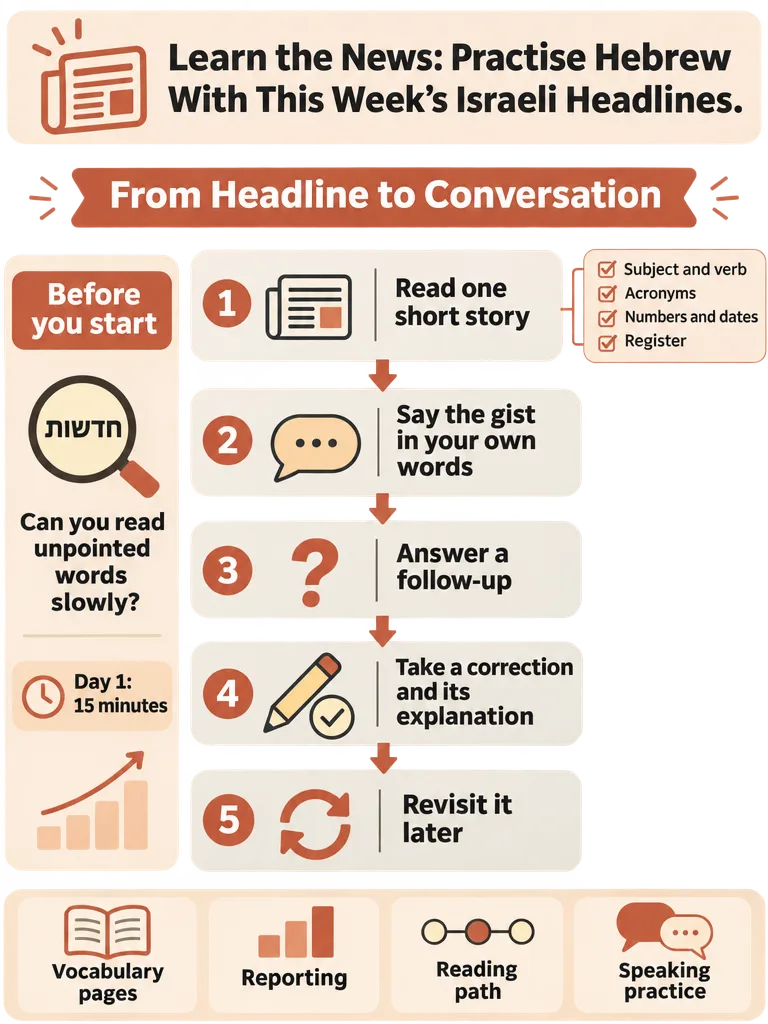
Yes. To learn Hebrew with news, read one short story, say its gist in your own words, then discuss it out loud instead of translating headline by headline. Baba describes its Read and Talk scenario in baba Learn as reading a short story together with an AI tutor, Maya or David, then discussing it.
The outcome to aim for is a spoken retelling. After one story, you should be able to say who did what in a sentence or two, in your own Hebrew, even if it's clumsy. A translation gets you the meaning. A retelling makes you produce the language.
One condition applies to unadapted news. Israeli news Hebrew is written without nikud, and Baba's Reading the Hebrew News Path asks learners to confirm they can already read unpointed words slowly before it starts. If that is still hard, supported reading comes first: text with vowels, transliteration or English alongside. The next section shows how to check.
Can I read Hebrew news if I can't read unpointed words yet?
Not unadapted news yet, but you can still start with supported reading. Hebrew news is printed without nikud, and Baba's Reading the Hebrew News Path opens with a 15-minute Day 1 level check that asks you to confirm you can already read unpointed words slowly.
That check is the entry requirement for that path. It isn't a rule that you must wait before touching any news-based material. Supported reading is the way in: short texts with vowels, transliteration or an English line underneath, so you can follow a story while your reading speed catches up. Ulpan-Or's E-Tone, for example, adapts each weekly issue into three levels, with audio, highlighted vocabulary and a full English translation.
Run the check yourself:
Can you sound out a line of Hebrew with no vowel marks, even slowly?
Do you know that modern spelling (ktiv male) adds extra letters to show vowels?
Are you ready to meet acronyms and numbers in the first lines you read?
The path puts ktiv male, news acronyms and numbers in its first week, so unadapted news hits them early. If the check fails, go back to letters and supported reading first.
The path has a 30-day structure, according to Baba's Reading the Hebrew News Path page. That describes the plan's contents, not a proficiency promise. Treat it as a reading sequence, not a deadline.
Watch
A summary of Israeli Hebrew news - with English subtitles
From AIJAC on YouTube
What should I notice in a Hebrew headline before I discuss it?
Before you talk about a headline, parse it in four passes: subject and verb, acronyms, numbers and dates, then register. These are the skills Baba's Reading the Hebrew News Path trains. Its stated outcomes include parsing a headline for subject and verb, expanding common news acronyms, and reading numbers, dates and place names.
Use this numbered checklist on any short story:
Find the subject and the verb. Who did something, and what was it?
Expand any acronym. Say what each letter group stands for before you move on.
Read the numbers and dates aloud. The path teaches numerals and number words as separate skills, and gives the Hebrew and civil dates on an article their own lesson.
Note the register. Is this the formal voice of a news desk or quoted street talk? The path has lessons on why a news desk doesn't sound like a café, and on slang inside quotes.
Watch for the verb forms the path covers: present-tense participles used as headline presents, passive voice ("was arrested," "was announced") and smichut chains that drop small words.
Register is the pass a translation skips. The Hebrew in the news page makes the point: a translated headline gives you the sentence, but it won't tell you, for example, that "Bibi" is a register. The page's whole purpose is to teach the Hebrew in the coverage, with the gender and the phrasing, and then point to baba News for the story.
How does a read-and-discuss session work, step by step?
A read-and-discuss session moves from a short story to spoken Hebrew in five moves. Baba's descriptions are limited: Read and Talk is reading a short story together and then discussing it, and its learning hub connects conversation with Maya or David to explanations, corrections and practice you can return to. The steps below are a suggested exercise for any story, not a record of in-app screens.
Read the short story. Read it through once without translating each word first.
Say the gist aloud. Give the main event in one or two sentences, in your own words.
Answer a follow-up. Ask yourself, or have a partner ask, what happened and what you think about it.
Check your forms. Look at each verb and adjective you used. Did it match the gender of the person you were talking about?
Revisit it later. Come back to the sentences you got wrong and say them again.
Reading and translating alone stop at step 1. You see words and check meaning, but you never have to produce a sentence.
Which resource do I use for vocabulary, the reporting, a reading plan, and speaking?
Use four different resources for four different jobs: Hebrew in the news for words and phrasing, baba News for the reporting, the Reading the Hebrew News Path for a reading sequence, and Read and Talk for spoken discussion. They are not interchangeable, and Baba's own pages draw those lines.
Resource
What it is for
What it is not
Hebrew in the news
The words the Israeli press is using, with gender and press usage
A second newspaper
baba News
The coverage itself; each Hebrew in the news word page links to live stories there
A vocabulary lesson
Reading the Hebrew News Path
A 30-day reading sequence: ktiv male, acronyms, verb forms, smichut
Speaking practice or a proficiency promise
Read and Talk (with Maya or David)
Reading a short story and discussing it aloud
A news feed or a translator
A sensible order: check your reading with the path, learn the words on a Hebrew in the news page, read the story on baba News, then talk it through. If you need a step before this one, the free Hebrew guides on baba cover letters, grammar and everyday phrases.
How do I check that a practice story is from this week?
To confirm a practice story is from this week, find a visible publication date, identify the outlet that published it, and look for a second outlet reporting the same event. Then note who wrote the Hebrew. Text adapted for learners is a teaching tool, not original reporting, and it can lag the news it's based on.
Apply this checklist to any source:
A visible date. No date means you can't call it this week's story.
A named outlet. Know who published it.
A second report. Find another outlet covering the same event.
Who wrote the Hebrew, and at what level. Learner-adapted text is simplified. A news desk's text isn't.
Public detail on how stories in Read and Talk are selected or reviewed is limited as of this writing, so apply the same check to them.
Where does news-based practice fit next to ulpan or other news readers?
A teacher-led class, a self-study news publication and an AI tutor conversation play different roles. A class gives structure and a teacher, a weekly publication gives you adapted reading to work through on your own schedule, and an AI tutor gives you something to answer on demand. Which fits depends on whether you want structure, reading volume or a conversation partner.
Hebrew College Ulpan is an online immersion program with ten levels that teaches grammar, reading comprehension and conversation skills. Its page says it brings in discussions of contemporary topics and readings drawn from current Israeli news and social commentary. It runs by semester with a teacher and classmates.
Ulpan-Or's E-Tone is a weekly digital publication. Its page says it turns current Israeli news into lessons, with audio, video, highlighted vocabulary and a full English translation across three levels. It's described as self-paced, with questions and drills to practice.
Read and Talk pairs a short story with a discussion with an AI tutor (Maya or David), available in the baba Learn beta. Baba's pages don't provide a comparison with the options above.
Public detail on pricing for these options is outside what's covered here. Check each provider's current page.
Can I try this now, or should I join the beta waitlist?
Baba's product information describes baba Learn as in private beta, which means access is limited rather than a public launch. The sign-up route is the waitlist, not a public download. The sources here don't cover store listings, ratings or prices, so check those directly before you rely on them.
Some facts from the publisher's product notes help you decide:
baba Learn is for adults 18+, the publisher states.
The interface is English only, per Baba's product notes.
The publisher says recordings are kept for 30 days to check a score, then deleted.
Baba's notes say feedback can be wrong and word stress is not scored. If a correction surprises you, check it with a teacher or a second source.
Until you have access, the five-step exercise above works with any short story and a willing listener.
Frequently asked questions
Where can I practice Hebrew conversation about the news?
A teacher, a language partner or an AI tutor can each give you someone to answer when you retell a story aloud. baba Learn offers conversation with the AI tutors Maya and David, including Read and Talk, where you read a short story and then discuss it. It is in private beta, so the way in is the waitlist.
How long does it take to learn Hebrew from the news?
There is no fixed timeline. Progress depends on your starting point, the skills you practice and the support you use, according to Baba's free Hebrew guides. Baba's Reading the Hebrew News Path has 30 days of reading lessons, but that is a content sequence, not a proficiency promise. Set a concrete goal, such as retelling one short story aloud.
Do I need to read Hebrew before I start speaking?
No. You can start with useful spoken phrases and transliteration while you learn the alphabet, according to Baba's free Hebrew guides. News is the exception: it is printed without nikud, and Baba's Reading the Hebrew News Path asks you to confirm you can already read unpointed words slowly before you begin.
Which level of Hebrew news should I read as a learner?
Start with text adapted to your level, then move to unadapted news once you can read unpointed words slowly. Ulpan-Or's E-Tone adapts each weekly issue into three levels, from Novice-Mid/High up to Advanced, with a full English translation. Unadapted news has no vowel marks, so it suits readers who can already sound out bare letters.
Why not just translate a Hebrew headline instead of studying it?
A translation gives you the sentence but not the register or the press usage. Baba's Hebrew in the news pages give examples: Bibi is a register, Yom Kippur is not greeted as a chag, and hatufim is not restated in Hebrew the way "hostages" is in English. Studying the headline teaches you those choices, so you can discuss the story naturally.
How long does baba Learn keep my voice recordings?
baba Learn keeps recordings for 30 days to check a score, then deletes them, according to Baba. The app is for adults 18+, has an English-only interface and is in private beta. Baba also says feedback can be wrong and word stress is not scored, so check a surprising correction with a teacher or another source.