Read a Hebrew date on a wedding invitation right to left, spot the weekday, and tell why an evening chuppah can shift the date.
How Do You Read the Hebrew Date on a Wedding Invitation?
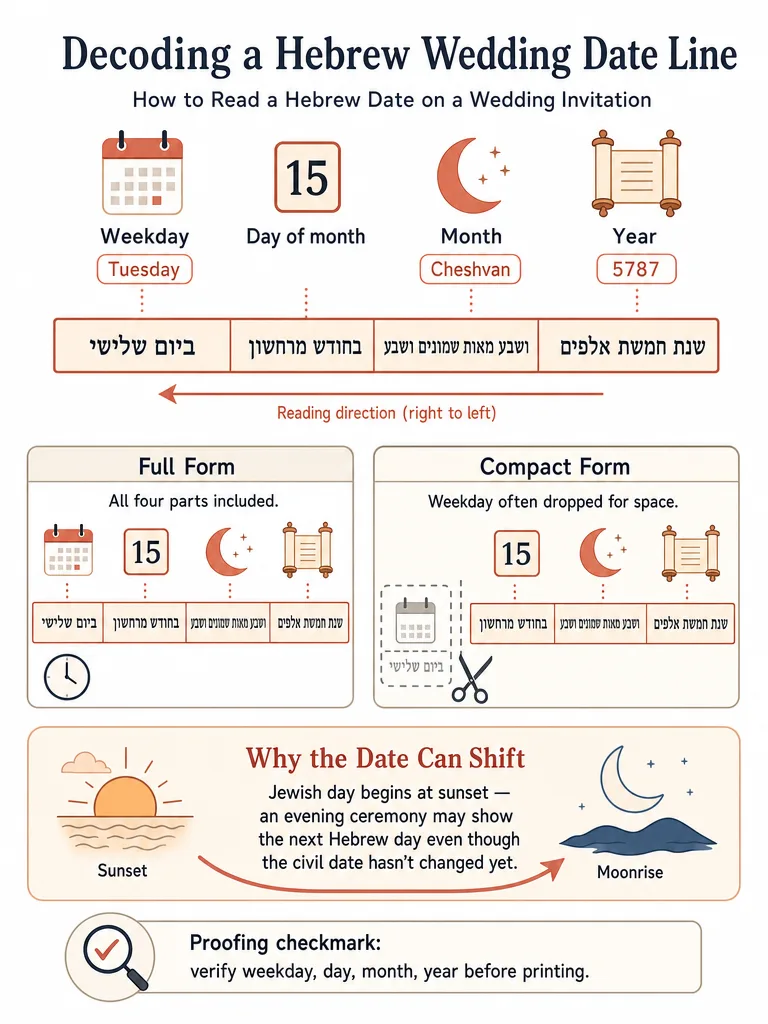
A Hebrew date on a wedding invitation reads right to left as weekday, day, month, and year in full form, or just day, month, and year in a shorter version. InviteLane's example, יום ג' כ״ז מרחשון תשפ״ז, shows the full line. Zola notes that pairing the Hebrew date with the secular date is traditional on Jewish wedding invitations.
Each piece of that line does a specific job. יום ג' marks the weekday, literally "day three," which is Tuesday. כ״ז is the day of the month, using Hebrew letters that double as numbers, so those two letters read as 27. מרחשון names the month, Cheshvan (also spelled Marcheshvan). תשפ״ז is the year, 5787 in the Hebrew calendar. Drop the weekday and you get the compact version, כ״ז מרחשון תשפ״ז, which many couples use when the line has to fit next to a secular date or inside a tighter layout. Neither form is more "correct" than the other; they answer different space and formality needs.
Why Does the Hebrew Date Sometimes Land a Day Later Than You Expect?
The Jewish calendar marks each day from sunset to sunset, not midnight to midnight, so an evening wedding can carry a Hebrew date one day ahead of the civil date sitting right next to it on the card. InviteLane walks through a Tuesday, November 10 wedding with a kabbalas panim at 6:00 p.m. and the chuppah at 7:15 p.m., both after a sunset of roughly 4:40 p.m. in the New York area. Because the chuppah itself starts after nightfall, the Hebrew date on that invitation correctly reflects the following day, not Tuesday itself.
Use this check before assuming your proof has a typo:
Find the sunset time for your wedding's date and location.
Check what time the chuppah itself is scheduled to begin, not just when the reception or kabbalas panim starts.
If the chuppah begins before sunset, the Hebrew date should match the same civil day, even if the celebration continues after dark.
If the chuppah begins after sunset, the Hebrew date should already show the next Hebrew day, the way InviteLane's November 10 example does.
How Can You Verify Your Wedding's Hebrew Date Before It Goes to Print?
Verify a Hebrew invitation date by converting your civil date independently, then checking that conversion letter by letter against your proof. Judaism Your Way recommends running the conversion through a dedicated hebrew date converter and then confirming the result with a rabbi, cantor, or trusted Jewish educator, since the sunset-based calendar can make the conversion tricky even for people who are used to working with it.
Enter your wedding's civil date into a hebrew date converter and write down the weekday, day, month, and year it returns.
Compare that output against the Hebrew text on your proof, starting with the weekday abbreviation at the start of the line.
Check the day-of-month letters and the year letters separately. A single swapped letter changes which number the line reads as.
Send the confirmed date to a rabbi, cantor, or Jewish educator for a final sign-off, especially if the chuppah falls near sunset.
Full Form vs Compact Form: Which Style Is on Your Invitation?
Two accepted forms show up on Hebrew wedding invitations, and the difference comes down to whether the weekday appears. InviteLane's full-form example, יום ג' כ״ז מרחשון תשפ״ז, includes the weekday letter; its compact example, כ״ז מרחשון תשפ״ז, drops it. Couples choose the compact wording when the Hebrew line has to sit beside a secular date or inside a layout that's already tight on space.
Form
Example
When It's Used
Full form
יום ג' כ״ז מרחשון תשפ״ז
Formal, standalone Hebrew lines where the weekday adds context
Compact form
כ״ז מרחשון תשפ״ז
Bilingual or space-constrained layouts, often set beside the civil date
Paperlust lists several bilingual layout options couples use once they've picked a date form: a side-by-side Hebrew and English panel, a double-sided card, a folded card design, or an English-primary layout with Hebrew elements worked in. The date form you choose should match whichever of those layouts you're building toward, since a full-form line with a weekday needs more horizontal room than the compact version does.
What Hebrew Year Is 2026 on a Wedding Invitation?
2026 weddings can land in Hebrew year 5786 or 5787, depending on where the date falls relative to Rosh Hashanah. Cohen Printing states that any date before Rosh Hashanah on September 11, 2026 is still 5786, while any date from that day onward is 5787.
That same source flags a spelling detail worth checking on any proof: the 15th and 16th of a Hebrew month are written ט״ו and ט״ז rather than following the straightforward letter-numeral pattern used for every other date. If your wedding falls on either of those two days, confirm the proof uses these specific forms rather than a generic numeral combination.
Hebrew Month Names and Weekday Abbreviations You'll See on an Invitation
Hebrew month and weekday abbreviations on an invitation come from two short, fixed vocabularies, which makes the rest of the date line easier to decode once you recognize the pattern. InviteLane's example uses מרחשון, Cheshvan, as the month name sitting between the day and the year on a wedding date line.
Weekday abbreviations follow the same compact logic: יום ג' reads literally as "day three" and corresponds to Tuesday, because Hebrew numbers the days of the week instead of naming them outright. InviteLane's broader guide on Hebrew wedding dates also notes that leap years split the month of Adar into Adar I and Adar II, which changes how dates in that stretch of the calendar get written. If your wedding falls in a Hebrew leap year, confirm which half of Adar your proof is referencing before you check anything else on the line.
How Do You Catch Hebrew Typesetting Mistakes on a Proof?
Hebrew typesetting mistakes on a wedding invitation usually come down to three things: reversed letter order, a missing geresh or gershayim mark, or the wrong final-letter form, and InviteLane warns that designers who don't read Hebrew can set any of these incorrectly without noticing. Catching them before printing is a matter of checking the proof against a few specific patterns rather than reading the line as a whole.
Confirm the line reads right to left in the proof file, not left to right with the Hebrew characters simply swapped in.
Check that every multi-letter numeral, like כ״ז or תשפ״ז, carries its gershayim mark between the last two letters.
Look at word endings, since some Hebrew letters use different final forms, and a wrong form is a common sign of a copy-paste error.
Cross-check the whole line one more time against an independent hebrew date conversion before approving the proof.
Do You Need an English Transliteration or a Bilingual Layout on the Invitation?
An English transliteration or a full bilingual panel becomes worth adding once guests who don't read Hebrew need to understand the date and wording on their own, instead of relying on someone else at the table to translate it for them. Zola notes that some communities put all the Hebrew wording on one side of the card specifically for guests who read Hebrew, while Paperlust lists several layout options for blending both languages: common options include a side-by-side bilingual panel, a double-sided card, a folded card design, or an English-primary layout with Hebrew elements worked in.
If you only need guests to hear how the Hebrew date and names sound, adding an English transliteration next to the Hebrew text covers that without a second printed panel. For couples blending both languages more fully, a bilingual layout remains the stronger choice, since it gives every guest a complete, readable version of the invitation rather than a partial phonetic guide.
Frequently asked questions
Do I need to include the Hebrew date on a Jewish wedding invitation?
Yes, it's traditional to include the Hebrew date alongside the secular date on a Jewish wedding invitation. Zola notes this pairing as a standard element of Jewish wedding wording, since the Hebrew calendar date connects the celebration to Jewish time even when the couple isn't especially observant. Most couples list the Hebrew date directly below or beside the Gregorian date rather than replacing it.
What else does a Jewish wedding invitation say besides the date?
A Jewish wedding invitation usually includes an opening line of joy, the parents' names, the couple's names connected by "and" rather than "to," the Hebrew date, the secular date and time, the venue, a reference to the chuppah, and RSVP details, according to InviteLane's breakdown of invitation anatomy. Some couples also add a biblical verse, often from Song of Songs.
Why do Jewish wedding invitations list both sets of parents as hosts?
Jewish wedding invitations traditionally list both sets of parents as hosts because the wedding is framed as a union of two families, not just two individuals, according to Paperlust's guide to Jewish wedding traditions. This is one reason Jewish invitations differ from typical Western wording, where only one family issues the invitation.
How far in advance should I order a Jewish wedding invitation to get the Hebrew typesetting right?
Plan to order at least 20 business days ahead if you want foil-printed Hebrew text, with proofs typically delivered within 1 to 2 business days, according to Paperlust's planning guide. That timeline matters more for Hebrew lines than English ones, since catching a typesetting error, like a missing gershayim mark, before the final print run avoids a costly reprint.
Is Cheshvan the same as Marcheshvan on a Hebrew wedding date?
Cheshvan and Marcheshvan are the same Hebrew month, just two spellings of the same name used across different sources and invitations. On a wedding invitation's date line, you'll most often see the shorter form, מרחשון, sitting between the day and the year, as in InviteLane's sample line יום ג' כ״ז מרחשון תשפ״ז. Either spelling refers to the identical month, so neither is wrong to use.
What does "b'simcha" mean on a Jewish wedding invitation?
"B'simcha" means "with joy" in Hebrew, and it shows up in wedding invitation phrasing such as "invite you with b'simcha," according to Judaism Your Way's guide to Jewish wedding invitation language. It reflects the broader Jewish wedding convention of framing the invitation around celebration rather than formal request, the same instinct behind phrases like "share in our joy."