
Hebrew Date Converter: Convert Gregorian and Jewish Dates

Use a Hebrew date converter to match Gregorian and Jewish dates, read Hebrew script, and handle after-sunset cases, leap years, and yahrzeits.

  • Hebrew calendar
  • Gregorian calendar
  • Jewish calendar
  • Hebcal
  • Adar I
  • Adar II
Hebrew Date Converter: Convert Gregorian and Jewish Dates featured image

What is today's Hebrew date?

Hebcal lists August 11, 2026 as the 28th of Av, 5786, written in Hebrew as כ״ח בְּאָב תשפ״ו. That's the answer most people typing "Hebrew date converter" want first: the current Jewish calendar date for today's civil date.

The Hebrew day is 28, the month is Av, and the Hebrew year is 5786. Read it right to left: day, then month name, then year.

One thing worth knowing before you rely on any single reading: the Hebrew day begins at sunset, not at midnight, per Masa Israel Journey. So after nightfall in Israel, the calendar has already rolled to the next Hebrew day even though the civil date on your phone hasn't changed. More on that below.
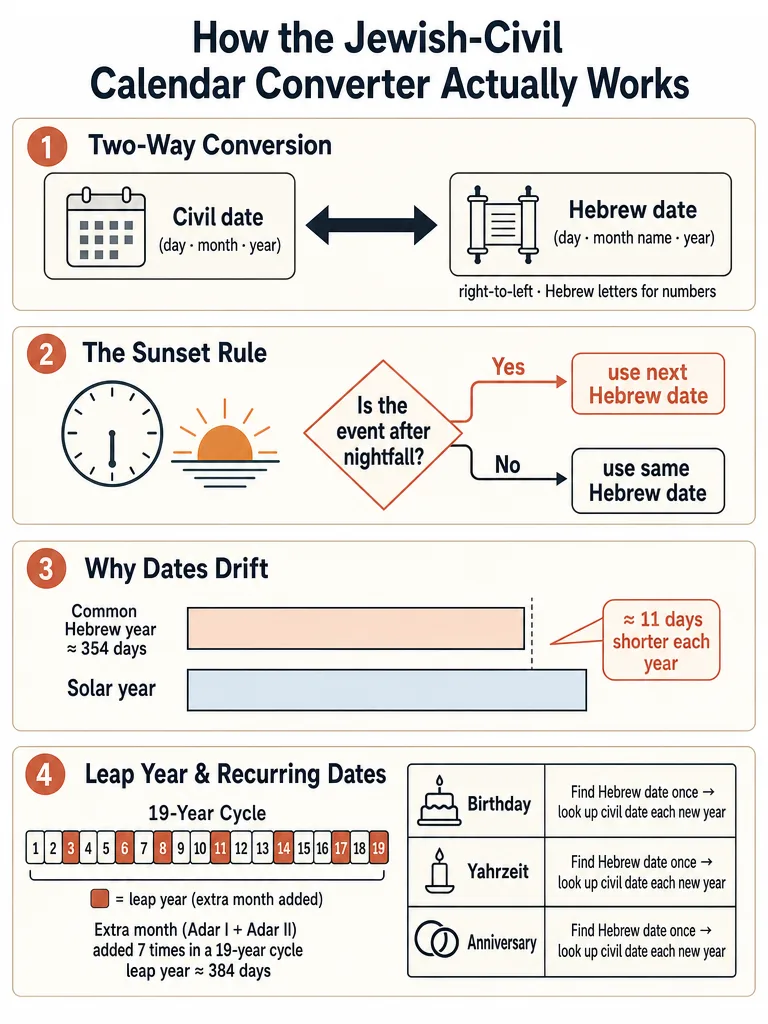
Hebrew Date Converter: Convert Gregorian and Jewish Dates infographic

How do I convert a Gregorian date to a Hebrew date?

To convert a Gregorian date to a Hebrew date, enter the civil day, month, and year, and the converter returns the matching Jewish calendar date. Every major tool does this the same way. On Hebcal, for example, Sunday, July 5, 2026 maps to the 20th of Tamuz, 5786.

The forward lookup is the most common job people ask a converter to do. Pick your everyday calendar date, and you get the Hebrew equivalent, usually with the day of the week attached.

Here's how the same-direction conversion looks across a few well-known tools:

ToolSample Gregorian dateHebrew equivalent
HebcalSun, July 5, 202620 Tamuz 5786
Chabad.orgThu, July 23, 2026Av 9, 5786
TorahCalcTue, June 30, 202615 Tamuz 5786

JewishGen and Masa Israel Journey run the same forward conversion. Masa notes its output comes in Hebrew script with gematriya numerals, English transliteration, and the day of the week.

How do I convert a Hebrew date to a Gregorian date?

Reverse conversion works by choosing a Hebrew day, month, and year to get the matching civil date. On Hebcal, the "Convert from Hebrew to Gregorian" panel lets you pick the day, the month from a dropdown, and the year, then returns the exact Gregorian date.

The month list is where reverse conversion gets particular. A well-built converter only shows Adar I and Adar II when the Hebrew year you picked is actually a leap year. Masa Israel Journey points this out directly: the month list shows Adar I and Adar II only in leap years, so you can't select a month that doesn't exist that year.

Hebcal's dropdown lists the full month set (Nisan, Iyyar, Sivan, Tamuz, Av, Elul, Tishrei, Cheshvan, Kislev, Tevet, Sh'vat, Adar, plus Adar I and Adar II). That guardrail matters most for anyone working backward from a Hebrew birthday or yahrzeit that fell in Adar.

Once you have the exact Hebrew date in front of you, our Hebrew transliteration guide for English speakers helps you say it out loud correctly. Try the free web translator: Try the free web translator.

What does after sunset mean in a Hebrew date converter?

The after-sunset toggle exists because the Hebrew day begins at nightfall, not at midnight. If an event happened in the evening, its correct Hebrew date may already be the next day even though the civil date on the wall calendar hasn't changed yet. Masa Israel Journey explains it plainly: tick the after-sunset box for evening dates and the converter advances to the correct day.

Here's the practical version. Say a baby is born at 9 PM on a Tuesday. The civil date still reads Tuesday, but the Hebrew day flipped over at sunset, so the Hebrew birthday belongs to what would be Wednesday's Hebrew date. Leave the toggle off and you'd get the wrong day.

This is the single setting most converter pages show but rarely explain. The rule is simple: daytime event, leave it unchecked; evening event, check it. For anything hinging on the precise moment of local sunset, confirm the local time rather than guessing, since nightfall differs by location.

How do Hebrew leap years work with Adar I and Adar II?

Hebrew leap years add a thirteenth month, which is exactly why doing this conversion in your head doesn't work. The Hebrew calendar is lunisolar: its months follow the moon while the year stays aligned with the solar seasons, according to Masa Israel Journey. A common 12-month Hebrew year runs about 354 days, roughly 11 days shorter than the solar year.

Left uncorrected, the holidays would drift through the seasons. The fix is a leap month. Masa notes the calendar adds a whole extra month seven times across a 19-year cycle, and a leap year runs about 384 days.

In a leap year, the month of Adar splits into two: Adar I and Adar II. That's the detail a converter has to handle for you automatically, because a Hebrew date in Adar can point to either month depending on the year.

Six possible year lengths, an 11-day annual drift, and a month that appears twice seven years out of nineteen. That's more moving parts than any mental shortcut can track, which is the whole case for using a tool.


How do I find my Hebrew birthday, yahrzeit, or anniversary?

Finding a recurring Hebrew date takes two steps: first convert the original event to its Hebrew date, then convert that Hebrew date forward to find this year's Gregorian equivalent. Because the Hebrew calendar drifts against the civil one, a Hebrew birthday or yahrzeit lands on a different Gregorian day each year, per Masa Israel Journey.

The workflow:

  1. Take the original civil date of the birth, death, or wedding.
  2. Convert it to its Hebrew date (check the after-sunset box if it happened in the evening).
  3. Convert that Hebrew date forward to this year's Gregorian date.

For observances that repeat year after year, some tools do the multi-year math in one pass. JewishGen can display yahrzeit dates for consecutive years, computing civil dates for 1 to 10 consecutive Hebrew years at once. Hebcal offers a Yahrzeit and Anniversary Calendar covering 20-plus years, with free annual email reminders and calendar downloads.

Common reasons people run this: Hebrew birthdays, yahrzeit dates, bar and bat mitzvah planning, and anniversaries. Setting up the email reminder once means you're not re-running the conversion every year and risking the after-sunset mistake each time.

Is the Hebrew date converter the same as a Jewish calendar converter?

Yes. "Hebrew date converter" and "Jewish calendar converter" name the same core job: converting dates in both directions between the Gregorian calendar and the Hebrew calendar. JewishGen describes exactly that, a tool that converts a civil date into the Hebrew calendar and back again.

What differs between tools is the extra output layered on top of that conversion. The date match is the constant. The trimmings vary:

ToolExtra outputs beyond the date match
HebcalHebrew niqqud toggle, parashah, yahrzeit/anniversary reminders
Chabad.orgWeekly Torah reading, birthday and yahrzeit lookups
TorahCalcAfter-sunset handling, two-way interface
JewishGenConsecutive-year yahrzeit dates
Masa Israel JourneyHebrew script, transliteration, day of week, after-sunset toggle

So the terms are interchangeable, but the results pages aren't. If you want the parashah for a date, or reminders for a recurring observance, pick a tool that surfaces those alongside the conversion.

How should you read a Hebrew date in Hebrew script, transliteration, and daily messages?

Hebrew dates read right to left in a fixed order: day of the month first, then the month name, then the Hebrew year. The numbers themselves are written with letters of the Hebrew alphabet, not digits, according to Hebcal. That's why a date appears as כ״ח בְּאָב תשפ״ו rather than in familiar numerals.

Once you can read the script, the transliteration is the bridge to saying it out loud. If you're not yet comfortable reading Hebrew letters as numbers, our Hebrew transliteration guide for English speakers walks through how the alef-bet maps to sounds, and our English to Hebrew translator with transliteration built in shows the pronunciation in English letters on the same result.

Dates rarely travel alone. They show up in WhatsApp invites, event messages, and everyday chats, where getting the phrasing to sound natural, not literal, matters. For turning those messages into Hebrew that reads like a person wrote it, see our guide to English to Hebrew for texts, dates, and daily chats. That's where baba Hebrew Translator handles the gender and tone that a raw date lookup leaves out, so your Hebrew sounds like a local wrote it rather than a machine.

Frequently asked questions

What is today's Hebrew date?

August 11, 2026 corresponds to the 28th of Av, 5786 — written in Hebrew as כ״ח בְּאָב תשפ״ו. The Hebrew day reads right to left: day number, then month name, then year. One catch: the Hebrew day begins at sunset, not midnight, so after nightfall the calendar has already rolled to the next Hebrew date even though your phone still shows the same civil date.

Why does the Hebrew calendar add a second Adar some years?

A standard 12-month Hebrew year runs about 354 days — roughly 11 days shorter than the solar year. Left uncorrected, holidays would drift through the seasons. The fix is adding a 13th month, Adar I, seven times in every 19-year cycle. In those leap years, the regular Adar becomes Adar II. A Hebrew year can be one of six possible lengths because the months Cheshvan and Kislev also vary.

What does the after-sunset toggle do in a Hebrew date converter?

It advances the result by one Hebrew day. Because the Hebrew day starts at nightfall, an event at 9 PM on a Tuesday already belongs to Wednesday's Hebrew date — even though the civil calendar still reads Tuesday. Check the after-sunset box for any evening event, or every future reminder built on that date will be off by one day.

How do I find my Hebrew birthday or yahrzeit date?

Run the conversion in two steps: first convert the original civil date to its Hebrew date (use the after-sunset toggle if the event happened in the evening), then convert that Hebrew date forward to this year's Gregorian equivalent. Hebcal's Yahrzeit and Anniversary Calendar covers 20-plus years and offers free annual email reminders so you don't have to repeat the calculation each year.

How do I convert a Hebrew date back to a Gregorian date?

Select a Hebrew day, month, and year in the reverse-conversion panel of any major tool. The month dropdown is the key detail: a well-built converter only shows Adar I and Adar II when the year you entered is actually a leap year, so you can't accidentally select a month that doesn't exist. Hebcal's panel lists all 14 possible months and applies that guardrail automatically.

Is a Hebrew date converter the same as a Jewish calendar converter?

Yes — the terms are interchangeable. Both describe the same core job: converting dates in either direction between the Gregorian and Hebrew calendars. What differs is the extra output each tool layers on top. Hebcal adds parashah and yahrzeit reminders; Chabad.org includes the weekly Torah reading; JewishGen can display yahrzeit dates for 1 to 10 consecutive Hebrew years at once.

Sources