Hebrew email subject lines work best when they name the topic first. See length rules, gender-safe phrasing, and 30 work and everyday examples.
How do you write a good Hebrew email subject line?
A good Hebrew email subject line names the topic and the action in the first few words, written in Hebrew rather than translated word-for-word from an English draft. Hebrew email subject lines that state directly what's inside, a meeting, a request, a deadline, open more reliably than ones that try to sound clever or stay vague.
Try it with a line you'd normally write in English, something like "Quick question about tomorrow." Translate the topic, not the sentence: what is the email actually about? A meeting, an approval, a document. Build the subject line around that noun first, and notice how much steadier it reads than a literal translation.
The logic behind that habit holds up in general email research, even though none of it is Hebrew-specific. Privy's benchmarks put the average email open rate at 20.4%, and Salesforce cites Gartner research showing 30.4% of readers would unsubscribe after a subject line that misled them about what the email actually contained. ActiveTrail's professional email guide adds a rule that applies in Hebrew just as well: skip exclamation marks, ALL CAPS, and words like "URGENT," since those read as noise to a person and as risk to a spam filter.
The mistake that trips up English-speaking Hebrew learners most is translating the whole sentence instead of just the topic. A line that sounds natural in English can come out stiff, or carry the wrong gendered verb, once it's moved word-for-word into Hebrew. That's the gender problem covered next.
How long should a Hebrew email subject line be?
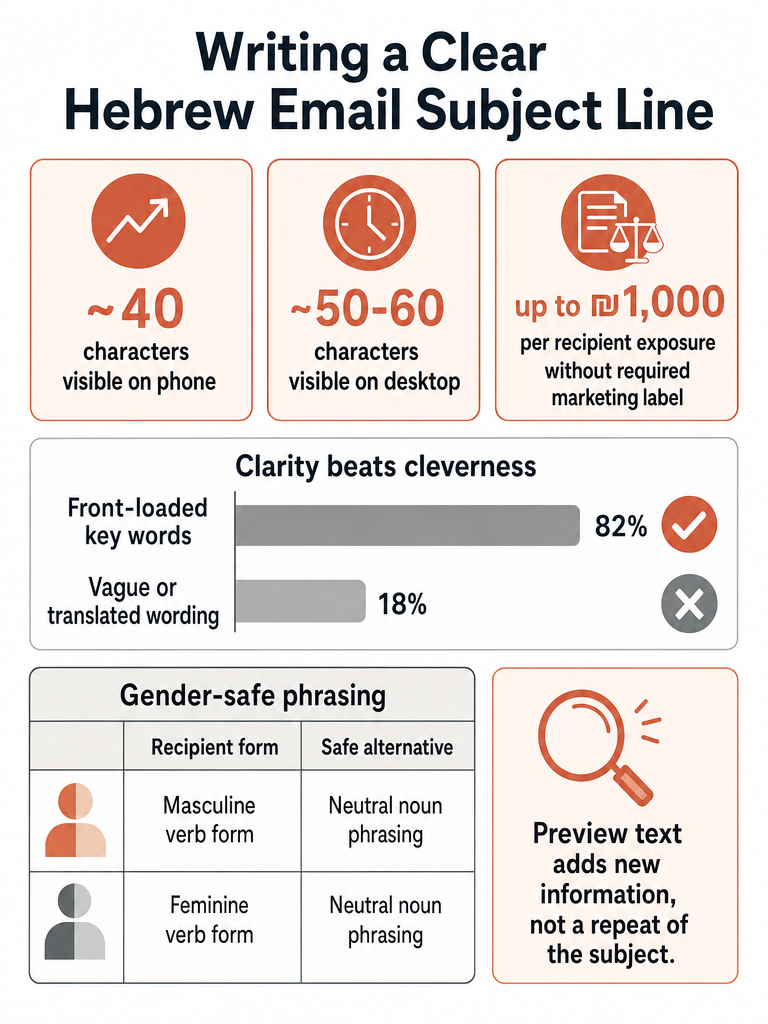
A Hebrew email subject line reads best around 40 characters on a phone screen, which is roughly where mobile inboxes cut the line off, according to Mailflow. Desktop inboxes show more room, and the preview snippet that follows adds even more visible space on top of that.
ActiveTrail's length guidelines line up closely with Mailflow's Hebrew-specific advice:
Where it shows
Roughly how much is visible
What to do
Phone inbox
About 40 characters
Put the key Hebrew words first; assume the rest gets cut
Desktop inbox list
About 50 to 60 characters
A full short sentence usually fits
Preview or preheader text
About 40 to 100 characters
Add a detail, don't repeat the subject
The practical rule for Hebrew: whichever word tells the reader what the email is actually about should be the first word they'd see, not the third or fourth.
Does a Hebrew marketing email need to start with פרסומת?
Yes, but only for promotional email. EmailPro states that Israeli marketing email subject lines must open with the word "פרסומת" (advertisement) under section 30א, and that skipping it exposes a sender to statutory compensation of up to ₪1,000 per recipient.
That label is specific to promotional messages: newsletters, sale announcements, and recurring marketing sends. A meeting request, a project update, a deadline reminder, a thank-you note, or a note to a friend about weekend plans isn't marketing, so it doesn't need "פרסומת" at the front. Confusing the two either wastes scarce character space on an unnecessary label or, worse, skips a label the law actually requires.
How do you avoid gender mistakes in a Hebrew email subject line?
The safest way to avoid gender mistakes in a Hebrew email subject line is to either know the recipient's gender for certain or choose wording that sidesteps a gendered verb altogether. Mailflow notes that dropping a first name into a Hebrew subject line can force a masculine or feminine verb ending, and guessing wrong reads as careless rather than personal.
Salesforce cites Gartner research showing only 31% of brands use personalized subject lines in email campaigns at all, a caution worth taking seriously in Hebrew, where a wrong gender guess stands out more than a plain, unpersonalized line ever would. Writing "מוזמן לפגישה" (invited, masculine form) to a woman reads worse than writing "הזמנה לפגישה" (invitation to a meeting), a noun-based phrasing that avoids the verb entirely.
That noun-first habit is the simplest fix available, and it works for most of the request and reminder patterns further down. For a fuller look at which Hebrew phrases change by gender and which don't, see gender grammar in Hebrew networking.
Hebrew subject-line patterns for meetings, requests, and updates at work
The clearest Hebrew subject lines for meetings and requests name the action first and the topic second, not the other way around. A guide to writing professional Hebrew emails gives exactly this pattern for a meeting request: "בקשה לפגישה" (bakasha le-fgisha), request for a meeting, rather than a vague opener that makes the reader guess what's inside.
That same direct structure extends to other workplace needs. ActiveTrail's email guide recommends a type-plus-topic-plus-date formula for professional subject lines generally: state what the message is first, then the specific topic or date. Applied to Hebrew, that formula produces lines built the same way every time.
Pattern
Hebrew
Transliteration
English meaning
Direct request
בקשה לפגישה
Bakasha le-fgisha
Request for a meeting
Type + topic + date
עדכון: ישיבת צוות ביום רביעי
Idkun: yeshivat tzevet be-yom revi'i
Update: team meeting on Wednesday
Type + topic
בקשה לאישור תקציב
Bakasha le-ishur taktziv
Request for budget approval
Type + topic + date
תזכורת: מועד אחרון ביום חמישי
Tazkoret: moed acharon be-yom chamishi
Reminder: deadline on Thursday
These four cover most meeting, request, and update emails at work. Build your own version by keeping the same order: name the type of message, then attach the real topic and date.
Hebrew subject-line patterns for thanks, reminders, and follow-ups at work
A reminder, thank-you, or follow-up email reads clearest in Hebrew when the subject states the type of message and the topic together, the same type-plus-topic-plus-date formula ActiveTrail recommends for professional email generally. Adapted into Hebrew, a reminder reads "תזכורת: פגישה מחר בשעה 10" (tazkoret: pgisha machar be-sha'a eser), reminder: meeting tomorrow at 10, rather than a bare "תזכורת" with no context attached.
Pattern
Hebrew
Transliteration
English meaning
Reminder + topic + time
תזכורת: פגישה מחר בשעה 10
Tazkoret: pgisha machar be-sha'a eser
Reminder: meeting tomorrow at 10
Thanks + topic
תודה על הפגישה היום
Toda al ha-pgisha hayom
Thank you for today's meeting
Follow-up + topic
המשך לשיחה שלנו מאתמול
Hemshech la-sicha shelanu me-etmol
Follow-up to our conversation from yesterday
Attached + topic
מצורף המסמך המבוקש
Metzoraf ha-mismach ha-mevukash
Attached: the requested document
These four lines reuse the same type-plus-topic order every time. Swap in your own meeting time, document name, or thread subject, and the structure still holds.
Hebrew subject-line patterns for family, friends, and everyday life
Everyday Hebrew subject lines to family and friends can stay casual, but gender still shows up in the verb, not just in the choice of words. The English sentence "I'm arriving" doesn't change with the speaker's gender; the Hebrew verb does, shifting between מגיע (magia) for a man and מגיעה (magi'a) for a woman.
Hebrew
Transliteration
English meaning
Gender in the verb
הזמנה לארוחת שישי
Hazmana le-aruchat shishi
Invitation to Friday dinner
None, הזמנה is a noun
מתי נפגשים השבוע?
Matai nifgashim ha-shavua?
When are we meeting this week?
None, the plural form avoids it
אני מגיע בשישי
Ani magia be-shishi
I'm arriving on Friday (said by a man)
Masculine verb ending
אני מגיעה בשישי
Ani magi'a be-shishi
I'm arriving on Friday (said by a woman)
Feminine verb ending
If a Hebrew email lands in your inbox and you're not sure which form the sender meant, you don't have to work it out alone. You can forward it and get an instant English translation instead of guessing.
How should the preview text support a Hebrew subject line?
A Hebrew email subject line and its preview text should never say the same thing twice. Mailflow recommends writing the subject and the preview together, with the preview adding a detail the subject line didn't have room for, and ActiveTrail notes the preheader typically shows 40 to 100 characters of extra space beyond the subject itself.
Take the reminder line from the earlier pattern: "תזכורת: פגישה מחר בשעה 10." A weak preview just repeats it: "פגישה קבועה למחר." A better one adds something new: "הביאו את המצגת המעודכנת, נדבר גם על לו״ז הרבעון" (bring the updated presentation, we'll also talk about the quarterly schedule). The subject earns the open; the preview gives the reader a reason to care once they've seen it.
How do you turn these subject lines into speaking practice?
Turning a written Hebrew subject line into speaking practice takes a few repeatable moves: say it with the gender form that matches you, swap in your own real detail, and reuse the pattern out loud the next time the situation comes up.
Pick one pattern from the tables above and say it out loud, choosing the verb or ending that matches your own gender, not a default.
Replace the placeholder, the name, the project, the day, with something true about your week, so the sentence is actually yours.
Say the line as an opening sentence, not just a subject: "תזכורת, פגישה מחר בשעה 10" works spoken into a phone call just as well as typed.
Check the register before you reuse a line outside email. Hebrew slang versus formal Hebrew explains when a casual family-style line would sound off to a boss, and the reverse.
Say the gendered pair out loud, both versions, so your mouth has practiced the one you'll actually need before the real conversation happens.
baba Learn, a speaking app for modern Israeli Hebrew currently in private beta, includes grammatical-gender-aware practice and correction explanations for exactly this kind of out-loud drilling.
Frequently asked questions
What's the penalty for an Israeli marketing email that skips פרסומת in the subject line?
An Israeli marketing email subject line without the required "פרסומת" label exposes the sender to statutory compensation of up to ₪1,000 per recipient under section 30א, according to EmailPro's guide. The label itself takes about 8 of the roughly 40 characters visible on a phone screen, a real cost against Hebrew's tight space. The rule applies only to promotional email, not meeting requests, reminders, or a personal note to a friend.
Should you avoid exclamation marks and ALL CAPS in a Hebrew email subject line?
Yes, exclamation marks, ALL CAPS, and words like "URGENT" read as noise to a person and as risk signals to a spam filter, a rule that holds in Hebrew just as it does in English, according to ActiveTrail's professional email guide. A calm subject line that names the topic directly, something like "עדכון: ישיבת צוות ביום רביעי," lands in the inbox and earns an open instead of getting flagged or ignored.
Does adding the recipient's name make a Hebrew subject line better?
Not necessarily, and it can backfire if you guess the recipient's gender wrong, since many Hebrew verbs change their ending by gender and a wrong guess reads as careless rather than personal. Only 31% of brands use personalized subject lines in email campaigns at all, per Gartner research cited by Salesforce. A safer route in Hebrew is a noun-based phrasing like "הזמנה לפגישה" (invitation to a meeting), which sidesteps the gendered verb entirely.
How much does a clear subject line actually affect whether an email gets opened?
A clear subject line affects both the open itself and what happens afterward: average email open rates run around 20.4%, per Privy's benchmark data, while Gartner research cited by Salesforce found that 30.4% of readers would unsubscribe after a subject line misrepresented what was actually inside the email. Vague or clever Hebrew subject lines risk the second problem; one that names the meeting, request, or deadline up front avoids it.
Does a Hebrew subject line need a different tone for a boss versus a friend?
Yes, Hebrew subject lines shift register the same way spoken Hebrew does. A line that sounds natural in a text to a friend, like "מתי נפגשים השבוע?", can read too casual in a message to a boss or client, where a noun-based opener like "בקשה לפגישה" fits better. Checking register before reusing a line outside its original context matters as much as checking gender, since the wrong register stands out immediately to an Israeli reader.
What's the most common mistake English speakers make writing Hebrew email subject lines?
The most common mistake is translating the whole English sentence instead of just the topic, which often produces a stiff line or the wrong gendered verb once it's moved word-for-word into Hebrew. Pulling out only the noun, a meeting, a request, a deadline, and building the subject line around that noun instead reads steadier and more natural. This matters more in Hebrew than English because Hebrew verbs carry gender that English sentences never need to specify.