baba Review: The Only Hebrew Translation App Built for Real Conversations
baba is a Hebrew translation app designed to solve the challenges of translating Hebrew accurately. Unlike generic tools, it handles Hebrew's gender-specific grammar, modern slang, and contextual nuances with precision. With over 30,000 translations and a perfect 5.0-star rating, baba ensures your messages sound natural, whether you're chatting casually or writing formally.
Key Features:
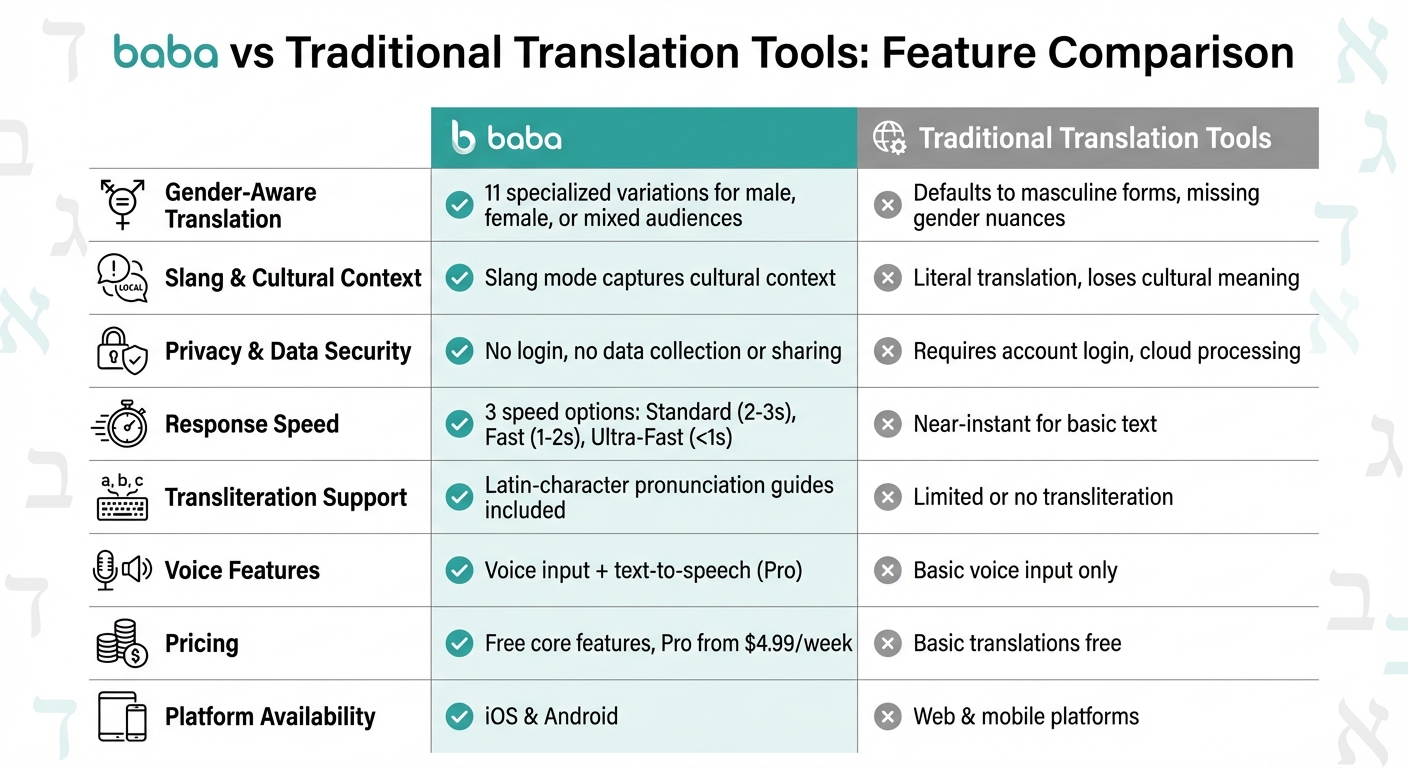
- Gender-Specific Translations: Adjusts for male, female, or mixed audiences.
- Modern Slang Support: Includes explanations for slang and informal phrases.
- Privacy-Focused: No login required, no data tracking, and encrypted translations.
- Flexible Speed Options: Standard, Fast, and Ultra-Fast modes for different needs.
Compared to tools like Google Translate, baba excels in conversational Hebrew, while Google struggles with gender distinctions and modern slang. baba is available on iOS and Android, with free core features and a Pro version starting at $4.99/week.
Want translations that sound natural? Download baba now and communicate in Hebrew with confidence.
1. baba - Smart Hebrew Translation
baba, available on iOS and Android, has handled over 30,000 translations while maintaining a perfect 5.0-star rating[1]. Designed specifically for Hebrew, it delivers translations that feel natural and conversational, steering clear of the stiff, textbook-like tone of traditional tools.
Gender‑Aware Translation
Hebrew grammar comes with its own set of challenges, especially when it comes to gender-specific language. baba’s AI is built to adapt translations based on gender - whether the audience is male, female, or mixed. The app ensures singular and plural forms are used correctly, so your message always feels personal and grammatically accurate. By addressing Hebrew's intricate gender rules, baba makes sure your communication sounds authentic and appropriate[2].
Slang and Contextual Understanding
Modern Hebrew is rich with evolving slang, and baba keeps up with it all. Its "slang mode" doesn’t just translate casual expressions - it also explains when and how to use them. Whether you're crafting a casual text or a formal email, baba adjusts tone and context to help you sound like a native speaker[2]. From everyday conversations to professional exchanges, baba ensures you hit the right note every time.
Translation Speed Options
baba offers three translation modes tailored to your needs: Standard mode for detailed accuracy, Fast mode for casual chats, and Ultra‑Fast mode for quick lookups[1]. Translations stream in real time with a smooth, animated text display, providing a seamless experience even on older devices. No matter the mode, baba delivers speed without compromising quality.
Privacy and Security
Your privacy is a top priority. baba doesn’t collect or share your data with third parties[2]. There’s no need for logins or registrations, and all data is encrypted. Plus, you can request a complete deletion of your data at any time. Whether you're working on personal or professional translations, baba ensures your information stays private and secure.
Download baba here and experience Hebrew translation that truly understands the nuances of gender, slang, and context.
2. Google Translate
Google Translate supports over 200 languages, including Hebrew, and is accessible on the web, iOS, and Android. It’s great for quick, straightforward translations, like deciphering signs or menus using the camera feature. However, it often stumbles when dealing with Hebrew's intricate grammar and cultural subtleties. These challenges become particularly noticeable in gender-specific translations.
Gender-Aware Translation
Hebrew grammar requires gender agreement, an area where Google Translate falls short. Instead of following explicit grammatical rules, it relies on statistical patterns, often defaulting to the masculine singular when the context is unclear [5][6][7][8][9]. This limitation can result in awkward or incorrect translations, especially in conversational settings, as users have no option to specify gender preferences.
"Google itself has acknowledged that Hebrew translations are generated according to statistical patterns in its corpus, without explicit rules to manage gender correctly."
– Best Hebrew Translators Guide 2026 [11]
Slang and Cultural Context
Modern slang and cultural nuances are another weak spot for Google Translate. While it handles literal, word-for-word translations well, it often fails to capture the tone, formality, or context that makes modern Hebrew feel authentic [2]. This can leave translations sounding stiff or out of touch. Additionally, while the app includes a conversation feature for spoken input, the lack of Hebrew text-to-speech output limits its usefulness for real-time, two-way communication [3][4].
Response Speed
One of Google Translate’s strengths is its speed. It can provide near-instant translations for simple tasks like reading street signs or translating menu items [10][11].
Privacy and Data Security
Google Translate processes all data through cloud systems, which means users should be cautious when handling sensitive or confidential information. This reliance on remote processing also brings up concerns about potential biases, such as reinforcing gender stereotypes through its statistical approach [11]. For sensitive communications, it’s wise to consider these limitations.