The Hebrew Translation App Every New Oleh Needs in Israel
Struggling with Hebrew as a new oleh in Israel? You’re not alone. Hebrew’s gendered grammar, evolving slang, and right-to-left text make it a tough language for newcomers. That’s why having a specialized translation app is a game-changer. Unlike generic tools, apps like baba are built to handle Hebrew’s unique challenges, ensuring accurate, context-aware translations for daily life.
Key Takeaways:
- Gender-Specific Grammar: Hebrew changes based on the speaker's gender. Apps like baba ensure translations are accurate and appropriate.
- Slang and Context: Everyday Hebrew is full of slang that generic tools often mishandle. baba decodes these nuances for natural communication.
- Privacy First: Many apps store your data, but baba prioritizes user privacy with no tracking or logins required.
Whether you’re navigating government offices, chatting with locals, or learning the language, baba helps bridge the gap. Download it today to make your transition smoother and more confident.
Demo: English to Hebrew Translator App and Hebrew to English Translator App
Key Features to Look for in a Hebrew Translation App
Choosing the right Hebrew translation app can be tricky. Hebrew's unique characteristics - like its gender-specific grammar and evolving slang - demand features that go beyond what works for more commonly translated languages like Spanish or French. Here's what you should focus on when picking a translation app for your life in Israel.
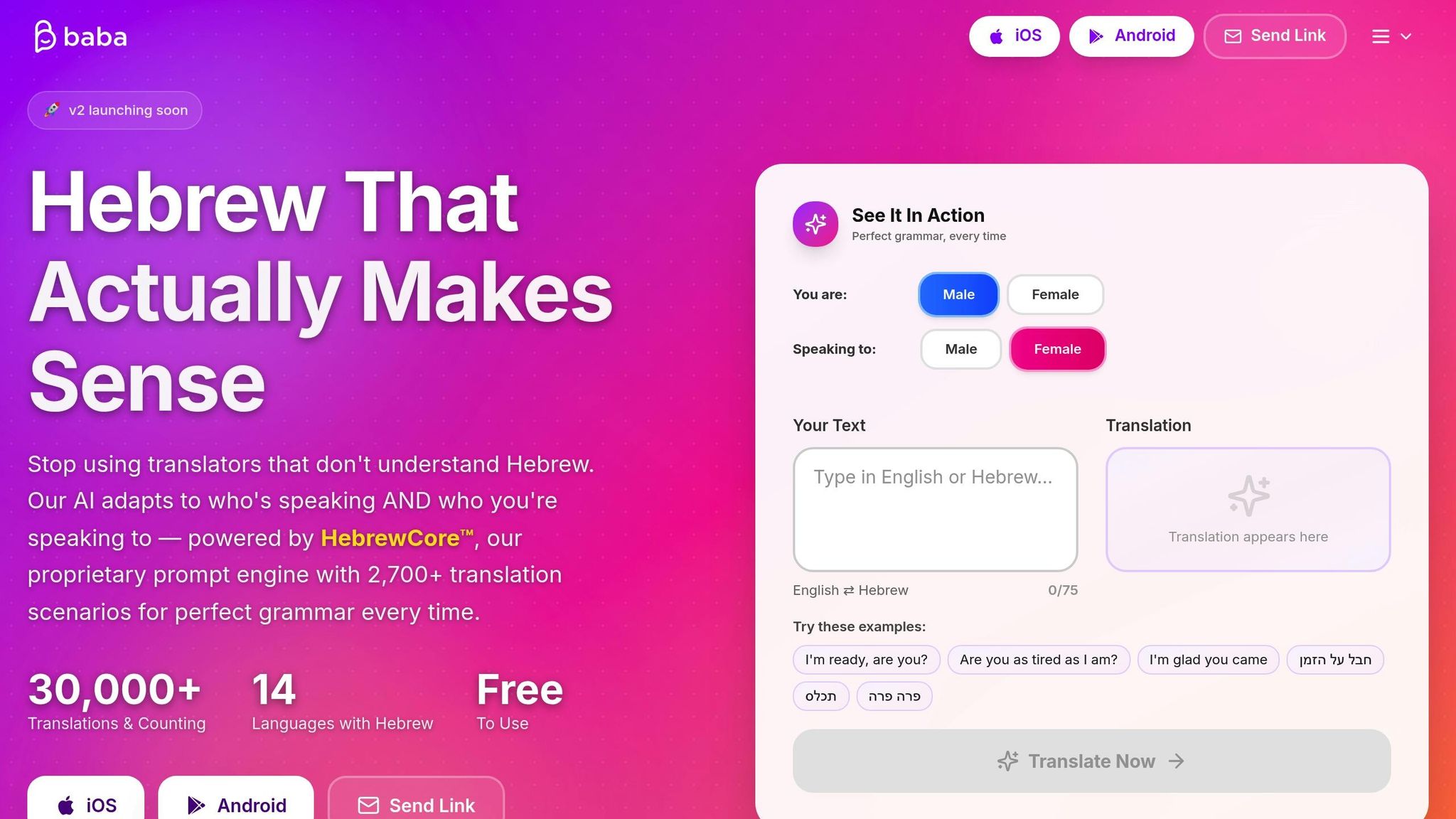
Gender-Aware Translation for Accurate Communication
Hebrew grammar changes based on gender, making it crucial to get translations right. Verbs and adjectives shift depending on whether you're male or female and who you're speaking to. For example, the phrase "I’m tired" translates to "אני עייפה" (ani ayefa) for women and "אני עייף" (ani ayef) for men. Using the wrong form can lead to confusion - or worse, come across as rude or unprofessional.
Many generic translation tools default to male forms, which might not fit your situation. Apps like baba solve this by asking for context before translating, ensuring you get the correct gendered form. This attention to detail is especially important in professional settings, where even a small grammatical error can leave the wrong impression.
The good news? baba is available on both iOS and Android, so it’s easy to access these advanced features. And while gender accuracy is essential, understanding Hebrew slang is just as critical for fitting in.
Understanding Slang and Context
Hebrew slang is everywhere, and it’s constantly changing. Words like "אחי" (achi), "יאללה" (yalla), and "סבבה" (sababa) are staples of everyday conversation, but their meanings go far beyond their literal translations. For example, "אחי" technically means "my brother", but it’s used more like "dude" or "bro" in casual speech. Similarly, "יאללה" is best understood as "let’s go" or "alright", depending on the context.
Most translation apps either skip slang entirely or translate it word-for-word, which can leave you scratching your head. Imagine receiving a text that says, "יאללה, נתראה" (yalla, nitra’eh). A literal translation might confuse you, but the actual meaning is simply, "Alright, see you later."
The best apps go beyond literal translations, offering explanations and context for slang and idiomatic phrases. They even account for regional differences - slang in Tel Aviv can differ from what you’ll hear in Jerusalem. Plus, with Israeli slang evolving rapidly due to social media and pop culture, apps that regularly update their slang databases are a huge plus.
While mastering slang helps you sound natural, it’s also important to consider how an app handles your data, especially when translating sensitive information.
Privacy and Security in Translation Apps
Translation apps often process highly personal or sensitive content. Whether it’s a private text, a business email, or a casual conversation, you need to trust that your data is secure.
Unfortunately, many popular apps store your translation history on external servers and link it to your personal account. This means your private messages could be tracked - or worse, exposed in a data breach. To avoid these risks, look for apps that prioritize privacy from the ground up.
The safest apps don’t require logins, don’t store your translation history, and don’t track your activity. For example, baba lets you use the app anonymously, so there’s no personal data tied to your translations. Additionally, make sure the app encrypts data during transmission to prevent unauthorized access.
How to Use baba for Daily Life in Israel
Moving to Israel as a new oleh comes with its share of challenges, especially when it comes to navigating daily life in a language you might not fully understand yet. From buying groceries to handling paperwork at government offices, knowing Hebrew can make all the difference. That’s where baba steps in - helping you bridge the language gap and feel more at home. Here’s how you can make baba a part of your everyday routine in Israel.
Setting Up baba for Daily Use
Getting started with baba is quick and straightforward. Just download the baba Hebrew Translator app from the Google Play Store or the iOS App Store. It’s available for both platforms and comes with an easy-to-use interface designed to make communication smoother.
One of the best parts? You don’t need to create an account or share personal information. Once installed, you can dive right into translating without the hassle of logins or passwords.
The app also offers customizable modes, allowing you to switch between casual and formal communication styles. Whether you’re bargaining at the market or filling out forms at a government office, baba adapts to fit your needs.
For those tackling more complex tasks - like translating rental agreements or government documents - baba Pro is worth considering. It provides extended context and higher character limits, making it ideal for situations where quick translations just won’t cut it.
Now, let’s see how baba can make your everyday life in Israel a whole lot easier.
Using baba for Everyday Tasks
Daily life in Israel comes with its own set of unique communication hurdles, and generic translation apps often fall short. baba’s thoughtful design helps you navigate these situations with ease.
- Shopping at the shuk (market): baba’s precise pluralization lets you order like a local, whether you’re asking for “3 kg of tomatoes” or “a dozen eggs.” Its gender-aware translations also ensure you address vendors correctly, whether they’re male or female.
- Using public transportation: baba’s context-savvy translations help you understand signs, announcements, and directions, making it easier to get where you need to go.
- Government offices and formal settings: When dealing with bureaucracy, banking, or visa paperwork, baba’s customizable modes allow you to maintain the right level of formality for official interactions.
- Healthcare and service calls: Explaining symptoms to a doctor or describing an issue to a repair technician can be tricky. baba’s accurate, context-aware vocabulary ensures you get your message across clearly in these critical moments.
With baba, you can communicate naturally and confidently, no matter the situation.
Tips for Using baba to Learn Hebrew
baba isn’t just a translation tool - it’s also a great way to improve your Hebrew skills. By paying attention to its translations, you’ll gain insights into how Hebrew is spoken in everyday life, beyond what you’d find in a textbook.
Here are some tips to make the most of baba as a learning tool:
- Notice gender patterns: Hebrew often changes based on the gender of the speaker and listener. baba’s gender-aware translations let you see these variations in action. Try translating the same sentence with different gender settings to understand these patterns better.
- Learn from context: baba’s translations are context-aware, so take a moment to study why certain words or phrases were chosen. This can help you pick up common Hebrew expressions and nuances that traditional dictionaries might miss.
- Prepare for real-life scenarios: Translate common phrases you’ll need at the grocery store, post office, or café. Practicing these ahead of time will not only prepare you for interactions but also reinforce your Hebrew vocabulary.
- Build a phrasebook: Use baba’s translation history to save phrases you find particularly useful. Over time, you’ll create a personalized collection of go-to expressions that will come in handy during your first months in Israel.
- Experiment with formality: Practice translating the same request in both casual and formal Hebrew. This will help you understand when to use each style and make your interactions more appropriate for different situations.
Every time you use baba, you’re not just translating - you’re learning. With consistent practice, you’ll gain a deeper understanding of Hebrew and feel more confident navigating life in Israel.
