
baba
Free, no AIHebrew-English guide 50 of 100

Israeli Fabric Labels, in Plain English

How to read Hebrew fabric names and care symbols.

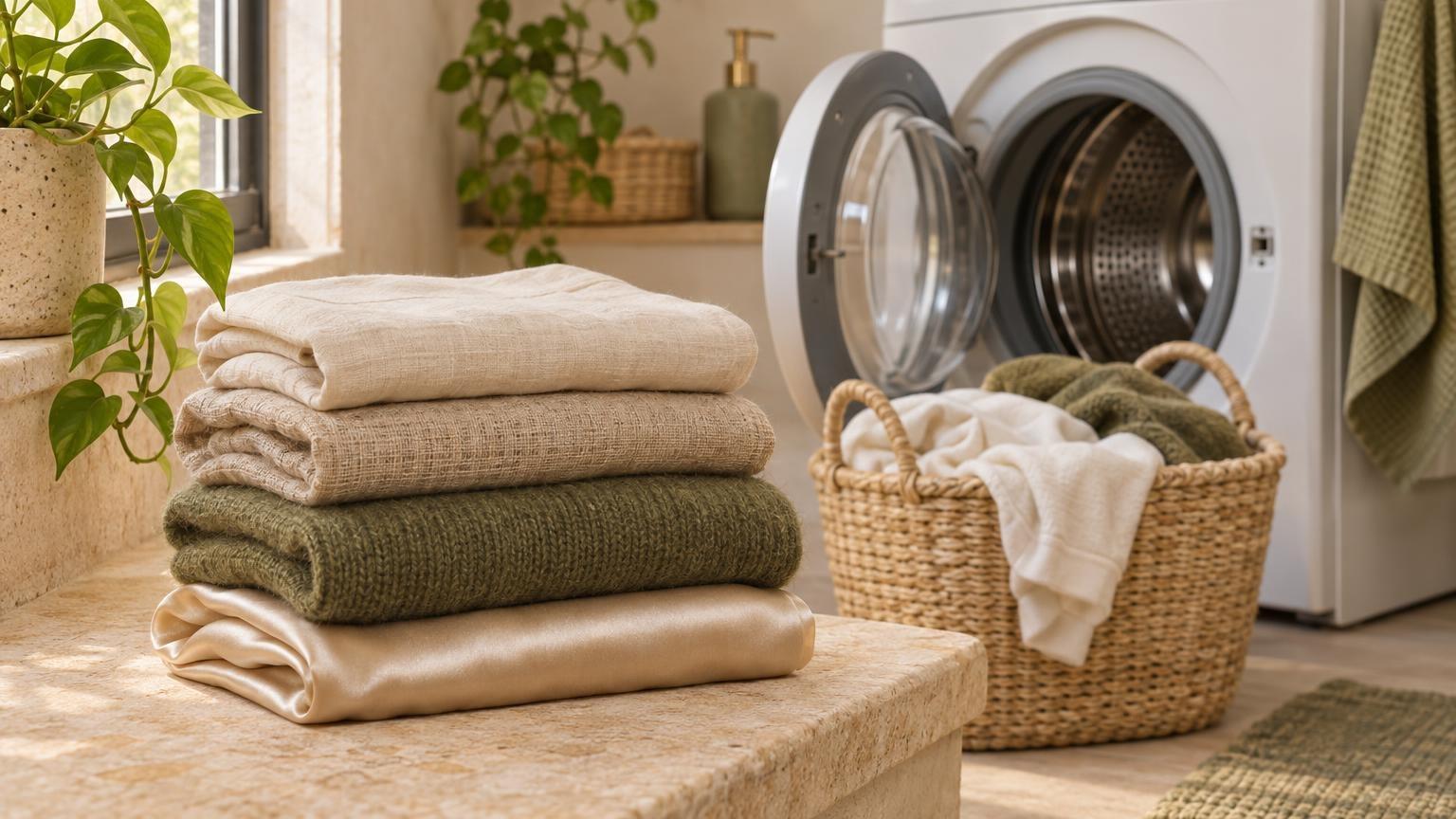
Folded fabrics beside a washing machine in an Israeli laundry corner

Mix-Ups to Avoid

  1. Do not treat a fabric name as a fiber. ג׳רסי, סאטן, ג׳ינס, and פלנל can each contain different fibers, so check הרכב בד and the percentages.
  2. A number inside the wash tub is a Celsius ceiling. One bar means a mild process, and two bars mean a very mild process with less mechanical action.
  3. A crossed care symbol means the treatment is prohibited. A crossed tub does not automatically mean dry-clean only, so read the other symbols too.
In This Guide25 entries

Reading The Label

On the label or sign

הרכב בד
fiber composition
בד חיצוני
shell or outer fabric
בִּטְנָה
lining

הרכב בדFiber composition

herkev bad

US English

Fiber content

UK English

Fibre content

What it is

הרכב בד or הרכב introduces the fiber composition. Mixtures list recognized fiber names and percentages by weight in descending order.

The difference

Composition is separate from fabric type, size, origin, and care. The shell, lining, filling, and trim may also have different compositions.

Common mistake

Read every component and percentage instead of treating one fabric name as the whole composition.

On the label or sign

כביסה רגילה
normal wash
כביסה עדינה
mild wash
אסור לכבס
do not wash

כביסהWashing symbols

kvissa

US English

Washing instructions

UK English

Washing instructions

What it is

A wash tub gives the maximum safe washing treatment. A number is the Celsius ceiling, one bar means a mild process, and two bars mean a very mild process.

The difference

The bars also limit mechanical action, load, rinsing, and spin. A hand in the tub means hand wash, while a crossed tub means do not wash.

Common mistake

Do not read 30 as Fahrenheit or assume every 30°C machine cycle gives the same treatment.

On the label or sign

כל חומר הלבנה
any bleach allowed
הלבנה ללא כלור
non-chlorine bleach only
אסור להלבין
do not bleach

הלבנהBleaching symbols

halbana

US English

Bleaching instructions

UK English

Bleaching instructions

What it is

The triangle is the bleaching family. An empty triangle allows chlorine or oxygen bleach, while two diagonal lines allow only oxygen or non-chlorine bleach.

The difference

A crossed triangle prohibits bleach. The diagonal lines belong to the bleach symbol and do not mean a gentle wash.

Common mistake

Check the triangle before using a product that contains any bleaching agent.

On the label or sign

ייבוש בתלייה
line dry or hang to dry
ייבוש בשכיבה
dry flat
אסור לייבש בתוף
do not tumble dry

ייבושDrying symbols

yibush

US English

Drying instructions

UK English

Drying instructions

What it is

A square is the drying family. A circle inside the square means tumble drying, while vertical or horizontal lines show natural drying methods.

The difference

One dot in the tumble-dryer symbol means low or mild heat, and two dots mean normal heat. A diagonal corner line adds a shade instruction.

Common mistake

A crossed tumble-dryer symbol prohibits tumble drying, so look for a separate line, drip, flat, or shade instruction.

On the label or sign

גיהוץ בחום נמוך
iron on low heat
גיהוץ בחום בינוני
iron on medium heat
אסור לגהץ
do not iron

גיהוץIroning symbols

gihuts

US English

Ironing instructions

UK English

Ironing instructions

What it is

The iron symbol controls ironing. Current ISO and GINETEX values are 120°C for one dot, 160°C for two dots, and 210°C for three dots.

The difference

The older Israeli consumer explainer shows 110°C, 150°C, and 200°C. A newer one-dot treatment explicitly prohibits steam, while a plain one-dot symbol is not the same mark.

Common mistake

Choose the iron setting from the care label rather than guessing from the fiber content.

On the label or sign

ניקוי יבש P
professional dry clean with the P solvent class
ניקוי יבש F
professional dry clean with hydrocarbons
ניקוי רטוב מקצועי W
professional wet clean

ניקוי מקצועיProfessional cleaning

nikui miktso'i

US English

Professional cleaning

UK English

Professional cleaning

What it is

A circle is the professional-care family. P and F are dry-cleaning solvent instructions, while W means professional wet cleaning.

The difference

The letters are instructions for a professional cleaner, not home-machine programs. Bars below the circle require a milder professional process.

Common mistake

Do not treat a W inside a circle as permission for ordinary home washing.

Fiber Names

On the label or sign

כותנה
cotton
כותנה סרוקה
combed cotton

כֻּתְנָהCotton

kutna

US English

Cotton

UK English

Cotton

What it is

כותנה is fiber from cotton bolls. The label gives the cotton percentage, either alone or in a blend.

The difference

Combed, organic, Egyptian, and Pima describe cotton rather than separate legal fibers. A cotton fabric can still use many different constructions.

Common mistake

Look for כותנה and a percentage instead of assuming a soft or familiar fabric is cotton.

On the label or sign

צמר
sheep or lamb wool
קשמיר
cashmere
מוהר
mohair

צֶמֶרWool and animal hair

tsemer

US English

Sheep or lamb wool

UK English

Sheep or lamb wool

What it is

צמר is sheep or lamb fleece fiber. Cashmere, alpaca, mohair, angora, camel, and other named animal hairs form a separate legal group.

The difference

Merino is a sheep breed or type, not a separate legal fiber. Angora is rabbit hair, while mohair comes from the Angora goat.

Common mistake

Read the exact animal name and percentage instead of translating every animal hair as wool.

On the label or sign

פשתן
flax or linen
דמוי פשתן
linen look

פִּשְׁתָּןLinen or flax

pishtan

US English

Flax or linen

UK English

Flax or linen

What it is

פשתן is bast fiber from the flax plant. On a composition label, פשתן corresponds to linen.

The difference

דמוי פשתן means a linen look and does not prove the presence of flax. True hemp is also a different fiber.

Common mistake

Check for פשתן and its percentage rather than trusting a linen-look description.

On the label or sign

משי
silk
משי סינתטי
silk-like synthetic material

מֶשִׁיSilk

meshi

US English

Silk

UK English

Silk

What it is

משי is fiber from silk-secreting insects. A composition label should state משי and its percentage.

The difference

A silky surface, סאטן, or משי סינתטי does not establish silk. Satin is a construction, and synthetic silk is an appearance claim.

Common mistake

Use the composition line to confirm silk instead of judging by shine or softness.

On the label or sign

ויסקוזה
viscose, commonly rayon in US retail

ויסקוזהViscose or rayon

viskoza

US English

Viscose, commonly rayon in US retail

UK English

Viscose

What it is

ויסקוזה is regenerated cellulose made by the viscose process. Israeli and UK labels commonly use viscose, while US shoppers often expect rayon.

The difference

The practical US mapping is close, but viscose is the adopted composition name. Plant-derived cellulose does not make viscose cotton or linen.

Common mistake

Read ויסקוזה as viscose or the familiar US retail term rayon, not as cotton.

On the label or sign

ליוסל
lyocell
מודל
modal
קופרו
cupro

ליוסל / מודל / קופרוRegenerated cellulose

liyosel / modal / kupro

US English

Lyocell, modal, or cupro

UK English

Lyocell, modal, or cupro

What it is

Lyocell, modal, and cupro are separate regenerated cellulose fibers made by different processes. Each composition word should appear with a percentage.

The difference

Modal is not a weave, and cupro is not identical to viscose. A Tencel label can refer to lyocell, modal, or lyocell filament.

Common mistake

Read the generic fiber beside any Tencel wording instead of assuming the fiber is always lyocell.

On the label or sign

פוליאסטר
polyester
מיקרופייבר
microfiber, with composition still to be checked

פוליאסטרPolyester

poliester

US English

Polyester

UK English

Polyester

What it is

פוליאסטר is a synthetic polyester fiber used in clothing, fleece, fillings, and microfiber. The composition line states its percentage.

The difference

Microfiber describes fineness or product type, not one polymer. Microfiber may contain polyester, polyamide, or a blend.

Common mistake

Do not assume every word beginning with poly means polyester.

On the label or sign

פוליאמיד
polyamide
ניילון
nylon

פוליאמיד או ניילוןPolyamide or nylon

poliamid o nailon

US English

Polyamide or nylon

UK English

Polyamide or nylon

What it is

פוליאמיד and ניילון are both accepted names for the same defined synthetic-fiber entry. Israeli labels may use either word.

The difference

Nylon is not a separate fiber from the polyamide entry. פוליאימיד is polyimide, a different polymer class with a very similar Hebrew spelling.

Common mistake

Distinguish פוליאמיד from פוליאימיד and read the stated percentage.

On the label or sign

אלסטן
elastane or spandex
לייקרה
brand wording associated with elastane

אלסטןElastane or spandex

elastan

US English

Spandex or elastane

UK English

Elastane

What it is

אלסטן is an elastic segmented-polyurethane fiber. Israeli and UK labels normally use elastane, while US shoppers often use spandex.

The difference

Lycra is a brand associated with elastane or spandex, not a separate generic fiber. A few percent of elastane can provide stretch.

Common mistake

Look for אלסטן and its percentage instead of treating Lycra as a separate fiber.

Fabric And Shop Names

On the label or sign

אריג
woven fabric
סריג
knit fabric or knitwear

אָרִיג / סָרִיגWoven or knit fabric

arig / sarig

US English

Woven fabric or knit fabric

UK English

Woven fabric or knitted fabric

What it is

אריג is woven from interlacing warp and weft yarn systems. סריג is knitted from intermeshing yarn loops.

The difference

Woven and knit describe construction, not fiber. Either construction can use cotton, wool, viscose, polyester, or a blend.

Common mistake

Identify the construction and then read the separate fiber composition.

On the label or sign

בד טריקו
knit fabric, often jersey
חולצת טריקו
T-shirt
ג׳רסי
jersey knit

טריקו / ג׳רסיKnit or jersey

triko / jerzi

US English

Knit or jersey fabric

UK English

Knitted or jersey fabric

What it is

בד טריקו broadly means knit fabric in Israeli trade usage, often jersey. ג׳רסי is a knit with a smooth face and looped reverse in single jersey.

The difference

חולצת טריקו means a T-shirt. Israeli טריקו should not always be narrowed to the technical English tricot warp knit.

Common mistake

Treat טריקו or ג׳רסי as construction wording and check the fiber percentages separately.

On the label or sign

פליז
fleece
שרפה
sherpa or borg fleece
פליז שרפה
sherpa fleece

פליז / שרפהFleece or sherpa

fliz / sherpa

US English

Fleece or sherpa fleece

UK English

Fleece or borg fleece

What it is

פליז is a pile fabric commonly made from polyester, though the fiber must be checked. שרפה is a curly pile that resembles sheep fleece and is often synthetic.

The difference

Fleece and sherpa describe fabric or pile type, not sheep wool. A sheep-like surface does not make sherpa wool or shearling.

Common mistake

Read the composition instead of inferring wool from the word fleece or a curly surface.

On the label or sign

טוויל
twill
דנים / בד ג׳ינס
denim
שמבריי
chambray

טוויל / דנים / בד ג׳ינס / שמברייTwill, denim, or chambray

tvil / denim / bad jeans / shambrei

US English

Twill, denim, or chambray

UK English

Twill, denim, or chambray

What it is

טוויל has woven diagonal ribs. Denim is typically a warp-faced twill, while chambray is usually a lightweight plain weave with a denim-like color effect.

The difference

Twill is not automatically denim or cotton. Chambray can look like denim without the twill diagonal, and stretch denim contains elastane.

Common mistake

Check the weave and composition instead of calling every blue woven cloth denim.

On the label or sign

סאטן
satin
סאטן כותנה
cotton in a satin or sateen-type weave

סאטןSatin

satin

US English

Satin

UK English

Satin

What it is

סאטן is a weave or structure with long floats and a smooth, lustrous face. Satin can contain silk, polyester, acetate, cotton, or another fiber.

The difference

סאטן כותנה is cotton in a satin or sateen-type weave, not silk. Shine describes the structure and surface rather than the fiber.

Common mistake

Read the composition before translating satin as silk.

On the label or sign

שיפון
chiffon
אורגנזה
organza
טול
tulle or net

שיפון / אורגנזה / טולSheer fabrics

shifon / organza / tul

US English

Chiffon, organza, or tulle

UK English

Chiffon, organza, or tulle

What it is

שיפון is very light and sheer with fluid drape. אורגנזה is sheer, crisp, and relatively stiff, while טול is an open mesh.

The difference

These words describe fabric structure or feel, not fiber. Chiffon and organza may be silk or synthetic, and mass-market tulle is usually synthetic.

Common mistake

Use drape and structure to distinguish the fabric names, then use the label to identify the fiber.

On the label or sign

טטרה
Israeli gauze fabric
טטרה כפולה
double gauze
גזה
gauze

טטרה / מוסלין כפול / גזהDouble gauze or gauze

tetra / muslin kaful / gaza

US English

Double gauze, muslin, or gauze

UK English

Double gauze, muslin, or gauze

What it is

Israeli טטרה commonly means loose, crinkled cotton gauze used for baby cloths and summer garments. טטרה כפולה has two gauze layers joined at intervals, while גזה is open plain-weave gauze.

The difference

Fashion טטרה is related to gauze but is not always the same specification as medical gauze. Muslin outside Israel does not always mean double gauze.

Common mistake

Translate טטרה by its gauze construction instead of reading the word as the chemical prefix tetra.

On the label or sign

פלנל
flannel

פלנלFlannel

flanel

US English

Flannel

UK English

Flannel

What it is

פלנל is woven or knit fabric with a soft raised surface. Flannel may contain wool, cotton, or synthetic fibers.

The difference

Flannel is a fabric type, while plaid is only a pattern. A soft raised surface does not identify the fiber.

Common mistake

Check the composition instead of assuming flannel is wool or that every plaid cloth is flannel.

On the label or sign

צמר
sheep or lamb wool
פשתן
flax or linen

שַׁעַטְנֵזShatnez

sha'atnez

US English

Sheep wool and flax linen combination

UK English

Sheep wool and flax linen combination

What it is

שעטנז is the Jewish-law prohibition on wearing sheep or lamb wool and flax linen combined in one garment. The issue can occur in the shell, stitching, padding, interfacing, collar canvas, or trim.

The difference

The rule does not cover every mixed-fiber garment. Cashmere, mohair, angora, camel, alpaca, and vicuña do not count as the relevant wool unless sheep wool is also present.

Common mistake

A label listing both צמר and פשתן is a warning, but observant shoppers should use a qualified shatnez checker because a retail label may omit internal components.

Your English Label Says This. Look for This Wording in Israel.

Your English label says this. Look for this wording in Israel.
English labelLook for in IsraelKeep in mind
CottonכותנהkutnaRead the percentage.
Linen or flaxפשתןpishtanדמוי פשתן only means linen look.
RayonויסקוזהviskozaViscose is the common Israeli label wording.
SpandexאלסטןelastanElastane is the common Israeli label wording.
Knit or jerseyטריקו / ג׳רסיtriko / jerziThese words describe construction.
Sweatshirt fabricפוטרfooterCheck whether the inside is looped or brushed.
Double gauzeטטרה כפולה / מוסלין כפולtetra kfula / muslin kafulIsraeli טטרה is a gauze market term.
Denimדנים / בד ג׳ינסdenim / bad jeansCheck for cotton and elastane percentages.

Knowing the word is half of it. Say it out loud.

A Hebrew speaking app with Maya and David, AI tutors who hold conversations, explain corrections and help you practise what you need to say. Private beta on iPhone and Android. Public store launch is still ahead. Free Classic lessons to start, no card needed.

Explore baba Learn

How we checked this guide

By the baba team. Checked on against 27 sources, mostly Israeli retailers, manufacturers and government pages, and updated . Products, labels and rules change, so check the pack or the office before you rely on a detail. Our methodology.

Frequently Asked Questions

What should I read first on an Israeli clothing label?

Start with הרכב בד and the fiber percentages. Read separate entries for the shell, lining, filling, and trim, then read the care symbols in their usual order: washing, bleaching, drying, ironing, and professional care.

Does סאטן mean silk?

No. סאטן is a weave or structure with a smooth, lustrous face and may contain silk, polyester, acetate, cotton, or another fiber. Check the composition for משי if you need silk.

What does טריקו mean in Israel?

בד טריקו broadly means knit fabric, often jersey, and חולצת טריקו means a T-shirt. The term does not state the fiber, so check הרכב בד too.

Does במבוק mean natural bamboo fiber?

Not necessarily. במבוק is often a feedstock claim for regenerated cellulose, commonly viscose or rayon, so the composition should name the recognized fiber and percentage.

Can a clothing label rule out shatnez?

A label listing both צמר and פשתן is a warning, but a retail label may not reveal every thread or internal component. Observant shoppers should ask a qualified shatnez checker about the garment.

More Hebrew-English Guides

All guides