How to Survive in Israel Without Speaking Hebrew (App Guide)
Navigating Israel without Hebrew can feel overwhelming, but technology makes it easier. Translation apps help you manage gender-specific grammar, decode slang, and understand signs or menus. baba, a translation app, stands out with features like gender-aware translations, slang understanding, and offline functionality. Whether you're ordering food, traveling, or handling emergencies, apps like baba simplify communication and improve your experience.
Key takeaways:
- Hebrew uses gender-specific grammar, affecting verbs and adjectives.
- Slang like "yalla" or "sababa" is common and context-dependent.
- baba offers real-time translations, slang support, and offline use.
For a smoother trip, download baba to bridge the language gap effectively.
Why Hebrew Translation Is Difficult
Hebrew's unique grammar throws a wrench into even the simplest sentences. When you add in the language's gender-specific rules, things get even trickier.
Gender Grammar and Context
Hebrew is deeply gendered, and this influences verbs, nouns, and adjectives. For example, asking someone "How are you?" in Hebrew isn't as straightforward as it sounds. The phrasing changes entirely depending on whether you're speaking to a man, a woman, or a mixed group. Unfortunately, many translation tools default to the masculine form, leading to translations that feel awkward or out of place. To make matters more complex, plural forms also need to align with the gender of the group being addressed.
Israeli Slang vs. Textbook Hebrew
The Hebrew you find in textbooks is worlds apart from what you'll hear on the streets of Tel Aviv. Modern Israeli slang is a melting pot of influences, including Palestinian Arabic, military jargon, and homegrown expressions. This makes it tough for standard translation tools to keep up with the ever-evolving language [2][3].
Take the phrase Khaval al ha zman. Literally, it translates to "a waste of time." But in slang, it's used to rave about something amazing. As Hebrew translator Mark L. Levinson explains:
"It means 'a waste of time,' but in slang, it's used favorably, as if to say 'I could try to tell you how great it is, but I'd be wasting my breath because no words could suffice'" [2].
On top of that, Hebrew is written without vowels, which means readers - and software - have to rely entirely on context to figure out the meaning of words that look identical but mean completely different things [3]. Combine that with slang that defies literal translation, and it's no wonder translations often fall short. Grasping these nuances is essential for navigating casual conversations in Israel.
Apps for Getting Around Israel Without Hebrew
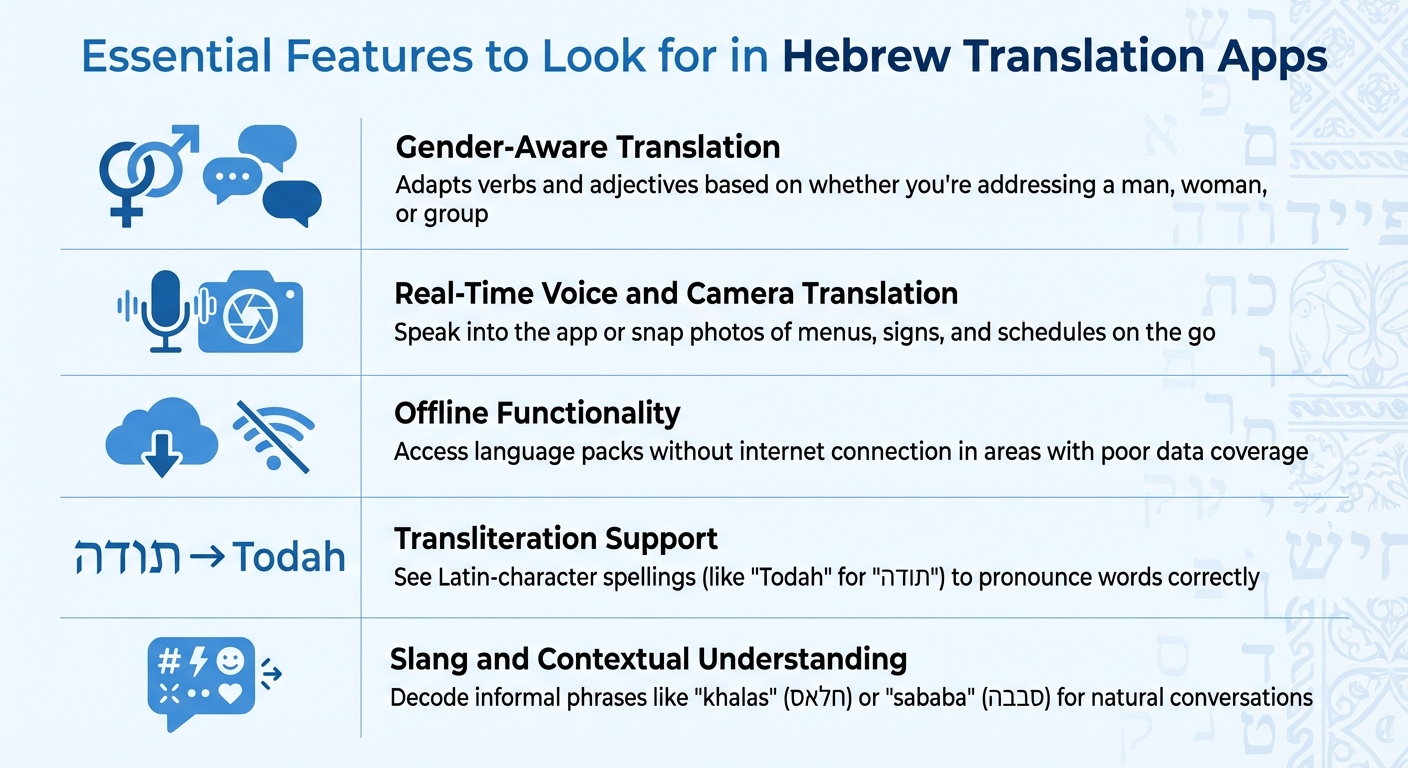
Essential Features to Look for in Hebrew Translation Apps
Getting around Israel without knowing Hebrew can be tricky if you're relying on basic translation apps. Hebrew's unique characteristics - like its gendered language, slang, and contextual nuances - can leave you scrambling in real-life situations, whether you're deciphering signs, ordering a meal, or handling emergencies. To make your experience smoother, it's essential to pick a translation app that goes beyond the basics.
Key Features to Look For
The right translation app for navigating Israel should offer more than just literal translations. Here's what to prioritize:
- Gender-Aware Translation: Hebrew modifies verbs and adjectives based on whether you're addressing a man, woman, or group. Apps that skip this can lead to awkward or even impolite translations.
- Real-Time Voice and Camera Translation: The ability to speak into the app or snap a photo of a menu, sign, or schedule is invaluable when you're on the go.
- Offline Functionality: Access to language packs without needing an internet connection is a lifesaver in areas with poor data coverage.
- Transliteration Support: Seeing Latin-character spellings (like "Todah" for "תודה") helps you pronounce words correctly, even if you're just starting to learn the Hebrew alphabet.
- Slang and Contextual Understanding: Everyday Hebrew is full of informal phrases like "חלאס" (khalas) or "סבבה" (sababa). Apps that explain these expressions help you use them naturally and confidently.
How baba Solves Communication Problems
baba is designed to tackle these challenges head-on, offering precise solutions for seamless communication in Hebrew. The app excels in areas where many others fall short, thanks to its advanced features tailored specifically for Hebrew speakers and learners.
One standout feature is baba's gender-aware AI, which adapts translations based on who you're speaking to. Whether you're addressing a man, woman, or group, baba adjusts verbs and adjectives to ensure your translations sound polite and natural.
For modern Hebrew, baba's slang mode is a game-changer. It deciphers and teaches you how to use contemporary Israeli expressions appropriately. As the baba team explains:
"baba was built by Hebrew language experts who understand the soul of the language. We capture nuances that other tools miss – because Hebrew isn't just words, it's context." - baba
Available on both iOS and Android, baba includes features like hands-free voice input, transliteration for accurate pronunciation, and offline mode for areas with limited internet access. With over 30,000 translations processed and a perfect 5.0-star rating, baba empowers you to handle everyday situations - from reading bus schedules to ordering at a restaurant - with confidence and ease.
Using Apps for Everyday Situations
Once you've got a handle on baba's main features, it's time to put the app to work in real-world scenarios where quick and accurate translations are a must. Whether you're grabbing a bite, navigating public transit, or managing an emergency, mastering these tools can make your experience in Israel much smoother. Here's how to tackle some of the most common situations.
Ordering Food and Reading Menus
Israel's food scene is vibrant and diverse, but navigating menus in Hebrew can be tricky. With baba, you can use the camera feature to translate menus instantly. Just snap a photo, and the app will decode the text for you.
If you have dietary restrictions, baba's voice feature is a lifesaver. Simply tap the microphone, say something like, "I'm vegan and allergic to nuts", and baba will provide a natural-sounding Hebrew translation. Thanks to its gender-aware tech, it ensures your message is appropriately tailored, whether you're speaking to a waiter or a waitress, making the exchange feel polite and effortless.
Another bonus? baba can help you understand common Hebrew slang on menus. As the baba team describes it:
"It's like having an Israeli friend translate for you." [1]
When you're ready to settle the bill, the app's tone selection feature lets you choose between casual or formal phrasing to match the restaurant's vibe.
Now, let's see how baba can simplify getting around.
Getting Around and Reading Signs
Navigating Israel's streets and public transit can feel overwhelming, especially with signs and schedules in Hebrew. baba's camera feature makes it easy - just snap a picture of a street sign or parking notice, and you'll get a clear translation on the spot.
At bus or train stations, baba's transliteration tool is especially handy. It helps you match Hebrew station names to your map, so you can confirm you're in the right place before hopping off.
Need help from locals? Use the voice input feature to translate your question in real-time. baba even has a slang mode to decode casual replies, like "יאללה" (yalla, meaning "let's go") or "ישר" (yashar, meaning "straight ahead"). And if you're heading to areas with limited cell service - like underground stations or hiking trails - download the Hebrew language pack for offline use.
These tools are invaluable for everyday travel, but they’re even more critical during emergencies.
Emergency Communication
In urgent situations, clear communication can make all the difference. baba's voice-to-voice translation feature is perfect for these high-pressure moments. Tap the microphone, say something like, "I need an ambulance" or "Where is the nearest hospital?" and baba will translate your words into Hebrew instantly, ensuring you can communicate effectively with emergency responders or medical staff.
The app's two-way translation feature also helps you understand instructions from doctors or paramedics on the spot. Its gender-smart translations reduce the chance of misunderstandings when accuracy is crucial.
Before your trip, make sure to download the Hebrew language pack to enable offline mode. This guarantees the app works even in areas with poor reception. And if you need to speak Hebrew yourself, baba's transliteration feature can guide you in pronouncing essential words like "עזרה" (help) correctly.
