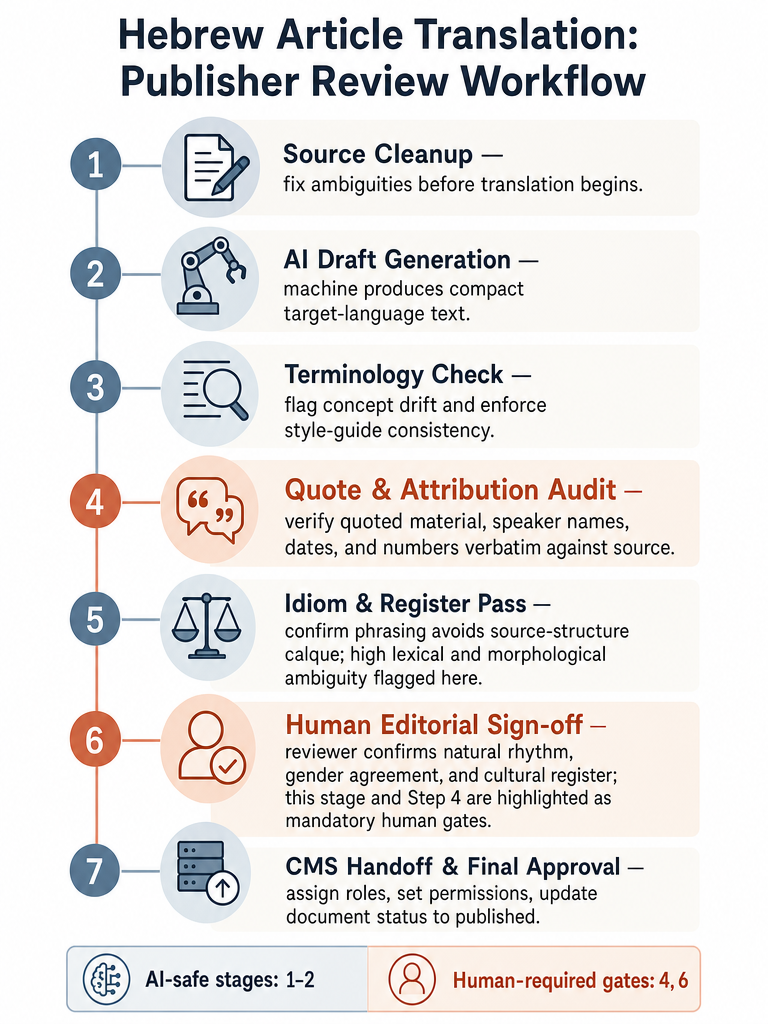
Hebrew article translation workflow should include intake, source cleanup, draft, Hebrew review, terminology checks, fact checks, CMS handoff, approval.
What should a Hebrew article translation workflow include before anything is published?
A Hebrew article translation workflow should move each piece through eight ordered stages before it goes live: intake, source cleanup, an AI or human draft, a Hebrew editorial review, terminology checks, quote and entity verification, CMS handoff, and final approval. Benzineb translation-workflow guidance links a structured process to better status visibility, deadline control, faster publication, and stronger content security. Skipping stages is where fluent-looking Hebrew slips past editors.
Here's the sequence publishers can adopt as-is:
Intake. Log the article, its source format, deadline, target register, and any style-guide notes.
Source cleanup. Fix the English original first—broken links, unclear pronouns, ambiguous names—so the translator isn't guessing.
Draft. Produce the Hebrew draft with AI, a human translator, or AI-plus-human depending on risk.
Hebrew editorial review. Read the Hebrew for meaning, tone, gender agreement, and register, not against the English word by word.
Terminology checks. Confirm recurring terms, product names, and titles match your glossary.
Quote and entity verification. Recheck every quote, attribution, number, date, and proper name.
CMS handoff. Move the approved Hebrew into your content management system with correct roles and version tracking.
Final approval. A named editor signs off before publish.
The stakes are real: translated work stays a niche in the U.S., where only about 3% of published books are translations (Source: Reading in Translation).
What is a translation workflow?
A translation workflow is the structured process that moves content from request through translation, review, revision, and release, with defined roles and status at each step. In publishing terms, it's the system that turns a raw article into a publish-ready Hebrew version without losing track of who has it, what stage it's in, or when it's due.
Benzineb translation-workflow guidance ties a well-designed process to concrete gains: simpler and faster translation requests, clearer visibility into status and deadlines, smoother document production, shorter time to publication, and improved content security. Translation workflows are usually folded into a larger organization-wide workflow built on a content management system, especially around document life cycle and user roles.
For a publishing team, the practical payoff is control. A workflow is the difference between knowing exactly where 40 pending Hebrew articles sit and finding out at deadline that half never got reviewed.
Why is Hebrew article translation harder than a generic multilingual workflow?
Most language pairs don't carry the ambiguity Hebrew does. Hebrew article translation is harder because the language packs high lexical and morphological ambiguity and has fewer linguistic resources to draw on. Research from Carnegie Mellon University states that Hebrew machine translation is especially difficult for exactly these reasons—one word can map to several meanings, and the morphology packs grammatical information that English spells out. That ambiguity means a fluent-sounding draft can still be conceptually wrong.
Three Hebrew-specific risks your workflow has to control:
Compact phrasing. Hebrew is a much more compact language than English, which creates rhythm and phrasing problems in translation (Source: NPR, on Robert Alter's Bible work). A one-to-one rendering often reads cramped or off-tempo.
Source-shadowing syntax. Good Hebrew translation avoids staying too close to the source sentence structure when the result sounds antiquated and artificial (Source: Publishing Perspectives). English word order dragged into Hebrew is the classic robotic tell.
Gender and register. Hebrew conjugates verbs, adjectives, and possessives by gender, so a reviewer has to confirm the Hebrew matches the actual speaker, listener, and subject—not a default masculine form.
The scale of getting Hebrew right is not trivial. Robert Alter spent 24 years on a 3,000-page English translation of the Hebrew Bible because the existing versions didn't do justice to the original (Source: NPR). Publishers don't have that runway, which is exactly why the workflow has to carry the load. See our breakdown of Hebrew gender rules for verbs and pronouns for what reviewers should watch.
AI draft + human review vs full human translation for Hebrew articles
Match the production model to article risk, not to habit. AI-assisted drafting plus human review works well for high-volume, lower-stakes content where speed matters and errors are recoverable. Full human translation is safer for high-stakes pieces where nuance, culture, and reputation are on the line. AI-assisted publishing translation only works when the workflow includes validation, not just draft generation—Integra's publishing case study names inconsistent terminology, fluent-looking conceptual errors, mixed file formats, and distributed-team coordination as the recurring failure points.
Content type
Recommended model
Why
News briefs, listings, routine updates
AI draft + human review
High volume, tight deadlines, low idiom load
Feature articles, columns
AI draft + heavier editorial revision
Tone and rhythm matter; source-shadowing risk is high
Interviews with direct quotes
Human review with quote verification
Attribution and voice must survive intact
Opinion, sensitive cultural topics
Full human translation
Nuance and register carry legal and reputational risk
The deciding question is recoverability. If a mistake would just need a quick correction, AI-plus-review is efficient. If a mistake would misquote a source or misread cultural context, escalate. For a deeper comparison, see when AI is enough and when human translators win for Hebrew.
The useful question isn't whether to use AI or a human. It's how much human review this specific article's risk demands.
How do you review a translation properly?
Read the Hebrew on its own terms first, then check it against the source—not the other way around. The core test: does the Hebrew stand on its own as natural writing, or does it shadow English syntax? Good Hebrew translation avoids staying too close to the source structure when the result sounds antiquated and artificial (Source: Publishing Perspectives). A reviewer who only checks word-for-word matching will bless a fluent-looking sentence that no Israeli would actually write.
Run the Hebrew editorial pass in this order:
Meaning. Does the Hebrew say what the source meant, including implied context? Ambiguity is Hebrew's biggest trap.
Standalone read. Read the Hebrew without the English. If it sounds translated, flag it.
Tone and register. Formal article, casual column, and quoted speech each need their own register.
Gender agreement. Confirm verbs, adjectives, and possessives match the real speaker, listener, and subject.
Idiom and slang. Check that idioms were rendered by meaning, not literally.
Reader fit. Would the target Hebrew reader find it clear and natural?
Reviewing well isn't only about correctness—it's about visibility for the work itself. In a market where translations are already a small niche, careful review is what promotes good translation to a wider audience (Source: Reading in Translation).
How should publishers catch terminology drift and fluent-but-wrong Hebrew?
Named checkpoints catch what a skim never will, because terminology drift and fluent-but-wrong Hebrew both hide behind readable output. Integra's publishing case study identifies inconsistent terminology and conceptually incorrect but fluent-looking translations as core quality-governance risks, alongside mixed file formats, distributed review teams, and tight schedules. The danger is that these errors read smoothly—an editor skimming for typos won't see them.
Build these checkpoints into the review stage:
Glossary enforcement. Maintain a living glossary of product names, titles, recurring terms, and preferred Hebrew renderings. Every article gets checked against it.
Recurring-entity list. Track how each person, place, and organization is spelled and referenced across articles so one source isn't three different Hebrew spellings by Friday.
Conceptual accuracy pass. A reviewer confirms the Hebrew idea matches the English idea, separately from the fluency read. Fluent and correct are two different checks.
Style-guide rules. Codify register, punctuation, and date/number formatting so distributed reviewers apply the same standard.
Handoff notes. When articles move between reviewers, attach context so decisions aren't relitigated or reversed silently.
For teams standardizing recurring language, our guide to reducing errors in Hebrew AI translation covers the specific gender and word-order slips that survive an inattentive review.
What review steps protect quotes, attribution, numbers, dates, and names?
Give facts their own verification pass, separate from the language review—because quotes, numbers, dates, and names are facts, not phrasing. A misrendered quote or a wrong date is a publication-safety failure, not a style choice. Do this check after the Hebrew reads naturally but before CMS handoff.
Work through this publication-safety checklist:
Quotes. Confirm every quoted passage carries the speaker's actual meaning and, where possible, their register. Direct quotes shouldn't be paraphrased into blandness.
Attribution. Verify each quote is tied to the correct speaker and title.
Names. Check proper names against the recurring-entity list; confirm transliteration is consistent and correct.
Numbers. Re-verify every figure, including any that were reformatted for locale.
Dates. Confirm dates converted correctly and match the source event.
Titles and roles. Confirm job titles, organization names, and honorifics.
Culturally sensitive references. Flag anything that reads differently in a Hebrew publishing context than in the English original.
Names and numbers are exactly where transliteration choices matter; our Hebrew transliteration guide for English speakers explains why a single name can have several valid spellings and how to pick one and stick to it.
How does a translation workflow fit into an existing CMS and editorial approval process?
Map each stage onto the CMS's roles, permissions, version control, and approval states—that's how a translation workflow fits into an existing system. Translation workflows are commonly integrated into a larger organization-wide workflow built on a content management system, especially around document life cycle and user roles (Source: Benzineb, translation-workflow guidance). In practice, each review stage becomes a CMS status, and each reviewer becomes a role with defined permissions.
Here's how the pieces line up:
Workflow stage
CMS element
Intake
New content item, assigned owner, deadline field
Draft
Draft status, translator/AI role permission
Hebrew editorial review
Review status, editor role assignment
Terminology + fact checks
Sub-review state or checklist gate
CMS handoff
Version locked, formatting preserved
Final approval
Approver role, publish permission
Version control keeps the reviewed Hebrew from being overwritten, and approval states stop anything from publishing before a named editor signs off. Because published translation ties directly to visibility—translated titles are still a small share of the U.S. market, around 3% of new titles across all foreign languages (Source: New York Jewish Week)—the handoff step is where quality either holds or quietly slips.
Public detail on specific CMS connectors and reviewer SLAs for Hebrew publishing teams is limited as of this writing, so map these stages to whatever platform your team already runs rather than assuming a turnkey integration.
Can it translate formal and casual Hebrew differently?
Yes—and it has to, because formal articles, casual columns, interviews, and Israeli idioms each demand different review rules. A hard-news feature needs measured, formal Hebrew. A lifestyle column needs a looser, conversational register. An interview needs quoted speech that sounds like the actual person. Treating all three with one setting produces Hebrew that's either too stiff or too loose for its context.
The register split maps directly to your review rules:
Formal articles: prioritize precise terminology and clean, standard Hebrew. Slang is a defect here.
Casual columns: allow natural rhythm and common expressions; overly formal Hebrew reads wrong.
Interviews and quotes: preserve the speaker's voice, including idiom, rather than sanding it smooth.
How to choose a Hebrew-first article translation workflow for scale
Test any workflow against seven things: Hebrew-specific quality controls, editorial workflow fit, CMS readiness, reviewer visibility, terminology governance, article-volume support, and honest handling of gender, slang, and register. A generic translator adapted from English will pass on speed and fail on exactly the parts that make Hebrew hard—the ambiguity and gender agreement that Carnegie Mellon University research flags as the core difficulty.
Use this buyer checklist:
What to check
Why it matters for Hebrew
Gender-aware output
Verbs and adjectives conjugate by speaker, listener, and subject
Slang and idiom handling
Israeli expressions must render by meaning, not literally
Register control
Formal, casual, and quoted speech need different tones
Terminology governance
Glossary and recurring-entity consistency across volume
Reviewer visibility
Status, deadlines, and handoffs at a glance
CMS readiness
Roles, permissions, version control, approval states
Volume support
Consistent quality as article count scales
A Hebrew-first tool belongs in the stack when your output volume is high enough that inconsistent terminology and gender errors would slip through manual review. baba Hebrew Translator is built Hebrew-first rather than adapted from English—useful when your workflow needs gender-aware drafting and slang handling that generic tools default past. Independent pricing, turnaround, and accuracy benchmarks for Hebrew publisher workflows are limited as of this writing, so run your own side-by-side test on real articles before committing at scale.
The workflow, not the tool alone, is what protects Hebrew quality at volume. Generation without validation is where fluent-but-wrong content ships.
Can it translate formal and casual Hebrew differently?
Yes — and register matters more in Hebrew than most languages. Formal news articles need precise, standard Hebrew where slang is a defect. Casual columns need looser rhythm and natural expressions. Interviews require preserving the speaker's actual voice, including idiom, rather than sanding it smooth. A single translation setting applied to all three produces Hebrew that's either too stiff or too loose for its context.
What makes Hebrew article translation harder than a generic multilingual workflow?
Hebrew packs high lexical and morphological ambiguity with fewer linguistic resources than major European languages — Carnegie Mellon University research identifies this as the core reason Hebrew machine translation is unusually difficult. One word can carry several meanings, and grammatical information that English spells out is compressed into morphology. Add mandatory gender agreement across verbs, adjectives, and possessives, and a fluent-looking draft can still be conceptually wrong.
What should a Hebrew article translation workflow include before anything is published?
Eight ordered stages: intake, source cleanup, draft production, Hebrew editorial review, terminology checks, quote and entity verification, CMS handoff, and final approval by a named editor. The editorial review reads Hebrew on its own terms — checking meaning, tone, gender agreement, and register — not word-for-word against the English. Skipping stages is precisely where fluent-looking but wrong Hebrew slips past editors undetected.
How do you review a Hebrew translation properly?
Read the Hebrew on its own first, then check against the source. The test: does it stand as natural writing, or does it shadow English syntax? A word-for-word accuracy check will bless fluent-but-artificial sentences that no Israeli would write. The review order is meaning, standalone read, tone and register, gender agreement, idiom handling, and reader fit. Fluent-but-wrong is the error a rushed review misses most often.
When should publishers use AI draft plus human review versus full human translation for Hebrew articles?
Match the model to article risk. AI draft plus human review works for high-volume, lower-stakes content — news briefs, listings, routine updates — where speed matters and errors are recoverable. Full human translation belongs on opinion pieces, sensitive cultural topics, and anything where a nuance failure carries legal or reputational risk. The deciding question isn't which tool, it's how much review this specific article's stakes demand.
How do publishers catch terminology drift and fluent-but-wrong Hebrew at scale?
Named checkpoints catch what a skim never will. Build a living glossary of product names, titles, and preferred Hebrew renderings — every article gets checked against it. Run a conceptual accuracy pass separately from the fluency read, since fluent and correct are two different checks. A recurring-entity list keeps each person, place, and organization spelled consistently across articles. Handoff notes prevent decisions from being reversed silently between reviewers.