How AI Shapes Gender-Inclusive Tools
AI is transforming how we handle gender in languages like Hebrew, where grammar and communication depend heavily on gender distinctions. Tools like translation apps often default to masculine forms, creating problems in both casual and professional settings. AI now addresses these challenges by improving accuracy, reducing bias, and respecting user preferences.
Key points:
- Hebrew grammar requires gender-specific forms for verbs, adjectives, and pronouns.
- Many tools default to masculine forms, which can feel dismissive or incorrect.
- AI-powered solutions like baba offer gender-aware translations, considering speaker and audience gender.
- Challenges include biased training data and the complexity of cultural norms.
- AI tools are now using diverse datasets, personalization, and user feedback to improve inclusivity in communication.
Bottom line: AI-driven tools are addressing the gaps in gender-sensitive language use, offering smarter, user-focused solutions for complex languages like Hebrew.
Designing for Diversity: A Gender-Inclusive Approach to AI Deployment - Ishita Barua, Deloitte

Problems with Creating Gender-Inclusive Tools
Developing tools that are inclusive for all genders is no small feat. The challenges developers face go well beyond coding - they must navigate the complexities of grammar, cultural nuances, and deeply ingrained biases in AI systems. These hurdles highlight just how intricate creating gender-inclusive technology can be.
How Gendered Grammar Creates Language Problems
Languages like Hebrew present unique challenges that English-speaking developers may never encounter. In Hebrew, gender is embedded into nearly every aspect of the language - verbs, adjectives, and even seemingly neutral words require gender-specific forms.
Take the phrase "I am tired." In English, it’s neutral and works for anyone. But in Hebrew, the sentence changes depending on the speaker’s gender. A woman would say "ani ayefa", while a man would say "ani ayef." Using the wrong form doesn’t just sound awkward - it can come across as incorrect or even offensive to native speakers.
Hebrew also distinguishes between addressing all-male, all-female, or mixed-gender groups. Unfortunately, many translation tools default to masculine forms, which can feel dismissive or inappropriate. These missteps aren’t just linguistic - they can be culturally insensitive and unprofessional.
This creates a domino effect of challenges for developers. They need to consider who’s speaking, who’s being addressed, the level of formality, and the cultural context - all while ensuring the language feels natural. Many systems default to masculine forms simply because it’s easier, but this perpetuates exclusion and reinforces outdated norms.
On top of that, the technical hurdles are immense. Developers must design systems that juggle multiple variables simultaneously while recognizing that gender in Hebrew isn’t just biological - it’s an integral part of communication. And even when the grammar is correct, biases in the underlying data can still distort translations.
Hidden Bias in AI Models
AI models rely on training data, but that data often reflects societal biases that have built up over decades. Masculine language patterns dominate many datasets, especially in professional and technical fields where men have historically been overrepresented.
As a result, AI often assumes male speakers and audiences by default, even when that assumption is entirely wrong. For example, a translation tool might automatically use masculine forms in business contexts, reinforcing stereotypes and excluding women.
The issue doesn’t stop at language. Development teams themselves often lack diversity, which means these biases can go unnoticed until the tools are already in use. A team made up mostly of male, English-speaking developers might not realize their Hebrew translation tool produces clunky or exclusionary results for female users.
Biases in training data can also show up in subtle ways. AI might associate specific professions or activities with certain genders, leading to translations that reinforce harmful stereotypes. For example, a dataset filled with male-dominated texts might cause an AI to assume that doctors are men and nurses are women, perpetuating outdated ideas.
Addressing these biases takes deliberate effort. It’s not enough to simply add more data - developers need to actively seek out diverse language samples and test their tools with users from a variety of backgrounds to ensure inclusivity.
Cultural Awareness and Inclusivity
In Hebrew, language and culture are tightly intertwined, and communication styles vary widely across different communities. This makes it essential for developers to consider cultural context when designing gender-inclusive tools.
Some Hebrew-speaking communities stick to traditional gender distinctions, while others embrace more fluid approaches. What works for one group might alienate another. For example, a business email that uses the wrong gender form can damage professional relationships or even jeopardize deals. Similarly, legal documents, medical communications, and educational materials demand precise language that respects both grammatical rules and cultural expectations.
Gender in Hebrew goes beyond grammar - it’s about respect, identity, and social dynamics. Ignoring these nuances can result in tools that feel tone-deaf or even offensive.
The challenge isn’t limited to language processing. User interface design also plays a role. How do you ask users about their gender preferences without making assumptions? How do you accommodate users who don’t fit traditional categories? These questions require a level of cultural sensitivity that extends far beyond technical expertise.
To create truly gender-inclusive tools, developers must strike a balance between linguistic precision and cultural respect. This means understanding not just the mechanics of Hebrew but also how different communities use the language in everyday life. Without this awareness, even the most technically advanced tools can fail to meet the needs of their users effectively.
How AI Creates Gender-Inclusive Design
AI tackles design challenges by refining data practices, training models effectively, and offering real-time personalization. Together, these elements create a solid framework for achieving gender-inclusive design in Hebrew translation. The key lies in how developers approach each step - data collection, model training, and user personalization - to transform tools that may exclude into platforms that embrace linguistic diversity and respect cultural nuances.
Data Management and Reducing Bias
The foundation of gender-inclusive AI begins with thoughtful data selection and addressing bias. Traditional models often reinforce gender bias due to imbalanced training data, but modern AI development has introduced methods to counteract these issues.
Balanced datasets are a crucial step. Developers actively gather diverse language samples that reflect various gender perspectives, communication styles, and social contexts. For Hebrew, this means sourcing examples from both male and female speakers across different scenarios - whether in professional settings, casual conversations, or across age groups. Instead of defaulting to male-dominated professional texts, training datasets now aim for equal representation of masculine and feminine language forms.
To further address bias, teams continuously monitor and adapt their models. This involves running systematic evaluations to identify when models produce biased outputs, such as favoring masculine forms or making incorrect gender assumptions. For example, translations are tested with different gender combinations to ensure fairness and accuracy.
The most effective strategies combine automated bias detection with human oversight. Algorithms can spot statistical patterns, but human reviewers bring a nuanced understanding of cultural subtleties that machines might miss. This combination ensures AI produces translations that are both accurate and inclusive.
AI-Powered Personalization in Tools
Once balanced data is in place, AI can personalize user interactions, tailoring its outputs to individual preferences. This eliminates the “one-size-fits-all” approach and creates a smoother, more inclusive experience.
Context-aware translation is a game-changer. AI now considers variables like the speaker, the audience, the formality of the conversation, and the cultural context to ensure translations are both gender-accurate and respectful.
User preference learning allows AI to adapt based on individual habits. For instance, if someone consistently opts for formal language or specific gendered forms, the system remembers and adjusts its suggestions accordingly.
Dynamic interface adaptation takes personalization further by letting users choose how they interact with the tool. Some might prefer explicit gender selection options, while others may want the system to infer context from past interactions. AI can adapt its interface to suit these varying needs.
Real-time cultural sensitivity is particularly critical in Hebrew, where gender dynamics are deeply embedded in the language. AI can recognize when a specific gender form might be inappropriate and suggest alternatives that maintain both accuracy and cultural respect.
Case Study: baba - Smart Hebrew Translation
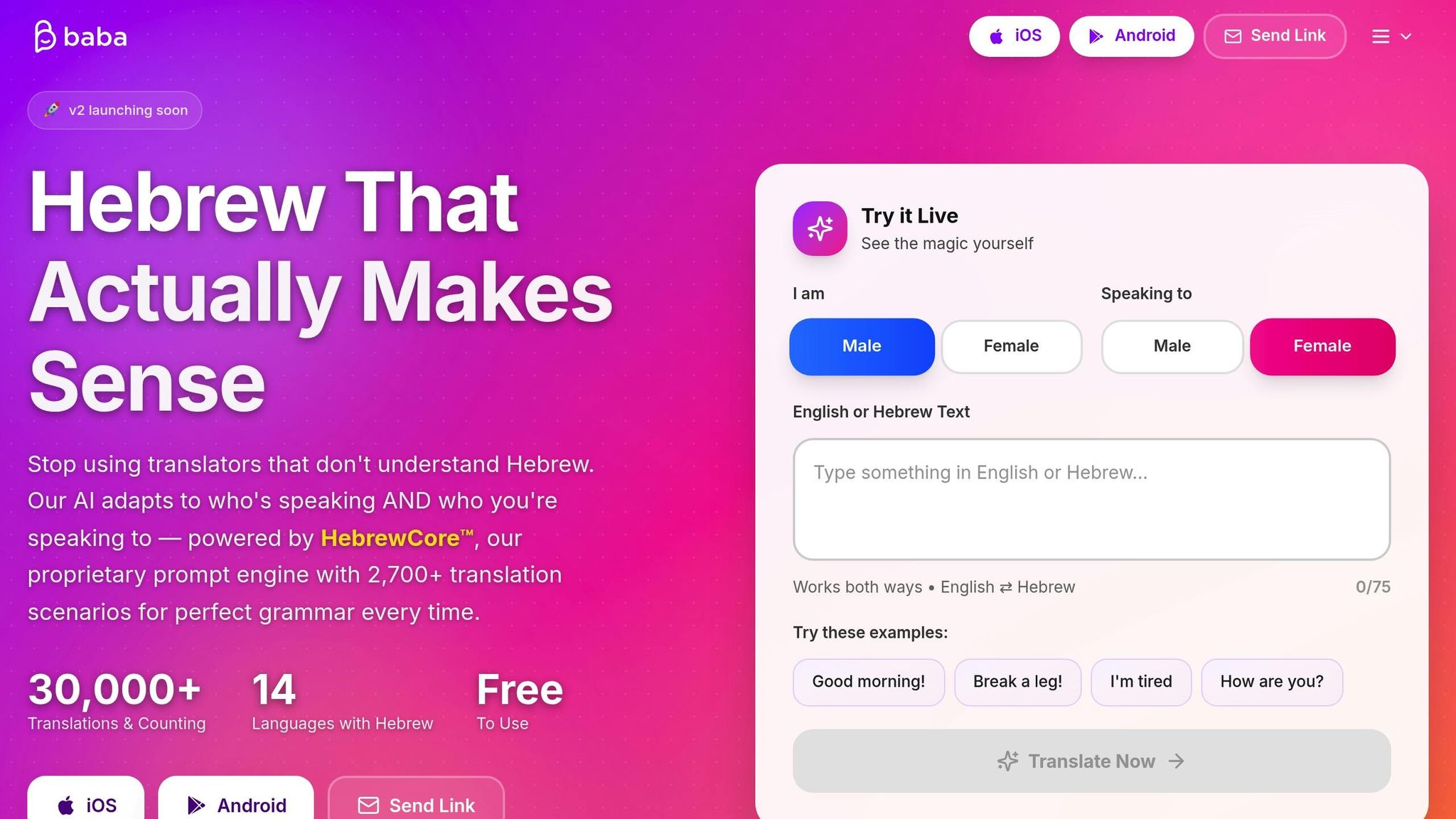
The app baba showcases how AI innovations can address gender inclusivity in Hebrew translation. It goes beyond generic solutions by offering features tailored to the unique challenges of Hebrew’s grammatical gender system.
baba’s gender-aware translation technology employs 11 specialized AI variations that consider both the speaker’s and audience’s gender. Unlike standard tools that default to masculine forms, baba lets users specify whether they’re addressing a woman, man, group of men, group of women, or a mixed audience. This ensures translations align with Hebrew’s complex gender rules.
The app also uses custom backend prompts and a slang mode to incorporate cultural context. With 22 specialized prompts, baba adapts to various scenarios, understanding Israeli slang, cultural nuances, and appropriate formality levels. For instance, Hebrew slang often changes meaning based on the speaker's and listener’s gender, and baba not only translates these expressions accurately but also explains when and where they’re appropriate.
Privacy is another priority. With a privacy-first design, baba doesn’t require logins or collect personal data, allowing users to explore gender-inclusive communication freely and securely.
To enhance usability, baba offers multi-model speed options - Standard for the most accurate translations, Fast for a balance of speed and precision, and Ultra-Fast for instant results. This flexibility ensures that inclusivity doesn’t compromise efficiency.
Users of baba benefit from smoother, more natural communication in Hebrew. Business professionals can craft gender-appropriate emails, language learners can grasp slang in context, and casual users can express themselves without worrying about grammatical or cultural errors.
This case study highlights how targeted AI development can solve specific linguistic and cultural challenges. By focusing on Hebrew’s unique gender complexities, baba provides tools that generic translators simply can’t match. The app’s success underscores the importance of building gender awareness into the very foundation of AI tools, rather than treating it as an afterthought.
