How AI Translates Hebrew Emotions
Translating emotions from Hebrew to English is complex due to gendered language, cultural expressions, and contextual nuances. Here's how AI tackles these challenges:
- Gender-Specific Language: Hebrew phrases like "I'm happy" differ based on the speaker's gender (ani sameach for males, ani smecha for females). AI adjusts translations to match these variations.
- Cultural Idioms: Expressions like "לעשות חיים" (literally "make life") mean "have a great time." AI must interpret such phrases beyond their literal meanings.
- Contextual Nuances: Emotional intensity and relationship dynamics influence translations. For example, "לב שבור" (broken heart) conveys deep sadness, not just the literal phrase.
- Advanced AI Tools: Using Natural Language Processing (NLP), AI identifies Hebrew roots, analyzes sentence structures, and interprets emotional context for accurate translations.
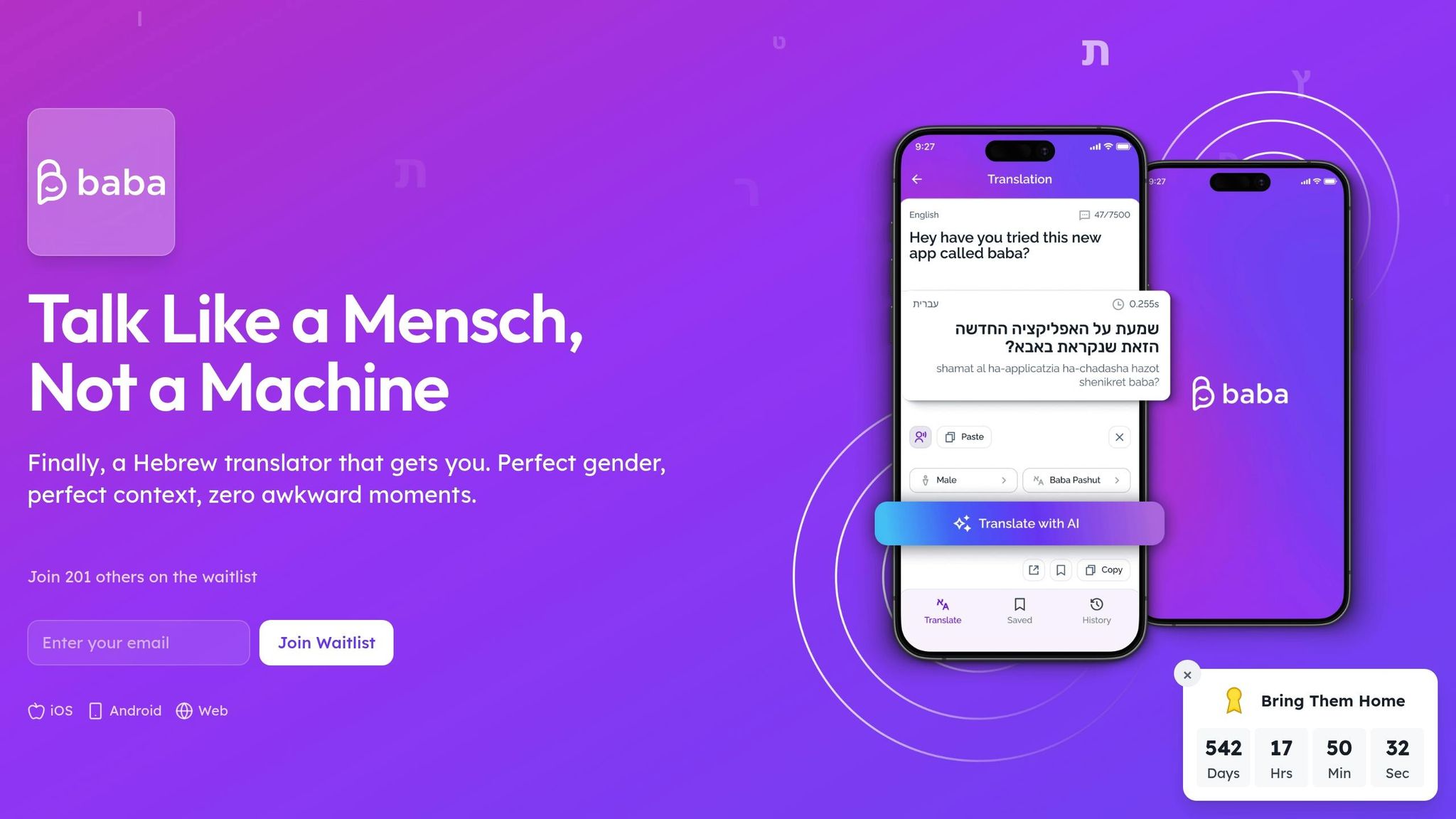
Modern tools like baba integrate gender detection, context awareness, and cultural subtleties to ensure translations feel natural and meaningful. The future of AI in Hebrew translation includes real-time updates, multimodal inputs, and enhanced cultural understanding.
[DEMO] From Hebrew to English: How AI Instantly Translates ...
Hebrew Emotion Basics
Hebrew grammar plays a big role in how emotions are expressed, which can make translation, especially for AI, a bit tricky. Grasping these basics is key to translating emotions accurately.
Gender and Number in Hebrew
In Hebrew, gender influences nearly every aspect of the language. Nouns, verbs, and adjectives all need to match the gender of both the speaker and the subject. This creates four possible variations for most emotional expressions:
| Speaker | Subject | Example (Happy) | Transliteration |
|---|---|---|---|
| Male | Male | אני שמח בשבילו | Ani same'ach bishvilo |
| Male | Female | אני שמח בשבילה | Ani same'ach bishvila |
| Female | Male | אני שמחה בשבילו | Ani sme'cha bishvilo |
| Female | Female | אני שמחה בשבילה | Ani sme'cha bishvila |
In plural forms, masculine is often the default, though modern Hebrew sometimes uses gender-neutral options. These details are essential for understanding how Hebrew handles emotions.
Hebrew Emotion Words
Hebrew emotion words reflect both linguistic and cultural depth. For example, the word nachat (נחת) captures a mix of pride and satisfaction, often used to describe the feeling parents have when their children succeed. English doesn’t have a single word that fully conveys this.
Here are some highlights of how Hebrew expresses emotions:
- Intensifying emotions: Repetition is a common way to emphasize feelings. For instance, tov tov (טוב טוב), which literally means "good good", conveys a stronger sense of "very good" or "really good."
- Blended emotions: Hebrew combines words to express layered feelings. Lev shavur (לב שבור), or "broken heart", goes beyond heartbreak to describe deep disappointment in various contexts.
The root system in Hebrew also allows for precise emotional expressions. Take the root ש-מ-ח (s-m-ch), which relates to happiness. From it, you get:
- שמחה (simcha) - happiness or joy
- משמח (mesame'ach) - bringing happiness to others
- לשמוח (lismo'ach) - to be happy or to rejoice
Understanding these nuances is essential for translating Hebrew emotions into English with accuracy.
Get on the waitlist for our mobile app at www.itsbaba.com
AI Translation Hurdles
Translating emotional expressions from Hebrew using AI comes with its own set of challenges. Let's dive into how cultural sayings and context create obstacles for AI translation.
Hebrew Sayings and Context
Hebrew idioms and emotional expressions often carry meanings that go far beyond their literal translations. For example, the phrase "לעשות חיים" (la'asot chaim) literally means "make life", but its actual meaning is closer to "have a great time" or "live it up." AI needs to interpret these phrases based on context, not just word-for-word translation.
Here are some examples of common challenges:
| Hebrew Expression | Literal Translation | Emotional Context | Translation Challenge |
|---|---|---|---|
| יצא לי הלב | My heart went out | Deep worry or concern | Recognizing metaphorical use |
| נמס לי הלב | My heart melted | Overwhelming affection | Adjusting to cultural intensity |
| על הפנים | On the face | Feeling terrible | Completely non-literal meaning |
| לא בא לי | Doesn't come to me | Lack of desire/motivation | Requires contextual understanding |
These idiomatic expressions highlight the difficulty of capturing emotional nuance in translation. But idioms aren't the only hurdle - gendered language adds another layer of complexity.
Gender Rules in Translation
Hebrew's gendered structure means AI must also pay attention to who is speaking and who is being addressed. Properly translating emotions requires tracking gender for verbs and adjectives.
- Speaker and recipient gender: AI needs to adjust verbs and adjectives based on whether the speaker or recipient is male, female, or part of a mixed group.
- Group dynamics: When translating for groups, gender impacts the phrasing. For example, "אנחנו שמחים" (anachnu smechim) is used for a mixed or all-male group, while "אנחנו שמחות" (anachnu smechot) applies to an all-female group.
In group conversations, maintaining these distinctions ensures the translation feels natural and accurate while preserving the emotional tone.
Get on the waitlist for our mobile app at www.itsbaba.com
AI Systems for Hebrew Translation
Modern AI systems tackle the complexities of translating Hebrew emotions by diving deeper than simple word-for-word translation. They work to grasp cultural context and emotional subtleties, making translations more accurate and meaningful.
NLP for Emotion Detection
Natural Language Processing (NLP) plays a key role in identifying emotions within Hebrew text. These systems break down text into layers for analysis, focusing on individual words, their relationships, and the overall emotional tone. Here's how it works:
- Morphological analysis: Identifies Hebrew roots and modifiers to understand word meanings.
- Syntactic parsing: Examines sentence structure to determine emotional emphasis.
- Semantic analysis: Interprets emotional meaning based on context.
For instance, when the AI processes the phrase "לב שבור" (broken heart), it doesn't just translate the words. It also recognizes the phrase as an emotional marker for deep sadness.
| Analysis Level | Function | Example Processing |
|---|---|---|
| Morphological | Identifies root words | שמח (s-m-ch) root, linked to happiness |
| Syntactic | Analyzes sentence structure | Understands how word order affects meaning |
| Semantic | Interprets contextual meaning | Differentiates literal vs. metaphorical usage |
AI Learning Methods
AI systems rely on advanced training methods to understand Hebrew context and emotional depth. Two key approaches include:
Deep Learning Networks
- Process parallel texts in Hebrew and English to find emotional equivalents.
- Learn how emotions are expressed differently across languages.
- Adjust translations based on specific contexts.
Pattern Recognition
- Detects frequently used emotional expressions.
- Maps intensifiers unique to Hebrew.
- Incorporates cultural markers to refine emotional understanding.
Through exposure to diverse Hebrew texts, conversations, and cultural references, these AI systems continuously improve. This ongoing refinement allows for more nuanced and context-aware translations of emotional language.
Get on the waitlist for our mobile app at www.itsbaba.com