How AI Tracks Hebrew Grammar Evolution
AI is transforming how we study Hebrew grammar, from its Biblical roots to its modern form. Here's the key takeaway: AI tools analyze massive datasets to identify shifts in grammar, pronunciation, and sentence structure, helping both researchers and learners understand Hebrew's evolution.
Key Insights:
- Grammar Evolution: Modern Hebrew shifted from Biblical VSO (Verb-Subject-Object) to SVO (Subject-Verb-Object), similar to English.
- AI's Role: Tools like LSTM and BERT analyze texts, track linguistic changes, and provide real-time updates on grammar trends.
- Learning Impact: AI-powered platforms improve vocabulary retention by 30% and provide personalized feedback on grammar and pronunciation.
- Speech Analysis: AI studies spoken Hebrew using datasets like "ivrit.ai" (3,300+ hours of recordings), linking pronunciation to grammar changes.
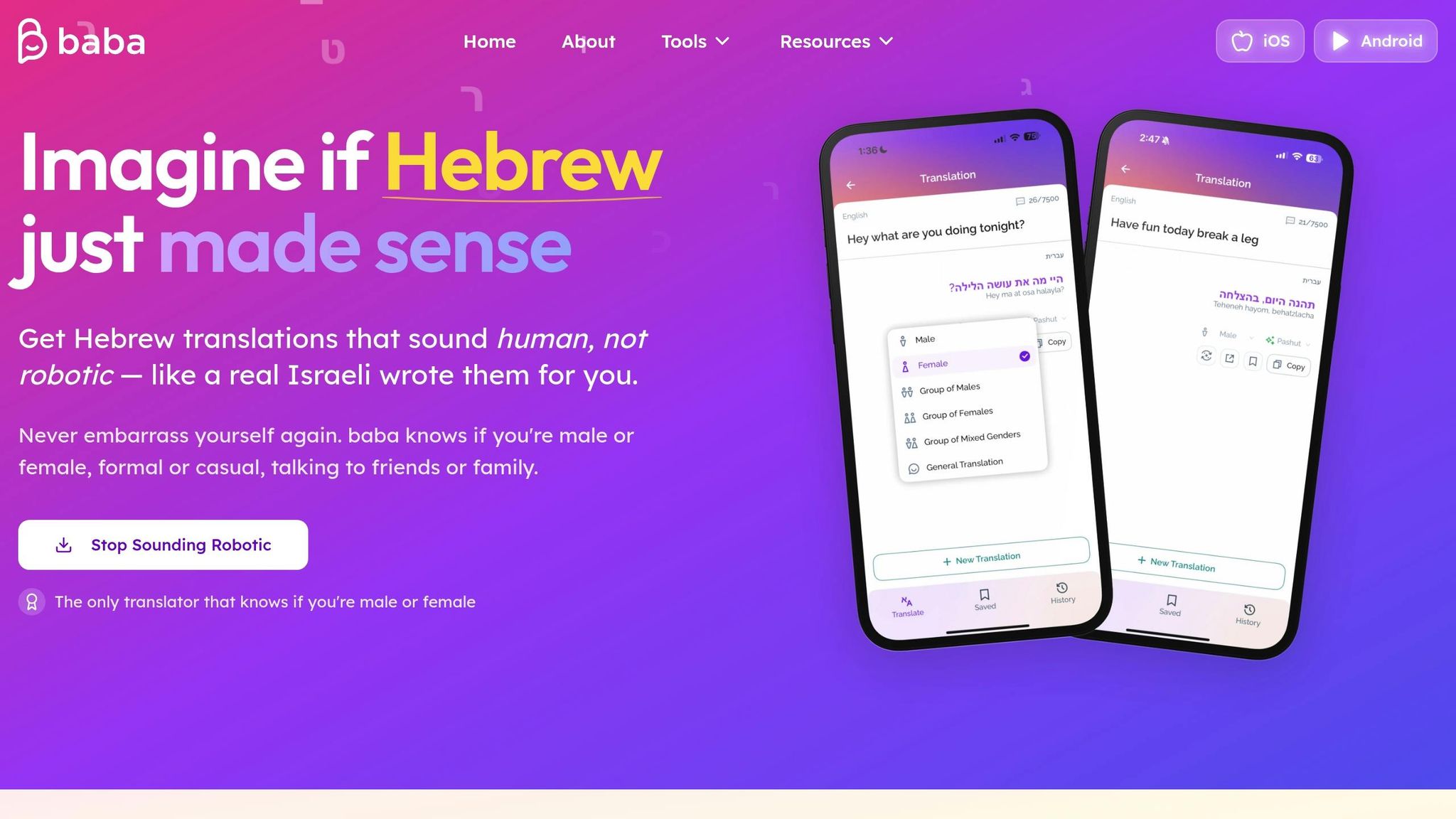
- Translation Precision: Apps like "baba" adjust translations based on gender, plurality, and context, ensuring accuracy in daily use.
AI doesn't just analyze text - it also supports learners and researchers by providing instant feedback, context-aware translations, and insights into how Hebrew continues to develop.
AI Methods for Studying Hebrew Grammar Changes
AI uses three interconnected approaches to track the evolution of Hebrew grammar and keep translation tools up to date. Let’s take a closer look at how AI breaks down Hebrew words, analyzes sentence structures, and examines spoken language to understand these changes.
Word Structure Analysis: How AI Breaks Down Hebrew Words
Hebrew's word structure is rooted in a unique system of morphology that revolves around a three-consonant root, known as the "shoresh" [3]. This system can be challenging to analyze, but it also provides AI with a clear framework to identify patterns. By processing thousands of examples at once, AI can pinpoint how prefixes, suffixes, and infixes shift over time, revealing trends in word usage.
AI also studies verb conjugation patterns, or "binyanim", which are groups of verbs that follow specific conjugation rules [3]. The same root can appear in multiple binyanim, each carrying a different meaning. By examining historical texts and modern language, AI tracks how these patterns evolve. Using machine learning, AI assigns probabilities to word sequences and updates its understanding of Hebrew morphology as it processes more data [4].
This continual analysis allows AI to detect even subtle shifts in grammar, making it a powerful tool for adapting translations to Hebrew's changing linguistic landscape.
Sentence Structure and Meaning Analysis
AI systems like LSTM, BERT, and GPT2 excel at mapping Hebrew sentence structures [5]. These deep learning models perform tasks such as syntax tree analysis, morphological tagging, and semantic analysis, helping researchers understand how sentence meanings have evolved [2].
By identifying semantic patterns in texts, AI uncovers nuances that traditional methods might overlook. Natural Language Processing (NLP) advancements have significantly enhanced AI's ability to track these changes [5]. This is especially important as Hebrew continues to adapt its ancient grammatical structures to fit modern communication styles.
AI-driven tools also enhance this process by quickly analyzing the grammatical roles of words within sentences [2]. This capability ensures that AI remains a valuable resource for understanding Hebrew's ongoing linguistic transformation.
Sound and Pronunciation Analysis
AI doesn’t just focus on written Hebrew - it also analyzes spoken language to uncover how pronunciation influences grammar. Changes in pronunciation can alter grammatical usage, and AI tools are becoming increasingly adept at detecting these shifts [1]. By studying phonetics and phonology, AI links pronunciation changes to evolving grammatical patterns.
The development of extensive Hebrew speech datasets, such as "ivrit.ai", which includes over 3,300 hours of recorded speech, has been a game-changer in this area [6]. Using these datasets, AI can break down spoken words into their roots and affixes, showing how pronunciation impacts word formation and conjugation [1].
Automated Speech Recognition (ASR) technology has also advanced significantly for Hebrew, enabling AI to analyze spoken language in real time [6]. This provides valuable insights into pronunciation trends and their connection to grammar. For instance, unclear sounds in rapid speech may lead speakers to adjust grammatical structures for better clarity. By integrating speech data, AI offers a more complete picture of how Hebrew grammar continues to evolve.
Want to stay updated? Join the waitlist for our mobile app at www.itsbaba.com.
AI Tools That Adapt to Modern Hebrew
Modern AI tools have taken a leap forward by adapting to the evolving nature of Hebrew. They continuously learn from how Hebrew is used in everyday life, refining their capabilities in real time. Let’s explore how these tools are shaping the analysis of spoken Hebrew and its grammar.
Speech Recognition for Modern Hebrew
Speech recognition technology has become a key player in understanding spoken Hebrew. These systems analyze speech patterns to uncover how pronunciation impacts grammar and meaning. They provide instant feedback on pronunciation, helping users speak more naturally while keeping up with how the language is changing in daily conversations [7].
Here’s how it works: the technology compares spoken words against massive databases of Hebrew speech patterns. When it detects pronunciation differences that might affect grammar, it adjusts its understanding. This ensures that translation tools remain aligned with the way Hebrew is spoken across various regions and social groups.
Additionally, these systems monitor how rapid or unclear speech can lead to grammatical shifts. By studying these trends, AI tools can anticipate and adapt to new pronunciation styles that influence Hebrew grammar.
Smart Translation Based on Context
Context-aware AI translation has transformed Hebrew language processing. These advanced systems go beyond translating words - they analyze the entire communication context, considering factors like the speaker, the audience, and the setting.
Using neural networks, these tools tokenize and encode Hebrew text to grasp its deeper meaning [8]. This approach allows AI to account for cultural subtleties in Hebrew, making it particularly effective for creative or nuanced content [9].
By combining neural processing with standardized translation memory, these systems ensure both accuracy and consistency across documents and conversations [9]. Machine learning algorithms, trained on extensive Hebrew language datasets, enable these tools to understand grammar and syntax in ways that reflect how the language is used today [8].
The translation industry has embraced these advancements, blending AI’s capabilities with human expertise for complex tasks [8]. These contextual insights also enhance personalized language learning, which we’ll explore next.
AI Grammar Learning Tools
AI-powered platforms are revolutionizing Hebrew grammar education by tailoring learning experiences to each individual. These tools create customized learning paths that adapt based on a user’s progress, focusing on areas that need the most improvement [7].
With the help of data analytics, these platforms highlight a learner’s strengths and weaknesses, offering targeted instruction that aligns with modern Hebrew grammar patterns. Interactive exercises and real-life scenarios make vocabulary retention more effective [7]. AI chatbots act as virtual tutors, providing practical language practice while exposing learners to contemporary Hebrew usage.
Interestingly, 70% of users who used AI tools for learning Hebrew reported gaining a deeper understanding of the language’s nuances [2].
What makes these tools stand out is their ability to stay updated with current Hebrew usage. This ensures that students learn grammar and vocabulary that reflect how the language is spoken and written today. By combining personalized feedback, engaging activities, and real-world context, AI grammar tools are making it easier than ever to master modern Hebrew.
Want to stay ahead in learning Hebrew? Join the waitlist for our mobile app at www.itsbaba.com.