Measuring AI Translation Quality
Evaluating how AI translates Hebrew proverbs involves more than just technical accuracy. It also requires understanding cultural nuances to ensure translations are both precise and contextually appropriate.
Translation Accuracy Standards
Assessing AI's translations of Hebrew proverbs involves looking at three key areas: linguistic precision, cultural relevance, and gender accuracy. Research on GPT-3.5's performance with Hebrew texts has uncovered challenges, particularly with verb conjugation and identifying word roots [1]. Additionally, studies show a persistent gender bias - only 30% of feminine translations are rendered correctly [2].
| Assessment Dimension |
What’s Measured |
Translation Issues |
| Linguistic Accuracy |
Verb conjugation, root identification |
Struggles with Hebrew's root system |
| Gender Handling |
Proper gender assignment, context recognition |
Tendency toward masculine defaults |
| Cultural Context |
Nuances and cultural relevance |
Often misses subtle cultural meanings |
Gender accuracy is a recurring issue, as AI often defaults to masculine forms, failing to account for proper grammatical agreement. These problems highlight the need for improvements in AI systems to better handle Hebrew's unique linguistic and cultural characteristics.
Translation Case Studies
Looking at specific examples sheds light on how AI performs under different circumstances. Professor Orly Lobel notes that AI often exaggerates gender biases when translating from gender-neutral languages into gendered ones [2].
AI tends to perform well with simple translations but struggles with more complex proverbs. For instance, culturally rich expressions often lose their deeper meaning without human intervention. This gap has driven the creation of advanced tools aimed at addressing Hebrew's specific linguistic challenges, focusing on both technical precision and maintaining cultural depth.
sbb-itb-7e51dcc
baba: Advanced Hebrew Translation
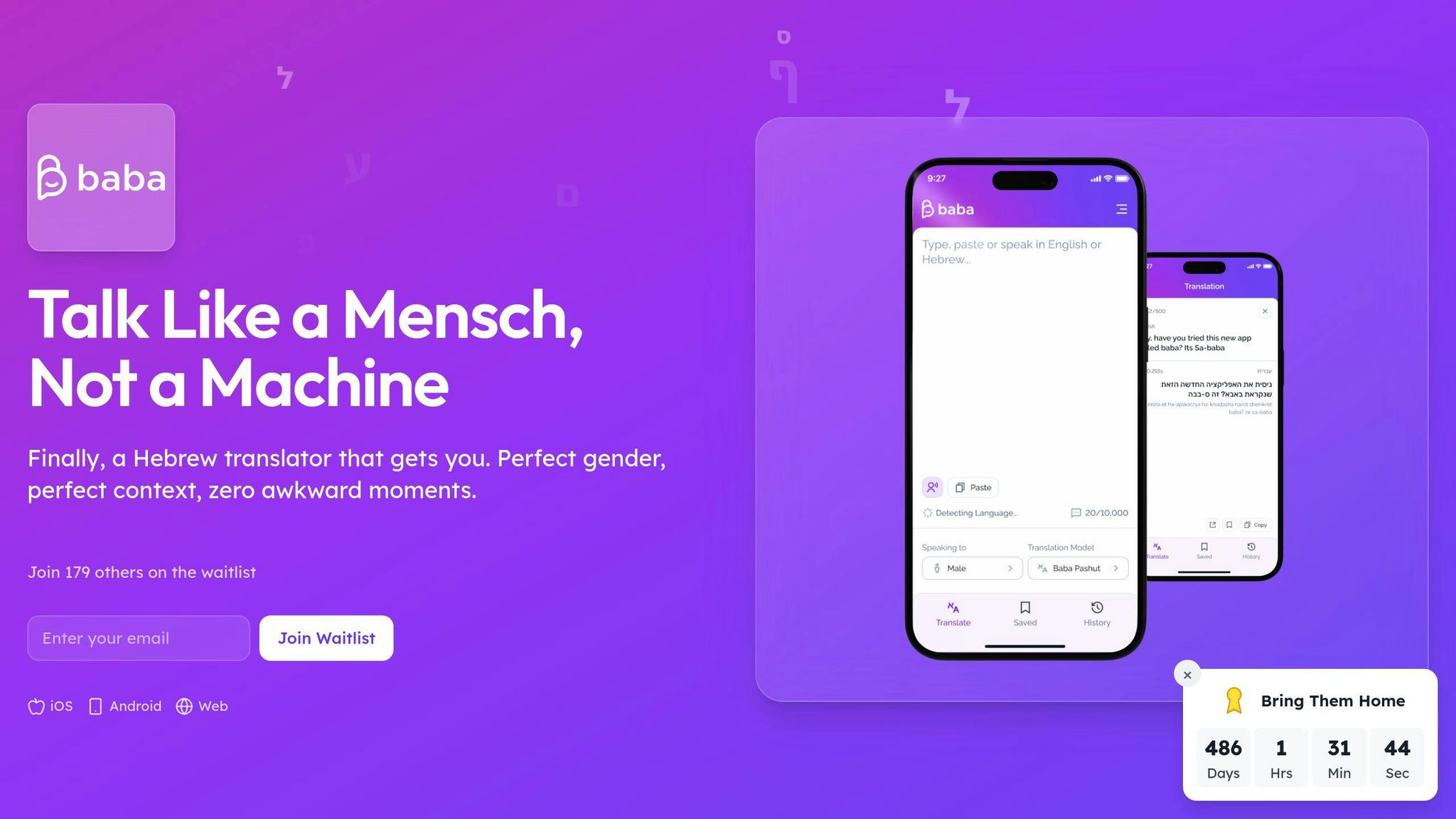
baba takes on the challenges of translating Hebrew, particularly when it comes to proverbs, by offering a better way to handle the unique aspects of the language. It focuses on solving common problems like gender accuracy and understanding cultural context - issues that many AI translation tools often get wrong.
baba's Context Recognition System
What makes baba stand out is its ability to handle Hebrew's complex grammar. Hebrew requires nouns, verbs, and adjectives to match in gender and number, a detail many tools overlook by defaulting to masculine forms. baba ensures these grammatical rules are followed while also respecting cultural context. This means translations stay true to the original meaning, especially for Hebrew proverbs, which often lose their essence with other tools.
Using baba in Practice
Whether you're working in a professional setting or having casual conversations, baba adjusts to the tone and style you need. It combines formal accuracy with an understanding of Hebrew's cultural layers, delivering translations that are both precise and meaningful. This makes it a great option for anyone looking for high-quality translations that don't sacrifice depth or authenticity.
AI tools today often fall short when it comes to Hebrew grammar [1], and baba directly addresses these gaps. For example, it targets the 70% gender bias found in existing tools [2], offering translations that are more accurate and culturally sensitive. The app is designed to handle Hebrew's unique challenges while staying true to the essence of traditional sayings, making it a valuable resource for users.
Next Steps in AI Translation
AI translation tools have come a long way, but they still struggle with complex tasks like translating Hebrew proverbs. These challenges underline the growing need to blend machine efficiency with human insight.
Current AI Limitations
AI translation tools often fall short when it comes to interpreting cultural nuances and context. While simpler language pairs can reach up to 90% accuracy, expressions rich in cultural meaning - like Hebrew proverbs - frequently lose their essence. These gaps highlight the need for better solutions to balance linguistic accuracy with cultural understanding.
Advances in Translation Technology
Recent developments aim to address challenges like cultural sensitivity, idiomatic phrases, emotional undertones, and gender-specific grammar - essential for translating Hebrew proverbs. For example, Google Translate now offers gender-specific translations for Hebrew, tackling some of the language's grammatical complexities. Despite these improvements, human expertise is still critical for capturing deeper meanings.
Combining AI and Human Translation
The best approach to translating Hebrew proverbs combines AI's efficiency with human expertise. As Gary Marcus, CEO of Robust.AI, explains:
"No current AI is remotely close to understanding the everyday physical or psychological world, what we have now is an approximation to intelligence, not the real thing, and as such it will never really be trustworthy."
This hybrid method uses AI for speed and pattern recognition while relying on humans to handle cultural and contextual subtleties. This approach has already led to a 60% increase in adoption by organizations aiming to balance speed with meaningful, accurate translations. For Hebrew proverbs, where meaning often goes beyond the surface, this collaboration ensures the output is both precise and culturally rich.
Conclusion: AI Progress in Hebrew Translation
Key Takeaways
AI's ability to translate Hebrew proverbs highlights a major step forward in language technology. Translating Hebrew has always been tricky due to its layered cultural meanings and intricate grammar. TAUS's 2022 study revealed that AI translation systems now come within a 5% margin of human translators in technical areas. This is a big deal for Hebrew, where gendered grammar and cultural subtleties have historically made machine translation a tough challenge.
One platform making waves in this field is baba, leading the charge in Hebrew translation advancements.
Why baba Stands Out
Unlike older tools that stumble over Hebrew's gendered grammar and idiomatic expressions, baba tackles these challenges head-on with impressive accuracy. Here's what sets it apart:
| Feature |
Advantage |
| Context and Cultural Understanding |
Delivers translations that are accurate and culturally appropriate |
| Handling Gendered Grammar |
Navigates Hebrew's gender and plural complexities with ease |
| Instant Processing |
Provides quick translations without compromising quality |
baba combines AI's speed with a deep appreciation for Hebrew's cultural richness. It captures the essence of Hebrew proverbs while ensuring grammatical precision, making it a go-to tool for anyone working with or exploring Hebrew culture.
Interested in trying baba? The platform's mobile app waitlist is now open at www.itsbaba.com.
Frequently Asked Questions
Why do Hebrew proverbs lose their meaning in translation?
Hebrew is a 'depth language' where a single word can carry layered cultural, historical, and spiritual meaning rooted in a three-consonant system. Literal translation strips that depth away, leaving a sentence that's technically correct but culturally hollow.
How does gendered grammar affect Hebrew proverb translation?
Hebrew requires nouns, verbs, and adjectives to agree in gender and number, meaning every sentence has multiple correct forms depending on who is speaking or being addressed. Most AI tools default to masculine forms by a wide margin, which produces grammatically wrong output in a large share of real-world cases.
Can AI translation tools handle Hebrew slang and idioms, or just formal text?
Most general-purpose tools are trained heavily on formal text, so colloquial Israeli expressions, slang, and culturally loaded idioms often come out awkward or meaningless. A Hebrew-first tool built around cultural context handles these cases far better than one adapted from a broad multilingual model.
Do I still need a human translator for Hebrew proverbs, or can AI handle it alone?
For high-stakes or deeply cultural content, a hybrid approach works best: AI handles speed and pattern recognition while a human reviewer catches nuances the model might miss. For everyday use, a context-aware tool can get you much closer to natural-sounding output without requiring a human at every step.
What makes a Hebrew translation sound natural rather than robotic?
Natural Hebrew translation depends on getting gender agreement right, respecting idiomatic phrasing, and matching the tone to the situation—whether that's a casual conversation, a workplace message, or a culturally rich proverb. Sentence-level meaning always beats word-by-word substitution.