Hebrew Slang for Tech Professionals
Israeli tech culture is informal, fast-paced, and deeply rooted in slang. If you're working in Israel’s tech industry, understanding common Hebrew slang can help you communicate effectively, connect with your team, and navigate the workplace more confidently. Here’s a quick rundown of essential terms and phrases:
- Tachles: Get straight to the point.
- Rosh Gadol/Rosh Katan: Describes work attitude - proactive vs. minimal effort.
- Sababa: Cool or great.
- Yalla: Let’s go or hurry up.
- Balagan: Chaos or mess.
- Chaval al ha-zman: Amazing (despite its literal meaning, "shame on the time").
- Achi/Achoti: Bro/Sis, used casually for camaraderie.
- 8200/Mamramnik: Refers to elite Israeli military tech units, signaling expertise.
- Chai Be'Seret: Living in a fantasy or being overly dramatic.
- Lisgor Pina: Wrapping up loose ends or finishing small tasks.
Why It Matters
Using these terms helps you fit into Israel’s direct, results-driven work culture. It’s not just about speaking the language - it’s about understanding the tone and style of communication. Whether in meetings, Slack chats, or coffee breaks, these phrases make your interactions smoother and more relatable.
How to Learn
Start small - focus on a few terms weekly, practice in casual settings, and use tools like baba to learn slang with context. Engage with coworkers, attend local events, or watch Israeli shows to pick up the rhythm and usage naturally.
Mastering Hebrew slang isn’t just helpful - it’s essential for thriving in Israel’s tech scene.
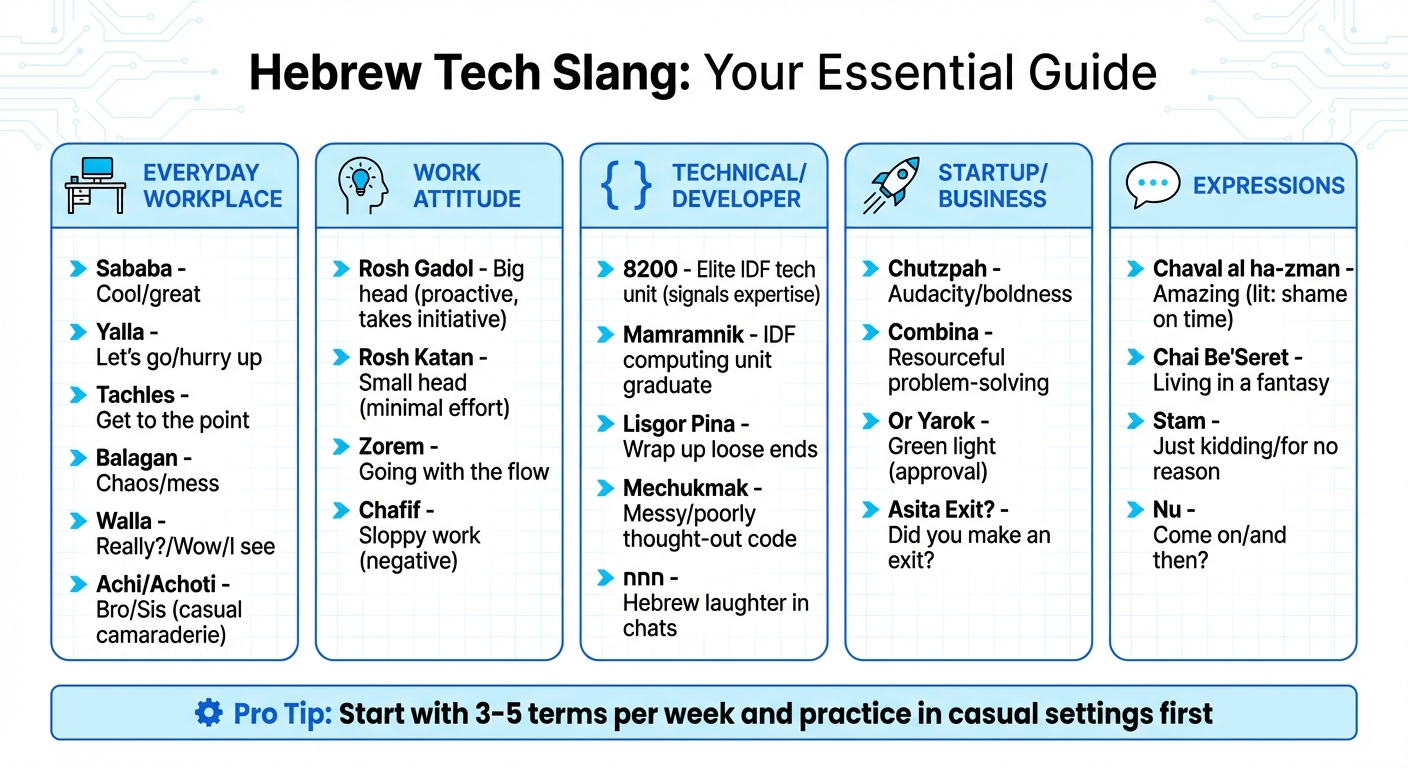
Essential Hebrew Tech Slang Terms for Israeli Workplace Communication
Basic Hebrew Slang for Tech Offices
Everyday Workplace Terms
Israeli tech offices are a melting pot of languages, blending Hebrew slang and formal Hebrew, Arabic, Yiddish, and English loanwords into everyday conversations. A couple of must-know words? Sababa (cool/great) and Yalla (let's go). These are staples. For instance, when someone says, "The meeting is at 2:00 PM? Sababa", it's a casual thumbs-up. Or when your manager says, "Yalla, let's finish this sprint by EOD", they’re urging the team forward without overcomplicating things.
Another term you’ll hear often is Tachles (bottom line). It’s used to cut through unnecessary chatter and get straight to the point. On the flip side, if things go haywire, expect someone to call it a Balagan (chaos). For example, "The server migration was a total balagan" is a common post-deployment grumble.
Managers might also talk about Rosh Gadol (big head) to describe someone who takes initiative, or Rosh Katan (small head) for someone who sticks to the bare minimum. For quick tasks, they’ll say Lisgor Pina (to tie up a loose end), as in, "I just need ten minutes to lisgor pina on this bug." If a colleague is easygoing and flexible, they’re Zorem (going with the flow), but don’t be the one labeled Chafif (sloppy work) - that’s not a compliment.
Lastly, two more handy terms: Ashkara (literally/really) adds emphasis, like, "This is ashkara the best code I’ve seen all week." And Ten Bis refers to the company-paid meal card system that’s super popular in Israeli tech offices.
These phrases don’t just set the tone for navigating Israeli work culture during in-person chats - they’re just as common in digital team communication.
Slang for Team Chats and Meetings
In digital communication, these slang terms are just as essential for keeping things light and efficient. Terms like Achi (my brother) and Achoti (my sister) work like "bro" or "dude" in Slack messages, creating instant camaraderie even between teammates who barely know each other. Meanwhile, Walla is a versatile reaction meaning anything from "Really?" to "Wow", or even "I see." It’s a go-to in meetings for acknowledging updates.
When someone’s taking forever to explain something, a quick Nu (borrowed from Yiddish, meaning "Come on" or "And then what?") nudges them to wrap it up. And while Chaval al ha-zman literally translates to "shame on the time", it’s actually used to describe something amazing - like saying, "The new office is chaval al ha-zman", meaning it’s incredible. For urgent matters, tag them as Dakhuf (urgent) in subject lines or chat headers to make sure they get noticed.
Need to clarify you’re joking? Use Stam (just kidding/for no reason), as in, "I’m quitting! Stam, I’m just going to lunch." For laughter in written chats, Israelis type חחח (the Hebrew letter chet repeated), with the number of letters showing how hard they’re laughing. You’ll also come across AMLEK (the Hebrew version of TL;DR) for summarizing long threads, or BALTAK (an acronym for "without reading previous comments") when someone jumps into a conversation mid-thread.
These terms help keep communication sharp, relatable, and just a little bit playful - hallmarks of Israeli tech culture.
sbb-itb-7e51dcc
Hebrew Slang for Developers and Engineers
Technical Terms in Hebrew Slang
Israeli developers have crafted a unique mix of technical jargon and colloquial expressions, creating a language that's both precise and relatable. One standout term is 8200 (Shmoneh Matayim), referring to the elite IDF intelligence unit known for producing some of Israel's sharpest tech minds. If someone casually mentions they're "from 8200", it’s like flashing a badge of technical mastery and problem-solving prowess. Similarly, a Mamramnik - a graduate of the IDF's central computing system unit - carries a similar air of credibility in the tech world.
In day-to-day work, Rosh Gadol (big head) and Rosh Katan (small head) are shorthand for work attitudes. A developer with Rosh Gadol goes above and beyond, solving tricky bugs without being asked. On the flip side, Rosh Katan describes someone who sticks strictly to the task at hand, doing no more than what's required. If your manager asks you to Le'hagdil Rosh (enlarge your head), they’re encouraging you to think beyond the surface issue and address the root cause.
For code quality, Khetzi Ko'akh (half power) is a blunt way to describe sloppy or incomplete work. Mechukmak paints a picture of messy, poorly thought-out solutions - think spaghetti code or unstable builds. On the brighter side, Mitz'ta'yen means excellent work, while Khafifa refers to the crucial handoff period where outgoing developers train their replacements on the codebase. When it’s time to tackle minor bug fixes, developers might say they need to Lisgor Pina (close a corner). And if someone is obsessing over every little detail in a meeting, they might be teased as a Chofer (digger) - a lighthearted nudge to keep things moving.
These terms not only streamline conversations but also add a layer of personality to the often dry world of tech discussions.
How Developers Use Humor in Hebrew
Israeli developers are masters at weaving humor into their work, making even the toughest critiques feel lighter. Take Stam (just kidding/for no reason), for example. It’s a go-to phrase during code reviews: "This function is awful. Stam, it just needs a little refactoring." The humor softens the blow, turning critique into collaboration.
When someone has wildly unrealistic expectations or reacts dramatically to a bug, you might hear, Chai Be'Seret (living in a movie). It’s a playful way to bring them back to reality without causing offense.
To keep things efficient, developers often Le'amlek (summarize) lengthy technical documents or pull requests. Adding an "Amlek" summary at the top of a code change helps reviewers cut to the chase and understand the key points. And when discussing whether a project or feature is feasible, the phrases Yesh Matzav (there’s a chance) and Ein Matzav (no way) are often used. These expressions are usually accompanied by a knowing smile, adding a touch of humor to the otherwise serious topic of deadlines and scope.
This blend of humor and slang transforms potentially stressful moments - like debugging or project planning - into opportunities for connection and teamwork. It’s not just about solving problems; it’s about enjoying the process with your team.
Startup and Business Slang in Israeli Tech
Common Startup Terms in Hebrew
Israeli startup culture has a knack for putting its own spin on language, blending everyday Hebrew with the high-energy vibe of entrepreneurship. Take Chutzpah - a word that perfectly captures the audacity and boldness required to pitch groundbreaking ideas to investors. It’s not just a word; it’s practically a badge of honor in Israel's startup scene.
In the workplace, you’ll often hear terms like Rosh Gadol (big head) and Rosh Katan (small head). These phrases go beyond their literal meanings, describing whether someone takes initiative and thinks outside the box or just sticks to doing the bare minimum. Naturally, startups are all about finding those Rosh Gadol types who can think creatively and solve problems. Then there’s Combina, the art of navigating challenges with clever deals, resourcefulness, or even leveraging personal connections - a skill that’s practically a survival tool for early-stage companies. And when an opportunity feels like it was made just for you? That’s Tafur Alaykh (tailor-made for you).
This lively mix of slang doesn’t stop at the office, even when translating Hebrew emails from colleagues. It flows seamlessly into investment meetings and networking events, where real-time Hebrew translation can help bridge the gap and ensure quick thinking and fast connections are the name of the game.
Slang for Investment and Networking Talks
When it comes to investment lingo, Israel’s tech scene has its own unique flavor. The term Sevev Gi'u'sim (funding round) is a staple in conversations about raising capital. And at any tech event, it’s not unusual to break the ice with, Asita Exit? (did you make an exit?), a casual way of asking if someone has successfully built and sold a company.
Other common phrases include Optziot (stock options), which often come up during compensation negotiations, and Or Yarok (green light), signaling that a project or deal has been approved. When it’s time to finalize the finer points of an agreement, you might hear someone say they need to Lisgor Pina (close a corner), meaning they’re wrapping up the last details.
Credentials carry weight, too. Mentioning Shmoneh Matayim (8200, the elite IDF intelligence unit) can instantly establish credibility, as it’s synonymous with technical expertise and innovation. And after a meeting, don’t be surprised if someone says, Chapes Oti Be-LinkedIn (look me up on LinkedIn), casually signaling they want to stay connected.
Even in high-stakes conversations, the tone often stays informal. You’ll hear endearing terms like Achi (my brother) or Gever (mate), which help create an approachable and friendly vibe. It’s a reminder that in Israel’s tech world, relationships are just as important as deals.