Hebrew NLP: University-Industry Partnerships
Hebrew NLP is advancing quickly thanks to collaboration between universities and tech companies. These partnerships combine academic expertise with industry resources to tackle the unique challenges of Hebrew, such as its right-to-left script, complex morphology, and gender-specific grammar. Here's the breakdown:
- Universities focus on research, creating tools like morphological analyzers and annotated datasets. They also provide theoretical frameworks and train future Hebrew NLP professionals.
- Tech Companies prioritize solving practical problems, using large datasets and computational power to build scalable tools for everyday use, like translation apps and chatbots.
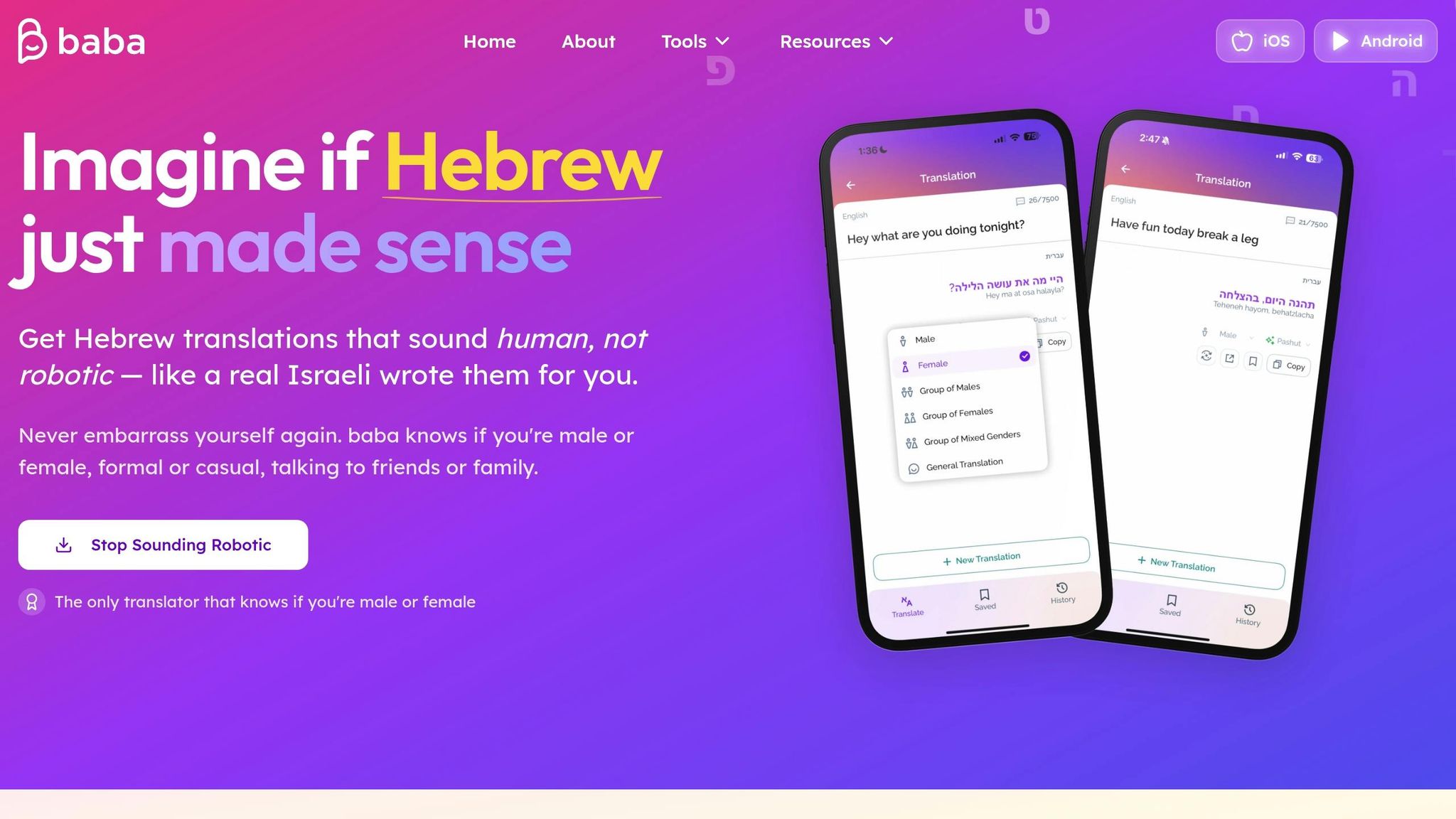
Together, these sectors accelerate progress, with academic insights informing commercial tools and industry feedback improving academic research. A great example is baba – Smart Hebrew Translation, which combines linguistic precision with user-friendly features. This synergy is shaping the future of Hebrew NLP.
Want to see how it works? Check out tools like baba at www.itsbaba.com.
1. What Universities Bring to Hebrew NLP
Research Focus
Israeli universities have long been at the forefront of Hebrew computational linguistics, leveraging decades of expertise to tackle the language's unique challenges. One standout area is Hebrew's intricate root-and-pattern system. In this system, a single three-letter root can produce dozens of related words by applying different patterns. Universities excel at unraveling this complexity, ensuring more precise language processing.
Another key focus is Hebrew's contextual gender rules. Unlike English, Hebrew requires verbs, adjectives, and even some nouns to shift forms depending on the gender of the subject or object. Academic researchers have developed detailed frameworks to understand these relationships, which are essential for building NLP systems capable of generating grammatically accurate Hebrew text.
Technical Advances
Universities don’t just stop at theoretical insights - they’re also driving technical progress. Instead of focusing on large-scale implementations, they specialize in algorithmic advancements that lay the groundwork for broader applications.
For example, university labs have created sophisticated morphological analyzers. These tools break down complex Hebrew words into their components, identifying roots, patterns, and any prefixes or suffixes that alter meaning. This foundational work directly supports applications like machine translation and text summarization.
Hebrew syntactic parsing has also seen significant progress thanks to academic research. Universities have designed parsers tailored to Hebrew's flexible word order and intricate sentence structures. These tools enable deeper semantic understanding, forming the backbone of many commercial applications that process Hebrew text.
Resource Contribution
Universities play a key role in providing essential resources for Hebrew NLP development. One of their most valuable contributions is the creation of gold-standard corpora - annotated datasets that serve as training material for machine learning models. These corpora are not only critical for training but also act as benchmarks for companies to evaluate and refine their Hebrew NLP systems.
Beyond resources, universities contribute expertise. Faculty members often consult with tech companies, sharing their deep linguistic knowledge to solve real-world challenges. Graduate students, too, bridge the gap between academia and industry through internships, bringing theoretical insights into practical applications.
Commercialization Impact
The ripple effects of academic research extend well into the commercial sector. While it may take three to five years for university breakthroughs to influence consumer-facing products, the impact is undeniable when they do.
For instance, university research has been instrumental in improving Hebrew language tools that handle the language's complex grammar more effectively. Many companies rely on algorithms and methodologies originally developed in academic settings, adapting them for large-scale use in commercial NLP systems.
Another critical contribution is the talent pipeline from universities to industry. Many of today’s top Hebrew NLP engineers and researchers began their journeys in university labs, where they gained a deep understanding of the language’s nuances. This academic foundation equips them to tackle the challenges of commercial applications with confidence and expertise.
2. What Companies Bring to Hebrew NLP
Research Focus
Universities often shine when it comes to building theoretical frameworks, but tech companies take a different approach - they focus on solving real-world problems. For Hebrew NLP, this means tackling the way people actually use the language online. Whether it’s decoding informal texts, understanding social media slang, or navigating the Hebrew-English mashups common in Israeli tech circles, companies prioritize practical solutions over linguistic theory. Instead of aiming for perfect morphological analysis, the goal is to create tools that handle Hebrew as it’s used day-to-day. This hands-on approach not only solves immediate issues but also lays the groundwork for future technical advancements.
Technical Advances
Hebrew’s complex morphology and syntax present unique challenges, but tech companies bring serious firepower to the table. With access to massive computing resources, they can train large language models on extensive Hebrew datasets. Their ability to iterate quickly means they can test, tweak, and deploy new features in record time, figuring out what works best in practice. Beyond just building models, companies excel at integrating these tools into existing software. They ensure their systems handle millions of requests seamlessly, perform consistently across devices, and fit into the broader digital ecosystem without a hitch.
Resource Contribution
Tech companies pour significant resources into Hebrew NLP, funding large-scale data collection, rigorous user testing, and end-to-end system development - areas that academic budgets often can’t cover. Every interaction with their tools generates valuable data, creating a feedback loop that continuously improves their models. By offering competitive salaries, companies also attract top-tier talent. These dedicated teams of researchers and engineers focus exclusively on Hebrew’s linguistic complexities, pushing the field forward in ways that would be hard to achieve without such concentrated effort.
Commercialization Impact
With their technical expertise and deep pockets, companies are turning Hebrew NLP research into tools millions of people use every day. Take baba - Smart Hebrew Translation, for example. This product tackles Hebrew’s unique challenges by delivering context-aware translations that feel natural and intuitive. It doesn’t just translate words - it considers the nuances of both the speaker and the listener. The push to create user-friendly tools has made advanced linguistic processing almost invisible to the end user, opening the door for broader accessibility. Plus, market competition has sped up the journey from research to reliable, real-world applications, ensuring that progress in Hebrew NLP keeps moving at a rapid pace.
Get on the waitlist for our mobile app at www.itsbaba.com
DataTalks #22: Prof. Reut Tsarfaty - Current advances in Hebrew Named Entity Recognition
sbb-itb-7e51dcc
Strengths and Weaknesses Comparison
This section takes a closer look at how universities and tech companies contribute to the field of Hebrew NLP, highlighting their distinct strengths and limitations. The table below provides a side-by-side comparison of their approaches:
| Aspect | Universities | Tech Companies |
|---|---|---|
| Research Depth | Focused on deep theoretical insights | Centered on solving practical, real-world problems |
| Resource Scale | Smaller teams with limited funding | Access to extensive funding and advanced computing resources |
| Timeline Approach | Long-term research with rigorous peer review | Quick iteration and fast deployment cycles |
| Data Access | Relies on curated datasets | Utilizes large-scale user data with ongoing feedback |
| Innovation Type | Groundbreaking theoretical advancements | Incremental updates aimed at enhancing user experience |
| Talent Pool | Composed of graduate students and academic researchers | Includes seasoned professionals drawn by competitive salaries |
This comparison highlights how universities and tech companies complement each other. Universities excel at providing the theoretical frameworks essential for understanding Hebrew's linguistic intricacies. On the other hand, tech companies leverage their resources and scale to develop and deploy solutions quickly, ensuring they meet user needs.
By working together, these two sectors create a synergy that drives Hebrew NLP forward. Universities can test their theories on a broader scale with the help of industry resources, while companies benefit from academic insights to refine their language models. This collaboration is crucial for tackling the complexities of Hebrew and delivering practical solutions.
For instance, tools like baba – Smart Hebrew Translation exemplify this partnership. They combine deep linguistic knowledge with user-friendly applications, bridging the gap between theory and practice. Interested in trying it out? Join the waitlist for the mobile app at www.itsbaba.com.