Gender Differences in Hebrew Emotional Phrases
Hebrew’s grammar is deeply tied to gender, impacting every verb, adjective, and pronoun. When expressing emotions, the speaker’s and listener’s genders must align with the language's grammatical structure. For example, a man says "ani sameach" for "I’m happy", while a woman says "ani smecha." This makes accurate communication in Hebrew challenging, especially for non-native speakers, as even common translation mistakes stand out to native speakers.
Most translation tools struggle with Hebrew’s gendered nuances, often defaulting to masculine forms or producing awkward results. baba, a translation app, solves this issue using 11 gender-aware AI models that ask who is speaking and who is listening and conjugate for that context, rather than defaulting to masculine forms. It considers seven gender contexts (e.g., personal, formal, or mixed group), ensuring translations feel natural and precise. The app also supports slang and provides transliterations for learners.
Key takeaways:
- Hebrew requires gender-specific grammar for emotional phrases.
- Errors in gender usage can cause confusion or seem unprofessional.
- Generic tools often fail to account for these nuances.
- baba excels with high accuracy and context-aware translations.
For anyone learning Hebrew or aiming to communicate effectively, tools like baba simplify navigating the language's complex gender rules.
Introduction to Hebrew Adjectives: gender and number
sbb-itb-7e51dcc
1. How Gender Shapes Hebrew Emotional Language
In Hebrew, expressing emotions isn't just about choosing the right words - it’s about matching those words to both the speaker’s and listener’s gender. For instance, if a woman wants to say "I'm worried", she would say Ani do'eget (אני דואגת), while a man would say Ani do'eg (אני דואג). The difference is small but crucial. Using the wrong form isn't just a grammatical hiccup - it stands out immediately to native speakers.
This gender alignment goes beyond the speaker’s words. It also shapes how questions and statements are directed at others. Take the question "Are you coming?" as an example. If you're addressing a man, you'd say Ata ba? (אתה בא?). For a woman, it’s At ba'ah? (את באה?). And for a mixed group, it becomes Atem ba'im? (אתם באים?). Getting this wrong risks not just grammatical confusion but also miscommunication.
In professional settings, accuracy with gendered language carries extra weight. Using the wrong form can seem unprofessional - or worse, disrespectful. Israelis tend to value the effort to use correct grammar because it shows an understanding of cultural norms. On the flip side, defaulting to masculine forms (a common shortcut in many translation tools) can come across as dismissive, especially when addressing women.
Hebrew goes even further by distinguishing seven gender contexts: formal, personal, one man, one woman, mostly men, mostly women, and mixed groups. Each of these requires adjustments to verbs, adjectives, and pronouns. This complexity explains why translation tools often stumble when trying to capture Hebrew's grammatical precision.
Interestingly, Hebrew’s gendered language also plays a role in social dynamics. Among close friends, for example, masculine forms are sometimes used regardless of gender as a way to signal closeness or solidarity. This kind of gender switching adds another layer of meaning, showing how Hebrew’s emotional expressions are tied not just to grammar but also to relationships and cultural nuances.
These subtleties make mastering Hebrew’s gendered forms essential for anyone aiming to communicate effectively and authentically in the language.
2. baba - Smart Hebrew Translation
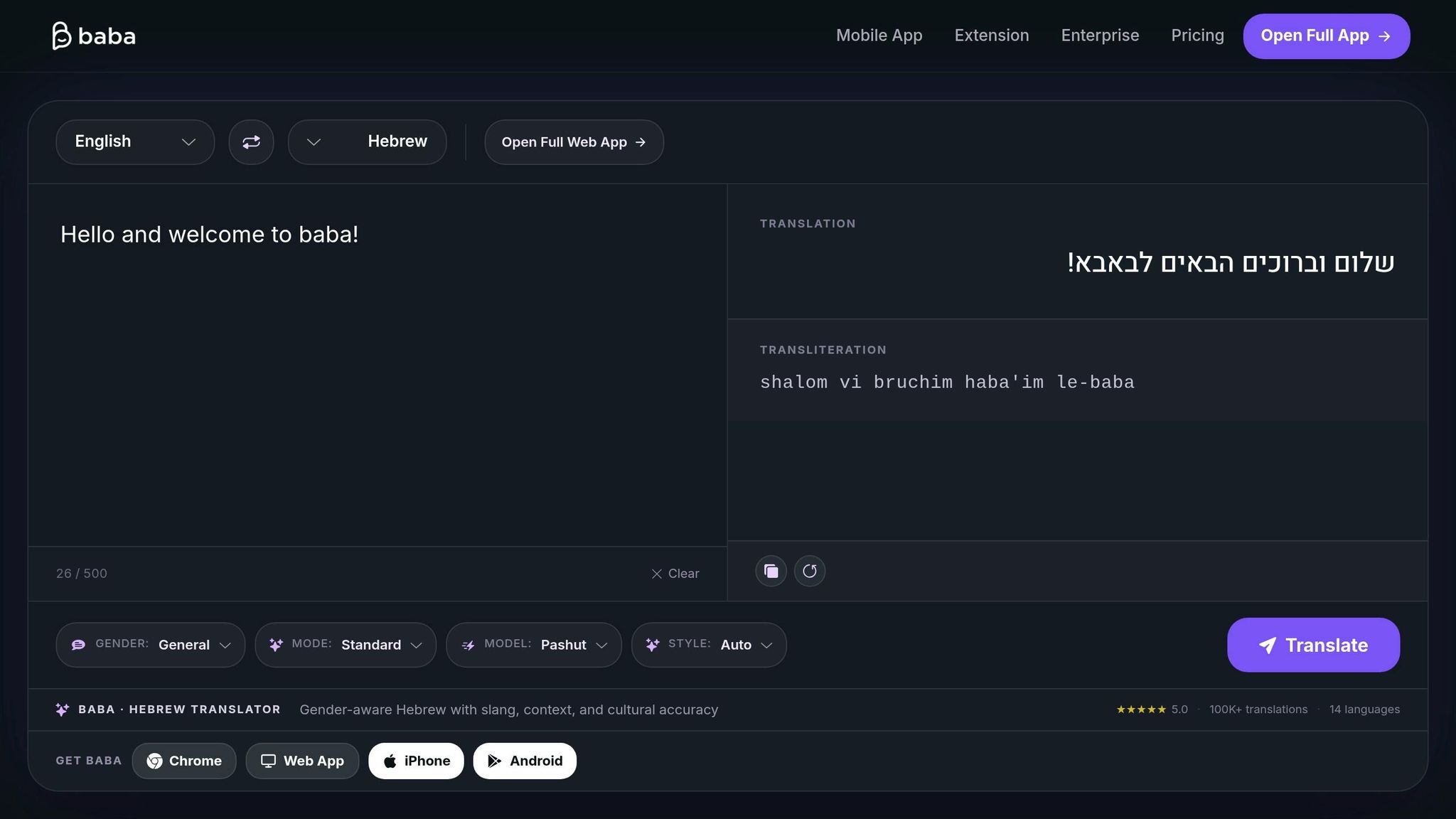
baba tackles the unique Hebrew gender rules for translating emotional phrases using specialized AI. The app employs 22 tailored AI prompts and 11 gender-aware variations to adjust verbs, adjectives, and pronouns based on both the speaker's and listener's gender. This ensures translations are not only accurate but also sensitive to context. For instance, translating "I'm so excited" for a female speaker addressing a group results in ani mitmodedet me'od!, rather than defaulting to the masculine form. This attention to detail makes baba a game-changer for adapting emotional language to fit specific social and emotional contexts.
In Hebrew, even subtle shifts in emotional expressions can completely alter grammatical structure. For example, ani ohev otach (male-to-female) translates to "I love you", while ani ohevet otcha (female-to-male) conveys the same sentiment with gender-specific accuracy. baba allows users to choose from gender contexts like Personal, To One Man, To One Woman, or To Mixed Group, ensuring every phrase feels personalized and correct[1].
Beyond delivering precise translations, baba's Slang Mode captures the nuances of Israeli slang. It provides not just translations but also cultural insights. For example, the casual term sababa (meaning "cool" or "awesome") is explained in context, and users learn when terms like motek (sweetie) are appropriate and how their meanings shift depending on the situation.
The app is available on both iOS and Android and boasts a perfect 5.0-star rating. It also caters to learners by offering Hebrew transliterations (Latin-character pronunciation guides). This feature helps users practice phrases like ani lo maspik! (male) or lo maspika! (female), meaning "I'm not enough!" - even if they're not yet comfortable with Hebrew script.
With a privacy-focused design, baba ensures sensitive messages stay secure. There’s no login, tracking, or data collection involved. Users can select from three modes: Standard (maximum accuracy), Fast (balancing speed and precision), or Ultra-Fast (for instant results). This flexibility makes baba suitable for everything from emotional personal messages to professional communications requiring careful attention to gender-specific language.
Ready to explore Hebrew's emotional depth with cultural precision? Download baba and see how AI transforms translation into an art.
Strengths and Limitations
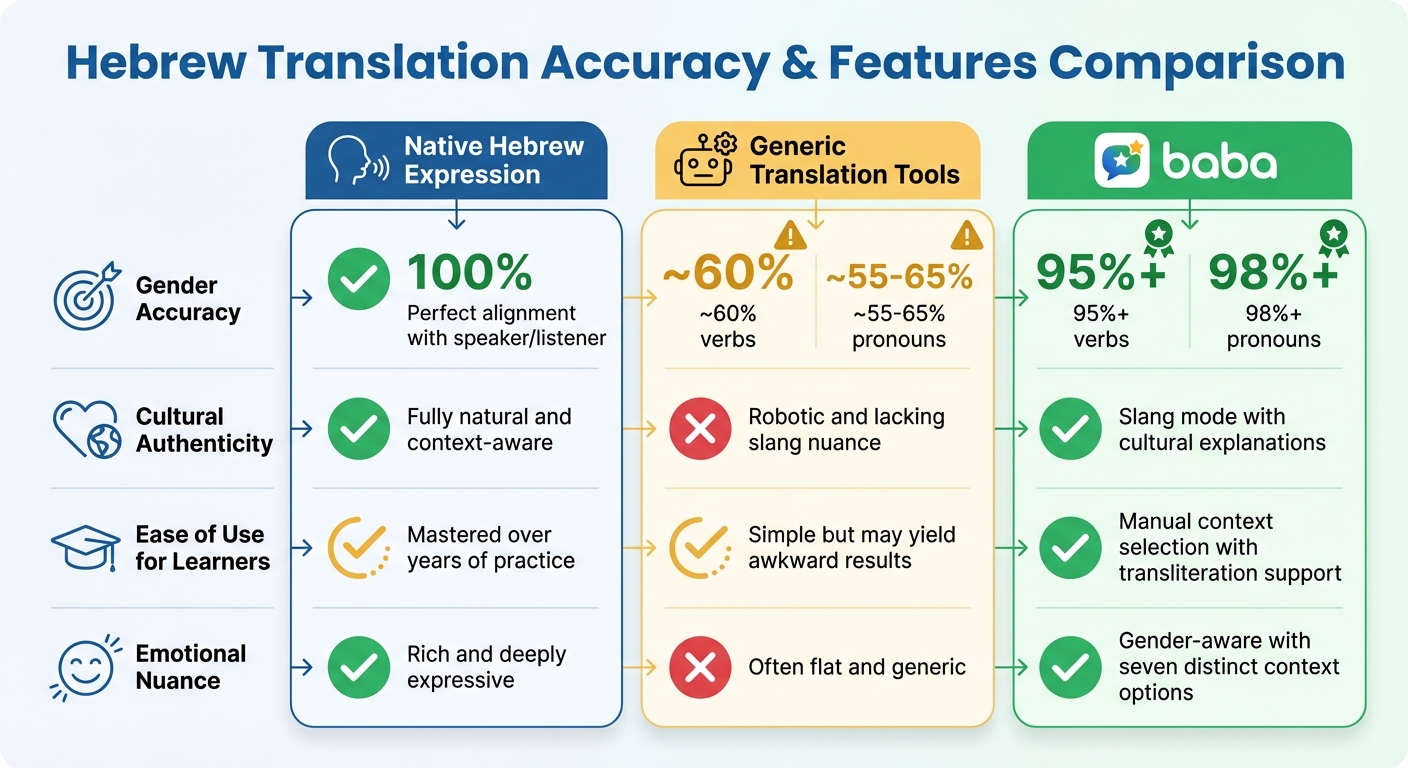
Hebrew Translation Accuracy Comparison: Native Speakers vs Translation Tools vs baba
Hebrew's gendered expressions offer a level of precision that brings emotional depth to communication, but this same complexity can pose challenges for non-native speakers. For native Hebrew speakers, the language's grammatical structure allows for expressions that feel deeply authentic and culturally aligned. For instance, when a female speaker says ani me'anyenet ("I'm sad" in the feminine form), the verb and adjective endings match Hebrew's gender rules perfectly, enhancing the emotional resonance. However, for learners or non-native speakers, navigating these rules can be tricky. Many default to masculine forms or inadvertently mix genders, which can lead to awkward or even disrespectful phrasing.
Generic translation tools struggle with this nuance, often defaulting to masculine forms because the English input carries no gender signal. For example, translating "I'm excited!" might result in just the masculine form, losing the gender-specific emotional undertones. This shortfall highlights the need for tools tailored to Hebrew's unique structure.
Specialized tools like baba address these challenges by offering high accuracy across seven distinct gender contexts, such as "Personal", "To One Man", "To One Woman", and "To Mixed Group" [1]. This level of precision ensures translations like "I love you" are rendered correctly - ani ohev otach for a male speaker addressing a female and ani ohevet otcha for a female addressing a male. Additionally, baba accounts for slang and cultural nuances, making translations feel more natural. Users are also required to manually select the appropriate gender context, as automatic detection isn't yet fully reliable.
| Aspect | Native Hebrew Expression | Generic Translation Tools | baba |
|---|---|---|---|
| Gender Accuracy | Perfect alignment with speaker/listener | Inferred from the text, often defaulting to masculine | Explicit speaker and listener controls |
| Cultural Authenticity | Fully natural and context-aware | Robotic and lacking slang nuance | Slang mode with cultural explanations |
| Ease of Use for Learners | Mastered over years of practice | Simple but may yield awkward results | Manual context selection with transliteration support |
| Emotional Nuance | Rich and deeply expressive | Often flat and generic | Gender-aware with seven distinct context options |
While baba's manual context selection might seem like an extra step, it ensures translations remain natural and emotionally accurate. Features like Hebrew transliteration and real-time streaming display further enhance the experience, particularly for beginners navigating the intricacies of the language.
